1
Materials:
Carrier gas, column, oven, detector, data acquisition and analysis system, THF.
References:
Dr. P. Wehrenberg, SUNY, Plattsburgh, NY 2013.
Objectives:
-To determine the purity of your sample of methyl cyclohexene isomers.
Pre-Lab Questions:
1. To determine the ratio of cis and trans 2-butene in a mixture of the isomers, would you be better
off using TLC or GC? Explain your answer.
Neither methods would be effective in determining the ratio of isomers because TLC does not
determine the ratios, and because it is an isomer, GC would not be able to differentiate between
the two isomers.
2. To determine the ratio of glucose to fructose in a mixture of sugars, would you be better off
using TLC or GC? Explain your answer.
Gas Chromatography would be better because TLC is unable to determine the amount of each
substance in each sample, while gas chromatography can.
3. In the chromatograph on the second page, why are there two peaks for the starting 2-methylcy–
clohexanol?
There are two peaks because there are two different isotopes of 2-methylcyclohexanol.
4. How many peaks do you expect to see in the GC output for your sample. Explain your answer.
We expect there to be three peaks because there are three different isotopes of
2
methylcyclohexanol that we synthesized.
5. In the chromatogram on the second page, what would happen to the areas of the peaks for the
2-methylcyclohexanol if twice as much material were injected? What would happen to the
ratio if twice as much material was injected?
(Area at 6.868)/(Area at 6.911)
The ratio of material would not change, assuming the same concentration of material was in-
jected as the initial injection.
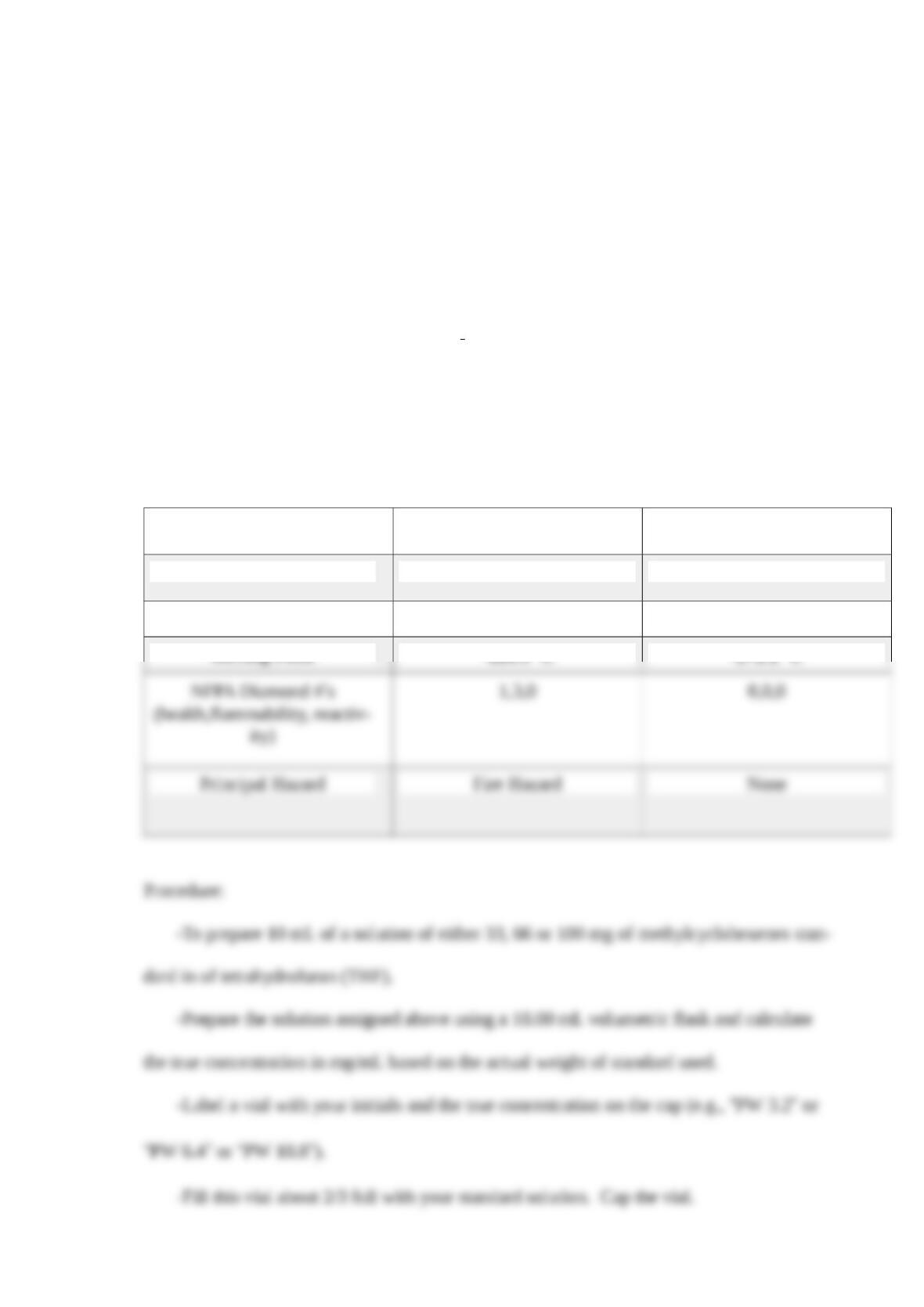
Safety Data:
Name of Chemical Methylcyclohexane Helium
Formula and FW C7H14 ,98.19g/mol He ,4.002g/mol
Boiling Point 101°C -268.928°C