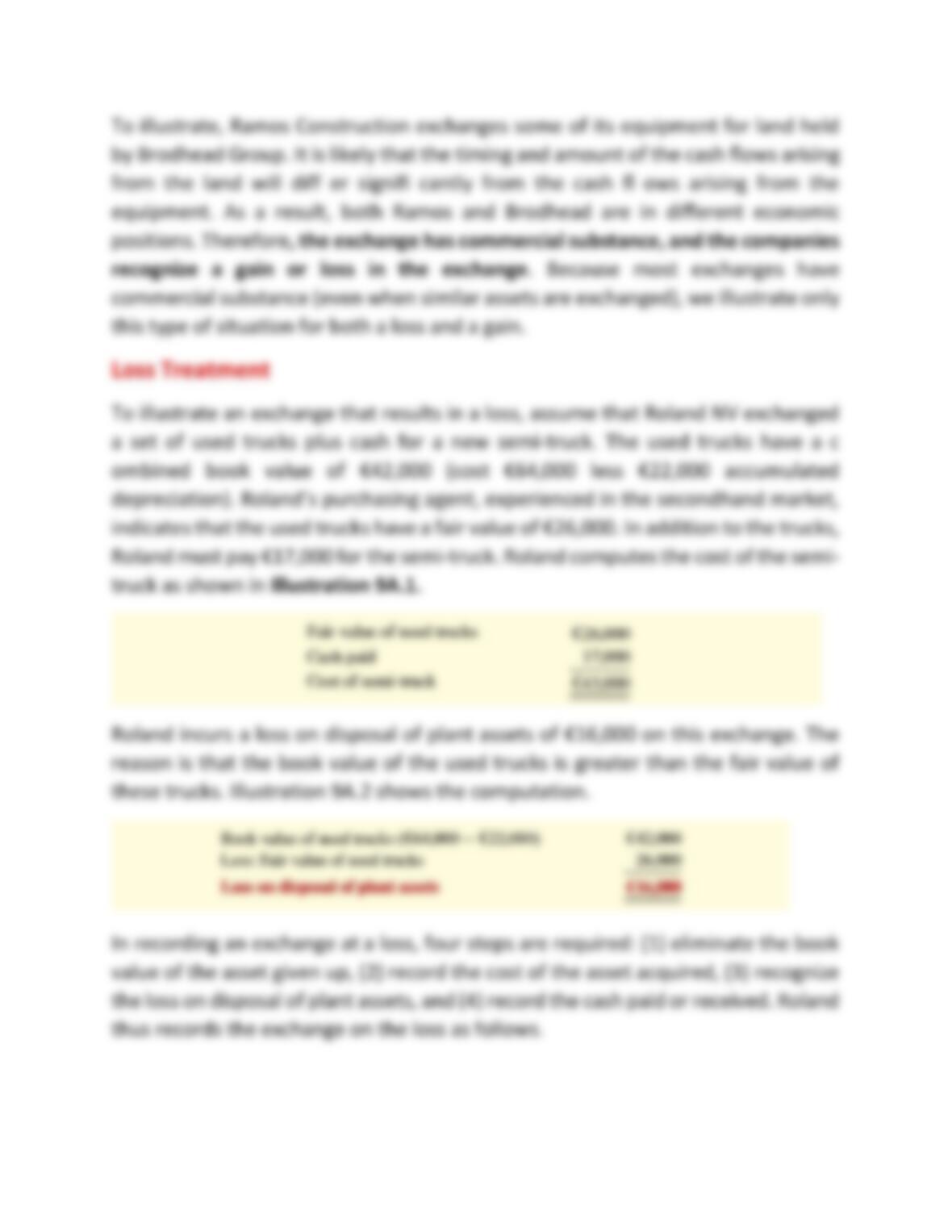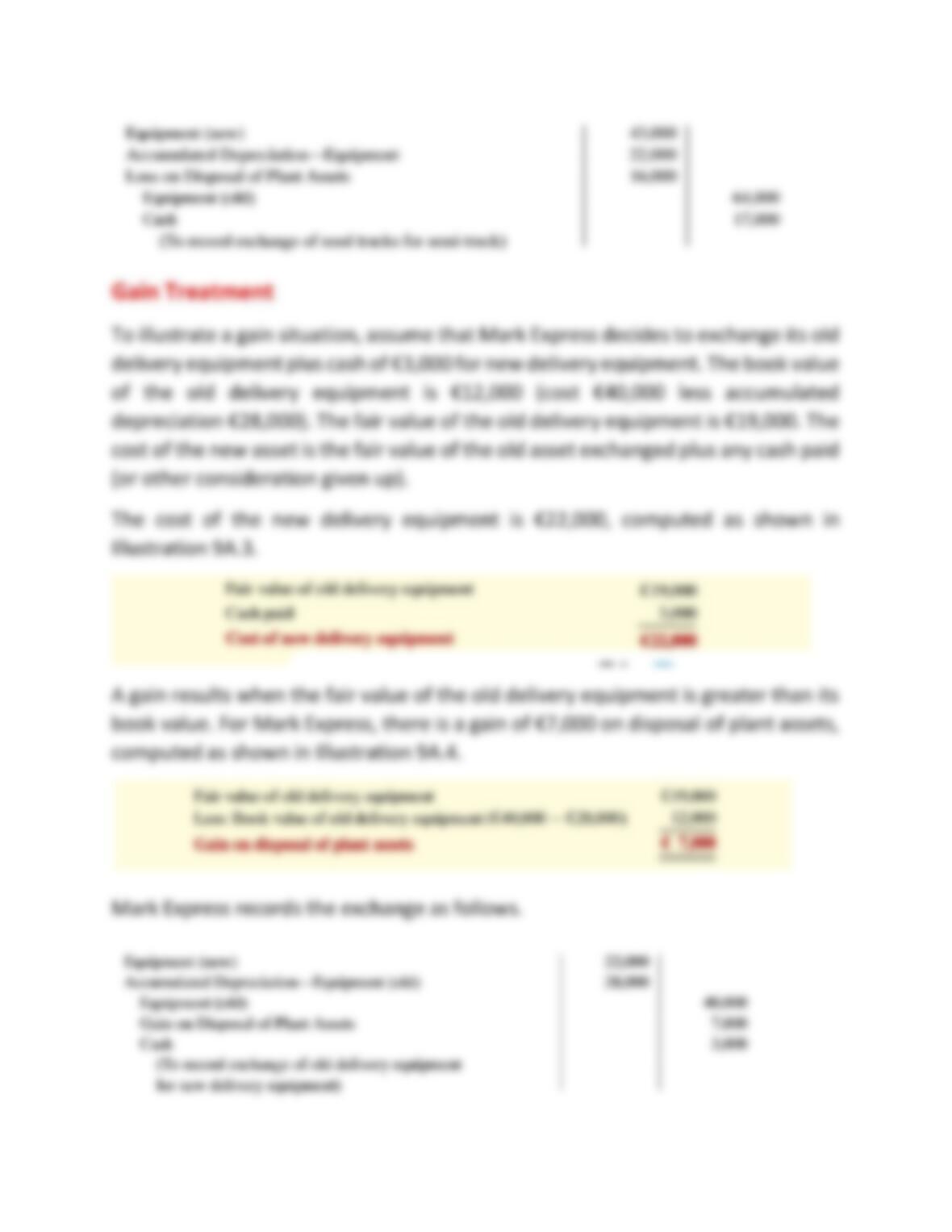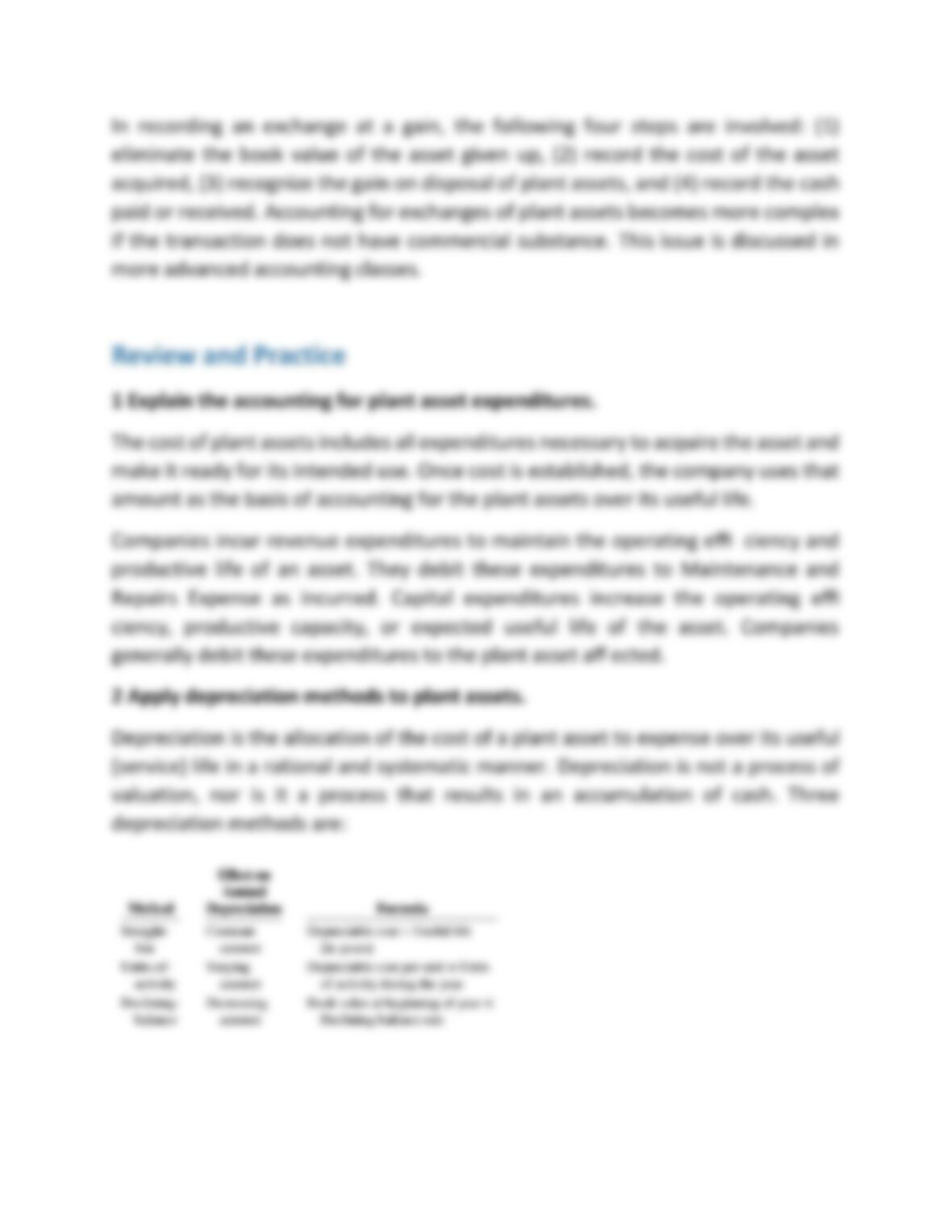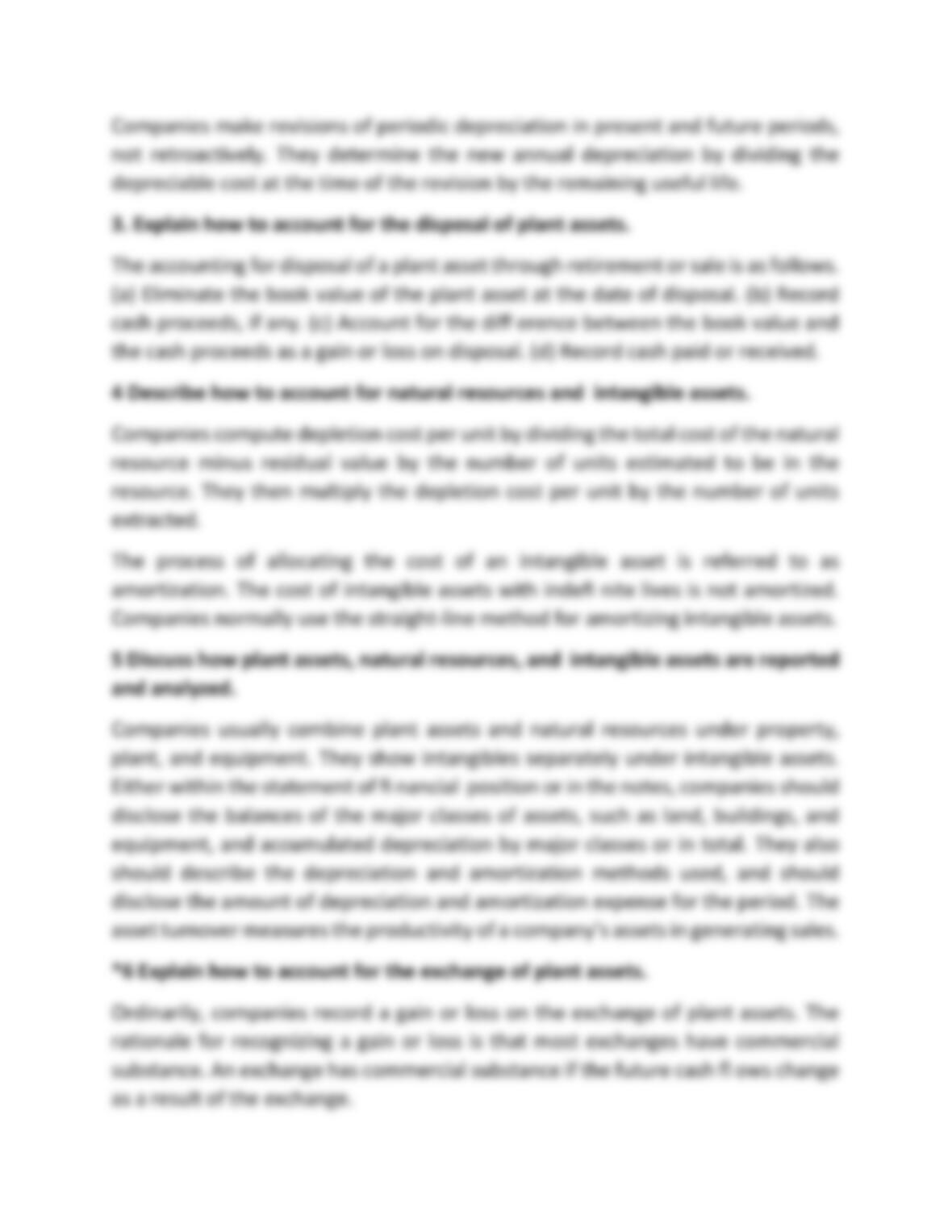
CHAPTER 9
Plant Assets, Natural Resources, and Intangible Assets
Plant Asset Expenditures
Plant assets are resources that have three characteristics. They have a physical
substance (a defi nite size and shape), are used in the operations of a business, and
are not intended for sale to customers. They are also called property, plant, and
equipment; plant and equipment; and fixed assets. These assets are expected to
be of use to the company for a number of years. Except for land, plant assets
decline in service potential over their useful lives.
Because plant assets play a key role in ongoing operations, companies keep plant
assets in good operating condition. They also replace worn-out or outdated plant
assets, and expand productive resources as needed. Many companies have
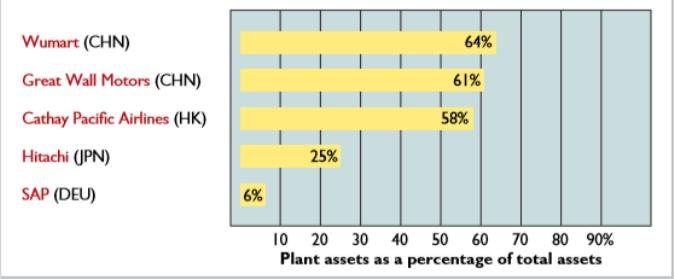
substantial investments in plant assets. Illustration 9.1 shows the percentages of
plant assets in relation to total assets of companies in a number of industries during
a recent year.
Determining the Cost of Plant Assets
The historical cost principle requires that companies record plant assets at cost.
Thus, Europcar (FRA) records its vehicles at cost. Cost consists of all expenditures
necessary to acquire the asset and make it ready for its intended use. For
example, the cost of factory machinery includes the purchase price, freight costs
paid by the purchaser, and installation costs. Once cost is established, the company
generally uses that amount as the basis of accounting for the plant asset over its
useful life.
In the following sections, we explain the application of the historical cost principle
to each of the major classes of plant assets.
Land
Companies often use land as a site for a manufacturing plant or offi ce building.
The cost of land includes (1) the cash purchase price, (2) closing costs such as title
and attorney’s fees, (3) real estate brokers’ commissions, and (4) accrued property
taxes and other liens assumed by the purchaser. For example, if the cash price is
NT$50,000 and the purchaser agrees to pay accrued taxes of NT$5,000, the cost of
the land is NT$55,000.
Companies record as debits (increases) to the Land account all necessary costs
incurred to make land ready for its intended use (see Helpful Hint). When a
company acquires vacant land, these costs include expenditures for clearing,
draining, fi lling, and grading. Sometimes, the land has a building on it that must be
removed before construction of a new building. In this case, the company debits to
the Land account all demolition and removal costs, less any proceeds from salvaged
materials.
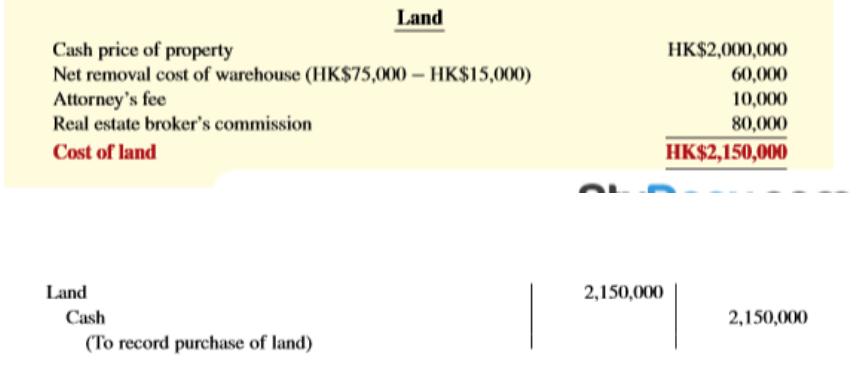
To illustrate, assume that Lew Ltd. acquires real estate at a cash cost of
HK$2,000,000. The property contains an old warehouse that is razed at a net cost
of HK$60,000 (HK$75,000 in costs less HK$15,000 in proceeds from salvaged
materials). Additional expenditures are the attorney’s fee, HK$10,000, and the real
estate broker’s commission, HK$80,000. The cost of the land is HK$2,150,000, as
computed in Illustration 9.2.
Lew makes the following entry to record the acquisition of the land.
Land Improvements
Land improvements are structural additions with limited lives that are made to
land. Examples are driveways, parking lots, fences, landscaping, and underground
sprinklers. The cost of land improvements includes all expenditures necessary to
make the improvements ready for their intended use. For example, the cost of a
new parking lot for a Hero Supermarket (IDN) includes the amount paid for paving,
fencing, and lighting. Thus, Hero Supermarket debits to Land Improvements the
total of all of these costs.
Land improvements have limited useful lives. Even when well-maintained, they will
eventually be replaced. As a result, companies expense (depreciate) the cost of
land improvements over their useful lives.
Buildings
Buildings are facilities used in operations, such as stores, offi ces, factories,
warehouses, and airplane hangars. Companies debit to the Buildings account all
necessary expenditures related to the purchase or construction of a building. When
a building is purchased, such costs include the purchase price, closing costs
(attorney’s fees, title insurance, etc.), and the real estate broker’s commission.
Costs to make the building ready for its intended use include expenditures for
remodeling and replacing or repairing the roof, fl oors, electrical wiring, and
plumbing. When a new building is constructed, its costs consist of the contract
price plus payments for architects’ fees, building permits, and excavation costs.
In addition, companies charge certain interest costs to the Buildings account.
Interest costs incurred to fi nance the project are included in the cost of the building
when a signifi cant period of time is required to get the building ready for use. In
these circumstances, interest costs are considered as necessary as materials and
labor. However, the inclusion of interest costs in the cost of a constructed building
is limited to interest costs incurred during the construction period. When
construction has been completed, the company records subsequent interest
payments on funds borrowed to fi nance the construction as debits (increases) to
Interest Expense.
Equipment
Equipment includes assets used in operations, such as store check-out counters,
factory machinery, delivery trucks, and airplanes. The cost of equipment, such as
Europcar vehicles, consists of the cash purchase price, sales taxes, freight charges,
and insurance during transit paid by the purchaser. It also includes expenditures
required in assembling, installing, and testing the unit. However, Europcar does not
include motor vehicle licenses and accident insurance on company vehicles in the
cost of equipment. These costs represent annual recurring expenditures and do
not benefi t future periods. Thus, they are treated as expenses as they are incurred.
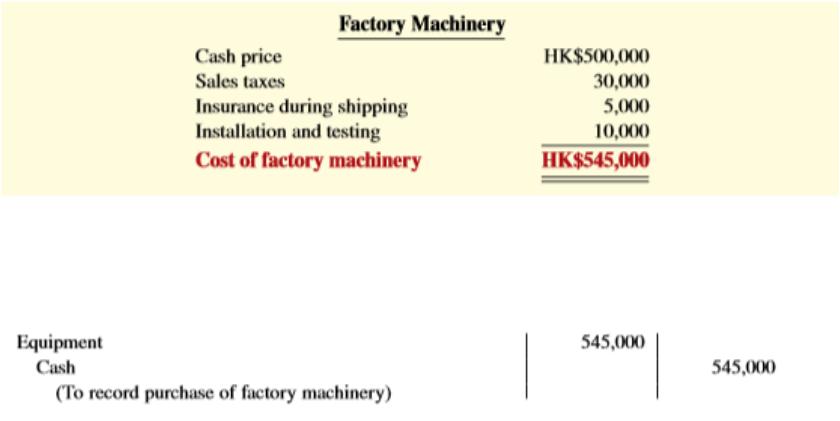
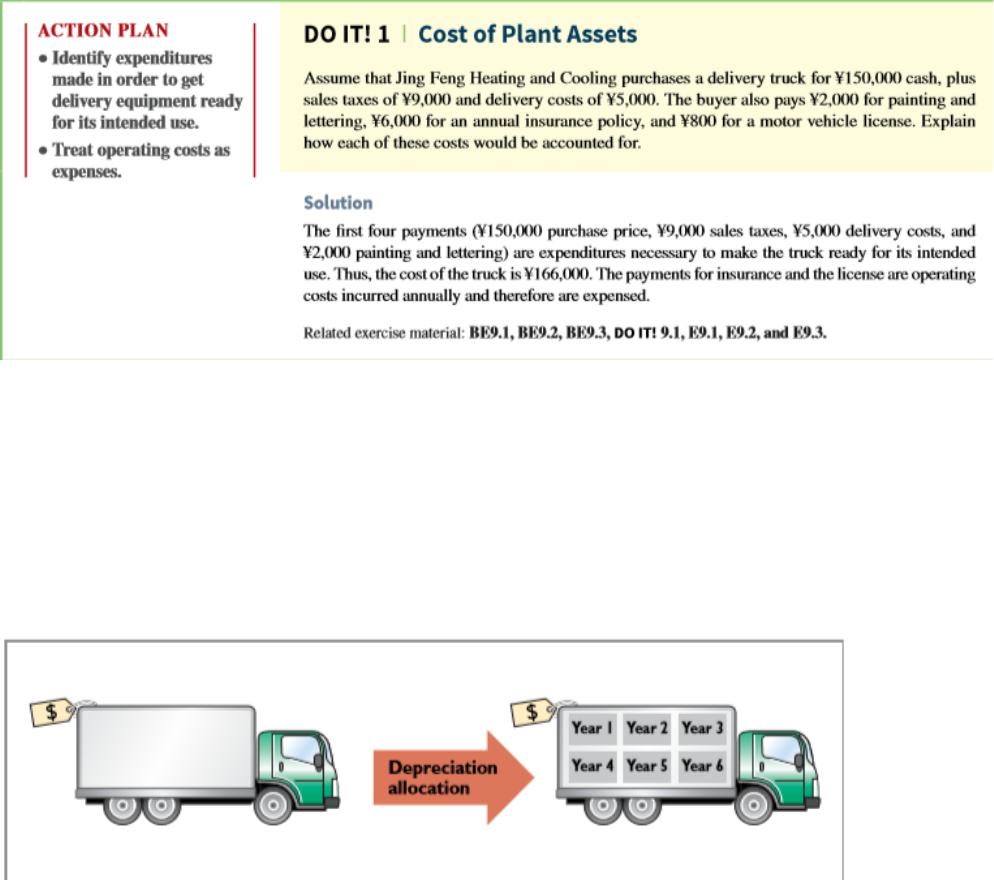
To illustrate, assume Zhang Ltd. purchases factory machinery at a cash price of
HK$500,000. Related expenditures are for sales taxes HK$30,000, insurance during
shipping HK$5,000, and installation and testing HK$10,000. The cost of the factory
machinery is HK$545,000, computed in Illustration 9.3.
Zhang makes the following summary entry to record the purchase and related
expenditures.
For another example, assume that Huang Group purchases a delivery truck at a
cash price of HK$420,000. Related expenditures consist of sales taxes HK$13,200,
painting and lettering HK$5,000, motor vehicle license HK$800, and a three-year
accident insurance policy HK$16,000. The cost of the delivery truck is HK$438,200,
computed as shown in Illustration 9.4.
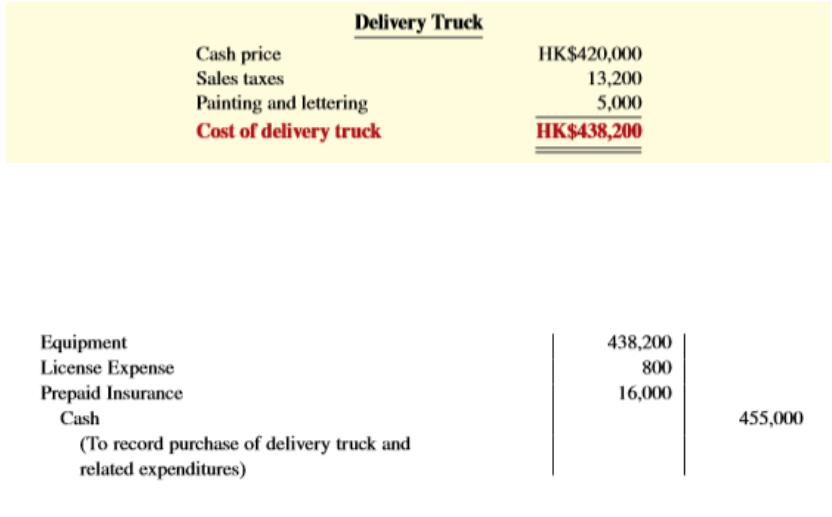
Huang treats the cost of the motor vehicle license as an expense and the cost of
the insurance policy as a prepaid asset. Thus, Huang makes the following entry to
record the purchase of the truck and related expenditures:
Expenditures During Useful Life
During the useful life of a plant asset, a company may incur costs for ordinary
repairs, additions, or improvements. Ordinary repairs are expenditures to
maintain the operating effi ciency and productive life of the unit. They usually are
fairly small amounts that occur frequently. Examples are motor tune-ups and oil
changes, the painting of buildings, and the replacing of worn–out gears on
machinery. Companies record such repairs as debits to Maintenance and Repairs
Expense as they are incurred. Because they are immediately charged as an expense
against revenues, these costs are often referred to as revenue expenditures .
In contrast, additions and improvements are costs incurred to increase the
operating effi ciency, productive capacity, or useful life of a plant asset. They are
usually material in amount and occur infrequently. Additions and improvements
increase the company’s investment in productive facilities. Companies generally
debit these amounts to the plant asset affected. They are often referred to as
capital expenditures.
Companies must use good judgment in deciding between a revenue expenditure
and capital expenditure. For example, assume that Rodriguez Co. purchases a
number of wastepaper baskets. Although the proper accounting would appear to
be to capitalize and then depreciate these wastepaper baskets over their useful
lives, it would be more usual for Rodriguez to expense them immediately. This
practice is justifi ed on the basis of materiality. Materiality refers to the impact of
an item’s size on a company’s fi nancial operations. The materiality concept states
that if an item would not make a diff erence in decision–making, the company does
not have to follow IFRS in reporting that item.
Depreciation Methods
As explained in Chapter 3, depreciation is the process of allocating to expense the
cost of a plant asset over its useful (service) life in a rational and systematic
manner. Cost a llocation enables companies to properly match expe nses with
revenues in accordance with the expense recognition principle, as shown in
Illustration 9.5.
It is important to understand that depreciation is a process of cost allocation. It is
not a process of asset valuation. No attempt is made to measure the change in an
asset’s fair value during ownership. So, the book value (cost less accumulated
depreciation) of a plant asset may be quite diff erent from its fair value. In fact, if
an asset is fully depreciated, it can have a zero book value but still have a positive
fair value (see Ethics Note).
Depreciation applies to three classes of plant assets: land improvements, buildings,
and equipment. Each asset in these classes is considered to be a depreciable asset.
Why? B ecause the usefulness to the company and revenue-producing ability of
each asset will decline over the asset’s useful life. Depreciation does not apply to
land because its usefulness and revenue-producing ability generally remain intact
over time. In fact, in many cases, the usefulness of land is greater over time because
of the scarcity of good land sites. Thus, land is not a depreciable asset.
During a depreciable asset’s useful life, its revenue-producing ability declines
because of wear and tear. A delivery truck that has been driven 100,000 miles will
be less useful to a company than one driven only 800 miles.
Revenue-producing ability may also decline because of obsolescence.
Obsolescence is the process of becoming out of date before the asset physically
wears out. For example, major airlines moved from Chicago’s Midway Airport to
Chicago-O’Hare International Airport because Midway’s runways were too short
for jumbo jets. Similarly, many companies replace their computers long before they
originally planned to do so because technological improvements make the old
computers obsolete.
Recognizing depreciation on an asset does not result in an accumulation of cash
for replacement of the asset. The balance in Accumulated Depreciation represents
the total amount of the asset’s cost that the company has charged to expense. It is
not a cash fund.
Note that the concept of depreciation is consistent with the going concern
assumption. The going concern assumption states that the company will continue
in operation for the foreseeable future. If a company does not use a going concern
assumption, then plant assets should be stated at their fair value. In that case,
depreciation of these assets is not needed.
Factors in Computing Depreciation
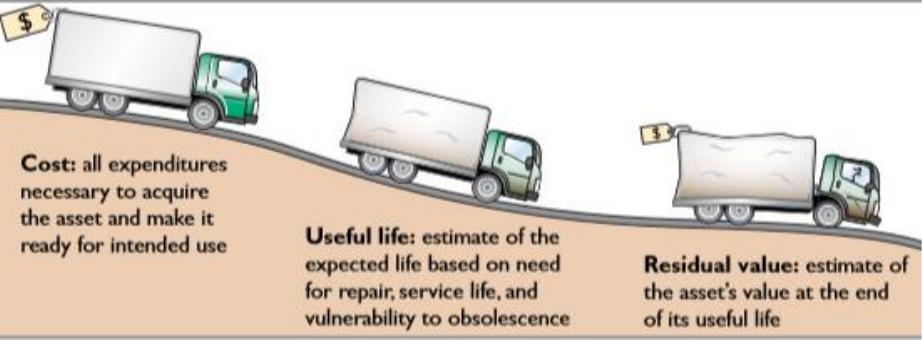
Three factors aff ect the computation of depreciation, as shown in Illustration 9.6.
1. Cost. Earlier, we explained the issues aff ecting the cost of a depreciable asset.
Recall that companies record plant assets at cost, in accordance with the historical
cost principle.
2. Useful life. Useful life is an estimate of the expected productive life, also called
service life, of the asset for its owner. Useful life may be expressed in terms of time,
units of activity (such as machine hours), or units of output. Useful life is an
estimate. In making the estimate, management considers such factors as the
intended use of the asset, its expected repair and maintenance, and its vulnerability
to obsolescence. Past experience with similar assets is often helpful in deciding on
expected useful life. We might reasonably expect Rent-A-Wreck and Europcar to
use diff erent estimated useful lives for their vehicles.
3. Residual value. Residual value is an estimate of the asset’s value at the end of
its useful life (see Alternative Terminology). This value may be based on the asset’s
worth as scrap or on its expected trade-in value. Like useful life, residual value is an
estimate. In making the estimate, management considers how it plans to dispose
of the asset and its experience with similar assets.

Depreciation Methods
Depreciation is generally computed using one of the following methods:
1. Straight-line
2. Units-of-activity
3. Declining-balance
Each method is acceptable under IFRS. Management selects the method(s) it
believes to be appropriate. The objective is to select the method that best
measures an asset’s contribution to revenue over its useful life. Once a company
chooses a method, it should apply it consistently over the useful life of the asset.
Consistency enhances the comparability of fi nancial statements. Depreciation aff
ects the statement of fi nancial position through accumulated depreciation and the
income statement through depreciation expense (see Helpful Hint).
We will compare the three depreciation methods using the following data for a
small delivery truck purchased by Barb’s Florists on January 1, 2020 (see Illustration
9.7).
No matter which method is used, the total amount depreciated over the useful life
of the asset is its depreciable cost. Depreciable cost is equal to the cost of the asset
less its residual value.
Straight-Line Method
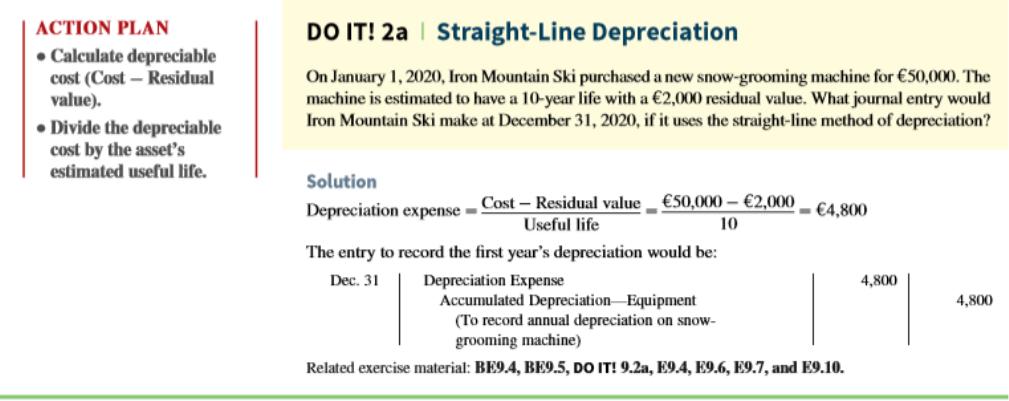
Under the straight-line method, companies expense the same amount of
depreciation for each year of the asset’s useful life. It is measured solely by the
passage of time.
To compute depreciation expense under the straight-line method, companies need
to determine depreciable cost. As indicated above, depreciable cost is the cost of
the asset less its residual value. It represents the total amount subject to
depreciation. Under the straight-line method, to determine annual depreciation
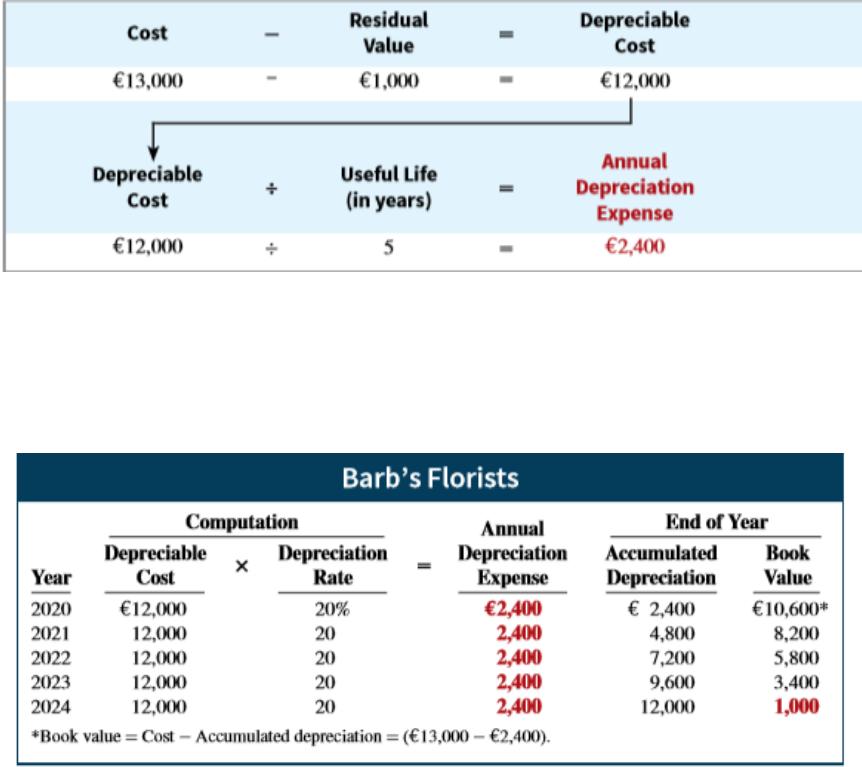
expense, we divide depreciable cost by the asset’s useful life. Illustration 9.8 shows
the computation of the fi rst year’s depreciation expense for Barb’s Florists.
Alternatively, we also can compute an annual rate of depreciation. In this case, the
rate is 20% (100% ÷ 5 years). When a company uses an annual straight-line rate, it
applies the percentage rate to the depreciable cost of the asset. Illustration 9.9
shows a depreciation schedule using an annual rate.
C
Note that the depreciation expense of €2,400 is the same each year. The book value
(computed as cost minus accumulated depreciation) at the end of the useful life is
equal to the expected €1,000 residual value.
What happens to these computations for an asset purchased during the year,
rather than on January 1? In that case, it is necessary to prorate the annual
depreciation on a time basis. If Barb’s Florists had purchased the delivery truck on
April 1, 2020, the company would own the truck for nine months of the fi rst year
(April–December). Thus, depreciation for 2020 would be €1,800 (€12,000 × 20% ×
9/12 of a year).
The straight-line method predominates in practice. Large companies such as
Daimler (DEU), Anheuser-Busch InBev (BEL), and Great Wall Motors (CHN) use the
straight-line method. It is simple to apply, and it matches expenses with revenues
when the use of the asset is reasonably uniform throughout the service life.
Units-of-Activity Method
Under the units-of-activity method, useful life is expressed in terms of the total
units of production or use expected from the asset, rather than as a time period
(see Alternative Terminology). The units-of-activity method is ideally suited to
factory machinery. Manufacturing companies can measure production in units of
output or in machine hours. This method can also be used for such assets as
delivery equipment (miles driven) and airplanes (hours in use). The units–of-activity
method is generally not suitable for buildings or furniture because depreciation for
these assets is more a function of time than of use.
To use this method, companies estimate the total units of activity for the entire
useful life and then divide these units into depreciable cost. The resulting number
represents the depreciable cost per unit. The depreciable cost per unit is then
applied to the units of activity during the year to determine the annual depreciation
expense (see Helpful Hint).
To illustrate, assume that Barb’s Florists drives its delivery truck 15,000 miles in the
fi rst year. Illustration 9.10 shows the units–of-activity formula and the c
omputation of the fi rst year’s depreciation expense.
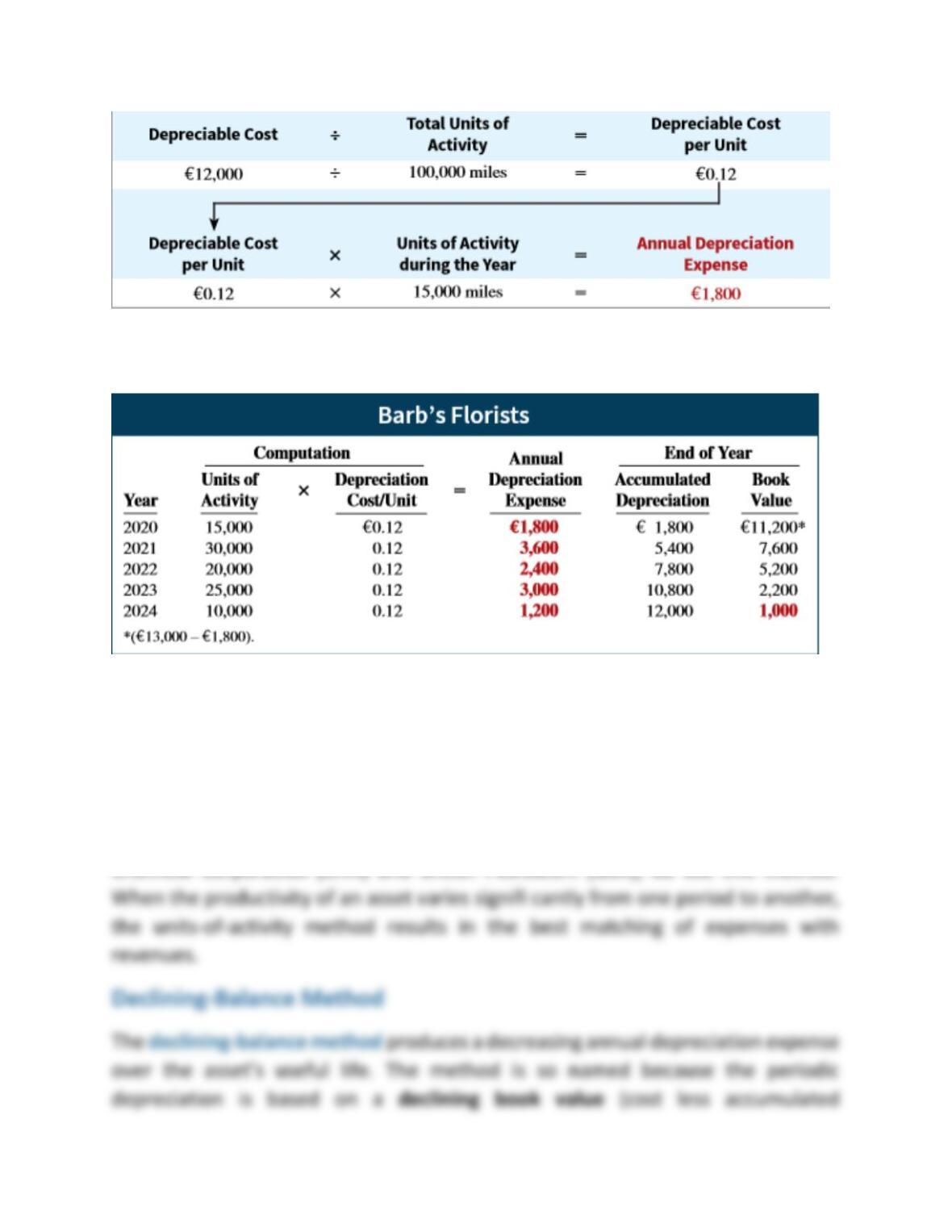
Illustration 9.11 shows the units-of-activity depreciation schedule, using assumed
mileage.
This method is easy to apply for assets purchased mid-year. In such a case, the
company computes the depreciation using the productivity of the asset for the
partial year.
The units-of-activity method is not nearly as popular as the straight-line method
primarily because it is often diffi cult for companies to reasonably estimate total
activity. However, some very large companies, such as China Petroleum and