CHAPTER 10
Current Liabilities
Accounting for Current Liabilities
What Is a Current Liability?
You have learned that liabilities are defi ned as “creditors’ claims on total assets”
and as “existing debts and obligations.” Companies must settle or pay these claims,
debts, and obligations at some time in the future by transferring assets or services.
The future date on which they are due or payable (the maturity date) is a signifi
cant feature of liabilities.
Recall that a current liability is a debt that a company expects to pay within one
year or the operating cycle, whichever is longer. Debts that do not meet this
criterion are non-current liabilities.
Financial statement users want to know whether a company’s obligations are
current or non-current. A company that has more current liabilities than current
assets often lacks liquidity, or short-term debt-paying ability. In addition, users
want to know the types of liabilities a company has. If a company declares
bankruptcy, a specifi c, predetermined order of payment to creditors exists. Thus,
the amount and type of liabilities are of critical importance.
The different types of current liabilities include notes payable, accounts payable,
unearned revenues, and accrued liabilities such as taxes, salaries and wages, and
interest payable (see Helpful Hint). In the sections that follow, we discuss common
types of current liabilities.
Notes Payable
Companies record obligations in the form of written notes as notes payable. Notes
payable are often used instead of accounts payable because they give the lender
formal proof of the obligation in case legal remedies are needed to collect the debt.
Companies frequently issue notes payable to meet short–term fi nancing needs.
Notes payable usually require the borrower to pay interest.
Notes are issued for varying periods of time. Those due for payment within one
year of the statement of fi nancial position date are usually classified as current
liabilities.
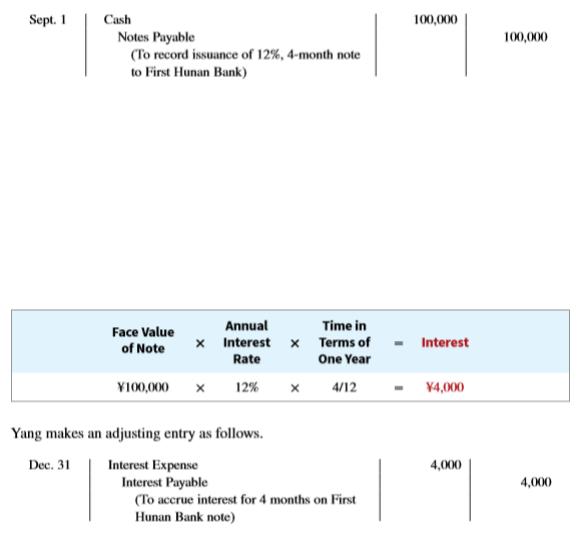
To illustrate the accounting for notes payable, assume that First Hunan Bank agrees
to lend ¥100,000 on September 1, 2020, if Yang Enterprises signs a ¥100,000, 12%,
four-month note maturing on January 1 (amounts in thousands). When a company
issues an interest-bearing note, the amount of assets it receives upon issuance of
the note generally equals the note’s face value. Yang therefore will receive
¥100,000 cash and will make the following journal entry.
Interest accrues over the life of the note, and the company must periodically record
that accrual. If Yang prepares fi nancial statements annually, it makes an adjusting
entry at December 31 to recognize interest expense and interest payable of ¥4,000
(¥100,000 × 12% × 4/12). Illustration 10.1 shows the formula for computing interest
and its application to Yang’s note.
In the December 31 fi nancial statements, the current liabilities section of the
statement of fi nancial position will show notes payable ¥100,000 and interest
payable ¥4,000. In addition, the company will report interest expense of ¥4,000
under “Other income and expense” in the income statement. If Yang prepared fi
nancial statements monthly, the adjusting entry at the end of each month would
be for ¥1,000 (¥100,000 × 12% × 1/12).
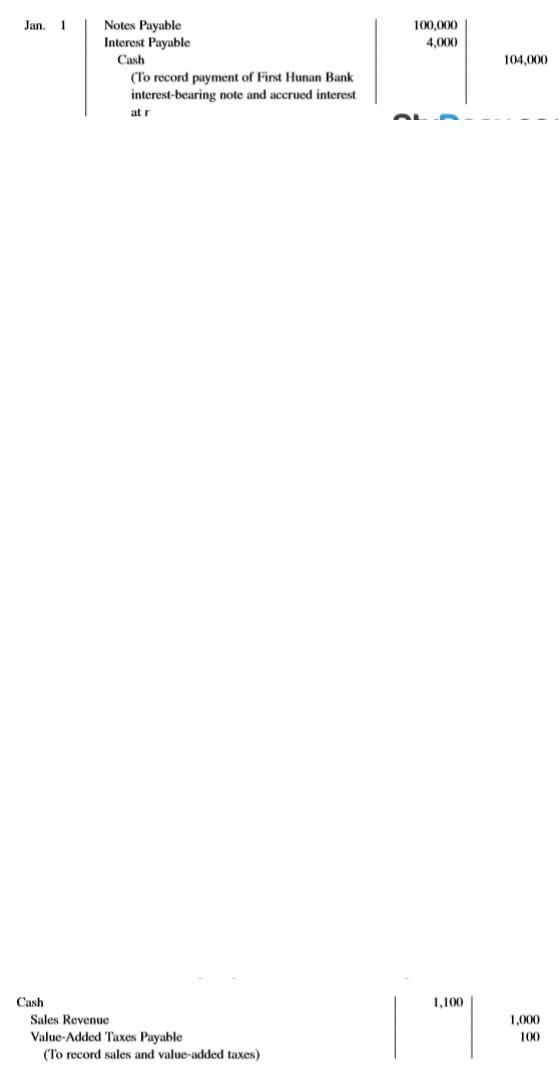
At maturity (January 1, 2021), Yang must pay the face value of the note (¥100,000)
plus ¥4,000 interest (¥100,000 × 12% × 4/12). It records payment of the note and
accrued interest as follows.
Value-Added and Sales Taxes Payable
Most countries have a consumption tax. Consumption taxes are generally either a
value-added tax (VAT) or sales tax. The purpose of these taxes is to generate
revenue for the government similar to the company or personal income tax. These
two taxes accomplish the same objective–– to tax the fi nal consumer of the good
or service. However, the two systems use diff erent methods to accomplish this
objective.
Value-Added Taxes Payable
Value-added taxes (VAT) are used by tax authorities more than sales taxes (over
100 countries require that companies collect a value-added tax). As indicated
earlier, a value-added tax is a consumption tax. This tax is placed on a product or
service whenever value is added at a stage of production and at fi nal sale. A VAT is
a cost to the end user, normally a private individual, similar to a sales tax.
However, a VAT should not be confused with a sales tax. A sales tax is collected
only once at the consumer’s point of purchase. No one else in the production or
supply chain is involved in the collection of the tax. In a VAT taxation system, the
VAT is collected every time a business purchases products from another business
in the product’s supply chain. To illustrate, assume that Hill Farms Wheat grows
wheat and sells it to Sunshine Baking for €1,000. Hill Farms Wheat makes the
following entry to record the sale, assuming the VAT is 10%.
Hill Farms Wheat then remits the €100 to the tax authority.1
Sales Taxes Payable
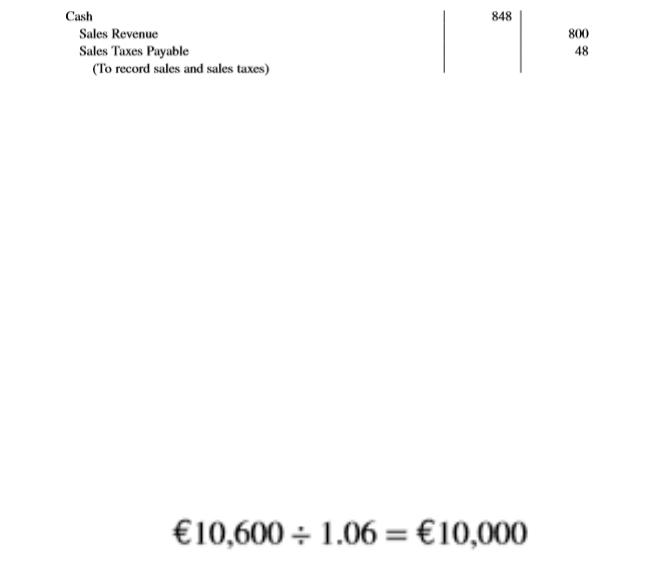
To illustrate the accounting for a sales tax, Cooley Grocery sells loaves of bread
totaling €800 on a given day. Assuming a sales tax rate of 6%, Cooley make the
following entry record the sale.
When the company remits the taxes to the taxing agency, it debits Sales Taxes
Payable and credits Cash. The company does not report sales taxes as an expense.
It simply forwards to the government the amount paid by the customers. Thus,
Cooley Grocery serves only as a collection agent for the taxing authority.
Sometimes companies do not enter sales taxes separately in the cash register. To
determine the amount of sales in such cases, divide total receipts by 100% plus the
sales tax percentage. For example, assume that Cooley Grocery enters total
receipts of €10,600. The receipts from the sales are equal to the sales price (100%)
plus the tax percentage (6% of sales), or 1.06 times the sales total. We can compute
the sales amount as follows.
Thus, we can fi nd the sales tax amount of €600 by either (1) subtracting sales from
total receipts (€10,600 − €10,000) or (2) multiplying sales by the sales tax rate
(€10,000 × .06).
Unearned Revenues
An airline company, such as Qantas Airways (AUS), often receives cash when it sells
tickets for future fl ights. A magazine publisher, such as Finance Asia (HKG), receives
customers’ payments when they order magazines. Season tickets for concerts,
sporting events, and theater programs are also paid for in advance. How do
companies account for unearned revenues that are received before goods are
delivered or services are performed?
1. W hen a company receives the advance payment, it debits Cash and credits a
current liability account identifying the source of the unearned revenue.
2. W hen the company recognizes revenue, it debits an unearned revenue account
and credits a revenue account.
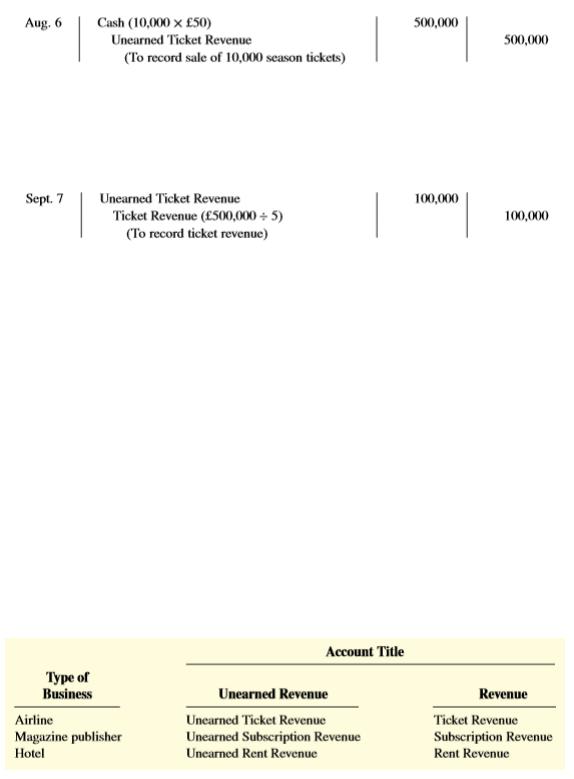
To illustrate, assume that the Liverpool F.C. (GBR) sells 10,000 season soccer
(football) tickets at £50 each for its fi ve-game home schedule. The club makes the
following entry for the sale of season tickets.
As each game is completed, Liverpool records the recognition of revenue with the
following entry.
The account Unearned Ticket Revenue represents unearned revenue, and
Liverpool reports it as a current liability. As the club recognizes revenue, it reclassifi
es the amount from unearned revenue to Ticket Revenue. Unearned revenue is
substantial for some companies. In the airline industry, for example, tickets sold for
future fl ights represent almost 50% of total current liabilities. At United Airlines
(USA), unearned ticket revenue is its largest current liability, recently amounting to
over $1 billion.
Illustration 10.2 shows specifi c unearned revenue and revenue accounts used in
selected types of businesses.
Salaries and Wages
Companies report as a current liability the amounts owed to employees for salaries
or wages at the end of an accounting period. In addition, they often also report as
current liabilities the following items related to employee compensation.
1. Payroll deductions.
2. Bonuses.
Payroll Deductions
The most common types of payroll deductions are taxes, insurance premiums,
employee savings, and union dues. To the extent that a company has not remitted
the amounts deducted to the proper authority at the end of the accounting
period, it should recognize them as current liabilities.
Social Security Taxes. Most governments provide a level of social benefi ts (for
retirement, unemployment, income, disability, and medical benefi ts) to individuals
and families. The benefi ts are generally funded from taxes assessed on both the
employer and the employees. These taxes are often referred to as Social Security
taxes (or Social Welfare taxes). Funds for these payments generally come from
taxes levied on both the e mployer and the employee. Employers collect the
employee’s share of this tax by deducting it from the employee’s gross pay, and
remit it to the government along with their share. The government often taxes both
the employer and the employee at the same rate. Companies should report the
amount of unremitted employee and employer Social Security tax on gross wages
paid as a current liability.
Income Tax Withholding. Income tax laws generally require employers to withhold
from each employee’s pay the applicable income tax due on those wages. The
employer computes the amount of income tax to withhold according to a
government-prescribed formula or withholding tax table. That amount depends on
the length of the pay period and each employee’s taxable wages, marital status,
and claimed dependents. Illustration 10.3 summarizes payroll deductions and
liabilities.
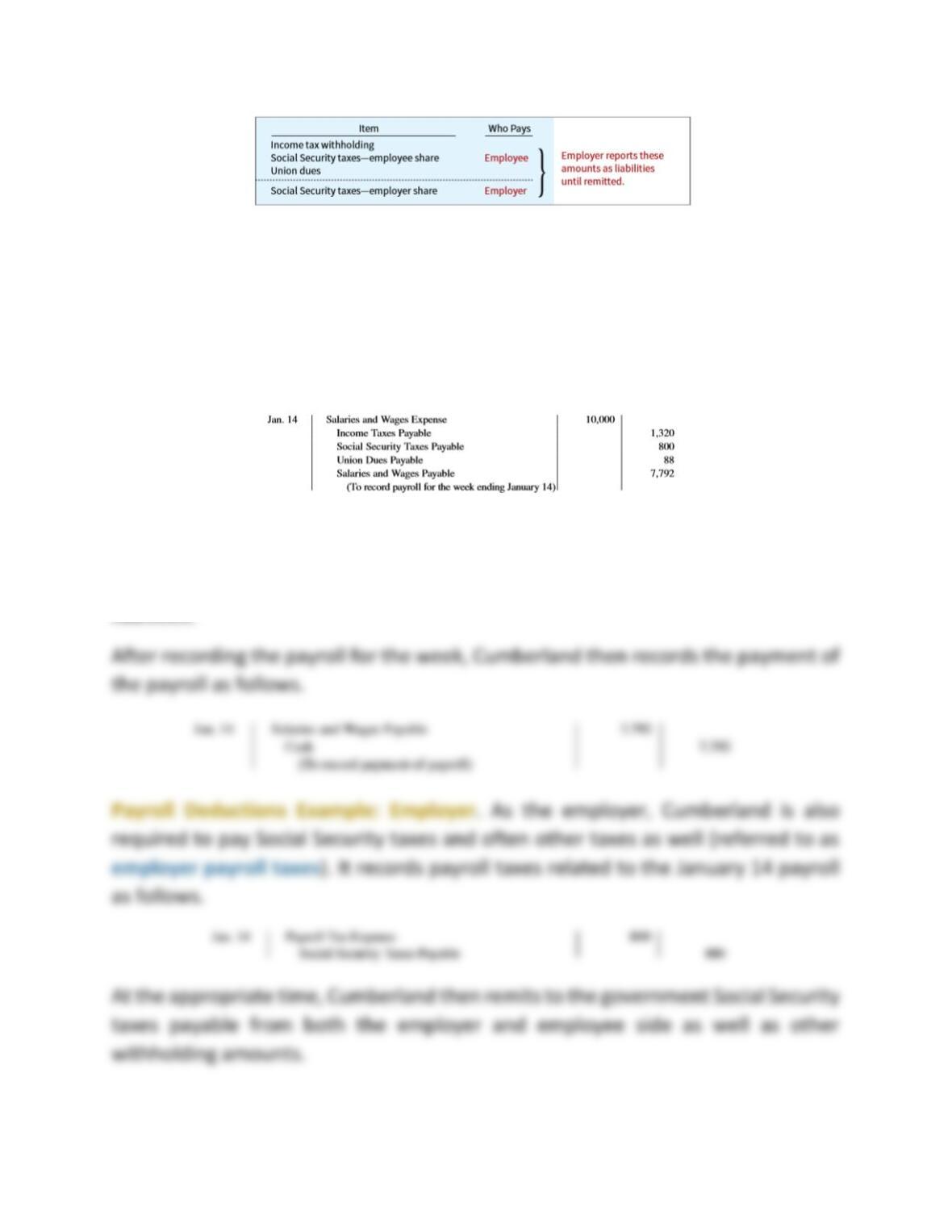
Payroll Deductions Example: Employee. Assume that Cumberland Company has a
weekly payroll of $10,000 (often referred to as gross earnings) entirely subject to
Social Security taxes (8%), with income tax withholding of $1,320 and union dues
of $88 d educted. If the weekly payroll is due on January 14, Cumberland records
the salaries and wages payable (often referred to as net pay) and the employee
payroll deductions as follows.
In many cases, employees ask the employer to withhold voluntary payments for
contributions to other organizations, such as payments for additional insurance or
charitable organizations, which requires the recording of additional withholding