Chapter Three: Job Analysis Page 1
CHAPTER THREE
JOB ANALYSIS
Definition
Developing organizations result in jobs that have to be staffed. Job analysis is the
procedure through which you determine the duties and nature of the jobs and the kinds
of people (in terms of skills and experience) and who should be hired for them. It
provides data on job requirements, which are then used for developing job descriptions
(what the job entails) and job specifications (what kind of people to hire for the job).
Job Analysis should collect information on the following areas:
• Duties and Tasks The basic unit of a job is the performance of specific tasks and
duties. Information to be collected about these items may include: frequency,
duration, effort, skill, complexity, equipment, standards, etc.
• Job context: Here you would include information concerning such matters as
physical working conditions, work schedule, and the organizational and social
context for instance, in terms of people with whom the employee would normally
be expected to interact. Also included here might be information regarding
financial and non-financial incentives the job entails.
• Tools and Equipment Some duties and tasks are performed using specific
equipment and tools. Equipment may include protective clothing. These items
need to be specified in a Job Analysis.
• Relationships: This includes supervision given and received and relationships
with internal or external people.
• Requirements The knowledge, skills, and abilities (KSA’s) required performing
the job. While an incumbent may have higher KSA’s than those required for the

Chapter Three: Job Analysis Page 2
job, a Job Analysis typically only states the minimum requirements to perform
the job.
Products of Job Analysis
Job analysis is a conceptual and analytical process or action, which results in
tangible outcomes of mainly JOB DESCRIPTION and JOB SPECIFICATIONS
a. Job Description (what a job entails): It is a list of a job’s duties, responsibilities,
reporting relationships, working conditions, and supervisory responsibilities. In
short, it concentrates on the job and lists what a jobholder does, how it is done
and why it is done.
b. Job Specification (what kind of people to hire for the job): It is a list of a job’s
“human requirements,” i.e, the requisite education, skills, personality, etc. In
other words, it is a statement of the minimum acceptable qualifications that a job
holder must possess to perform the job successfully.
c. Job Evaluations: In addition to providing data for job descriptions and
specifications, job analysis is also valuable in providing the information that makes
comparison of jobs possible. If an organization is to have an equitable
compensation program, jobs that have similar demands in terms of skills,
knowledge, and abilities should be placed in common compensation groups. Job
evaluation contributes toward that end by specifying the relative value of each job
in the organization. Thus, job evaluation is an important part of compensation
administration as will be discussed in detail in chapter 10.
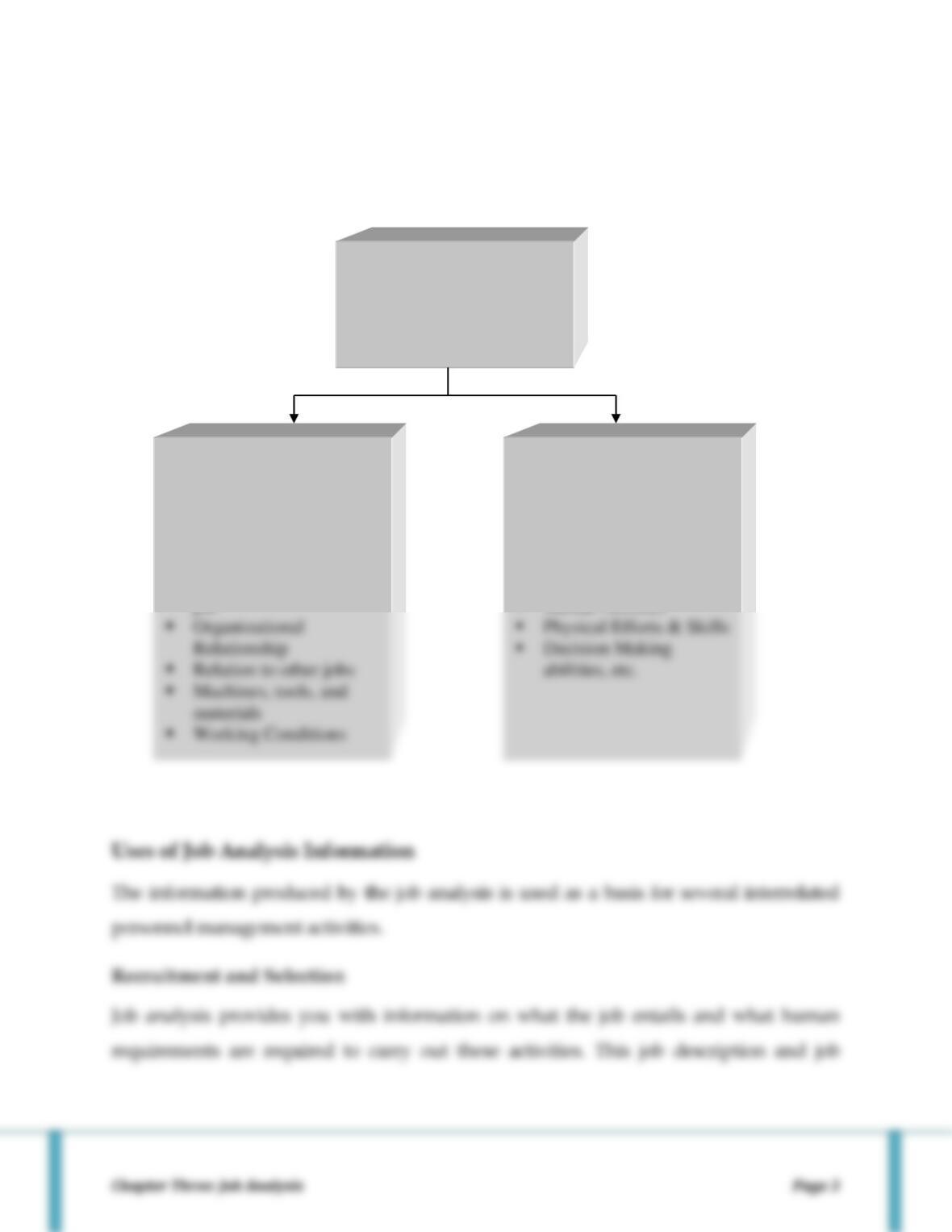
The Components of Job Descriptions & Job Specifications
( Byars/ Rue)
Job Analysis
Determining Pertinent
Information Relating to the
nature of a job
Job Description
A written description of a
job and its requirements
▪ Job Titles & Location
▪ Duties to be performed
▪ Characteristics of the
Job Specifications
A written statement of the
necessary qualification of
the job holder
▪ Education
▪ Experience
▪ Training