Point of Light: If you can buy your way out of a problem, it isn’t a problem…it’s an
irritation.
Chapter 9: Developing New Products and Services
https://www.youtube.com/watch?v=dPL1-8ypnEs
A product is a good, service, or idea consisting of a bundle of tangible and intangible attributes
that satisfies consumers’ needs and is received in exchange for money or something else of value.
Goods can also be divided into:
1. Nondurable Goods. A nondurable good is an item consumed in one or a few uses, such
as food products and fuel.
2. Durable Goods. A durable good is one that usually lasts over many uses, such as
appliances, cars, and mobile phones.
Services are intangible activities or benefits that an organization provides to satisfy consumers’
needs in exchange for money or something else of value. Services exceed 40% of GDP in the
US market.
Two main categories of products:
1. Consumer products are purchased by the ultimate consumer.
2. Business products (also called B2B products or industrial products) are products that
organizations buy that assist in providing other products for resale.
Some products can be both consumer products and business products, depending on their use.
For example, a computer can be used as a consumer product or as a business product.
Consumer products fall into 4 main categories:
1. Convenience products are items that the consumer purchases frequently, conveniently,
and with a minimum of shopping effort. (Soft drinks, snacks, inexpensive items)
2. Shopping products are items for which the consumer compares several alternatives on
criteria such as price, quality, or style. (Restaurant meal, clothes, small appliances)
3. Specialty products are items that the consumer makes a special effort to search out and
buy. (Cars, houses, jewelry, vacations).
4. Unsought products are items that the consumer does not know about or knows about but
does not initially want. (Insurance, medical procedures, root canal)
The sale of business products is often the result of derived demand; that is, sales of business
products frequently result (or are derived) from the sale of consumer products.
Business products are usually classified as either components or support products.
1. Components are items that become part of the final product. These include raw materials
such as grain or lumber, as well as assemblies or parts, such as a Ford car engine or car
door hinges.
2. Support products are items used to assist in producing other goods and services.
Support products include
• Installations, such as buildings and fixed equipment.
• Accessory equipment, such as tools and office equipment.
• Supplies, such as stationery, paper clips, and brooms.
• Industrial services, such as maintenance, repair, and legal services.
How Services are classified:
1. Delivery by people or equipment. Some services require a person to deliver
or perform the service, while other services are delivered by equipment or
technology.
2. Profit or Non-profit organizations: In contrast to profit organizations,
nonprofit organizations’ excesses in revenue over expenses are not taxed or
distributed to shareholders. When excess revenue exists, the money goes back
into the organization’s treasury to allow continuation of the service.
3. Government Sponsored: A third way to classify services is based on whether
they are government sponsored. Although there is no direct ownership and they
are nonprofit organizations, governments at the federal, state, and local levels
provide a broad range of services.
Services have become a significant component of the global economy and one of the most
important components of the U.S. economy.
There are four unique elements to services, often referred to as the four I’s of
services.
1. Intangibility: Services are intangible; that is, they can’t be held, touched, or
seen before the purchase decision. In contrast, before purchasing a traditional
product, a consumer can touch a box of laundry detergent, kick the tire of an
automobile, or sample a new breakfast cereal. Because services tend to be a
performance rather than an object, they are much more difficult for consumers to
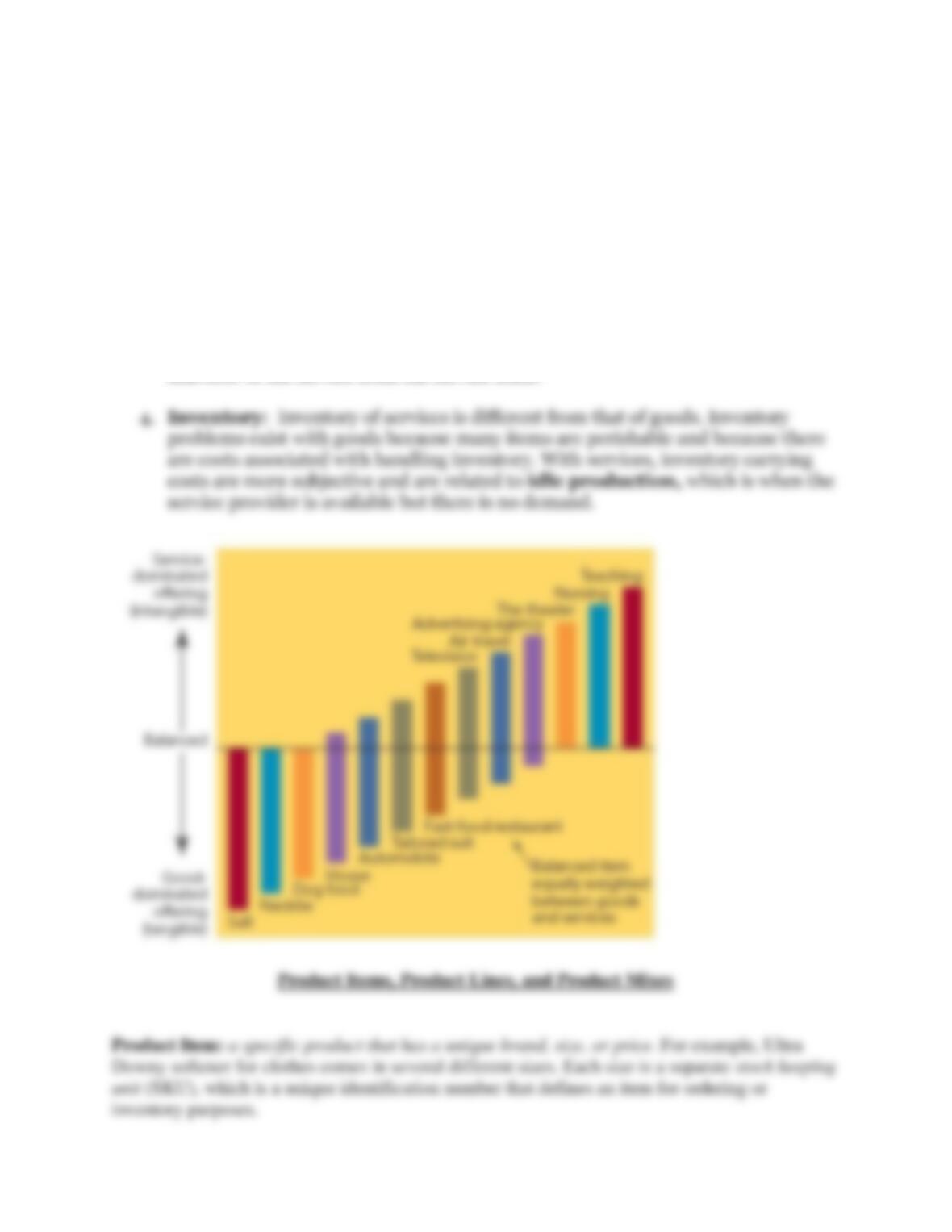
evaluate. To help consumers assess and compare services, marketers try to make
them tangible or show the benefits of using the service.
2. Inconsistency: Because services depend on the people who provide them, their
quality varies with each person’s capabilities and day-to-day job performance.
Inconsistency is much more of a problem in services than it is with tangible
goods. Tangible products can be good or bad in terms of quality, but with modern
production lines the quality will at least be consistent. On the other hand, one day
the Philadelphia Phillies baseball team may have great hitting and pitching and
look like a pennant winner and the next day lose by 10 runs.
3. Inseparability: In most cases, the consumer cannot (and does not) separate the