99
Copyright © 2019 Pearson Canada Inc.
Chapter 9
Fundamentals of Capital Budgeting
9-1.
a. Sales of new pizza – lost sales of original = 20 – (0.40 × 20) = $12 million.
b. Sales of new pizza – lost sales of original pizza from customers who would not have switched brands =
20 – (0.50 × 0.40 × 20) = $16 million.
9-2.
9-3.
a. No, this is a sunk cost and will not be included directly. (But see (f) below.)
b. Yes, this is a cost of opening the new store.
c. Yes, this loss of sales at the existing store should be deducted from the sales at the new store to
determine the incremental increase in sales that opening the new store will generate for HBS.
d. No, this is a sunk cost.
e. This is a capital expenditure associated with opening the new store, so it will not affect the reported
earnings other than through depreciation expenses (recall that depreciation is usually used for reporting
purposes but not for tax purposes). This capital expenditure affects the cash flows of the project by
causing a large initial outflow (the construction costs) followed by a series of inflows as the CCA tax
shields are realized.
f. Yes, this is an opportunity cost of opening the new store. (By opening the new store, HBS forgoes the
after-tax proceeds it could have earned by selling the land. This loss is equal to the sale price less the
taxes owed on the capital gain from the sale, which is the difference between the sale price and the
initial cost of the land.)
g. While these financing costs will affect HBS’s reported earnings, for capital budgeting purposes we
calculate the incremental earnings without including financing costs to determine the project’s
unlevered net income.
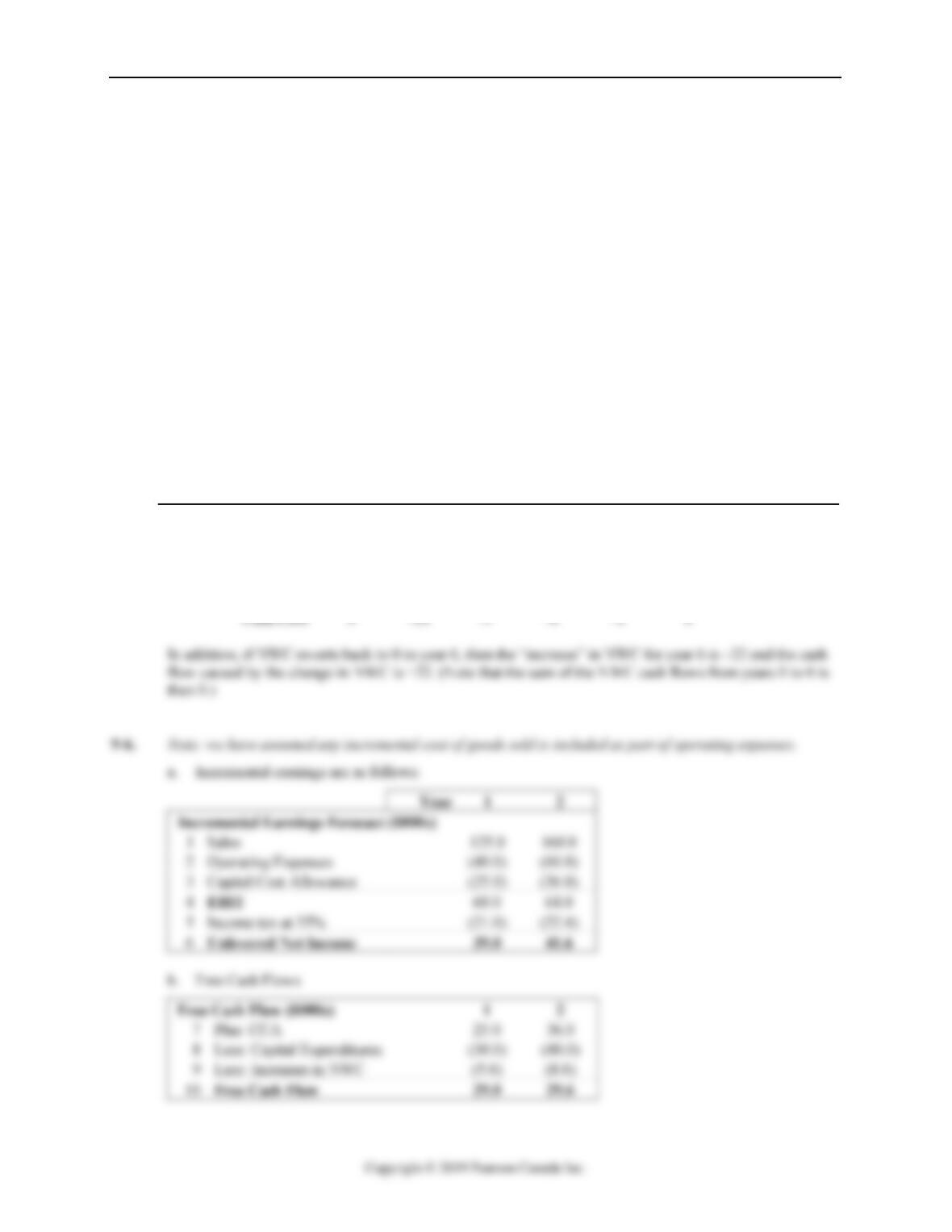
Ye ar 1 2
Incremental Earnings Forecast ($000s)
1 Sales of Mini Mochi Munch 9000 7,000
2 Other Sales 2000 2,000
3 Cost of Goods Sold (7,350) (6,050)
4Gros s Profit 3,650 2,950
5 Selling, General & Admin. (5,000) –
6 Depreciation – –
7EB IT (1,350) 2,950
8 Income tax at 35% 473 (1,033)
9Unlevered Net Income (878) 1,918
100 Solutions Manual for Berk/DeMarzo/Stangeland • Corporate Finance, 4th Canadian Edition
9-4.
a. Change in EBIT = Gross profit with price drop – Gross profit without price drop
= 25,000 × (300 – 200) – 20,000 × (350 – 200)
= –$500,000.
b. Change in EBIT from ink cartridge sales = 25,000 × $75 × 0.70 – 20,000 × $75 × 0.70 = $262,500
Therefore, incremental change in EBIT for the next three years is
Year 1: $262,500 – 500,000 = –$237,500
Year 2: $262,500
Year 3: $262,500.
9-5.
Since an increase in NWC is equivalent to a negative cash flow, the cash flow effects are as follows:
Year 0 Year 1 Year 2 Year 3 Year 4 Year 5
Year 0 Year 1 Year 2 Year 3 Year 4 Year 5
Cash 6 12151515
Accounts Receivable 21 22 24 24 24
Inventory 5 7 10 12 13
Accounts Payable 1822242530
Net working capital (1 + 2 + 3 – 4)0 1419252622
Increase in NWC 14561–4