Chapter 8 Flow in Pipes
Chapter 8
FLOW IN PIPES
Laminar and Turbulent Flow
8-1C Liquids are usually transported in circular pipes because pipes with a circular cross-section can
withstand large pressure differences between the inside and the outside without undergoing any significant
distortion.
8-2C Reynolds number is the ratio of the inertial forces to viscous forces, and it serves as a criteria for
determining the flow regime. At large Reynolds numbers, for example, the flow is turbulent since the
inertia forces are large relative to the viscous forces, and thus the viscous forces cannot prevent the random
and rapid fluctuations of the fluid. It is defined as follows:
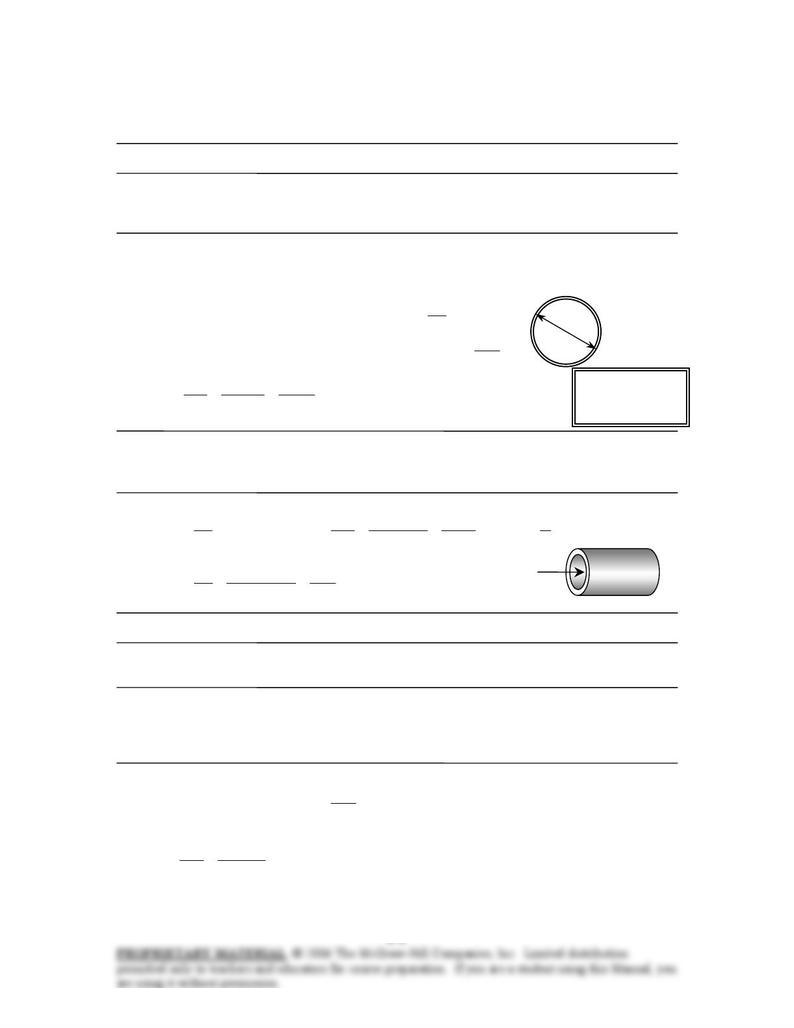
(a) For flow in a circular tube of inner diameter D:
ν
VD
=Re
(b) For flow in a rectangular duct of cross-section a × b:
ν
h
VD
=Re
where DA
p
ab
ab
ab
ab
h
c
==
+=+
44
2
2
()()
is the hydraulic diameter.
8-3C Reynolds number is inversely proportional to kinematic viscosity, which is much smaller for water
than for air (at 25°C, νair = 1.562×10⁻⁵ m2/s and νwater = µ⁄ρ = 0.891×10⁻³/997 = 8.9×10⁻⁷ m2/s). Therefore,
noting that Re = VD/ν, the Reynolds number is higher for motion in water for the same diameter and speed.
a
D
b
8-4C Reynolds number for flow in a circular tube of diameter D is expressed as
υ
VD
=Re where
ρ
µ
υ
ρππρ
ρ
===== and
4
)4/( 22 D
m
D
m
A
m
V
c
avg
&&&
V
Substituting, m, V
µπ
ρµρπ
υ
D
m
D
DmVD && 4
)/(
4
Re 2===
8-5C Engine oil requires a larger pump because of its much larger density.
8-6C The generally accepted value of the Reynolds number above which the flow in a smooth pipe is
turbulent is 4000.
8-7C Reynolds number is inversely proportional to kinematic viscosity, which is much smaller for water
than for air (at 25°C, νair = 1.562×10⁻⁵ m2/s and νwater = µ⁄ρ = 0.891×10⁻³/997 = 8.9×10⁻⁷ m2/s). Therefore,
for the same diameter and speed, the Reynolds number will be higher for water flow, and thus the flow is
more likely to be turbulent for water.
8-8C For flow through non-circular tubes, the Reynolds number and the friction factor are based on the
hydraulic diameter Dh defined as p
A
Dc
h
4
= where Ac is the cross-sectional area of the tube and p is its
perimeter. The hydraulic diameter is defined such that it reduces to ordinary diameter D for circular tubes
since D
D
D
p
A
Dc
h===
π
π
4/4
42
.

Chapter 8 Flow in Pipes
8-9C The region from the tube inlet to the point at which the boundary layer merges at the centerline is
called the hydrodynamic entrance region, and the length of this region is called hydrodynamic entry length.
The entry length is much longer in laminar flow than it is in turbulent flow. But at very low Reynolds
numbers, Lh is very small (Lh = 1.2D at Re = 20).
8-10C The wall shear stress
τ
w is highest at the tube inlet where the thickness of the boundary layer is zero,
and decreases gradually to the fully developed value. The same is true for turbulent flow.
8-11C In turbulent flow, the tubes with rough surfaces have much higher friction factors than the tubes
with smooth surfaces, and thus much larger pressure drop. In the case of laminar flow, the effect of surface
roughness on the friction factor and pressure drop is negligible.
Fully Developed Flow in Pipes
8-12C The wall shear stress
τ
w remains constant along the flow direction in the fully developed region in
both laminar and turbulent flow.
8-13C The fluid viscosity is responsible for the development of the velocity boundary layer.
8-14C In the fully developed region of flow in a circular pipe, the velocity profile will NOT change in the
flow direction.
8-15C The friction factor for flow in a tube is proportional to the pressure loss. Since the pressure loss
along the flow is directly related to the power requirements of the pump to maintain flow, the friction factor
is also proportional to the power requirements to overcome friction. The applicable relations are
ρ
ρ
L
L
Pm
W
V
D
L
fP ∆
==∆ &
&
pump
2
and
2
8-16C The shear stress at the center of a circular tube during fully developed laminar flow is zero since the
shear stress is proportional to the velocity gradient, which is zero at the tube center.
8-17C Yes, the shear stress at the surface of a tube during fully developed turbulent flow is maximum since
the shear stress is proportional to the velocity gradient, which is maximum at the tube surface.
8-18C In fully developed flow in a circular pipe with negligible entrance effects, if the length of the pipe is
doubled, the head loss will also double (the head loss is proportional to pipe length).
8-19C Yes, the volume flow rate in a circular pipe with laminar flow can be determined by measuring the
velocity at the centerline in the fully developed region, multiplying it by the cross-sectional area, and
dividing the result by 2 since .
cc AVAV )2/( maxavg ==
V
&
8-20C No, the average velocity in a circular pipe in fully developed laminar flow cannot be determined by
simply measuring the velocity at R/2 (midway between the wall surface and the centerline). The average
velocity is Vmax/2, but the velocity at R/2 is
4
3
1)2/( max
2/
2
2
max
V
R
r
VRV
Rr
=
−=
=
, which is much larger than Vmax/2.

Chapter 8 Flow in Pipes
8-21C In fully developed laminar flow in a circular pipe, the head loss is given by
g
V
D
L
Dg
V
D
L
DVg
V
D
L
g
V
D
L
fhL2
64
2/
64
2Re
64
2
222
ν
ν
====
The average velocity can be expressed in terms of the flow rate as 4/
2
D
Ac
π
VV
&&
==V. Substituting,
42222
128
2
464
4/
2
64
Dg
L
Dg
L
DD
g
L
D
hL
π
ν
π
ν
π
ν
VVV
&&&
==
=
Therefore, at constant flow rate and pipe length, the head loss is inversely proportional to the 4th power of
diameter, and thus reducing the pipe diameter by half will increase the head loss by a factor of 16 .
8-22C In turbulent flow, it is the turbulent eddies due to enhanced mixing that cause the friction factor to
be larger.
8-23C Turbulent viscosity µt is caused by turbulent eddies, and it accounts for momentum transport by
turbulent eddies. It is expressed as y
u
vu tt ∂
∂
=
′′
−=
µρτ
where u is the mean value of velocity in the
flow direction and and are the fluctuating components of velocity. u′u′
8-24C We compare the dimensions of the two sides of the equation 5
2
0826.0 D
fLhL
V
&
=,
[] [ ][]
[][
5
2
13
0826.0 −− ⋅⋅⋅= LTLLL
]
,
and the dimension of the constant is
[]
[
]
21TL0826.0 −
=
Therefore, the constant 0.0826 is NOT dimensionless. This is not a dimensionally homogeneous, and it
cannot be used in any consistent set of units..

Chapter 8 Flow in Pipes
8-25C In fully developed laminar flow in a circular pipe, the pressure loss and the head loss are given by
2
32
D
LV
PL
µ
=∆ and 2
32
gD
LV
g
P
hL
L
ρ
µ
ρ
=
∆
=
When the flow rate and thus average velocity are held constant, the head loss becomes proportional to
viscosity. Therefore, the head loss will be reduced by half when the viscosity of the fluid is reduced by
half.
8-26C The head loss is related to pressure loss by gPh LL
ρ
/
∆
=
. For a given fluid, the head loss can be
converted to pressure loss by multiplying the head loss by the acceleration of gravity and the density of the
fluid.
8-27C During laminar flow of air in a circular pipe with perfectly smooth surfaces, the friction factor will
NOT be zero because of the no-slip boundary condition. But it will be minimum compared to flow in pipes
with rough surfaces.
8-28C At very large Reynolds numbers, the flow is fully rough and the friction factor is independent of the
Reynolds number. This is because the thickness of laminar sublayer decreases with increasing Reynolds
number, and it be comes so thin that the surface roughness protrudes into the flow. The viscous effects in
this case are produced in the main flow primarily by the protruding roughness elements, and the
contribution of the laminar sublayer becomes negligible.
Chapter 8 Flow in Pipes
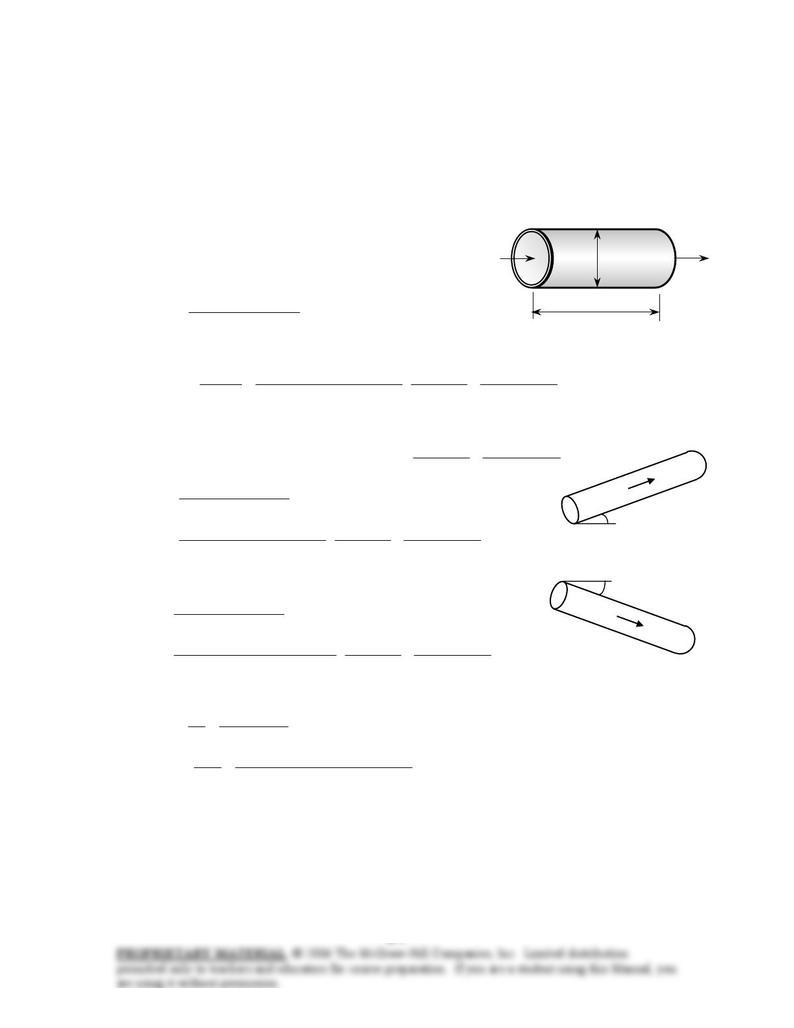
8-29E The pressure readings across a pipe are given. The flow rates are to be determined for 3 different
orientations of horizontal, uphill, and downhill flow. √
Assumptions 1 The flow is steady and incompressible. 2 The entrance effects are negligible, and thus the
flow is fully developed. 3 The flow is laminar (to be verified). 4 The pipe involves no components such as
bends, valves, and connectors. 5 The piping section involves no work devices such as pumps and turbines.
Properties The density and dynamic viscosity of oil are given to be ρ = 56.8 lbm/ft3 and µ = 0.0278
lbm/ft⋅s, respectively.
Analysis The pressure drop across the pipe and the cross-sectional area of the pipe are
222
21
ft 001364.04/ft) 12/5.0(4/
psi 10614120
===
=−=−=∆
ππ
DA
PPP
c
Oil
D = 0.5 in
L = 120 ft
(a) The flow rate for all three cases can be determined from
L
DgLP
µ
πθρ
128
)sin( 4
−∆
=
V
&
where θ is the angle the pipe makes with the horizontal. For the horizontal case, θ = 0 and thus sin θ = 0.
Therefore,
/sft 0.0109 3
=
⋅
⋅
=
∆
=lbf 1
ft/slbm 2.32
psi 1
lbf/ft 144
ft) s)(120lbm/ft 0278.0(128
ft) (0.5/12psi) 106(
128
22
4
4
horiz
π
µ
π
L
DP
V
&
(b) For uphill flow with an inclination of 20°, we have θ = +20°, and
psi 2.16
ft/slbm 2.32
lbf 1
lbf/ft 144
psi 1
20sin)ft 120)(ft/s 2.32)(lbm/ft 8.56(sin 22
23 =
⋅
°=
θρ
gL
/sft 0.00923 3
=
⋅
⋅
−
=
=
−∆
=
lbf 1
ft/slbm 2.32
psi 1
lbf/ft 144
ft) s)(120lbm/ft 0278.0(128
ft) (0.5/12psi) 2.16106(
128
)sin(
22
4
4
uphill
π
µ
πθρ
L
DgLP
V
&
20°
(c) For downhill flow with an inclination of 20°, we have θ = -20°, and
/sft 0.0126 3
=
⋅
⋅
−−
=
−∆
=
lbf 1
ft/slbm 2.32
psi 1
lbf/ft 144
ft) s)(120lbm/ft 0278.0(128
ft) (0.5/12psi] )2.16(106[
128
)sin(
22
4
4
downhill
π
µ
πθρ
L
DgLP
V
&
20°
The flow rate is the highest for downhill flow case, as expected. The average fluid velocity and the
Reynolds number in this case are
787
slbm/ft 0278.0
ft) 12ft/s)(0.5/ 24.9)(lbm/ft 8.56(
Re
ft/s 24.9
ft 0.001364
/sft 0126.0
3
2
3
=
⋅
==
===
µ
ρ
VD
A
V
c
V
&
which is less than 2300. Therefore, the flow is laminar for all three cases, and the analysis above is valid.
Discussion Note that the flow is driven by the combined effect of pressure difference and gravity. As can
be seen from the calculated rates above, gravity opposes uphill flow, but helps downhill flow. Gravity has
no effect on the flow rate in the horizontal case. Downhill flow can occur even in the absence of an applied
pressure difference.