• Question 1
5.625 out of 5.625 points
Which of the following statements regarding the chi-squared distribution is true?
Selected Answer:
All of these choices are true.
Correct Answer:
All of these choices are true.
• Question 2
5.625 out of 5.625 points
A chi-squared goodness–of-fit test is always conducted as a(n):
Selected Answer:
upper-tail test.
Correct Answer:
upper-tail test.
• Question 3
0 out of 5.625 points
In which of the following situations would it make the most sense to use a chi-squared
goodness-of-fit test?
Selected
Answer:
A new account analyst at a bank is interested in determining if the
distribution of the ages of customers coming in for service is associated
with the location of the bank branch. He gathers data from 400 randomly
selected transactions, recording the customer’s age category (less than 30,
30-55, 56 and older) and which branch the customer visited (main branch
or mall branch).
Correct
Answer:

An industry research group wants to determine if the market share—that is,
the proportion of the market’s total sales—for the smartphone vendors
Samsung, Apple, LG, and others is the same as it was a year ago. The
company conducts a survey of 300 randomly selected smartphone users
and records the number of users for each vendor.
Response
Feedback:
Remember that the goodness-of-fit test is used to analyze one
categorical random variable.
• Question 4
0 out of 5.625 points
Which of the following would represent the alternative hypothesis in a chi-squared
goodness-of-fit test conducted to determine if five colors of a certain candy appear in
the same proportion in the population?
Selected Answer:
H1: p1 = p2 = p3 = p4 = p5 = 0.20.
Correct Answer:
H1: At least one proportion is not equal to 0.20.
Response
Feedback:
Review Step 1 of the hypothesis testing procedure for the
goodness-of-fit test
• Question 5
5.625 out of 5.625 points
To determine the rejection region boundary in the chi-squared
distribution table, you need to know the:
Selected Answer:
degrees of freedom
Correct Answer:
degrees of freedom
• Question 6
5.625 out of 5.625 points
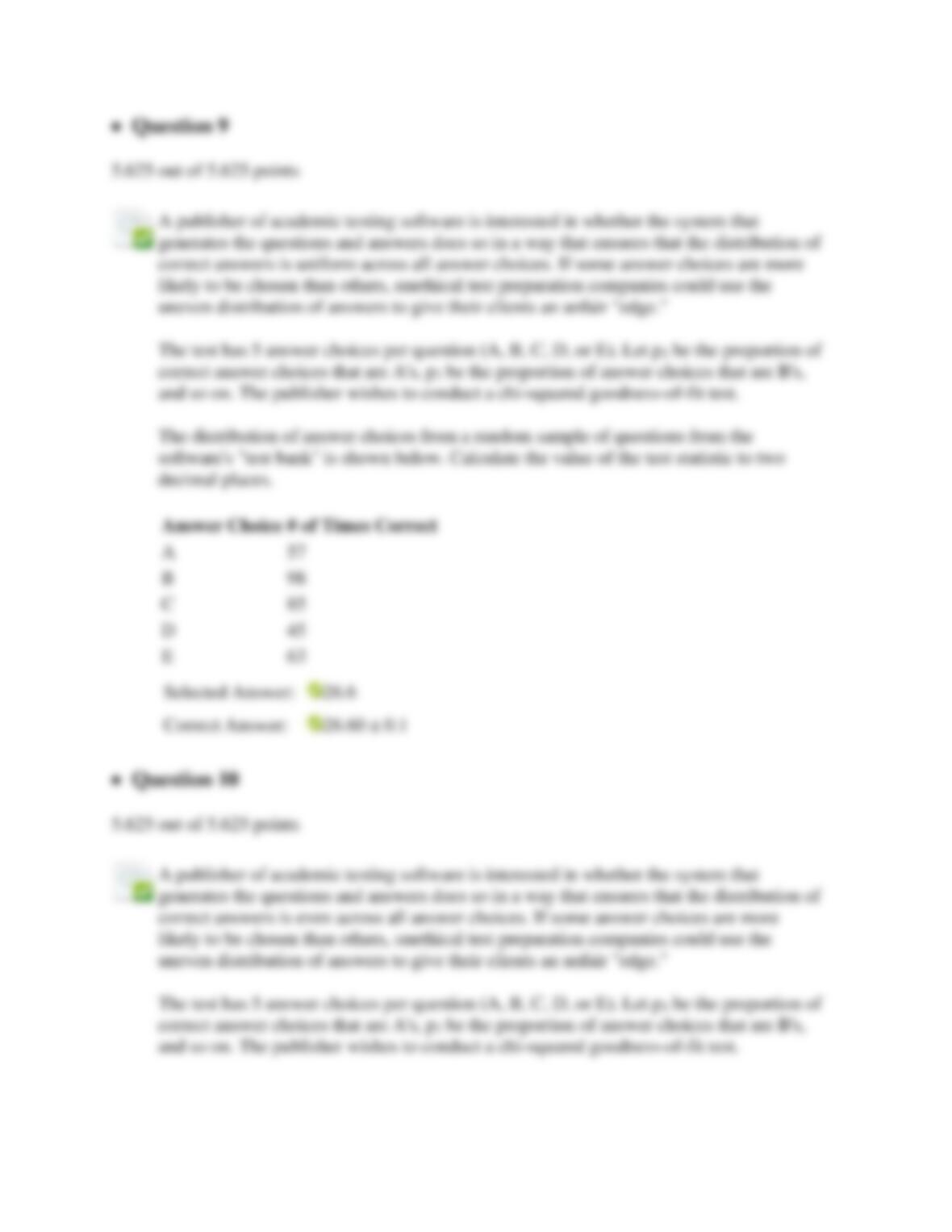
A publisher of academic testing software is interested in whether the system that
generates the questions and answers does so in a way that ensures that the distribution of
correct answers is uniform across all answer choices. If some answer choices are more
likely to be chosen than others, unethical test preparation companies could use the
uneven distribution of answers to give their clients an unfair “edge.”
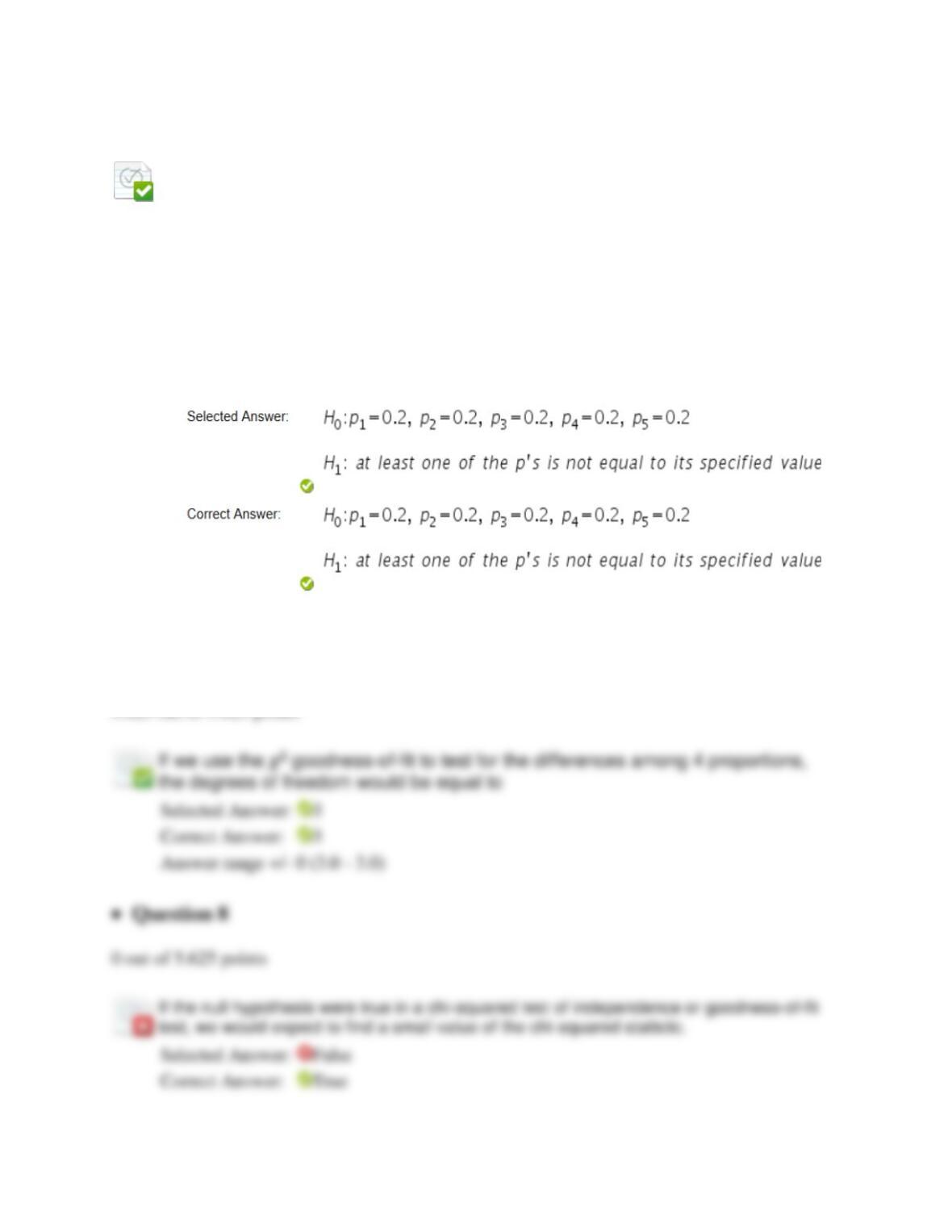
The test has 5 answer choices per question (A, B, C, D, or E). Let p1 be the proportion of
correct answer choices that are A’s, p2 be the proportion of correct answer choices that
are B’s, and so on. The publisher wishes to conduct a chi-squared goodness-of-fit test.
What are the null and alternative hypotheses for the test?
• Question 7
Selected Answer:
Correct Answer:
Answer range +/-
0 (3.0 – 3.0)
Selected Answer:
Correct Answer: