Chapter 5 Mass, Bernoulli, and Energy Equations
Review Problems
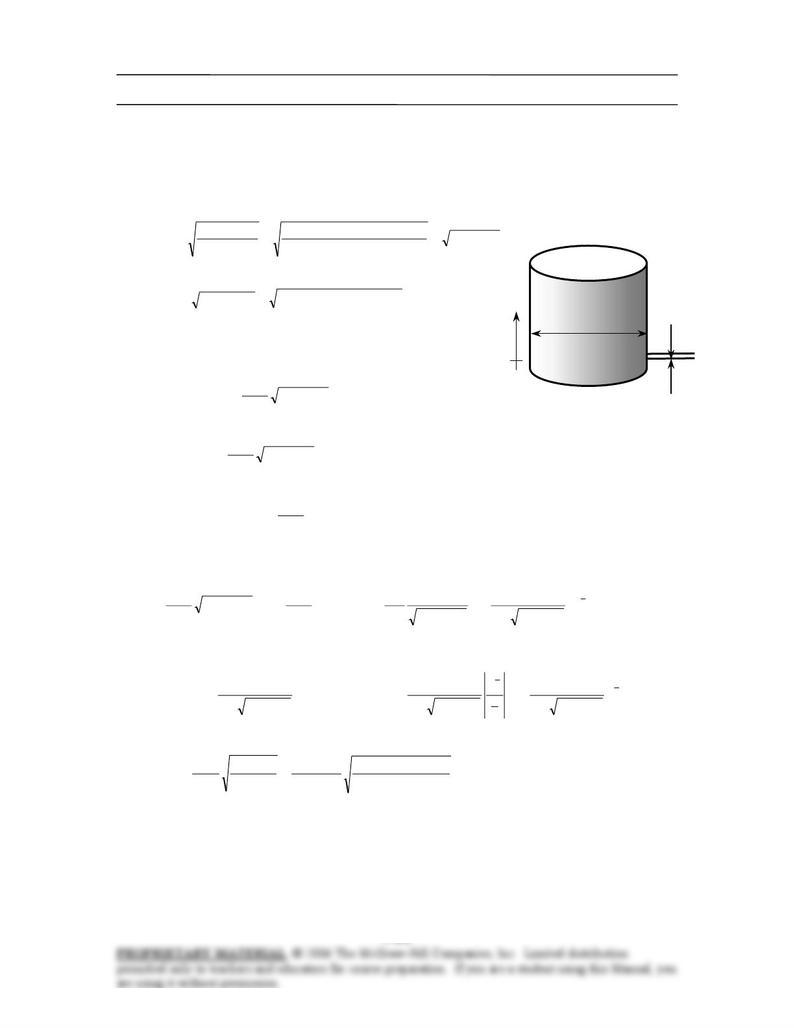
5-89 A water tank open to the atmosphere is initially filled with water. The tank discharges to the
atmosphere through a long pipe connected to a valve. The initial discharge velocity from the tank and the
time required to empty the tank are to be determined. √
Assumptions 1 The flow is incompressible. 2 The draining pipe is horizontal. 3 The tank is considered to
be empty when the water level drops to the center of the valve.
Analysis (a) Substituting the known quantities, the discharge velocity can be expressed as
gz
gz
DfL
gz
V1212.0
m) m)/(0.10 100(015.05.1
2
/5.1
2=
+
=
+
=
D
D
0
Then the initial discharge velocity becomes
m/s 1.54=== m) 2)(m/s 81.9(1212.01212.0 2
11 gzV
where z is the water height relative to the center of the orifice at that time.
z
(b) The flow rate of water from the tank can be obtained by multiplying
the discharge velocity by the pipe cross-sectional area,
gz
D
VA 1212.0
4
2
2pipe
π
==
V
&
Then the amount of water that flows through the pipe during a differential time interval dt is
dtgz
D
dtd 1212.0
4
2
π
==
VV
& (1)
which, from conservation of mass, must be equal to the decrease in the volume of water in the tank,
dz
D
dzAd k4
)(
2
0
tan
π
−=−=
V
(2)
where dz is the change in the water level in the tank during dt. (Note that dz is a negative quantity since the
positive direction of z is upwards. Therefore, we used –dz to get a positive quantity for the amount of water
discharged). Setting Eqs. (1) and (2) equal to each other and rearranging,
dzz
gD
D
gz
dz
D
D
dtdz
D
dtgz
D2
1
1212.0
1212.0
4
1212.0
42
2
0
2
2
0
2
0
2−
−=−=→−=
π
π
The last relation can be integrated easily since the variables are separated. Letting tf be the discharge time
and integrating it from t = 0 when z = z1 to t = tf when z = 0 (completely drained tank) gives
2
1
1
2
1
1
1
2
2
0
0
2
1
2
2
0
02/1
2
2
0
01212.0
2
1212.0
–
1212.0
z
gD
D
z
gD
D
tdzz
gD
D
dt
z
f
zz
t
t
f==→−= ∫∫ =
−
=
Simplifying and substituting the values given, the draining time is determined to be
h 7.21 ==== s 940,25
)m/s 81.9(1212.0
m 2
m) 1.0(
m) 10(2
1212.0
2
22
2
1
2
2
0
g
z
D
D
tf
Discussion The draining time can be shortened considerably by installing a pump in the pipe.
Chapter 5 Mass, Bernoulli, and Energy Equations
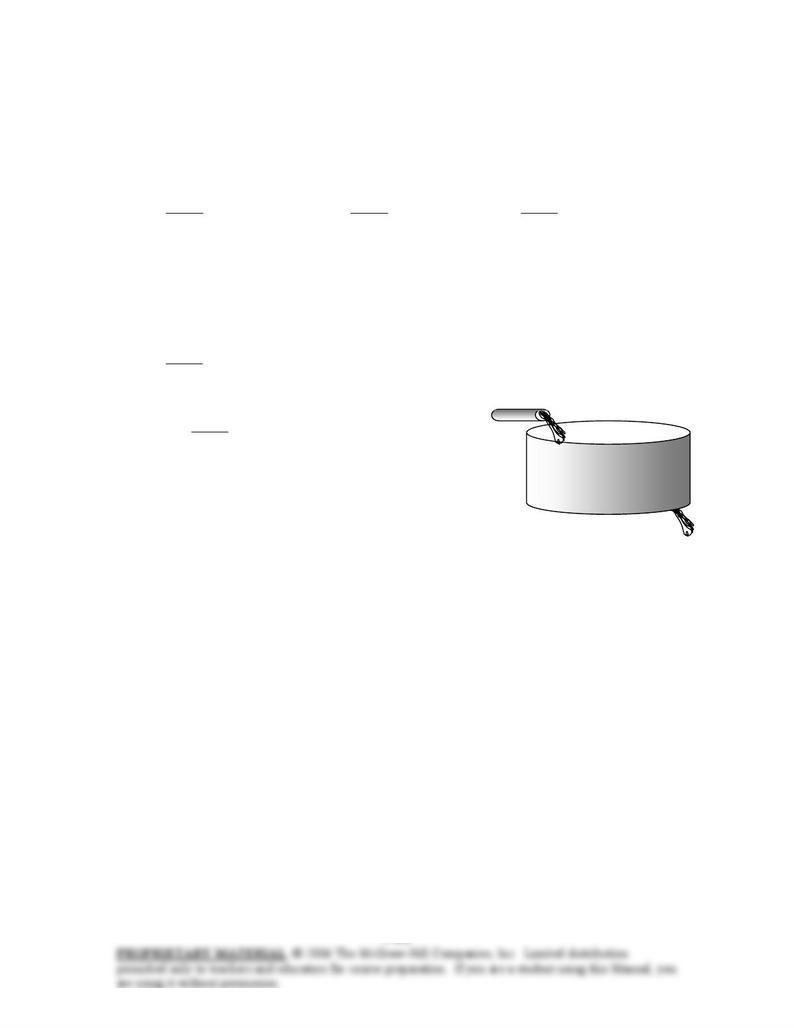
5-90 The rate of accumulation of water in a pool and the rate of discharge are given. The rate supply of
water to the pool is to be determined.
Assumptions 1 Water is supplied and discharged steadily. 2 The rate of evaporation of water is negligible.
3 No water is supplied or removed through other means.
Analysis The conservation of mass principle applied to the pool requires that the rate of increase in the
amount of water in the pool be equal to the difference between the rate of supply of water and the rate of
discharge. That is,
eieiei dt
d
m
dt
dm
mmm
dt
dm
V
V
V
&&
&&&& +=→+=→−= poolpoolpool
since the density of water is constant and thus the conservation of mass is equivalent to conservation of
volume. The rate of discharge of water is
/sm 00982.0m/s) /4](5m) (0.05[/4)( 32
e
2
e====
ππ
VDVAee
V
&
The rate of accumulation of water in the pool is equal to the cross-section of the pool times the rate at
which the water level rises,
/sm 0.00300 /minm 18.0m/min) m)(0.015 4m 3( 33
levelsection–cross
pool ==×== VA
dt
d
V
Substituting, the rate at which water is supplied to the pool is determined to be
/sm 0.01282 3
=+=+= 00982.0003.0
pool
ei dt
d
V
V
V
&&
Therefore, water is supplied at a rate of 0.01282 m3/s = 12.82 L/s.

Chapter 5 Mass, Bernoulli, and Energy Equations
5-91 A fluid is flowing in a circular pipe. A relation is to be obtained for the average fluid velocity in
therms of V(r), R, and r.
Analysis Choosing a circular ring of area dA = 2πrdr as our differential area, the mass flow rate through a
cross-sectional area can be expressed as
dr
r
R
() ()
∫∫ == R
A
drrrVdArVm
0
2
πρρ
&
Setting this equal to and solving for Vavg,
()
drrrV
R
R
avg ∫
=
0
2
2
V