Chapter 5 Mass, Bernoulli, and Energy Equations
Chapter 5
MASS, BERNOULLI, AND ENERGY EQUATIONS
Conservation of Mass
5-1C Mass, energy, momentum, and electric charge are conserved, and volume and entropy are not
conserved during a process.
5-2C Mass flow rate is the amount of mass flowing through a cross-section per unit time whereas the
volume flow rate is the amount of volume flowing through a cross-section per unit time.
5-3C The amount of mass or energy entering a control volume does not have to be equal to the amount of
mass or energy leaving during an unsteady-flow process.
5-4C Flow through a control volume is steady when it involves no changes with time at any specified
position.
5-5C No, a flow with the same volume flow rate at the inlet and the exit is not necessarily steady (unless
the density is constant). To be steady, the mass flow rate through the device must remain constant.
5-6E A garden hose is used to fill a water bucket. The volume and mass flow rates of water, the filling
time, and the discharge velocity are to be determined.
Assumptions 1 Water is an incompressible substance. 2 Flow through the hose is steady. 3 There is no
waste of water by splashing.
Properties We take the density of water to be 62.4 lbm/ft3.
Analysis (a) The volume and mass flow rates of water are
/sft 0.04363 3
==== ft/s) 8](4/ft) 12/1([)4/( 22
ππ
VDAV
V
&
lbm/s 2.72 === /s)ft 04363.0)(lbm/ft 4.62(m 33
V
&
&
ρ
(b) The time it takes to fill a 20-gallon bucket is
s 61.3=
==∆ gal 4804.7
ft 1
/sft 0.04363
gal 20 3
3
V
&
V
t
(c) The average discharge velocity of water at the nozzle exit is
ft/s 32====
]4/ft) 12/5.0([
/sft 04363.0
4/ 2
3
2
ππ
e
e
eD
A
V
VV
&&
Discussion Note that for a given flow rate, the average velocity is inversely proportional to the square of
the velocity. Therefore, when the diameter is reduced by half, the velocity quadruples.
Chapter 5 Mass, Bernoulli, and Energy Equations
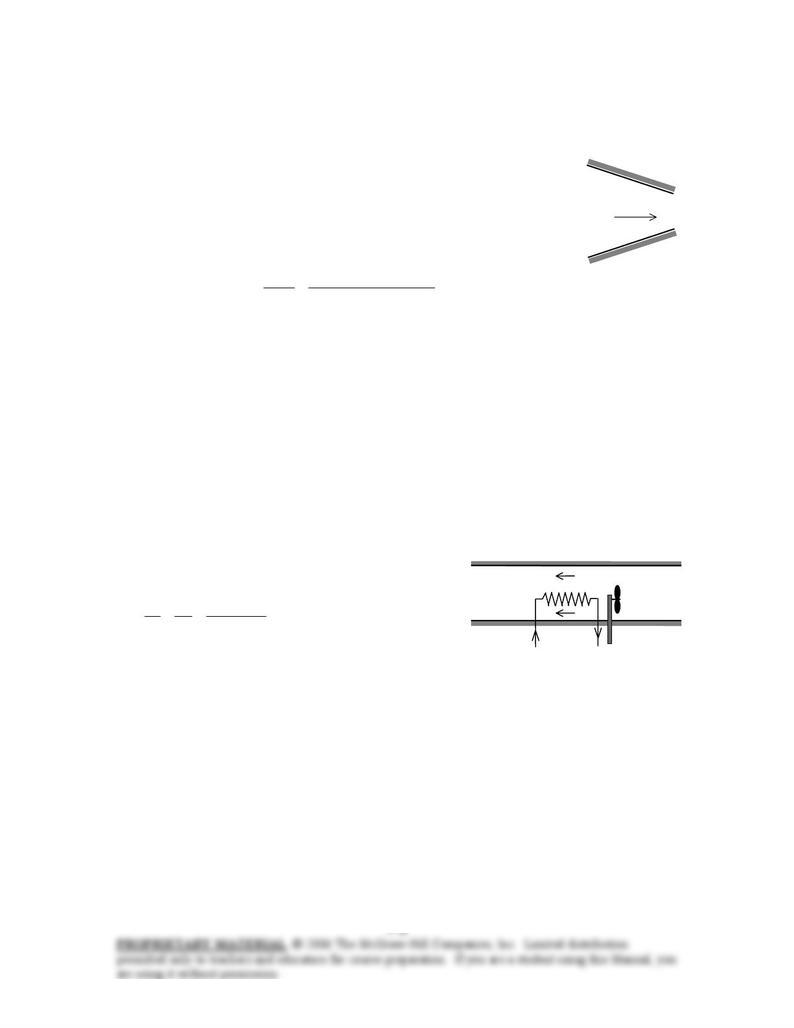
5-7 Air is accelerated in a nozzle. The mass flow rate and the exit area of the nozzle are to be determined.
Assumptions Flow through the nozzle is steady.
Properties The density of air is given to be 2.21 kg/m3 at the inlet, and 0.762 kg/m3 at the exit.
Analysis (a) The mass flow rate of air is determined from the inlet conditions to be
&
kg/s 0.530=== )m/s 30)(m 0.008)(kg/m 21.2( 23
111 VAm
ρ
&
(b) There is only one inlet and one exit, and thus &&
mm m
12
=
=
.
Then the exit area of the nozzle is determined to be
2
cm 38.7====→= 2
3
22
2222 m 00387.0
m/s) )(180mkg/ (0.762
kg/s 0.530
V
m
AVAm
ρ
ρ
&
&
V1 = 30 m/s
A
1 = 80 cm2 V2 = 180 m/s
AIR
5-8 Air is expanded and is accelerated as it is heated by a hair dryer of constant diameter. The percent
increase in the velocity of air as it flows through the drier is to be determined.
Assumptions Flow through the nozzle is steady.
Properties The density of air is given to be 1.20 kg/m3 at the inlet, and 1.05 kg/m3 at the exit.
Analysis There is only one inlet and one exit, and thus &&
mm m
12
&
=
=
. Then,
) of increase and (or, 1.14
kg/m 1.05
kg/m 1.20
3
3
2
1
1
2
2211
21
14% ===
=
=
ρ
ρ
ρρ
V
V
AVAV
mm &&
Therefore, the air velocity increases 14% as it flows through the hair drier.
V1 V2
Chapter 5 Mass, Bernoulli, and Energy Equations
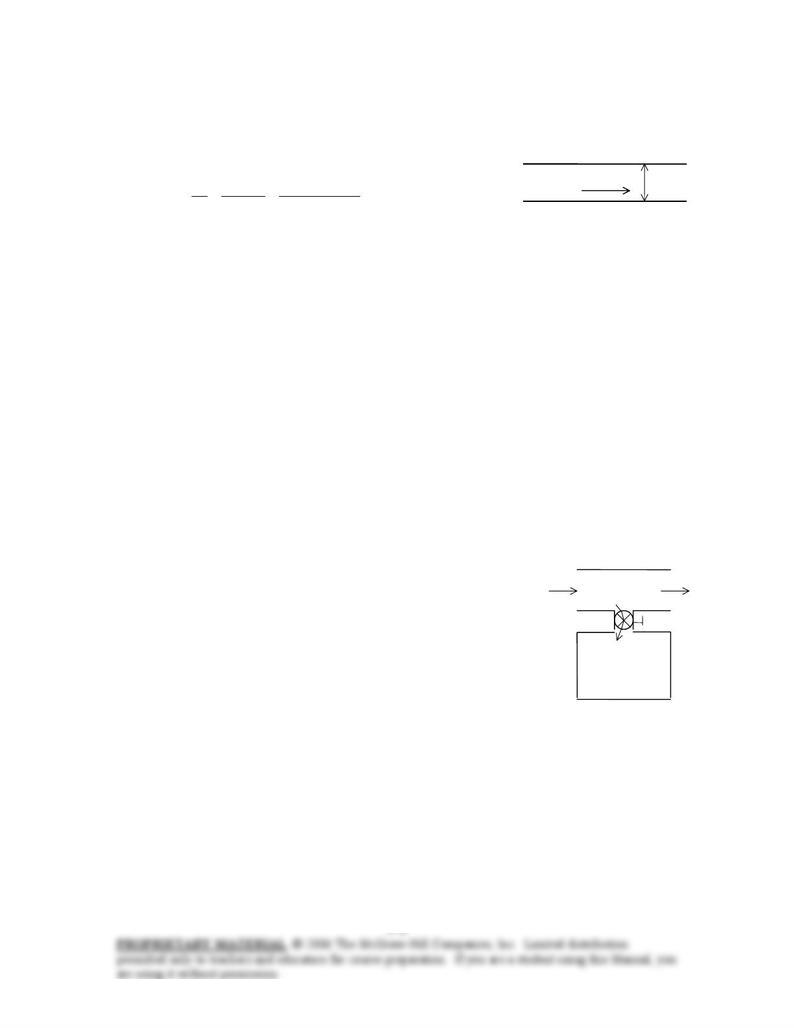
5-9E The ducts of an air-conditioning system pass through an open area. The inlet velocity and the mass
flow rate of air are to be determined.
Assumptions Flow through the air conditioning duct is steady.
Properties The density of air is given to be 0.078 lbm/ft3 at the inlet.
Analysis The inlet velocity of air and the mass flow rate through the duct are
450 ft3/min AIR
D
= 10 in
()
ft/s 13.8ft/min 825 =====
4/ft 10/12
/minft 450
4/ 2
3
2
1
1
1
1
π
π
D
A
V
VV
&&
lbm/s 0.585==== lbm/min 35.1min)/ft 450)(lbm/ft 078.0( 33
11
V
&
&
ρ
m
5-10 A rigid tank initially contains air at atmospheric conditions. The tank is connected to a supply line,
and air is allowed to enter the tank until the density rises to a specified level. The mass of air that entered
the tank is to be determined.
Properties The density of air is given to be 1.18 kg/m3 at the beginning, and 7.20 kg/m3 at the end.
Analysis We take the tank as the system, which is a control volume since mass crosses the boundary. The
mass balance for this system can be expressed as
Mass balance:
VV
1212system
ρ
ρ
−
=
−
=
→∆=− mmmmm ioutin
m
Substituting,
V
1 = 1 m3
ρ1 =1.18 kg/m3
kg 6.02==−= )m 1](kg/m 1.18)–(7.20[)( 33
12
V
ρρ
i
m
Therefore, 6.02 kg of mass entered the tank.
Chapter 5 Mass, Bernoulli, and Energy Equations
5-11 The ventilating fan of the bathroom of a building runs continuously. The mass of air “vented out” per
day is to be determined.
Assumptions Flow through the fan is steady.
Properties The density of air in the building is given to be 1.20 kg/m3.
Analysis The mass flow rate of air vented out is
kg/s036.0)/sm 030.0)( kg/m20.1( 33
airair ===
V
&
&
ρ
m
Then the mass of air vented out in 24 h becomes
kg 3110
=
×=∆= s) 3600kg/s)(24 036.0(
air tmm &
Discussion Note that more than 3 tons of air is vented out by a bathroom fan in one day.
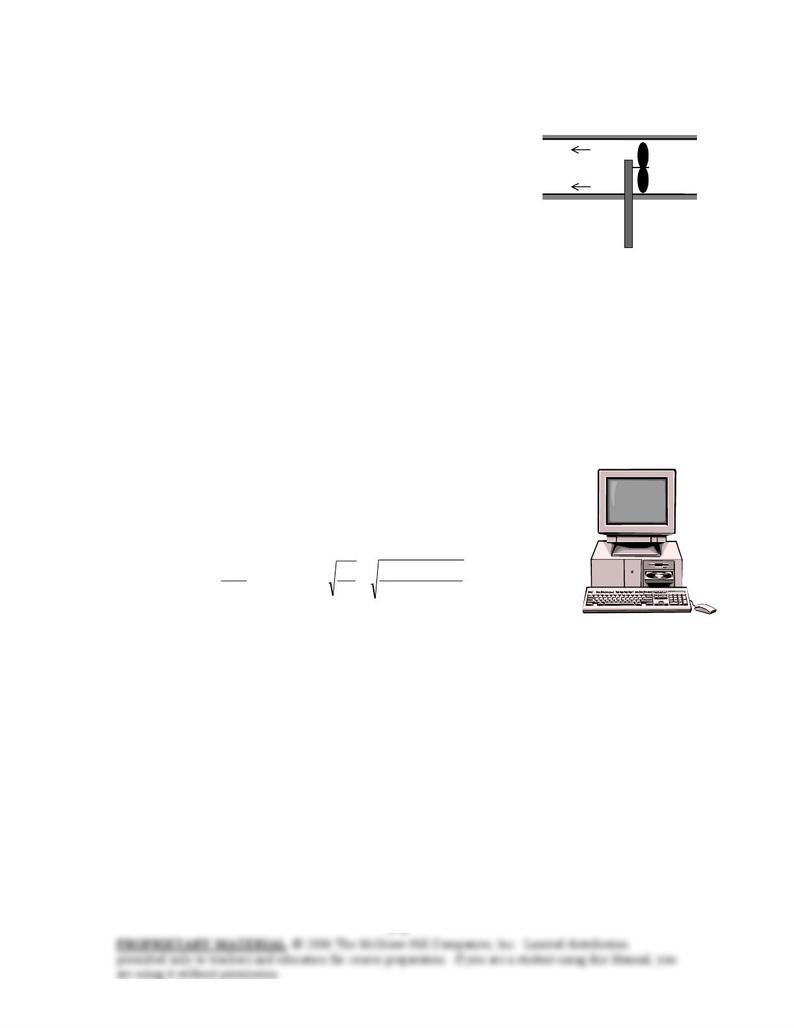
5-12 A desktop computer is to be cooled by a fan at a high elevation where the air density is low. The mass
flow rate of air through the fan and the diameter of the casing for a given velocity are to be determined.
Assumptions Flow through the fan is steady.
Properties The density of air at a high elevation is given to be 0.7 kg/m3.
Analysis The mass flow rate of air is
kg/s 0.0040 ==== kg/min 238.0)/minm 34.0)(kg/m 7.0( 33
airair
V
&
&
ρ
m
If the mean velocity is 110 m/min, the diameter of the casing is
m 0.063===→== m/min) (110
/min)m 34.0(4
4
4
3
2
ππ
π
V
DV
D
AV
V
V
&
&
Therefore, the diameter of the casing must be at least 6.3 cm to ensure that the mean
velocity does not exceed 110 m/min.
Discussion This problem shows that engineering systems are sized to satisfy certain constraints imposed by
certain considerations.
Chapter 5 Mass, Bernoulli, and Energy Equations
5-13 A smoking lounge that can accommodate 15 smokers is considered. The required minimum flow rate
of air that needs to be supplied to the lounge and the diameter of the duct are to be determined.
Assumptions Infiltration of air into the smoking lounge is negligible.
Properties The minimum fresh air requirements for a smoking lounge is given to be 30 L/s per person.
Analysis The required minimum flow rate of air that needs
to be supplied to the lounge is determined directly from
Smoking Lounge
15 smokers
30 L/s person
/sm 0.45 3
=L/s 450=persons) person)(15L/s (30=
persons) of No.(
personper air air
⋅
=
VV
&&
The volume flow rate of fresh air can be expressed as
)4/( 2
DVVA
π
==
V
&
Solving for the diameter D and substituting,
m 0.268=== m/s) (8
)/sm 45.0(4
43
ππ
V
D
V
&
Therefore, the diameter of the fresh air duct should be at least 26.8 cm
if the velocity of air is not to exceed 8 m/s.
5-14 The minimum fresh air requirements of a residential building is specified to be 0.35 air changes per
hour. The size of the fan that needs to be installed and the diameter of the duct are to be determined. √
Analysis The volume of the building and the required minimum volume flow rate of fresh air are
L/min 3150====×=
==
L/h 189,000h/m 189)/h35.0)(m 540(ACH
m 540)m m)(200 7.2(
33
room
32
room
VV
V
&
The volume flow rate of fresh air can be expressed as
)4/( 2
DVVA
π
==
V
&
Solving for the diameter D and substituting,
m 0.106=== m/s) (6
)/sm 3600/189(4
43
ππ
V
D
V
&
Therefore, the diameter of the fresh air duct should be at least 10.6 cm
if the velocity of air is not to exceed 6 m/s.
0.35 ACH
House
200 m2