1
Chapter 5
Values and Personality
Part 1 – Personality
❖ Personality
– Personality – the sum total of ways in which an individual reacts to and interacts with others
– Most often described in terms of measurable traits that a person exhibits such as shy, aggressive, submissive,
lazy, ambitious, loyal, and timid
– Personality is often defined by characteristics such as outgoing or charming. However, psychologists define
personality as the growth and development of a person’s whole psychological system.
❖ Measuring Personality
– Self-report surveys
• Most common
• Prone to error
– Evaluate on a series of factors
– Self-reports are the most common and easiest way to measure personality, but they are prone to error due to the
fact that the individual is reporting all the data about themselves.
❖ Personality Determinants
– Personality reflects heredity and environment.
– Heredity is the most dominant factor
◼ Twin studies: genetics more influential than parents
– Environmental factors do have some influence
– Aging influences levels of ability
◼ Basic personality is constant
– There are many determinants of personality including heredity, environmental factors, and age.
– There has been a long-standing debate about whether genetics or environment are more important in
determining personality. They both play an important role. The heredity approach refers to factors determined
at conception such as physical stature and gender. This has been reaffirmed by studies that have looked at
twins who were raised apart but still had similar personalities. However, there were differences observed
leading to the idea the environmental factors can have some influence.
– Age does influence the level of ability that an individual has even though it is widely held that the basic
personality stays constant throughout the life of the individual.
❖ Dominant Personality Frameworks Myers-Briggs Type Indicator
– Most widely used personality-assessment instrument in the world
– Individuals are classified as:
◼ Extroverted or Introverted (E/I)
◼ Sensing or Intuitive (S/N)
◼ Thinking or Feeling (T/F)
◼ Judging or Perceiving (J/P)
– Classifications combined into 16 personality types .
– The MBTI is the most widely used personality instrument worldwide.
– Participants are classified within four scales to determine 1 of 16 possible personality types. These types are
broken down into four dichotomies.
• The first is extroverts who tend to be sociable and assertive versus introverts who tend to be quiet and
shy.
• The second dichotomy is sensing and intuitive. Sensors are practical and orderly where intuits utilize
unconscious processes.
• The third dichotomy is thinking and feeling. Thinking focuses on using reason and logic whereas
feeling utilizes values and emotions.
• The final dichotomy is judging and perceiving. Judgers want order and structure whereas perceivers
are more flexible and spontaneous.
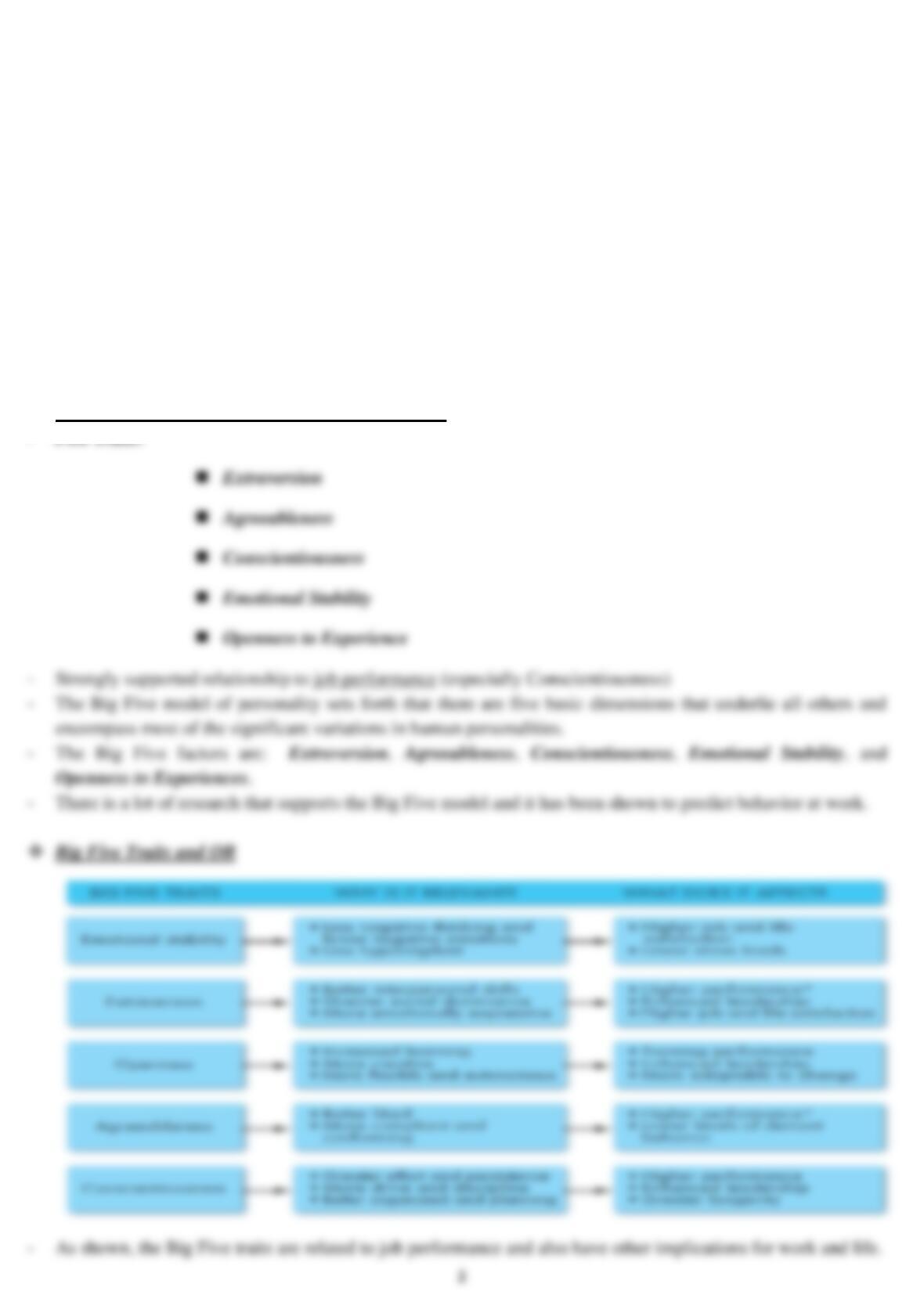
❖ Measuring Personality Traits: The Big-Five Mode