_______ 1. For a business, the advantage of offering credit to customers is that it:
A. increases the amount of sales.
B. increases cash flow from financing activities.
C. decreases cost of goods sold.
D. decreases the amount of inventory the company needs to carry.
_______ 2. The net realizable value of accounts receivable is calculated,
A. Accounts Receivable + Uncollectible Accounts Expense
B. Accounts Receivable + Notes Receivable
C. Accounts Receivable – Allowance for Doubtful Accounts
D. 365/Accounts Receivable
_______ 3. To estimate the amount of its uncollectible accounts receivable, a company might
A. consult industry publications.
B. look at its past history of uncollectible accounts.
C. take into account the current condition of the economy.
D. all of these.
_______ 4. Which of the following is not an advantage of accepting credit cards from retail customers?
A. The acceptance of credit cards tends to increase sales.
B. There are fees charged for the privilege of accepting credit cards.
C. The credit card company performs credit worthiness assessments.
D. The credit card company assumes the cost of slow collections and write-offs.
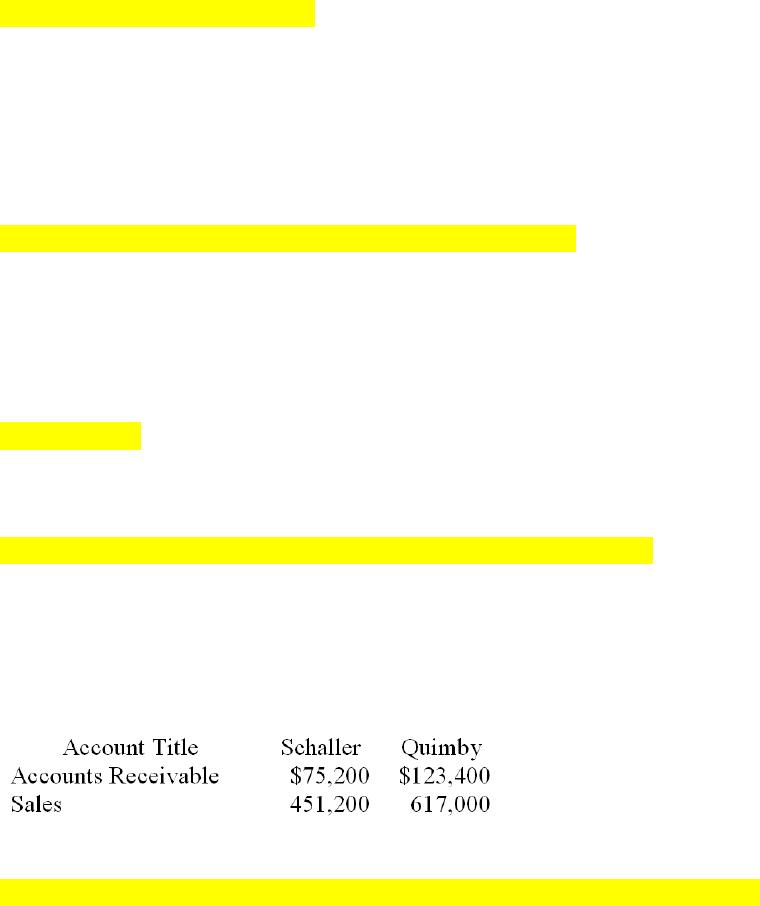
_______ 5. The accounting records of the Schaller Company and Quimby Company contained the following
account balances:
Select the true statement from the following options:
A. The accounts receivable for Schaller Company turned over 6 times per year.
B. The company with the higher turnover ratio will also have the longer average number of days to collect
accounts receivable.
C. Quimby Company is likely to incur lower costs from extending credit to customers than Schaller Company.
D. The average number of days to collect accounts receivable for Schaller is 73 days.

_______ 6. Which of the following businesses would most likely have the longest operating cycle?
A. A chain of pizza restaurants.
B. A national pharmacy chain.
C. A producer of wine.
D. A discount store.
_______ 7. The face value of Accounts Receivable less the balance in the Allowance for Doubtful Accounts is
equal to the net realizable value of the receivables.
True False
_______ 8. A company that uses the allowance write-off method of accounting for uncollectible accounts does
not prepare a year–end adjusting entry to estimate its uncollectibles.
True False
_______ 9. Which of the following would be classified as a long-term operational asset?
A. Accounts Receivable.
B. Prepaid Insurance.
C. Office Equipment.
D. Inventory.
_______ 10. Which of the following terms is used to identify the process of expense recognition for buildings
and equipment?
A. Amortization
B. Depletion
C. Depreciation