Fall 2019 – Copyright © Janet Huston, Ph.D., Texas Tech University
ACCT 2300 Chapter 4 – Page 1
Chapter 4 Notes
Internal Control and Cash
Learning Objectives:
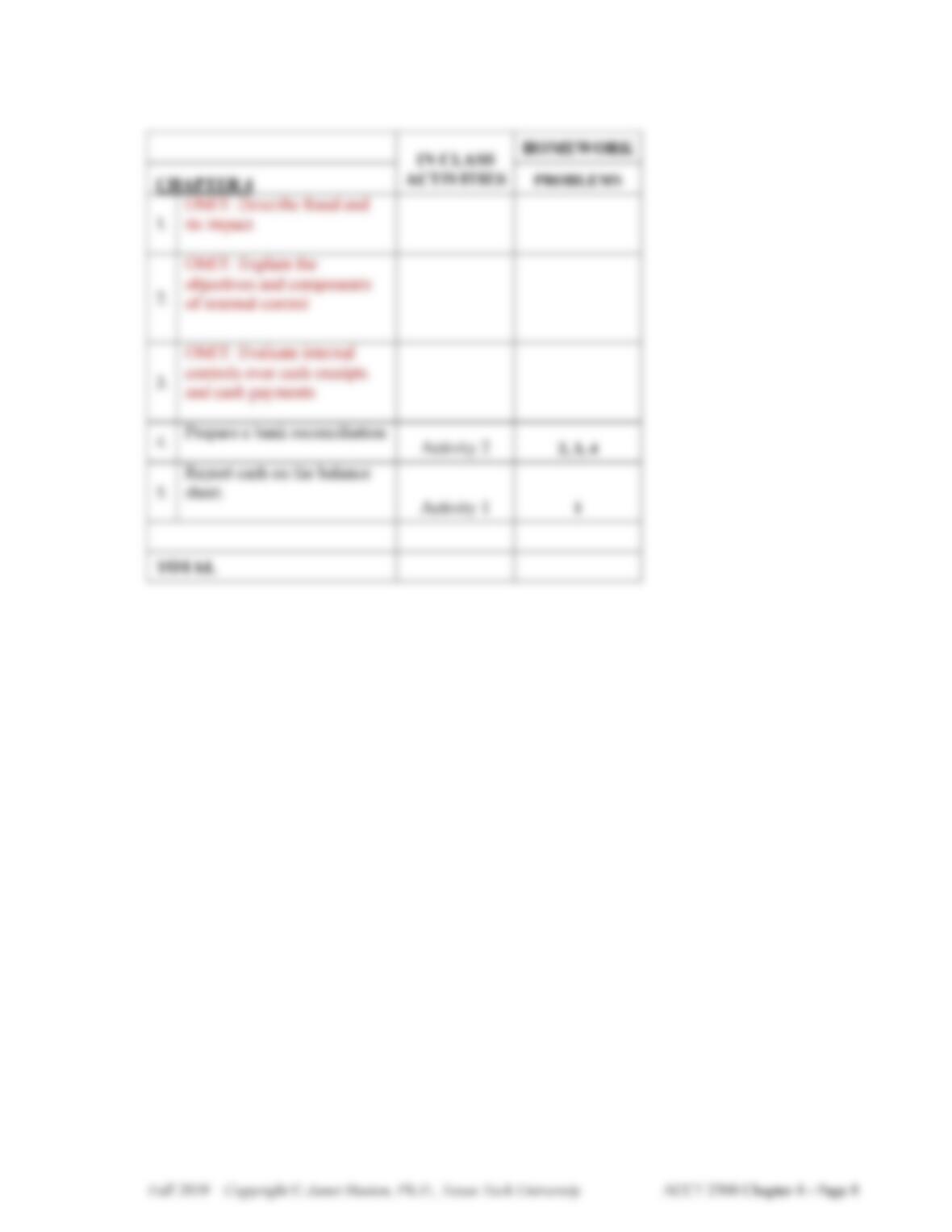
1. OMIT: Describe fraud and its impact
2. OMIT: Explain the objectives and components of internal control
3. OMIT: Evaluate internal controls over cash receipts and cash payments
4. Prepare a bank reconciliation
5. Report cash on the balance sheet.
Cash and Cash Equivalents
• Cash: amounts readily available to pay debts
o Cash on Hand: coin and currency on hand
Petty Cash Funds: money located in lock box in office manager’s
desk to pay for incidentals like postage stamps or office lunches.
All expenses should be evidenced by a receipt.
o Cash on Deposit: cash in banks in checking and savings accounts
o Undeposited checks: checks received from customers, cashier checks,
and certified checks that have not been deposited into the bank
• Cash Equivalents: Investments (maturity of 3 months or less at time of purchase)
that readily convertible to cash.
o Examples:
Time deposits: interest bearing accounts that can be withdrawn for
immediate use.
Commercial paper: investment in short term debt of other firms
High-grade U.S. or foreign government securities (Treasury bills)
Certificate of deposit (CD)
Money market funds
o Not Examples:
6 month bank CD is an investment
Postage stamps are office supplies
IOUs are receivables
• Presentation on Balance Sheet:
o Combines Cash and Cash Equivalents into a single total.
Activity #1
Objectives of Internal Control
1. Safeguard assets
2. Encourage employees to follow firm policies
3. Promote operational efficiency
4. Ensure accurate, reliable accounting records
5. Comply with legal requirements

Fall 2019 – Copyright © Janet Huston, Ph.D., Texas Tech University
ACCT 2300 Chapter 4 – Page 2
Cash Management
• Cash Management: a balance between having enough cash to pay creditors and
operate the business versus having too much idle cash on hand.
o Idle cash: uninvested cash of a company, considered a “nonearning” asset.
• Tools of Effective Cash Management:
o Cash Flow Statement
o Cash Budgets
o Use of Petty Cash Funds
o Bank Reconciliation (our focus in this chapter)
o Internal controls over cash receipts and cash disbursements
Internal Control of Cash Receipts
• Record when received
• Deposit receipts intact
• Separation of duties – Different employees for each of the
following: recording, custody & authorization
Internal Control of Cash Disbursements
• All major disbursements made by check
• Pay only small, misc. expenditures from Petty Cash
• Prepare Bank Reconciliation
What can happen without good Internal Controls for Cash?
• Embezzlement: theft or misappropriation of funds placed
in one’s trust or belonging to one’s employer.
http://www.nbc-2.com/story/12257706/woman-charged–in–elaborate–embezzlement–case
http://articles.orlandosentinel.com/2010-10-19/news/os-bookkeeper-defrauds–millions–
20101019_1_playoff-tickets–federal–prison-bookkeeper
http://www.foxnews.com/sports/2018/08/31/nba-team–executive-on–leave–amid-13-4m-
federal–embezzlement-probe-reports.html
http://www.chicagomag.com/Chicago–Magazine/December-2012/Rita-Crundwell-and–
the-Dixon–Embezzlement/index.php?cparticle=1&siarticle=0#artanc
Fall 2019 – Copyright © Janet Huston, Ph.D., Texas Tech University
ACCT 2300 Chapter 4 – Page 3
Bank Statement
• Bank Statement: a detailed list, provided by the bank, of all activity for a
particular bank account during the month.
• Bank Accounts help control cash by:
o Providing a safe place for cash
o Providing a detailed list of cash transactions that managers can compare to
the books (cash T-account) to correct books errors quickly.
• Includes:
o Beginning balance,
o Deposits,
o Check payments (“cleared” or “cancelled” checks)
o NSF checks (Not Sufficient Funds): customers’ checks that did not clear
the bank. Will reduce the firm’s cash account.
o Electronic fund transfers (EFT): bank receives or pays cash for firm.
o Service Charges: monthly activity fees, collection fees, new checks, rental
of lock box
o Interest Earned
o Customer Notes/Interested collect by the bank, on the firm’s behalf
o Credit Memos
o Debit Memos
o Ending balance (often a running balance for each day of the month)
Bank Reconciliation
• Bank Reconciliation: document that resolves any differences between (1)
ending balance on the bank statement and (2) ending balance in the T-account of
the firm’s Cash account.
• Helps control cash by:
o Ensuring the bank and book records of cash are correct
o Ensuring that the Firm accounts for all its cash transactions correctly.
o Establishing the balance of cash to report on the balance sheet.
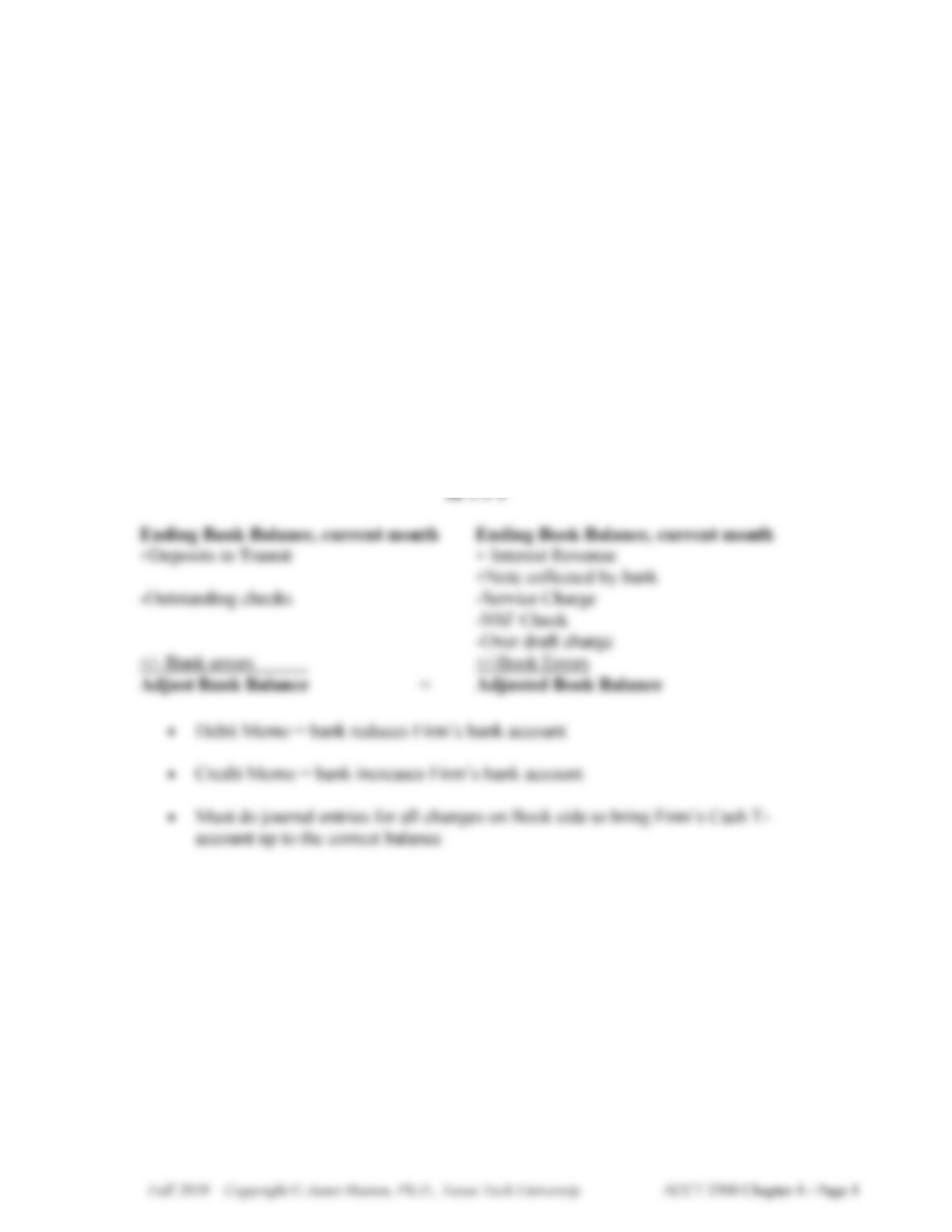
• 2 Sides of Bank Reconciliation:
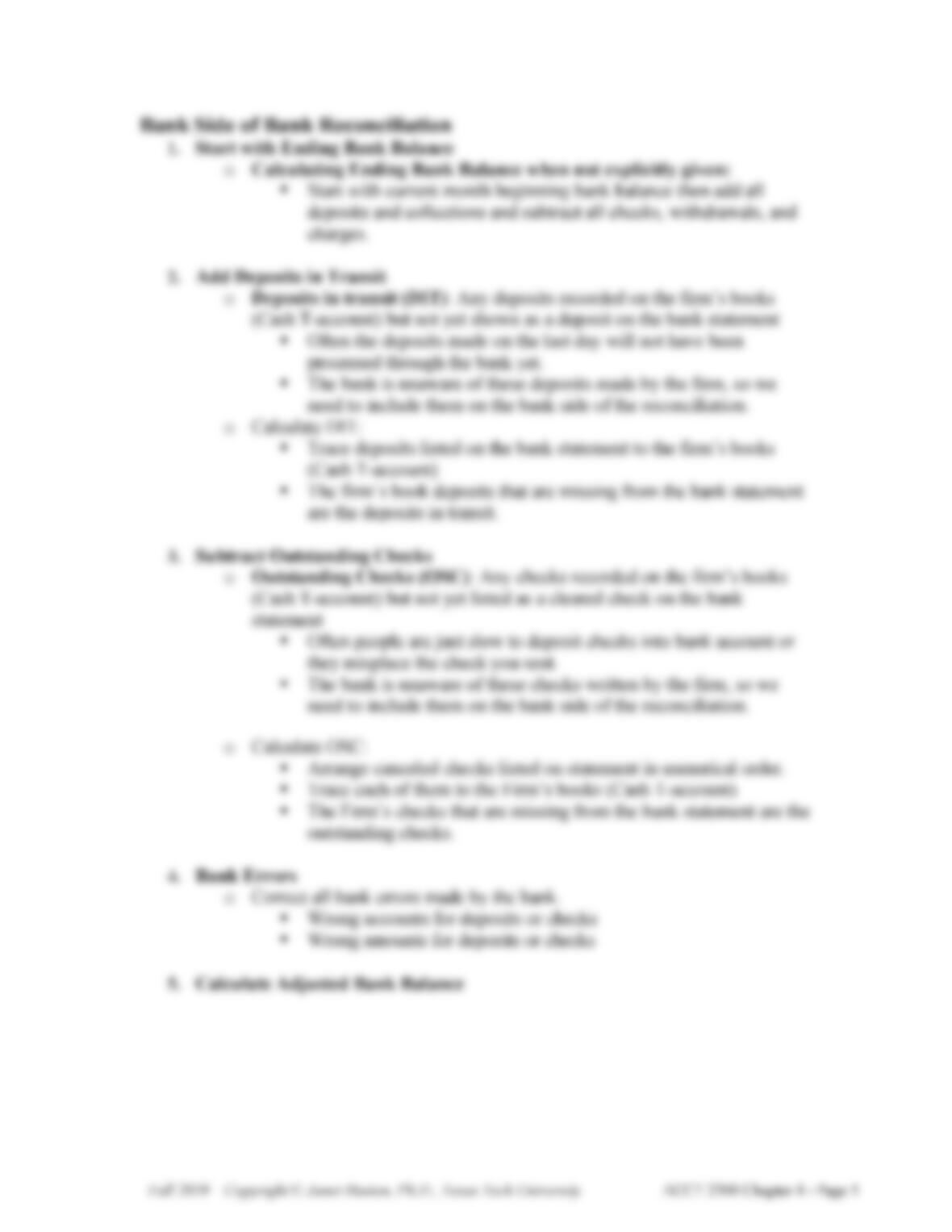
o Bank side
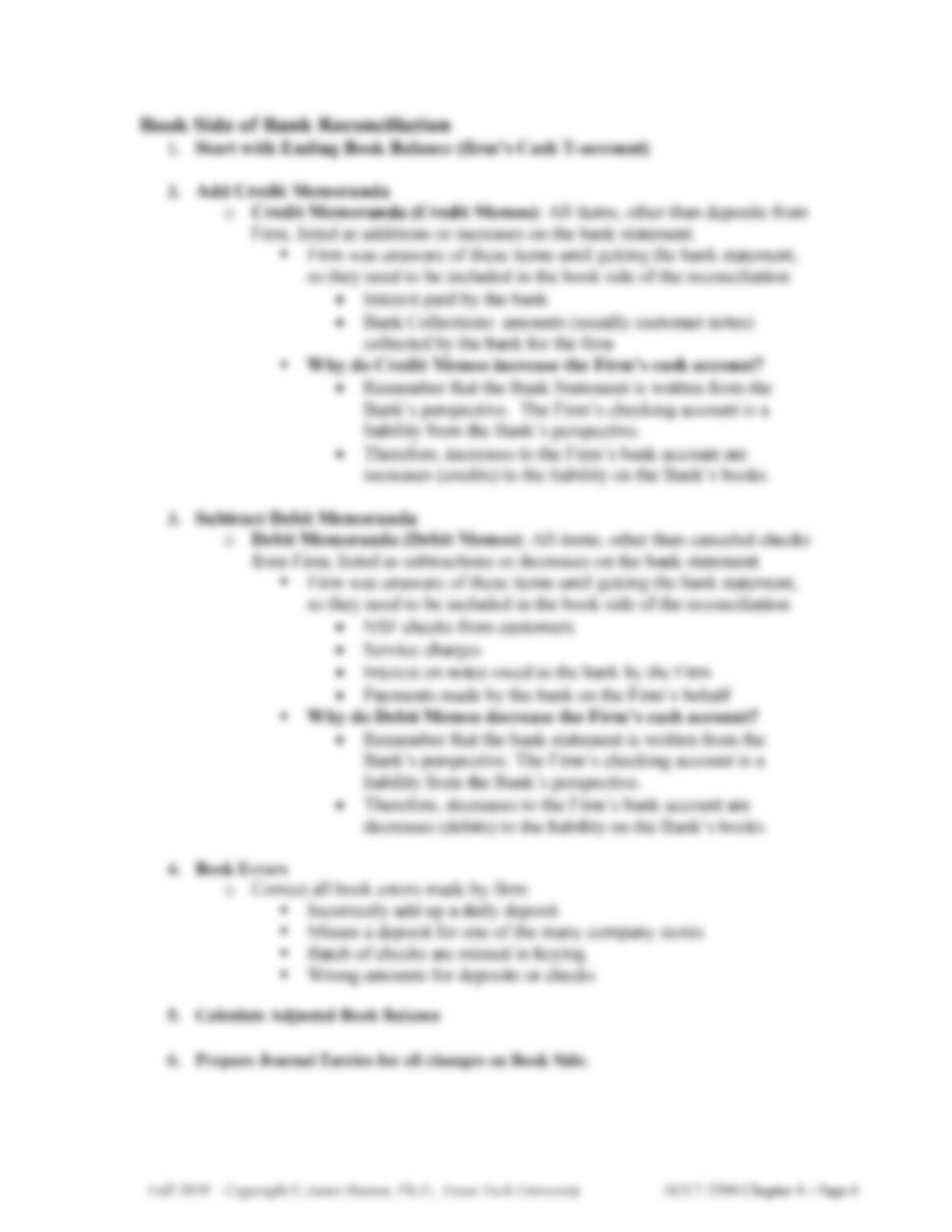
o Book side (Firm’s Cash T-account)
Raiderland Company
Bank Reconciliation
As of October 31, 20xx