Kimmel, Weygandt, Kieso, Trenholm, Irvine Financial Accounting, Sixth Canadian Edition
Solutions Manual 4-1 Chapter 4
Copyright © 2014 John Wiley & Sons Canada, Ltd. Unauthorized copying, distribution, or transmission of this page is strictly prohibited.
CHAPTER 4
Accrual Accounting Concepts
ASSIGNMENT CLASSIFICATION TABLE
Study Objectives
Questions
Brief
Exercises
Exercises
A
Problems
B
Problems
BYP
*1. Explain when
revenue and
expenses are
recognized and how
this forms the basis of
accrual accounting.
1, 2, 3, 4
1, 2
1, 2
1A, 6A
1B, 6B
5, 6
*2. Describe the types of
adjusting entries and
prepare adjusting
entries for
prepayments.
5, 6, 7, 8, 9,
10, 11, 12,
16
3, 4, 5
3, 4, 6, 7,
8
2A, 4A, 5A,
6A, 7A, 8A,
1
1A
2B, 4B, 5B,
6B, 7B
, 8B,
1
1B
1, 2,
3,
4,
5
, 7
*3. Prepare adjusting
entries for accruals.
10, 11, 12,
13, 14, 16
5, 6, 7, 8, 9
5, 6, 7, 8
3A, 4A, 5A,
6A, 7A, 8A,
11A
3B, 4B, 5B,
6B, 7B, 8B,
11B
1, 2,
3,
4,
5, 7
*4. Prepare an adjusted
trial balance.
15, 17, 18
10, 11
8, 9, 10
6A, 7A, 8A,
10A, 11A,
6B, 7B, 8B,
10B, 11B
3, 7
*5. Prepare closing
entries and a post–
closing trial balance.
16, 17, 18,
19, 20, 21,
22
12, 13, 14
11
9A, 10A,
1
2A
9B, 10B,
1
2B
1, 3

Kimmel, Weygandt, Kieso, Trenholm, Irvine Financial Accounting, Sixth Canadian Edition
Solutions Manual 4-2 Chapter 4
Copyright © 2014 John Wiley & Sons Canada, Ltd. Unauthorized copying, distribution, or transmission of this page is strictly prohibited.
ASSIGNMENT CHARACTERISTICS TABLE
Problem
Number
Description
Difficulty
Level
Time
Allotted (min.)
1A
Calculate profit on cash and accrual bases.
Moderate
25–35
2A
Prepare transaction and adjusting entries for
prepayments.
Simple
20–30
3A
Prepare adjusting and subsequent entries for
accruals.
Simple
20–30
4A
Prepare transaction and adjusting entries.
Simple
20–30
5A
Prepare adjusting entries.
Simple
20–30
6A
Convert cash to accrual basis; prepare financial
statements.
Complex
40–50
7A
Prepare and post adjusting entries; prepare adjusted
trial balance.
Moderate
30–40
8A
Complete accounting cycle through to preparation of
financial statements.
Moderate
70
9A
Prepare and post closing entries; prepare post–
closing trial balance.
Simple
25–35
10A
Prepare adjusted trial balance, closing entries and
post–closing trial balance.
Moderate
40–50
11A
Prepare and post adjusting entries; prepare adjusted
trial balance and financial statements; assess
financial performance.
Moderate
40–50
12A
Prepare and
post closing entries; prepare post–
closing trial balance.
Simple
25–35
1B
Calculate profit on cash and accrual bases.
Moderate
25–35
2B
Prepare transaction and adjusting entries for
prepayments.
Simple
20–30

Kimmel, Weygandt, Kieso, Trenholm, Irvine Financial Accounting, Sixth Canadian Edition
Solutions Manual 4-3 Chapter 4
Copyright © 2014 John Wiley & Sons Canada, Ltd. Unauthorized copying, distribution, or transmission of this page is strictly prohibited.
ASSIGNMENT CHARACTERISTICS TABLE (Continued)
Problem
Number
Description
Difficulty
Level
Time
Allotted (min.)
3B
Prepare adjusting and subsequent entries for
accruals.
Simple
20–30
4B
Prepare transaction and adjusting entries.
Simple
20–30
5B
Prepare adjusting entries.
Simple
20–30
6B
Convert cash to accrual basis; prepare financial
statements.
Complex
40–50
7B
Prepare and post adjusting entries; prepare adjusted
trial balance.
Moderate
30–40
8B
Complete accounting cycle through to preparation of
financial statements.
Moderate
70
9B
Prepare and post closing entries; prepare post–
closing trial balance.
Simple
25–35
10B
Prepare adjusted trial balance, closing entries and
post–closing trial balance.
Moderate
40–50
11B
Prepare and post adjusting entries; prepare adjusted
trial balance and financial statements; assess
financial performance.
Moderate
40–50
12B
Prepare and post closing
entries; prepare post–
closing trial balance.
Simple
25–35

Kimmel, Weygandt, Kieso, Trenholm, Irvine Financial Accounting, Sixth Canadian Edition
Solutions Manual 4-4 Chapter 4
Copyright © 2014 John Wiley & Sons Canada, Ltd. Unauthorized copying, distribution, or transmission of this page is strictly prohibited.
ANSWERS TO QUESTIONS
1. Adjusting entries are made to adjust the accounts at the end of the period to ensure
revenues and expenses are recorded when they are earned or incurred.
When revenues and expenses should be recognized in the accounting records is
dictated by recognition criteria. Revenue is recognized or recorded when, due to
ordinary activities, an increase in future economic benefits arising from an increase in
an asset or a decrease in a liability has occurred. In general, revenue recognition
occurs when the sales or performance effort is substantially complete, the amount is
determinable (measurable), and collection is reasonably assured. In a service
company, revenue is considered to be earned when the service is provided. In a
merchandising company, revenue is considered to be earned when the merchandise
is sold (normally at the point of sale).
Expenses are recognized in the income statement when, due to an ordinary activity,
there is a decrease in future economic benefits related to a decrease in an asset or an
increase in a liability and this change can be measured reliably.
2. The law firm should recognize the revenue in April because that is when it was earned;
the work was performed during that month.
3. Expenses of $4,500 should be deducted from the revenues in April because that is
when the expenses were incurred and the revenues earned.
4. Under the cash basis of accounting, events are only recognized in the period that cash
is paid or received. Under the accrual basis, revenue is recognized when the goods or
services are delivered or performed and expenses are recognized when incurred.
Information presented on an accrual basis is more useful because it records events
when they actually occurred and the timing of their recognition cannot be manipulated
by delaying or speeding up the time at which the related cash flow occurs. Because of
this, accrual basis information is better at predicting future performance.
5. (a) Prepaid expenses are assets because they have a future benefit since they were
paid for before they are used or consumed.
(b) As the benefit of the prepayment expires (often with the passage of time) the asset
must be reduced and an expense recognized. This requires an adjustment at the
end of each accounting period, to expense the portion of the prepaid that has
expired (been used up) during the period.

Kimmel, Weygandt, Kieso, Trenholm, Irvine Financial Accounting, Sixth Canadian Edition
Solutions Manual 4-5 Chapter 4
Copyright © 2014 John Wiley & Sons Canada, Ltd. Unauthorized copying, distribution, or transmission of this page is strictly prohibited.
Answers to Questions (Continued)
6. (a) Unearned revenue arises when cash is received for goods or services to be
provided in the future. It represents a liability because the cash has not yet been
earned—the company has a future obligation to provide the goods or services.
(b) Unearned revenues must be adjusted at the end of an accounting period to reflect
any revenues that have been earned.
7. No. Depreciation is the process of allocating the cost of a long–lived asset to expense
over its useful life. Depreciation results in the presentation of the carrying amount (cost
less accumulated depreciation) of the asset, not its fair value.
8. (a) Depreciation expense is an expense account with a normal debit balance and is
reported on the income statement as part of the operating expenses. This account
shows the portion of the cost of a long–lived asset that has expired during the
current accounting period.
Accumulated depreciation is a contra asset account with a normal credit balance
that is reported on the statement of financial position as a reduction of a
depreciable asset (such as building and equipment). The balance in the
accumulated depreciation account is the total depreciation that has been
recognized from the date of acquisition to the statement of financial position date.
(b) Cost is the original cost of the asset when purchased.
The carrying amount (also known as net book value) is the original cost of the
asset less its related accumulated depreciation, and represents the portion of the
asset that has not yet been depreciated.
9. A contra asset account is an account with a credit balance that is deducted from the
related asset account on the statement of financial position. Using a contra asset
account discloses both the original cost of the asset and the total estimated cost which
has expired or been used up to date. This information is useful to the financial
statement user.
10. Yes, I agree. A “simple” adjusting entry affects one statement of financial position
account and one income statement account. An adjusting entry reallocates amounts
between a statement of financial position account and an income statement account.
For example: to record the expiration of insurance the following entry would be
recorded; a debit to Insurance Expense (an income statement account) and a credit to
Prepaid Insurance (a statement of financial position account). Compound adjusting
journal entries are also possible which would affect more accounts, but at least one
statement of financial position account and one income statement account is always
affected whether a simple adjusting entry or a compound adjusting entry is made.

Kimmel, Weygandt, Kieso, Trenholm, Irvine Financial Accounting, Sixth Canadian Edition
Solutions Manual 4-6 Chapter 4
Copyright © 2014 John Wiley & Sons Canada, Ltd. Unauthorized copying, distribution, or transmission of this page is strictly prohibited.
Answers to Questions (Continued)
11. Disagree. Adjusting entries never involve the Cash account. In making adjusting
entries for prepayments, the cash has already been paid or received and recorded.
The adjusting journal entry is prepared to reflect the fact that a portion of the unearned
revenue or prepaid expense arising in the past when the cash flow occurred is now
earned or incurred, respectively. In making adjusting entries for accruals, we record
the fact that although the cash has not been paid or received, revenue has been
earned or an expense has been incurred. Again, there is no impact on the Cash
account because cash has not yet been received or paid.
12. To ensure that the adjusting entry is properly calculated and prepared, the preparer of
the adjusting entry must first properly understand the original cash payment
transaction that lead to the recording of the prepayment. On the other hand, in the
case of an accrual, there is no cash payment to look up in the accounts. Consequently
no original entry can be examined in the process of preparing an adjusting entry
related to an accrual.
13. Before the recording of adjusting entries to accrued revenues in the amount of $780
and accrued expenses in the amount of $510, the profit would be understated by the
net of the amount of unrecorded revenue of $780, less unrecorded expense of $510 or
$270.
14. Reactor should recognize the expense in the period that it was incurred—December—
and set up the corresponding liability to the utility company. On December 31, Utility
Expense should be debited and an accrued liability account such as Accounts Payable
should be credited.
15. Financial statements are prepared from an adjusted trial balance because the
balances of all accounts have been adjusted to show the effects of all financial events
that have occurred during the accounting period. An unadjusted trial balance is not up
to date for prepayments and accruals.

Kimmel, Weygandt, Kieso, Trenholm, Irvine Financial Accounting, Sixth Canadian Edition
Solutions Manual 4-7 Chapter 4
Copyright © 2014 John Wiley & Sons Canada, Ltd. Unauthorized copying, distribution, or transmission of this page is strictly prohibited.
Answers to Questions (Continued)
16. Adjusting entries are only recorded at the end of the accounting period, prior to the
preparation of the financial statements. Transaction entries are made throughout the
accounting period when transactions arise. As well, adjusting entries never affect the
Cash account and always result in an adjustment to a statement of financial position
account and an income statement account. Transaction entries often result in a debit
or credit to Cash and can affect any account on the statement of financial position or
the income statement (or both).
Closing entries are required to reset the revenue and expense (income statement) and
dividend accounts to zero and to update the balance in Retained Earnings to the
closing balance per the statement of changes in equity. Unlike adjusting entries, which
are prepared before the financial statements and could be prepared more than once
per year, closing entries are only prepared and posted after the year–end financial
statements have been completed.
17. The unadjusted, adjusted, and post–closing trial balances are similar in that they prove
the equality of the total debit and total credit balances. Another similarity between the
unadjusted and adjusted trial balances is that they are prepared at the end of an
accounting period. Where trial balances differ is that the unadjusted trial balance is
prepared before any adjusting entries have been recorded or posted. An adjusted trial
balance is prepared after the adjusting entries have been posted to the accounts. The
financial statements are prepared from the adjusted trial balance. After the financial
statements have been prepared, closing entries are prepared and posted. The post–
closing trial balance is then prepared and used to form the basis of the opening
balances for the next accounting period. Unlike the adjusted trial balance which will list
temporary (revenue, expense, dividend) account balances prior to recording the
closing entries, a post–closing trial balance will not list temporary account balances as
these have now been closed out to the Retained Earnings account. Unadjusted and
adjusted trial balances are prepared whenever financial statements are prepared but a
post–closing trial balance is prepared only at the end of the year.
18. The retained earnings balance on the unadjusted and adjusted trial balances are often
the same since the account does not yet reflect the changes that arise from the
recording of closing entries. After the adjusted trial balance and financial statements
are prepared, closing entries are recorded. These will change the retained earnings
balance by updating it for the effect of any profit or loss and dividends. Consequently,
the retained earnings balance on the post–closing trial balance will be different from
the balance shown on the adjusted trial balance.
19. Closing entries are prepared to transfer temporary account balances to retained
earnings, a permanent account, so retained earnings will show an up–to–date amount.
Secondly, closing entries produce a zero balance in each temporary account so that
the temporary accounts are ready for the next accounting period, where only
transactions relating to that period are recorded in them.

Kimmel, Weygandt, Kieso, Trenholm, Irvine Financial Accounting, Sixth Canadian Edition
Solutions Manual 4-8 Chapter 4
Copyright © 2014 John Wiley & Sons Canada, Ltd. Unauthorized copying, distribution, or transmission of this page is strictly prohibited.
Answers to Questions (Continued)
20. The Dividends account is not closed with the expense accounts because it is not an
expense; it was not incurred for the purpose of generating revenue and does not
appear on the income statement. Dividends represent a distribution of retained
earnings and are reported on the statement of changes in equity. The Dividends
account is also a temporary account and therefore requires a closing entry.
21. (a) Profit:
(1) (Dr) Individual revenue accounts and (Cr) Income Summary
(2) (Dr) Income Summary and (Cr) Individual expense accounts
(3) (Dr) Income Summary and (Cr) Retained Earnings
(4) (Dr) Retained Earnings and (Cr) Dividends
(b) Loss:
(1) (Dr) Individual revenue accounts and (Cr) Income Summary
(2) (Dr) Income Summary and (Cr) Individual expense accounts
(3) (Dr) Retained Earnings and (Cr) Income Summary
(4) (Dr) Retained Earnings and (Cr) Dividends
Note that it is only step 3 that differs between the two situations.
22. Steps in the accounting cycle that may be done on a daily basis include:
1) Analyzing business transactions
2) Journalizing the transactions
Steps in the accounting cycle that are done on a periodic basis include:
3) Posting to the general ledger accounts
4) Preparing a trial balance
5) Journalizing and posting adjusting entries (prepayments and accruals)
6) Preparing an adjusted trial balance
7) Preparing the financial statements – income statement, statement of changes in
equity, statement of financial position, and statement of cash flows
Steps in the accounting cycle that are usually only done at the company’s year–end
include:
8) Journalizing and posting closing entries
9) Preparing a post–closing trial balance

Kimmel, Weygandt, Kieso, Trenholm, Irvine Financial Accounting, Sixth Canadian Edition
Solutions Manual 4-9 Chapter 4
Copyright © 2014 John Wiley & Sons Canada, Ltd. Unauthorized copying, distribution, or transmission of this page is strictly prohibited.
SOLUTIONS TO BRIEF EXERCISES
BRIEF EXERCISE 4-1
Cash
Profit
(a)
(b)
(c)
(d)
(e)
(f)
(g)
(h)
(i)
(j)
(k)
–$ 100
0
0
+800
–5,000
0
+1,000
0
+500
0
0
$ 0
–75
+1,000
0
0
–1,000
0
–50
0
+200
–250
BRIEF EXERCISE 4-2
(a) (b)
Accrual Cash
Basis Basis
1. Collected $200 cash from customers for
services provided in August. $ 0 $200
2. Collected $500 cash from customers
for services provided in September. 500 500
3. Billed customers $600 for services
provided in September. 600 0
4. Provided $100 services to customers
who paid in advance in August. 100 0
5. Received $100 from customers in advance
for services to be provided in October. 0 100
Total revenue $1,200 $800

Kimmel, Weygandt, Kieso, Trenholm, Irvine Financial Accounting, Sixth Canadian Edition
Solutions Manual 4-10 Chapter 4
Copyright © 2014 John Wiley & Sons Canada, Ltd. Unauthorized copying, distribution, or transmission of this page is strictly prohibited.
BRIEF EXERCISE 4-3
(a)
May 1 Supplies ………………………………………………………………. 4,800
Accounts Payable ………………………………………….. 4,800
(b)
Supplies Used = $1,500 + $4,800 – $2,300 = $4,000
(c)
Dec. 31 Supplies Expense ………………………………………………….. 4,000
Supplies ……………………………………………………….. 4,000
(d)
Supplies
Supplies Expense
Open. bal 1,500
May 1 4,800
Dec. 31 Adj. 4,000
Dec. 31 Adj. 4,000
Dec. 31 Bal. 2,300

Kimmel, Weygandt, Kieso, Trenholm, Irvine Financial Accounting, Sixth Canadian Edition
Solutions Manual 4-11 Chapter 4
Copyright © 2014 John Wiley & Sons Canada, Ltd. Unauthorized copying, distribution, or transmission of this page is strictly prohibited.
BRIEF EXERCISE 4-4
(a) Jan. 2 Vehicles …………………………………………………………….. 50,000
Cash …………………………………………………………….. 50,000
(b) The journal entry for the years 2015 and 2016 will be the same:
Dec. 31 Depreciation Expense …………………………………………. 10,000
Accumulated Depreciation—Vehicles ……………….. 10,000
($50,000 ÷ 5 = $10,000 per year)
(c)
CLAYMORE CORPORATION
Statement of Financial Position (partial)
December 31
2016
2015
Property, plant, and equipment
Vehicles
$50,000
$50,000
Less: Accumulated depreciation
20,000
10,000
Carrying amount
$30,000
$40,000
Kimmel, Weygandt, Kieso, Trenholm, Irvine Financial Accounting, Sixth Canadian Edition
BRIEF EXERCISE 4-5
(a)
(1) Bere Ltd.
June 1 Prepaid Insurance ………………………………………………….. 6,000
Cash ……………………………………………………………. 6,000
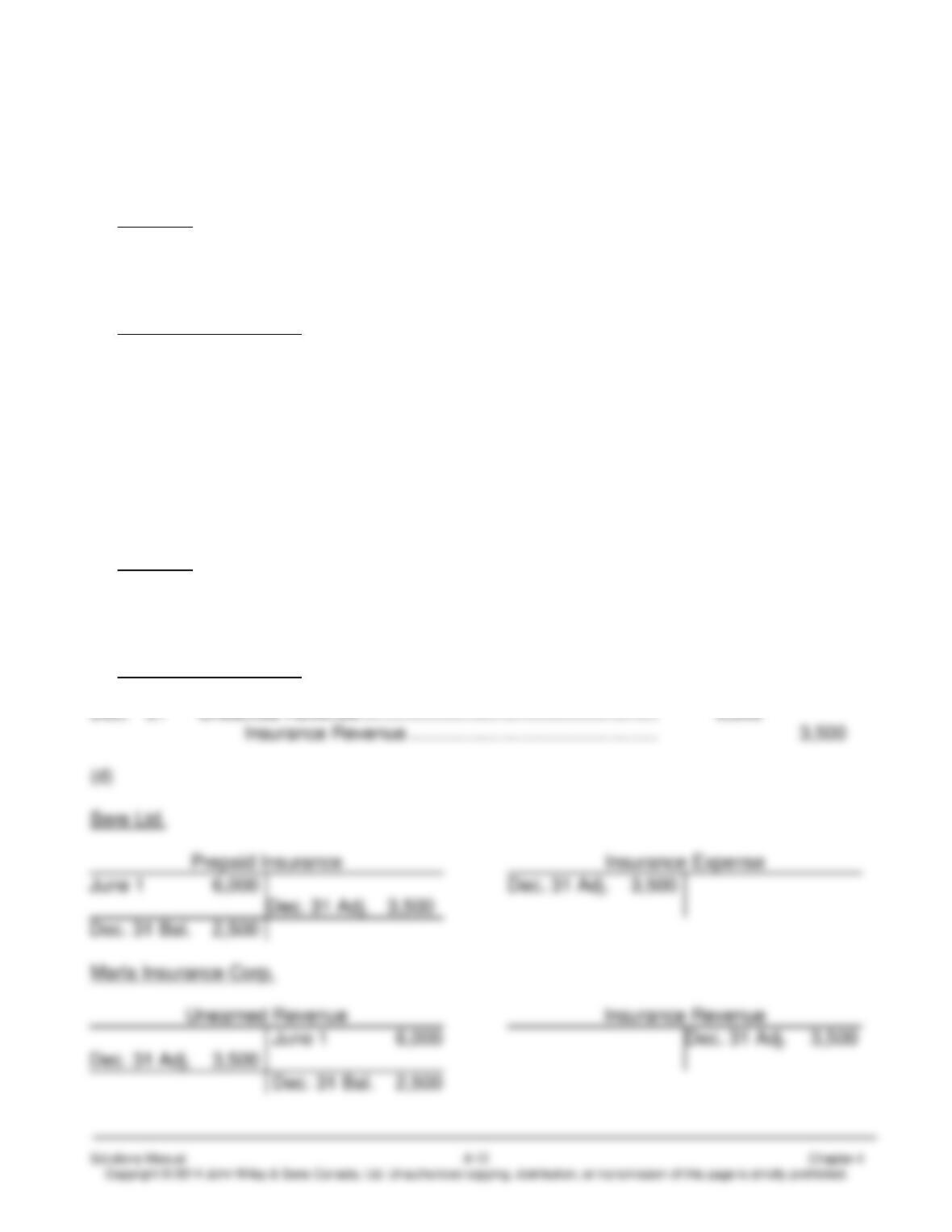
(2) Marla Insurance Corp.
June 1 Cash ……………………………………………………………………. 6,000
Unearned Revenue ………………………………………… 6,000
(b) Expired in 2015 = $6,000 × 7/12 = $3,500
Unexpired at December 31, 2015 = $6,000 × 5/12 = $2,500
(c)
(1) Bere Ltd.
Dec. 31 Insurance Expense ………………………………………………… 3,500
Prepaid Insurance ………………………………………….. 3,500
(2) Marla Insurance Corp.