MCBC 3724: CHAPTER 4
REVIEW & APPLICATION QUESTIONS: BROCK
1. With reference to DNA, what is meant be complementary, semi-conservative, and
anti-parallel?
→ Complementary: Double stranded DNA synthesized from a single strand of
RNA.
→ Semiconservative: the two strands from the parental DNA separate and serve
as template strands for the synthesis of new, complementary strands
→ Antiparallal: In the DNA double helix, strands run in opposite directions of one
another (5′ —> 3′, 3′ <— 5′)
2. Describe the central dogma of molecular biology.
→ The central dogma holds that genetic information is contained in DNA. The
flow of information is from DNA → RNA → protein.
3. Genes were discovered before their chemical nature was known. Define a gene
without mentioning its chemical nature. Then name the chemicals that compose a
gene.
→ Before our chemical understanding of a gene, a gene was defined by its ability
to breed a phenotypic trait and sometimes to mutate randomly.
→ Only about 0.5% of the chromosome consists of noncoding, repetitive
sequences.
7. What are R plasmids and why are they of medical concern?
→ R plasmids are genetic elements in microorganisms that confer resistance to
antibiotics and other growth inhibitors.
→ The ability of these large plasmids to carry multiple antibiotic resistance genes
and to spread rapidly by cell-to-cell contact makes them a serious medical
problem.
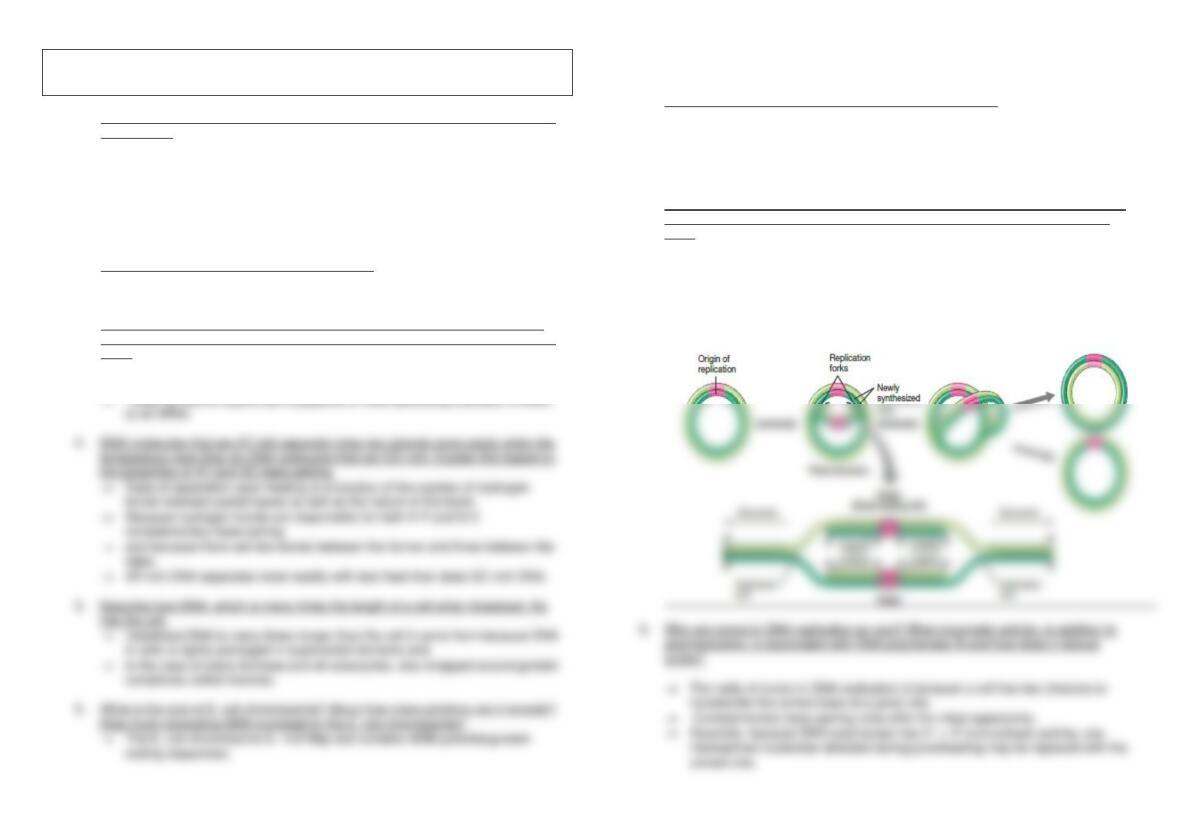
8. A structure commonly seen in circular DNA during replication is the theta structure.
Draw a diagram of the replication process and show how a theta structure could
arise.
→ Replication of circular bacterial chromosomes is bidirectional at the origin.
→ When replication is underway, newly formed DNA forces adjacent strands
apart, leading to a structure resembling the Greek letter theta.
→ Eventually, as the round of replication is completed, two newly synthesized,
semiconservative, circular chromosomes are produced.