Chapter 3 Pressure and Fluid Statics
Chapter 3
PRESSURE AND FLUID STATICS
Pressure, Manometer, and Barometer
3-1C The pressure relative to the atmospheric pressure is called the gage pressure, and the pressure
relative to an absolute vacuum is called absolute pressure.
3-2C The atmospheric air pressure which is the external pressure exerted on the skin decreases with
increasing elevation. Therefore, the pressure is lower at higher elevations. As a result, the difference
between the blood pressure in the veins and the air pressure outside increases. This pressure imbalance
may cause some thin-walled veins such as the ones in the nose to burst, causing bleeding. The shortness of
breath is caused by the lower air density at higher elevations, and thus lower amount of oxygen per unit
volume.
3-3C No, the absolute pressure in a liquid of constant density does not double when the depth is doubled. It
is the gage pressure that doubles when the depth is doubled.
3-4C If the lengths of the sides of the tiny cube suspended in water by a string are very small, the
magnitudes of the pressures on all sides of the cube will be the same.
3-5C Pascal’s principle states that the pressure applied to a confined fluid increases the pressure
throughout by the same amount. This is a consequence of the pressure in a fluid remaining constant in the
horizontal direction. An example of Pascal’s principle is the operation of the hydraulic car jack.
3-6C The density of air at sea level is higher than the density of air on top of a high mountain. Therefore,
the volume flow rates of the two fans running at identical speeds will be the same, but the mass flow rate of
the fan at sea level will be higher.
3-7 The pressure in a vacuum chamber is measured by a vacuum gage. The absolute pressure in the
chamber is to be determined.
Analysis The absolute pressure in the chamber is determined from
24 kPa
Pabs
kPa 68=−=−= 2492
vacatmabs PPP
Patm = 92 kPa
Chapter 3 Pressure and Fluid Statics
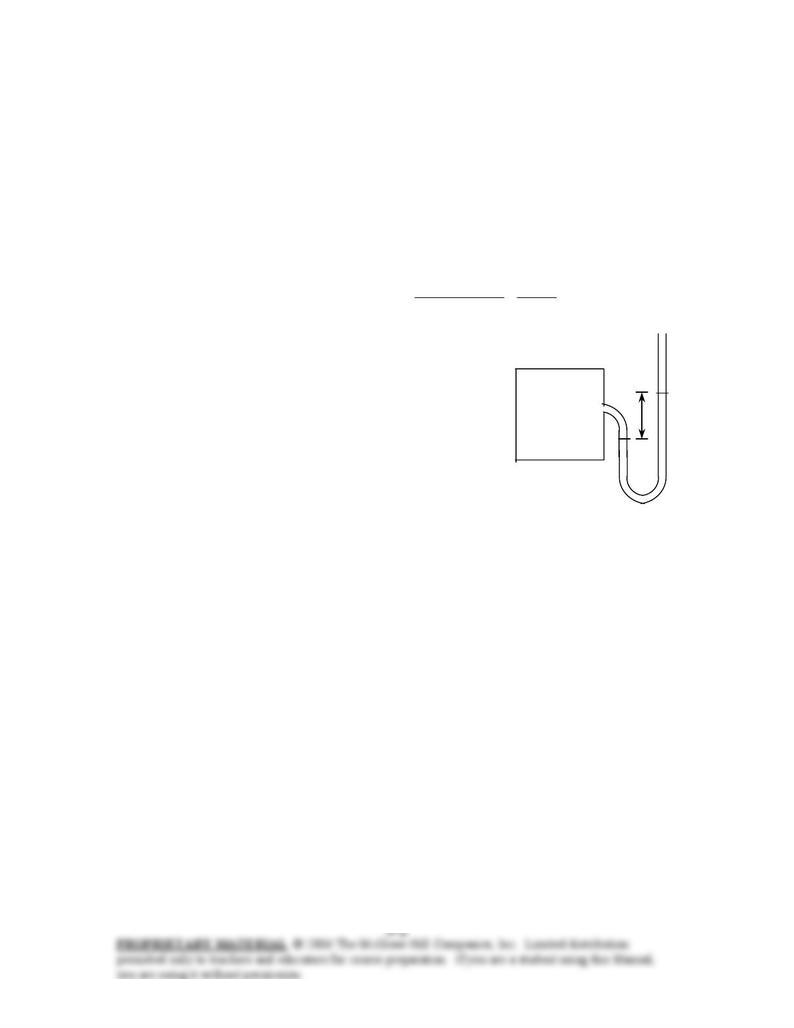
3-8E The pressure in a tank is measured with a manometer by measuring the differential height of the
manometer fluid. The absolute pressure in the tank is to be determined for the cases of the manometer arm
with the higher and lower fluid level being attached to the tank .
Assumptions The fluid in the manometer is incompressible.
Properties The specific gravity of the fluid is given to be SG = 1.25. The density of water at 32°F is 62.4
lbm/ft3.
Analysis The density of the fluid is obtained by multiplying its specific gravity by the density of water,
33 lbm/ft0.78)lbm/ft4(1.25)(62.SG 2==×= OH
ρρ
The pressure difference corresponding to a differential height of 28 in between the two arms of the
manometer is
psia26.1
in144
ft1
ft/slbm32.174
lbf1
ft))(28/12ft/s)(32.174lbm/ft(78 2
2
2
23 =
⋅
==∆ ghP
ρ
Then the absolute pressures in the tank for the two cases become:
28 in
Patm = 1.26 psia
SG= 1.25
Air
(a) The fluid level in the arm attached to the tank is higher (vacuum):
psia 11.44
=
−=−= 26.17.12
vacatmabs PPP
(b) The fluid level in the arm attached to the tank is lower:
psia 13.96=+=+= 26.17.12
atmgageabs PPP
Discussion Note that we can determine whether the pressure in
a tank is above or below atmospheric pressure by simply
observing the side of the manometer arm with the higher fluid
level.
Chapter 3 Pressure and Fluid Statics
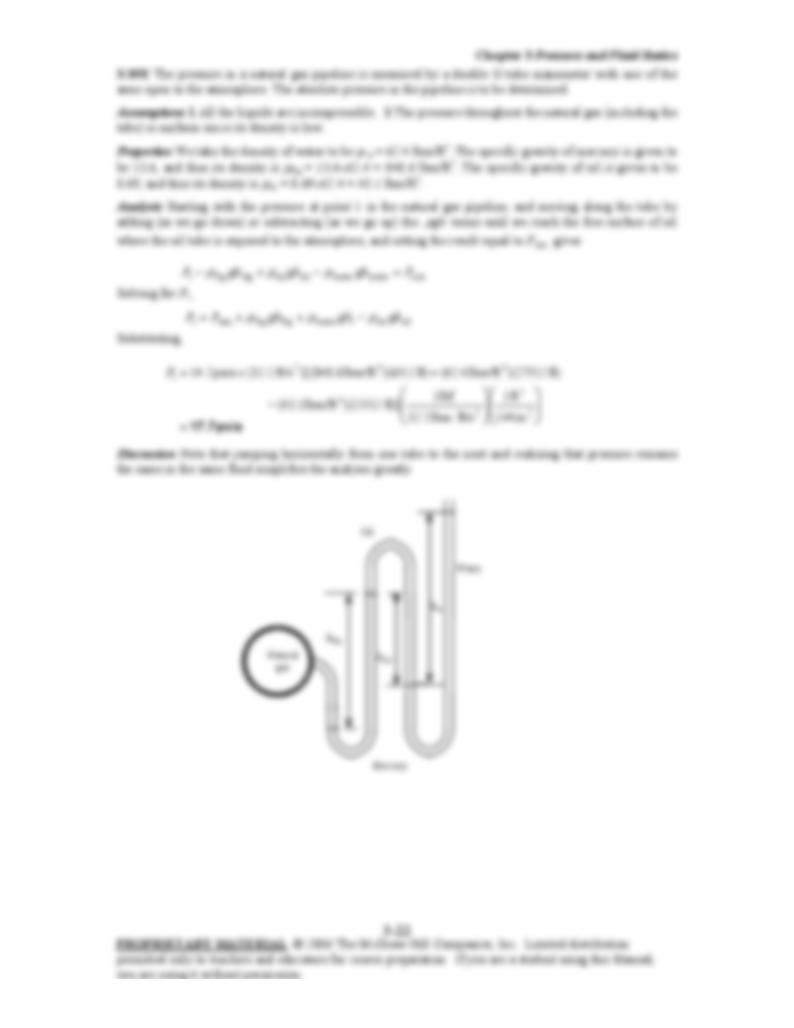
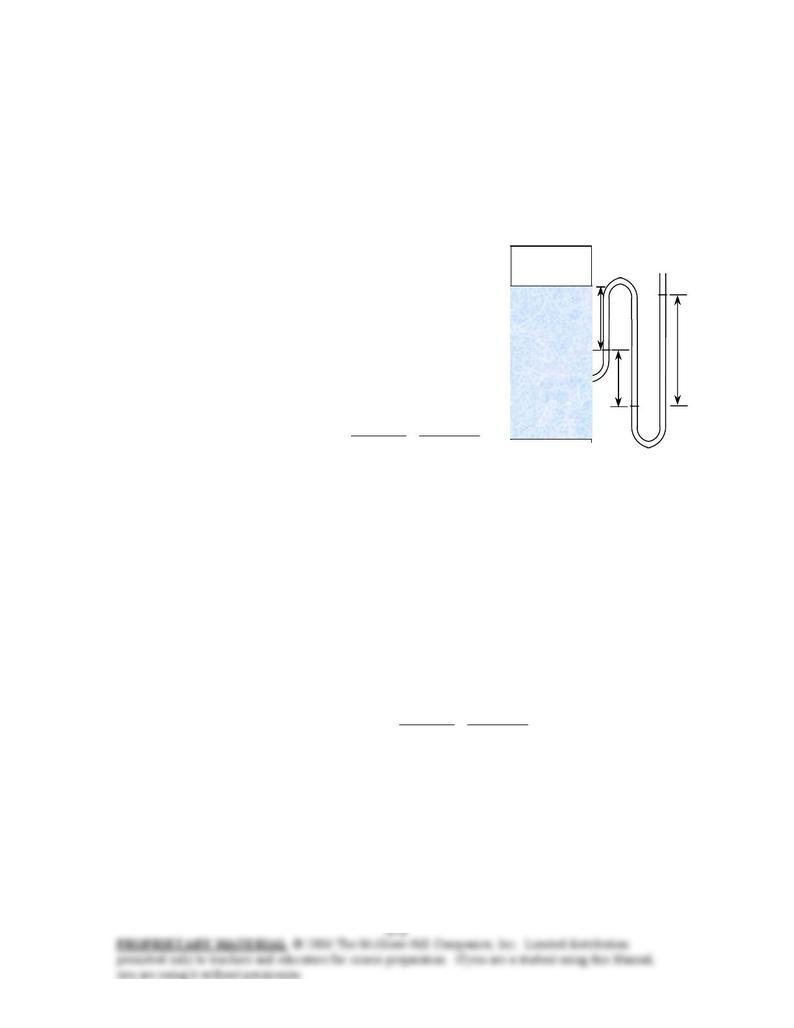
3-9 The pressure in a pressurized water tank is measured by a multi-fluid manometer. The gage pressure of
air in the tank is to be determined.
Assumptions The air pressure in the tank is uniform (i.e., its variation with elevation is negligible due to its
low density), and thus we can determine the pressure at the air-water interface.
Properties The densities of mercury, water, and oil are given to be 13,600, 1000, and 850 kg/m3,
respectively.
Analysis Starting with the pressure at point 1 at the air-water interface, and moving along the tube by
adding (as we go down) or subtracting (as we go up) the gh
ρ
terms until we reach point 2, and setting the
result equal to Patm since the tube is open to the atmosphere gives
atm
PghghghP =−++ 3mercury2oil1water1
ρρρ
Solving for P1,
3mercury2oil1wateratm1 ghghghPP
ρρρ
+−−=
or,
h2
h3
Air
1
h1
Water
)( 2oil1water3mercuryatm1 hhhgPP
ρρρ
−−=−
Noting that P1,gage = P1 – Patm and substituting,
kPa 56.9=
⋅
−=
22
3
332
,1
N/m 1000
kPa 1
m/skg 1
N 1
m)] 3.0)(kg/m (850–
m) 2.0)(kg/m (1000m) 46.0)(kg/m )[(13,600m/s (9.81
gage
P
Discussion Note that jumping horizontally from one tube to the next and realizing that pressure remains
the same in the same fluid simplifies the analysis greatly.
3-10 The barometric reading at a location is given in height of mercury column. The atmospheric pressure
is to be determined.
Properties The density of mercury is given to be 13,600 kg/m3.
Analysis The atmospheric pressure is determined directly from
kPa 100.1=
⋅
=
=
22
23
N/m 1000
kPa 1
m/skg 1
N 1
m) 750.0)(m/s 81.9)(kg/m (13,600
ghPatm
ρ
Chapter 3 Pressure and Fluid Statics
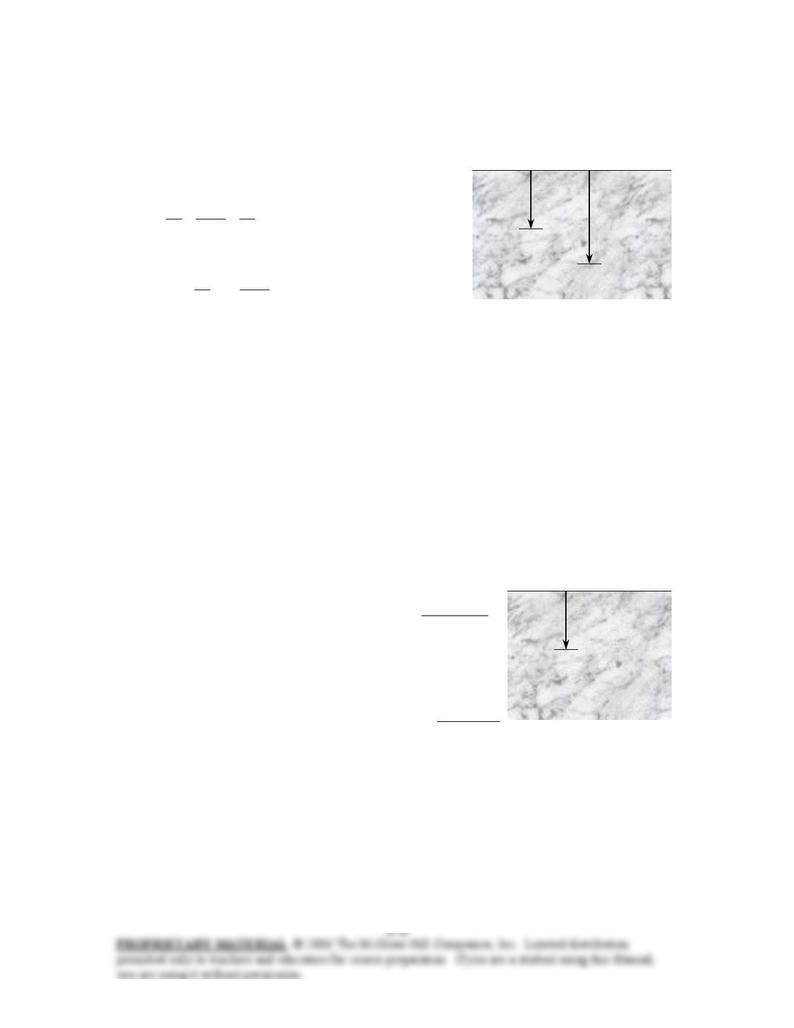
3-11 The gage pressure in a liquid at a certain depth is given. The gage pressure in the same liquid at a
different depth is to be determined.
Assumptions The variation of the density of the liquid with depth is negligible.
Analysis The gage pressure at two different depths of a liquid can be expressed as
11 ghP
ρ
= and 22 ghP
ρ
=
h2
2
h1
1
Taking their ratio,
1
2
1
2
1
2
h
h
gh
gh
P
P==
ρ
ρ
Solving for P2 and substituting gives
kPa 112=== kPa) 28(
m 3
m 12
1
1
2
2P
h
h
P
Discussion Note that the gage pressure in a given fluid is proportional to depth.
3-12 The absolute pressure in water at a specified depth is given. The local atmospheric pressure and the
absolute pressure at the same depth in a different liquid are to be determined.
Assumptions The liquid and water are incompressible.
Properties The specific gravity of the fluid is given to be SG = 0.85. We take the density of water to be
1000 kg/m3. Then density of the liquid is obtained by multiplying its specific gravity by the density of
water,
33 kg/m850)kg/m 0(0.85)(100SG 2==×= OH
ρρ
Analysis (a) Knowing the absolute pressure, the atmospheric pressure can be determined from
kPa 96.0=
−=
−=
2
23
N/m 1000
kPa 1
m) )(5m/s )(9.81kg/m (1000kPa) (145
ghPPatm
ρ
(b) The absolute pressure at a depth of 5 m in the other liquid is
kPa 137.7=
+=
+=
2
23
N/m1000
kPa1
m) )(5m/s )(9.81kg/m (850kPa) (96.0
ghPP atm
ρ
P
atm
h
P
Discussion Note that at a given depth, the pressure in the lighter fluid is lower, as expected.
Chapter 3 Pressure and Fluid Statics
3-13E It is to be shown that 1 kgf/cm2 = 14.223 psi .
Analysis Noting that 1 kgf = 9.80665 N, 1 N = 0.22481 lbf, and 1 in = 2.54 cm, we have
lbf 20463.2
N 1
lbf 0.22481
) N 9.80665( N 9.80665 kgf 1 =
==
and
psi 14.223==
== 2
2
222 lbf/in 223.14
in 1
cm 2.54
)lbf/cm 20463.2( lbf/cm 20463.2kgf/cm 1
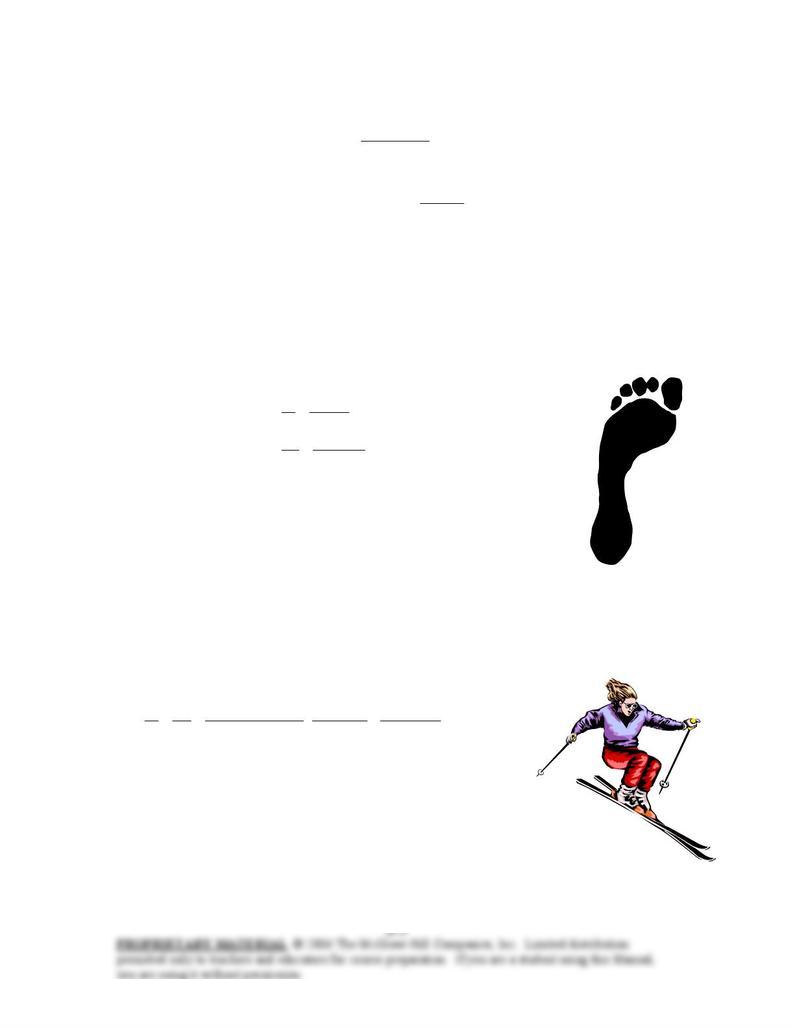
3-14E The weight and the foot imprint area of a person are given. The pressures this man exerts on the
ground when he stands on one and on both feet are to be determined.
Assumptions The weight of the person is distributed uniformly on foot imprint area.
Analysis The weight of the man is given to be 200 lbf. Noting that pressure is force per unit area, the
pressure this man exerts on the ground is
(a) On one foot: psi 5.56==== lbf/in 56.5
in 36
lbf 200 2
2
A
W
P
(a) On both feet: psi 2.78==
×
== lbf/in 78.2
in 362
lbf 200
2
2
2
A
W
P
Discussion Note that the pressure exerted on the ground (and on the feet) is reduced by
half when the person stands on both feet.
3-15 The mass of a woman is given. The minimum imprint area per shoe needed to enable her to walk on
the snow without sinking is to be determined.
Assumptions 1 The weight of the person is distributed uniformly on the imprint area of the shoes. 2 One
foot carries the entire weight of a person during walking, and the shoe is sized for walking conditions
(rather than standing). 3 The weight of the shoes is negligible.
Analysis The mass of the woman is given to be 70 kg. For a pressure of 0.5 kPa on the snow, the imprint
area of one shoe must be
2
m 1.37=
⋅
=== 22
2
N/m 1000
kPa 1
m/skg 1
N 1
kPa 0.5
)m/s kg)(9.81 (70
P
mg
P
W
A
Discussion This is a very large area for a shoe, and such shoes would be
impractical to use. Therefore, some sinking of the snow should be allowed to
have shoes of reasonable size.