Chapter 3 Pressure and Fluid Statics
Fluid Statics: Hydrostatic Forces on Plane and Curved Surfaces
3-53C The resultant hydrostatic force acting on a submerged surface is the resultant of the pressure forces
acting on the surface. The point of application of this resultant force is called the center of pressure.
3-54C Yes, because the magnitude of the resultant force acting on a plane surface of a completely
submerged body in a homogeneous fluid is equal to the product of the pressure PC at the centroid of the
surface and the area A of the surface. The pressure at the centroid of the surface is CC ghPP
ρ
+= 0 where
is the vertical distance of the centroid from the free surface of the liquid.
C
h
3-55C There will be no change on the hydrostatic force acting on the top surface of this submerged
horizontal flat plate as a result of this rotation since the magnitude of the resultant force acting on a plane
surface of a completely submerged body in a homogeneous fluid is equal to the product of the pressure PC
at the centroid of the surface and the area A of the surface.
3-56C Dams are built much thicker at the bottom because the pressure force increases with depth, and the
bottom part of dams are subjected to largest forces.
3-57C The horizontal component of the hydrostatic force acting on a curved surface is equal (in both
magnitude and the line of action) to the hydrostatic force acting on the vertical projection of the curved
surface.
3-58C The vertical component of the hydrostatic force acting on a curved surface is equal to the hydrostatic
force acting on the horizontal projection of the curved surface, plus (minus, if acting in the opposite
direction) the weight of the fluid block.
3-59C The resultant hydrostatic force acting on a circular surface always passes through the center of the
circle since the pressure forces are normal to the surface, and all lines normal to the surface of a circle pass
through the center of the circle. Thus the pressure forces form a concurrent force system at the center,
which can be reduced to a single equivalent force at that point. If the magnitudes of the horizontal and
vertical components of the resultant hydrostatic force are known, the tangent of the angle the resultant
hydrostatic force makes with the horizontal is HV FF /tan
=
α
.
Chapter 3 Pressure and Fluid Statics
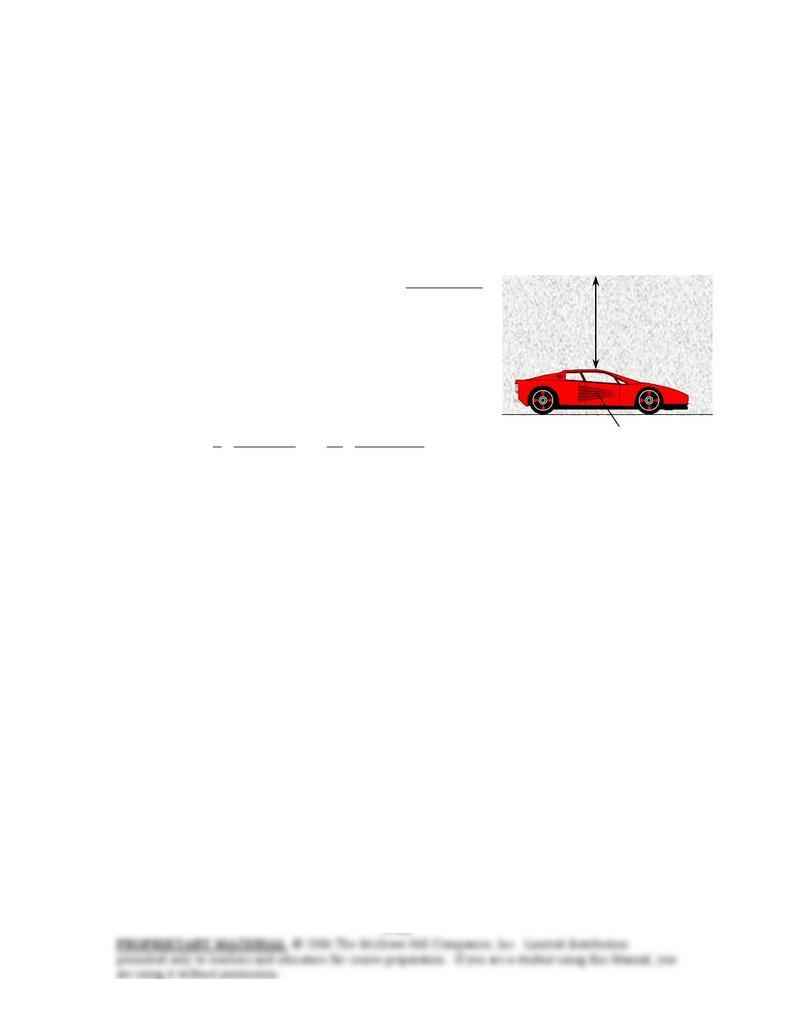
3-60 A car is submerged in water. The hydrostatic force on the door and its line of action are to be
determined for the cases of the car containing atmospheric air and the car is filled with water.
Assumptions 1 The bottom surface of the lake is horizontal. 2 The door can be approximated as a vertical
rectangular plate. 3 The pressure in the car remains at atmospheric value since there is no water leaking in,
and thus no compression of the air inside. Therefore, we can ignore the atmospheric pressure in
calculations since it acts on both sides of the door.
Properties We take the density of lake water to be 1000 kg/m3 throughout.
Analysis (a) When the car is well-sealed and thus the pressure inside the car is the atmospheric pressure,
the average pressure on the outer surface of the door is the pressure at the centroid (midpoint) of the
surface, and is determined to be
2
2
23
kN/m88.83
m/s kg1000
kN1
m) 2/1.18)(m/s 81.9)( kg/m1000(
)2/(
=
⋅
+=
+=== bsgghPP CCave
ρ
ρ
Door
,
1.1 m
×
0.9
m
s
= 8
m
Then the resultant hydrostatic force on the door becomes
kN 83.0 =×== m) 1.1m 9.0)(kN/m 88.83( 2
APF aveR
The pressure center is directly under the midpoint of the plate, and its
distance from the surface of the lake is determined to be
m 8.56=
+
++=
+
++= )2/1.18(12
1.1
2
1.1
8
)2/(122
22
bs
bb
syP
(b) When the car is filled with water, the net force normal to the surface of the door is zero since the
pressure on both sides of the door will be the same.
Discussion Note that it is impossible for a person to open the door of the car when it is filled with
atmospheric air. But it takes no effort to open the door when car is filled with water.
Chapter 3 Pressure and Fluid Statics
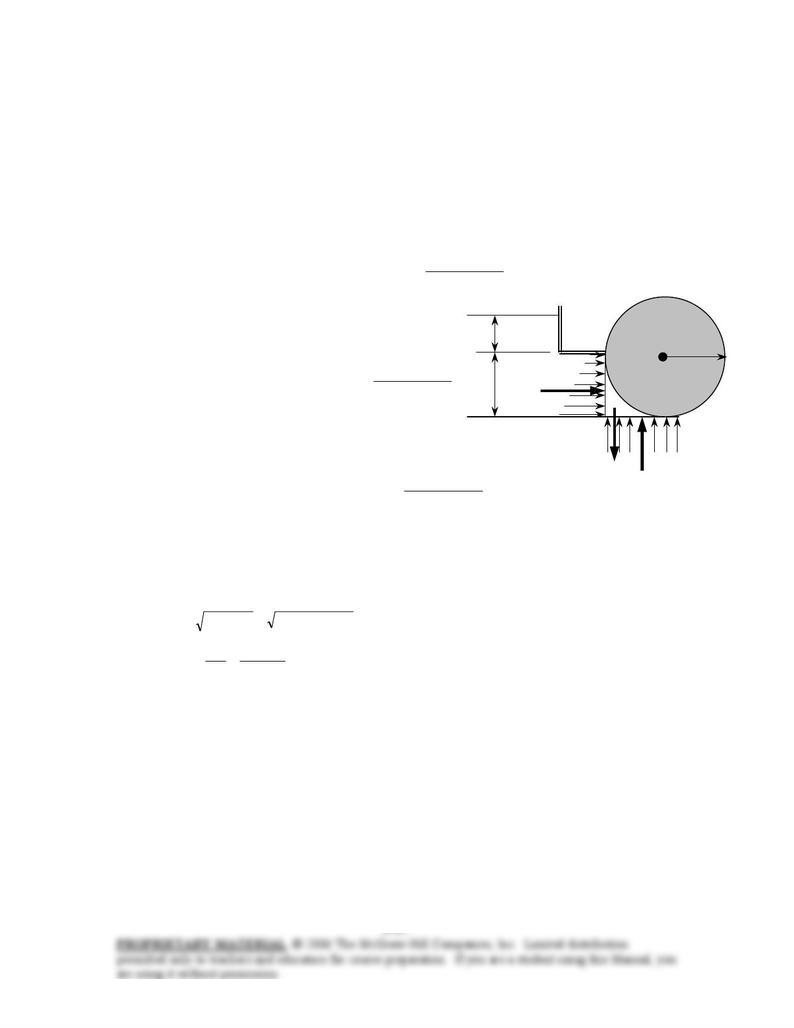
3-61E The height of a water reservoir is controlled by a cylindrical gate hinged to the reservoir. The
hydrostatic force on the cylinder and the weight of the cylinder per ft length are to be determined. √ Feb05
Assumptions 1 The hinge is frictionless. 2 The atmospheric pressure acts on both sides of the gate, and thus
it can be ignored in calculations for convenience.
Properties We take the density of water to be 62.4 lbm/ft3 throughout.
Analysis (a) We consider the free body diagram of the liquid block enclosed by the circular surface of the
cylinder and its vertical and horizontal projections. The hydrostatic forces acting on the vertical and
horizontal plane surfaces as well as the weight of the liquid block per ft length of the cylinder are:
Horizontal force on vertical surface:
lbf 1747
ft/slbm 32.2
lbf 1
ft) 1 ft ft)(2 2/213)(ft/s 2.32)(lbm/ft 4.62(
)2/(
2
23
=
⋅
×+=
+
==== ARsgAghAPFF CavexH
ρ
ρ
Vertical force on horizontal surface (upward):
lbf 1872
ft/slbm 32.2
lbf 1
ft) 1 ft ft)(2 15)(ft/s 2.32)(lbm/ft 4.62( 2
23
bottom
=
⋅
×=
=== AghAghAPF Cavey
ρρ
Weight of fluid block per ft length (downward):
lbf 54
ft/slbm 32.2
lbf 1
ft) /4)(1–(1ft) 2)(ft/s 2.32)(lbm/ft 4.62(
ft) 1)(4/1(ft) 1)(4/(
2
223
222
=
⋅
=
−=−===
π
πρπρρ
gRRRggmgW
V
b=R
=2 ft
s = 13 ft
R
=2 ft
W
F
V
F
H
Therefore, the net upward vertical force is
lbf 1818541872 =−=−= WFF yV
Then the magnitude and direction of the hydrostatic force acting on the cylindrical surface become
flb 2521=+=+= 2222 18181747
VHR FFF
°=→=== 1.46 041.1
lbf 1747
lbf 1818
tan
θθ
H
V
F
F
Therefore, the magnitude of the hydrostatic force acting on the cylinder is 2521 lbf per ft length of the
cylinder, and its line of action passes through the center of the cylinder making an angle 46.1° upwards
from the horizontal.
(b) When the water level is 15-ft high, the gate opens and the reaction force at the bottom of the cylinder
becomes zero. Then the forces other than those at the hinge acting on the cylinder are its weight, acting
through the center, and the hydrostatic force exerted by water. Taking a moment about the point A where
the hinge is and equating it to zero gives
(per ft)
lbf 1817=°==→=− 146sinlbf) (2521sin 0sin .FWRWRF RcylcylR
θθ
Discussion The weight of the cylinder per ft length is determined to be 1817 lbf, which corresponds to a
mass of 1817 lbm, and to a density of 145 lbm/ft3 for the material of the cylinder.
Chapter 3 Pressure and Fluid Statics
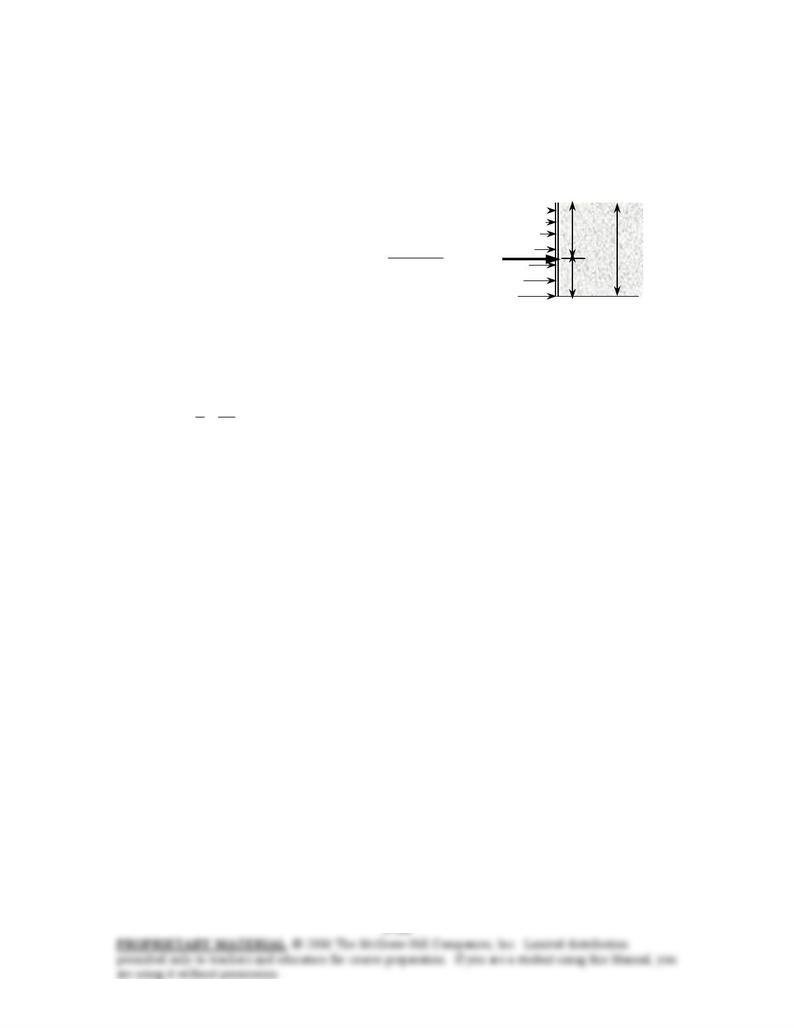
3-62 An above the ground swimming pool is filled with water. The hydrostatic force on each wall and the
distance of the line of action from the ground are to be determined, and the effect of doubling the wall
height on the hydrostatic force is to be assessed.
Assumptions The atmospheric pressure acts on both sides of the wall of the pool, and thus it can be ignored
in calculations for convenience.
Properties We take the density of water to be 1000 kg/m3 throughout.
Analysis The average pressure on a surface is the pressure at the
centroid (midpoint) of the surface, and is determined to be
h/3
2h/3 h = 1.5 m
F
R
2
2
23
N/m 5.7357
m/skg 1
N 1
m) 2/5.1)(m/s 81.9)(kg/m 1000(
)2/(
=
⋅
=
=== hgghPP CCave
ρ
ρ
Then the resultant hydrostatic force on each wall becomes
kN 44.1≅=×== N 145,44m) 5.1m 4)(N/m 5.7357( 2
APF aveR
The line of action of the force passes through the pressure center, which is 2h/3 from the free surface and
h/3 from the bottom of the pool. Therefore, the distance of the line of action from the ground is
m 0.50=== 3
5.1
3
h
yP (from the bottom)
If the height of the walls of the pool is doubled, the hydrostatic force quadruples since
2/))(2/( 2
gwhwhhgAghF CR
ρρρ
=×==
and thus the hydrostatic force is proportional to the square of the wall height, h2.
Chapter 3 Pressure and Fluid Statics
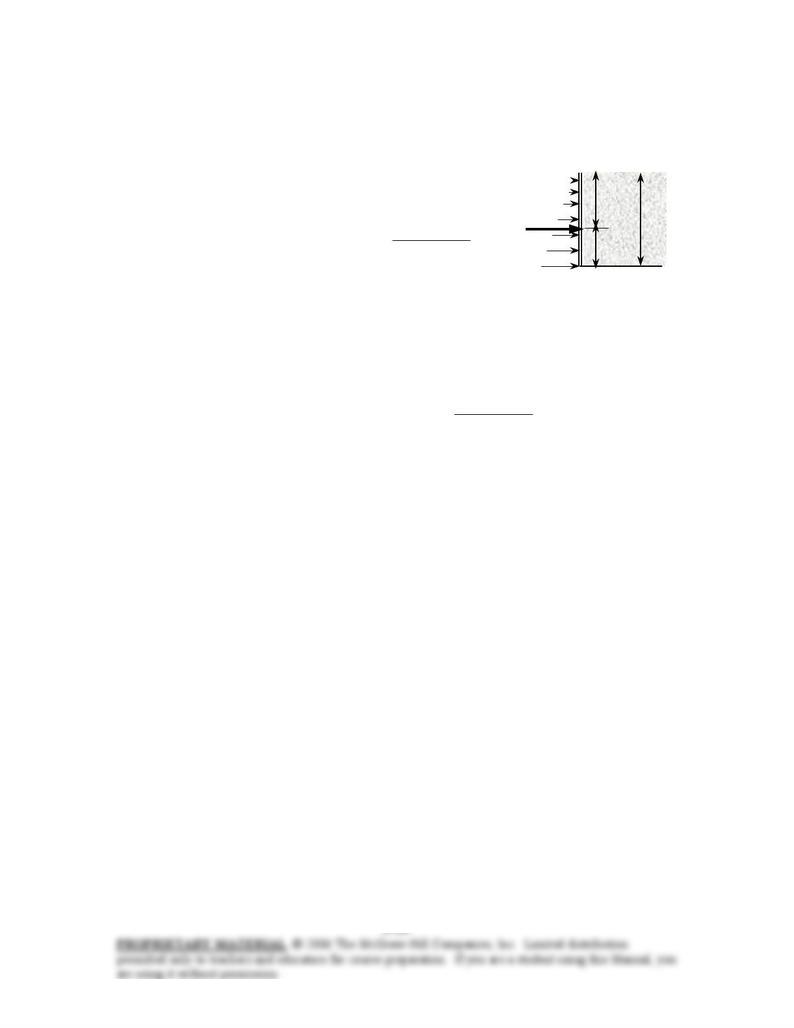
3-63E A dam is filled to capacity. The total hydrostatic force on the dam, and the pressures at the top and
the bottom are to be determined.
Assumptions The atmospheric pressure acts on both sides of the dam, and thus it can be ignored in
calculations for convenience.
Properties We take the density of water to be 62.4 lbm/ft3 throughout.
Analysis The average pressure on a surface is the pressure at the
centroid (midpoint) of the surface, and is determined to be
h/3
2h/3 h=200 ft
F
R
2
2
23
lbf/ft 6240
ft/slbm 32.2
lbf 1
ft) 2/200)(ft/s 2.32)(lbm/ft 4.62(
)2/(
=
⋅
=
== hgghP Cave
ρ
ρ
Then the resultant hydrostatic force acting on the dam becomes
lbf 101.50 9
×=×== ft) 1200ft 200)(lbf/ft 6240( 2
APF aveR
Resultant force per unit area is pressure, and its value at the top and the bottom of the dam becomes
=P
ρ
2
lbf/ft 0=
toptop gh
2
lbf/ft 12,480=
⋅
== 2
23
bottombottom ft/slbm 32.2
lbf 1
ft) 200)(ft/s 2.32)(lbm/ft 4.62(ghP
ρ