Chapter 3 Pressure and Fluid Statics
Review Problems
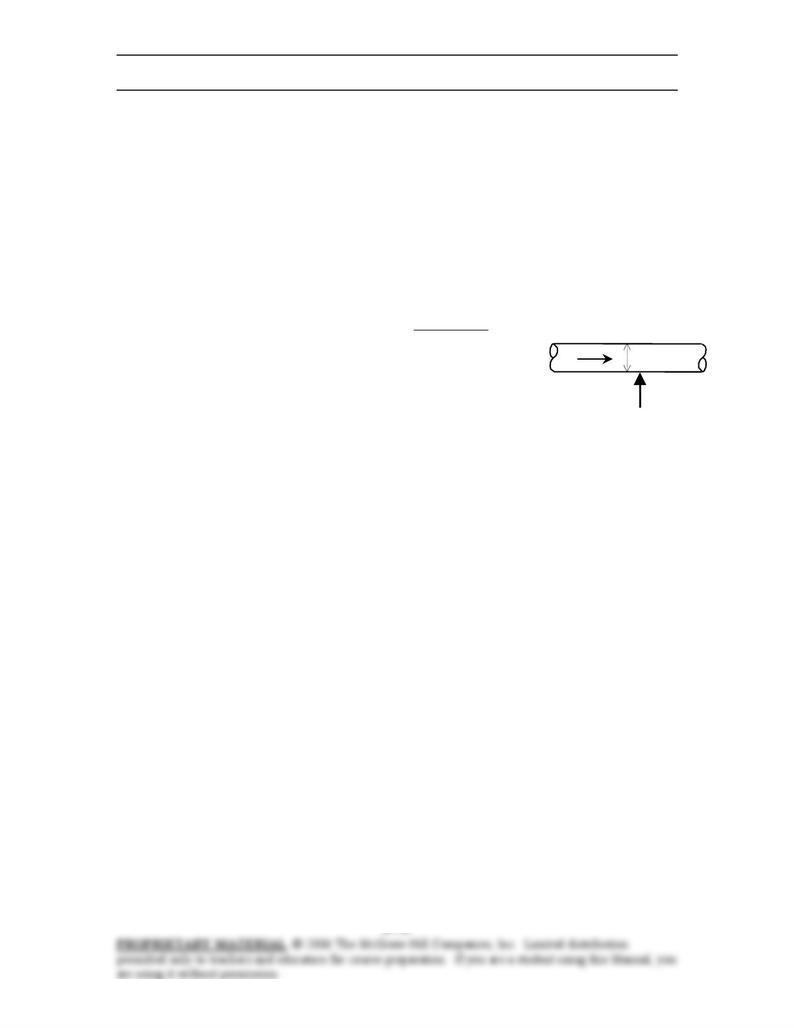
3-110 One section of the duct of an air-conditioning system is laid underwater. The upward force the water
will exert on the duct is to be determined.
Assumptions 1 The diameter given is the outer diameter of the duct (or, the thickness of the duct material is
negligible). 2 The weight of the duct and the air in is negligible.
Properties The density of air is given to be ρ = 1.30 kg/m3. We take the density of water to be 1000
kg/m3.
Analysis Noting that the weight of the duct and the air in it is negligible, the net upward force acting on the
duct is the buoyancy force exerted by water. The volume of the underground section of the duct is
m 0.3534=m) /4](20m) 15.0([)4/( 322
ππ
=== LDAL
V
Then the buoyancy force becomes
kN 3.47=
⋅
== 2
323
m/skg 0001
kN 1
)m )(0.3534m/s )(9.81kg/m (1000
V
gFB
ρ
F
B
L = 20 m
D =15 cm
Discussion The upward force exerted by water on the duct is 3.47
kN, which is equivalent to the weight of a mass of 354 kg. Therefore,
this force must be treated seriously.
Chapter 3 Pressure and Fluid Statics
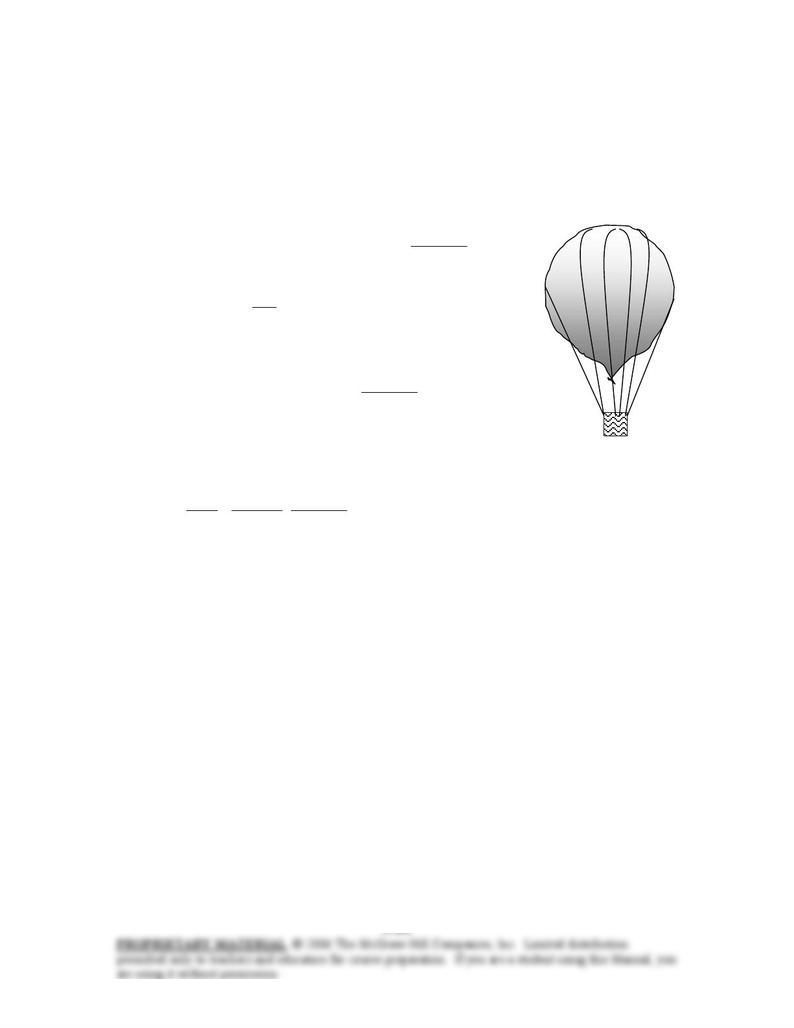
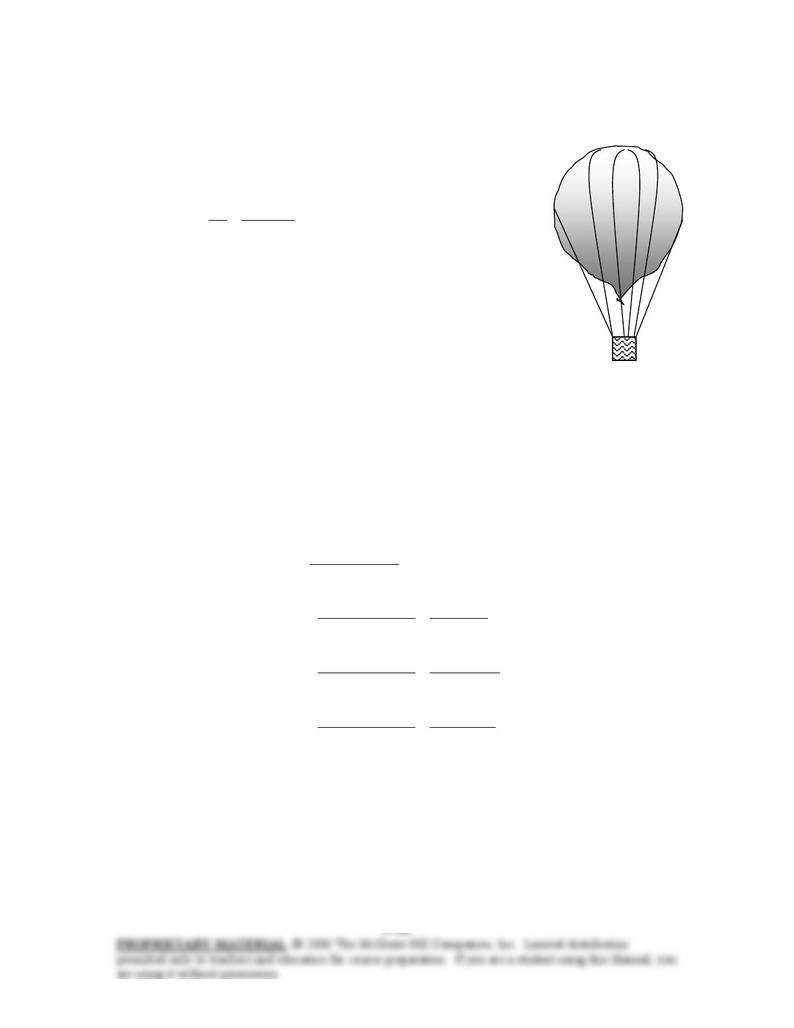
3-111 A helium balloon tied to the ground carries 2 people. The acceleration of the balloon when it is first
released is to be determined.
Assumptions The weight of the cage and the ropes of the balloon is negligible.
Properties The density of air is given to be ρ = 1.16 kg/m3. The density of helium gas is 1/7th of this.
Analysis The buoyancy force acting on the balloon is
N 5958.4
m/skg 1
N 1
)m )(523.6m/s )(9.81kg/m (1.16
m 523.63m 5434
2
323
333
=
⋅
=
=
===
balloonairB
balloon
gF
/)π(/rπ
V
V
ρ
Helium
balloon
m = 140 kg
The total mass is
kg226.870286.8
kg86.8)m(523.6kg/m
7
1.16 33
=×+=+=
=
==
people
He
total
HeHe
mmm
m
Vρ
The total weight is
N 2224.9
m/skg 1
N 1
)m/s kg)(9.81 (226.8 2
2=
⋅
== gmW total
Thus the net force acting on the balloon is
N 3733.52224.95958.6
=
−=−= WFF Bnet
Then the acceleration becomes
2
m/s 16.5=
⋅
== N 1
m/skg 1
kg 226.8
N 3733.5 2
total
net
m
F
a
Chapter 3 Pressure and Fluid Statics
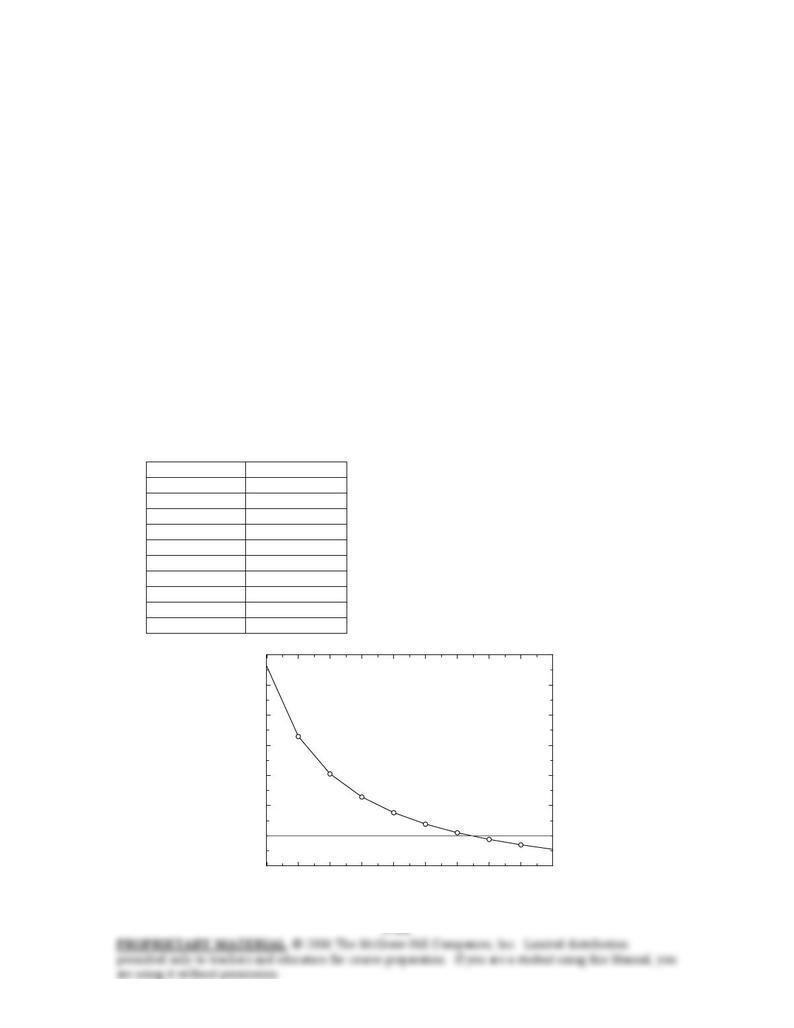
3-112 Problem 3-111 is reconsidered. The effect of the number of people carried in the balloon on
acceleration is to be investigated. Acceleration is to be plotted against the number of people, and the results
are to be discussed.
“Given Data:”
rho_air=1.16“[kg/m^3]” “density of air”
g=9.807“[m/s^2]”
d_balloon=10“[m]”
m_1person=70“[kg]”
{NoPeople = 2} “Data suppied in Parametric Table”
“Calculated values:”
rho_He=rho_air/7“[kg/m^3]” “density of helium”
r_balloon=d_balloon/2“[m]”
V_balloon=4*pi*r_balloon^3/3“[m^3]”
m_people=NoPeople*m_1person“[kg]”
m_He=rho_He*V_balloon“[kg]”
m_total=m_He+m_people“[kg]”
“The total weight of balloon and people is:”
W_total=m_total*g“[N]”
“The buoyancy force acting on the balloon, F_b, is equal to the weight of the air displaced by
the balloon.”
F_b=rho_air*V_balloon*g“[N]”
“From the free body diagram of the balloon, the balancing vertical forces must equal the
product of the total mass and the vertical acceleration:”
F_b- W_total=m_total*a_up
Aup [m/s2] NoPeople
28.19 1
16.46 2
10.26 3
6.434 4
3.831 5
1.947 6
0.5204 7
-0.5973 8
-1.497 9
-2.236 10
12345678910
-5
0
5
10
15
20
25
30
NoPeople
aup [m/s^2]
Chapter 3 Pressure and Fluid Statics
3-113 A balloon is filled with helium gas. The maximum amount of load the balloon can carry is to be
determined.
Assumptions The weight of the cage and the ropes of the balloon is negligible.
Properties The density of air is given to be ρ = 1.16 kg/m3. The density of helium gas is 1/7th of this.
Analysis In the limiting case, the net force acting on the balloon will be
zero. That is, the buoyancy force and the weight will balance each other:
Helium
balloon
m
kg 607.4
m/s 9.81
N 5958.4
2===
==
g
F
m
FmgW
B
total
B
Thus,
kg 520.6=−=−= 86.8607.4
Hetotalpeople mmm
3-114E The pressure in a steam boiler is given in kgf/cm2. It is to be expressed in psi, kPa, atm, and bars.
Analysis We note that 1 atm = 1.03323 kgf/cm2, 1 atm = 14.696 psi, 1 atm = 101.325 kPa, and 1 atm =
1.01325 bar (inner cover page of text). Then the desired conversions become:
In atm: atm 6.72
kgf/cm 1.03323
atm 1
)kgf/cm (75 2
2=
=P
In psi: psi 1067=
=atm 1
psi 696.41
kgf/cm 1.03323
atm 1
)kgf/cm (75 2
2
P
In kPa: kPa 7355=
=atm 1
kPa 325.011
kgf/cm 1.03323
atm 1
)kgf/cm (75 2
2
P
In bars: bar 73.55=
=atm 1
bar 01325.1
kgf/cm 1.03323
atm 1
)kgf/cm (75 2
2
P
Discussion Note that the units atm, kgf/cm2, and bar are almost identical to each other.
Chapter 3 Pressure and Fluid Statics
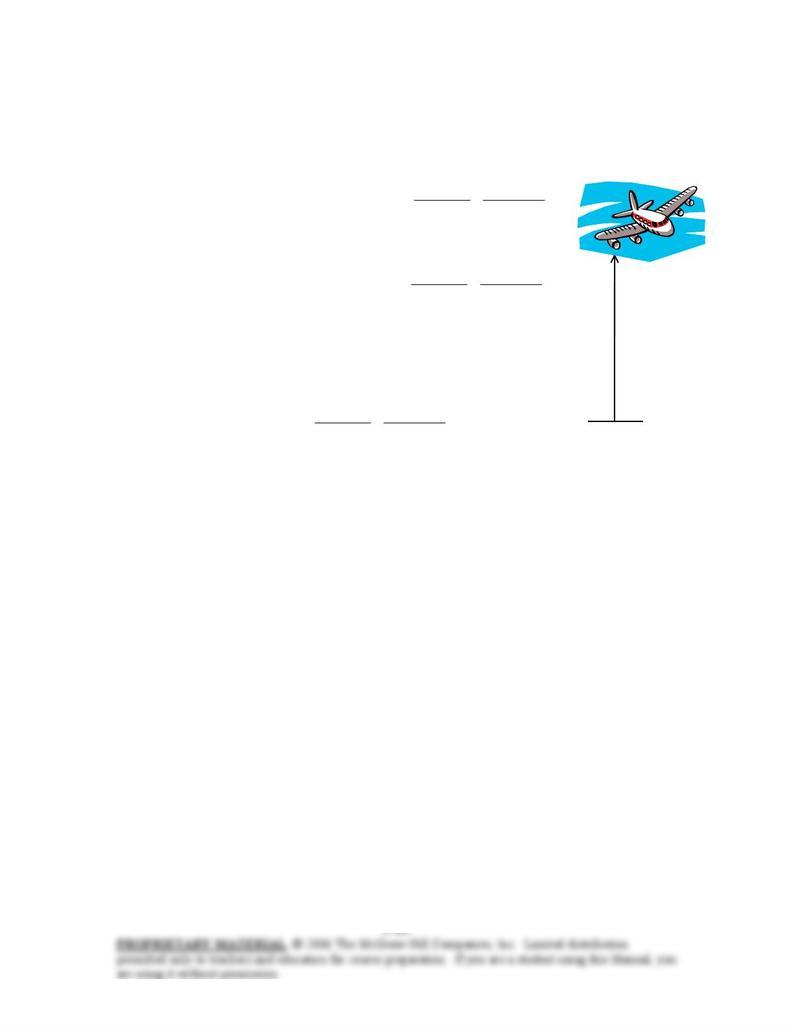
3-115 A barometer is used to measure the altitude of a plane relative to the ground. The barometric
readings at the ground and in the plane are given. The altitude of the plane is to be determined.
Assumptions The variation of air density with altitude is negligible.
Properties The densities of air and mercury are given to be ρ = 1.20 kg/m3 and ρ = 13,600 kg/m3.
Analysis Atmospheric pressures at the location of the plane and the ground level are
kPa 100.46 N/m 1000
kPa 1
m/skg 1
N 1
m) )(0.753m/s 1)(9.8kg/m (13,600
)(
kPa 92.06 N/m 1000
kPa 1
m/skg 1
N 1
m) )(0.690m/s )(9.81kg/m (13,600
)(
22
23
groundground
22
23
planeplane
=
⋅
=
=
=
⋅
=
=
hgP
hgP
ρ
ρ
Taking an air column between the airplane and the ground and
writing a force balance per unit base area, we obtain
kPa 92.06)(100.46
N/m 1000
kPa 1
m/skg 1
N 1
))(m/s 1)(9.8kg/m (1.20
)(
/
22
23
planegroundair
planegroundair
−=
⋅
−=
−=
h
PPhg
PPAW
ρ
h
0Sealevel
It yields h = 714 m
which is also the altitude of the airplane.