521
© 2012 Cengage Learning. All Rights Reserved. May not be scanned, copied or duplicated, or posted to a publicly accessible website, in whole or in part.
WHAT’S NEW IN THE SIXTH EDITION:
There are no major changes in this chapter.
LEARNING OBJECTIVES:
By the end of this chapter, students should understand:
➢ how net exports measure the international flow of goods and services.
➢ how net capital outflow measures the international flow of capital.
➢ why net exports must always equal net foreign investment.
➢ how saving, domestic investment, and net capital outflow are related.
➢ the meaning of the nominal exchange rate and the real exchange rate.
➢ purchasing-power parity as a theory of how exchange rates are determined.
CONTEXT AND PURPOSE:
Chapter 18 is the first chapter in a two-chapter sequence dealing with open-economy macroeconomics.
Chapter 18 develops the basic concepts and vocabulary associated with macroeconomics in an
international setting: net exports, net capital outflow, real and nominal exchange rates, and purchasing–
power parity. The next chapter, Chapter 19, builds an open-economy macroeconomic model that shows
how these variables are determined simultaneously.
The purpose of Chapter 18 is to develop the basic concepts macroeconomists use to study open
economies. It addresses why a nation’s net exports must equal its net capital outflow. It also addresses
the concepts of the real and nominal exchange rate and develops a theory of exchange rate
determination known as purchasing-power parity.
31
OPEN-ECONOMY
MACROECONOMICS: BASIC
CONCEPTS

522 ❖ Chapter 31/Open-Economy Macroeconomics: Basic Concepts
© 2012 Cengage Learning. All Rights Reserved. May not be scanned, copied or duplicated, or posted to a publicly accessible website, in whole or in part.
KEY POINTS:
• Net exports are the value of domestic goods and services sold abroad (exports) minus the value of
foreign goods and services sold domestically (imports). Net capital outflow is the acquisition of
foreign assets by domestic residents (capital outflow) minus the acquisition of domestic assets by
foreigners (capital inflow). Because every international transaction involves an exchange of an asset
for a good or service, an economy’s net capital outflow always equals its net exports.
• An economy’s saving can be used to finance investment at home or buy assets abroad. Thus,
national saving equals domestic investment plus net capital outflow.
• The nominal exchange rate is the relative price of the currency of two countries, and the real
exchange rate is the relative price of the goods and services of two countries. When the nominal
exchange rate changes so that each dollar buys more foreign currency, the dollar is said to
appreciate
or
strengthen
. When the nominal exchange rate changes so that each dollar buys less
foreign currency, the dollar is said to
depreciate
or
weaken
.
• According to the theory of purchasing-power parity, a dollar (or a unit of any other currency) should
be able to buy the same quantity of goods in all countries. This theory implies that the nominal
exchange rate between the currencies of two countries should reflect the price levels in those two
countries. As a result, countries with relatively high inflation should have depreciating currencies, and
countries with relatively low inflation should have appreciating currencies.
CHAPTER OUTLINE:
I. We will no longer be assuming that the economy is a closed economy.
A. Definition of closed economy: an economy that does not interact with other economies
in the world.
B. Definition of open economy: an economy that interacts freely with other economies
around the world.
II. The International Flows of Goods and Capital
A. The Flow of Goods: Exports, Imports, and Net Exports
1. Definition of exports: goods and services that are produced domestically and sold
abroad.
2. Definition of imports: goods and services that are produced abroad and sold
domestically.
3. Definition of net exports: the value of a nation’s exports minus the value of its
imports, also called the trade balance.
Point out foreign products that students are likely to buy.
Chapter 31/Open-Economy Macroeconomics: Basic Concepts ❖ 523
© 2012 Cengage Learning. All Rights Reserved. May not be scanned, copied or duplicated, or posted to a publicly accessible website, in whole or in part.
4. Definition of trade balance: the value of a nation’s exports minus the value of its
imports, also called net exports.
5. Definition of trade surplus: an excess of exports over imports.
6. Definition of trade deficit: an excess of imports over exports.
7. Definition of balanced trade: a situation in which exports equal imports.
8. There are several factors that influence a country’s exports, imports, and net exports:
a. The tastes of consumers for domestic and foreign goods.
b. The prices of goods at home and abroad.
c. The exchange rates at which people can use domestic currency to buy foreign
currencies.
d. The incomes of consumers at home and abroad.
e. The cost of transporting goods from country to country.
f. Government policies toward international trade.
9.
Case Study: The Increasing Openness of the U.S. Economy
a. Figure 1 shows the total value of exports and imports (expressed as a percentage of
GDP) for the United States since 1950.
b. Advances in transportation, telecommunications, and technological progress are some of
the reasons why international trade has increased over time.
c. Policymakers around the world have also become more accepting of free trade over time.
10.
In the News: Breaking Up the Chain of Production
a. Some goods have parts that are manufactured in many countries.
b. This is an article from
The
New York Times
describing the origin of the 451 parts that
make up the Apple iPod.
B. The Flow of Financial Resources: Net Capital Outflow
= Exports Imports
NX
−
Point out to students that a trade surplus implies a positive level of net exports, a
trade deficit means that net exports are negative, and balanced trade occurs when
net exports are equal to zero. While this will likely be obvious to most students, some
will benefit if you review this.
Figure 1
524 ❖ Chapter 31/Open-Economy Macroeconomics: Basic Concepts
© 2012 Cengage Learning. All Rights Reserved. May not be scanned, copied or duplicated, or posted to a publicly accessible website, in whole or in part.
1. Definition of net capital outflow (NCO): the purchase of foreign assets by domestic
residents minus the purchase of domestic assets by foreigners.
2. The flow of capital abroad takes two forms.
a. Foreign direct investment occurs when a capital investment is owned and operated by a
foreign entity.
b. Foreign portfolio investment involves an investment that is financed with foreign money
but operated by domestic residents.
3. Net capital outflow can be positive or negative.
a. When net capital outflow is positive, domestic residents are buying more foreign assets
than foreigners are buying domestic assets. Capital is flowing out of the country.
b. When net capital outflow is negative, domestic residents are buying fewer foreign assets
than foreigners are buying domestic assets. The country is experiencing a capital inflow.
4. There are several factors that influence a country’s net capital outflow:
a. The real interest rates being paid on foreign assets.
b. The real interest rates being paid on domestic assets.
c. The perceived economic and political risks of holding assets abroad.
d. The government policies that affect foreign ownership of domestic assets.
C. The Equality of Net Exports and Net Capital Outflow
1. Net exports and net capital outflow each measure a type of imbalance in a world market.
a. Net exports measure the imbalance between a country’s exports and imports in world
markets for goods and services.
b. Net capital outflow measures the imbalance between the amount of foreign assets
bought by domestic residents and the amount of domestic assets bought by foreigners in
world financial markets.
2. For an economy, net exports must be equal to net capital outflow.
3. Example: You are a computer programmer who sells some software to a Japanese consumer
for 10,000 yen.
You will likely have to write this equation several times on the board for students
when discussing this chapter and the next. Students can grasp the concept of net
exports more easily than they can grasp the concept of net capital outflow.
purchases of foreign assets purchases of domestic assets
by domestic residents by foreigners
NCO
=−
Chapter 31/Open-Economy Macroeconomics: Basic Concepts ❖ 525
a. The sale is an export for the United States so net exports increases.
b. There are several things you could do with the 10,000 yen
c. You could hold the yen (which is a Japanese asset) or use it to purchase another
Japanese asset. Either way, net capital outflow rises.
d. Alternatively, you could use the yen to purchase a Japanese good. Thus, imports will rise
so the net effect on net exports will be zero.
e. One final possibility is that you could exchange the yen for dollars at a bank. This does
not change the situation though, because the bank then must use the yen for something.
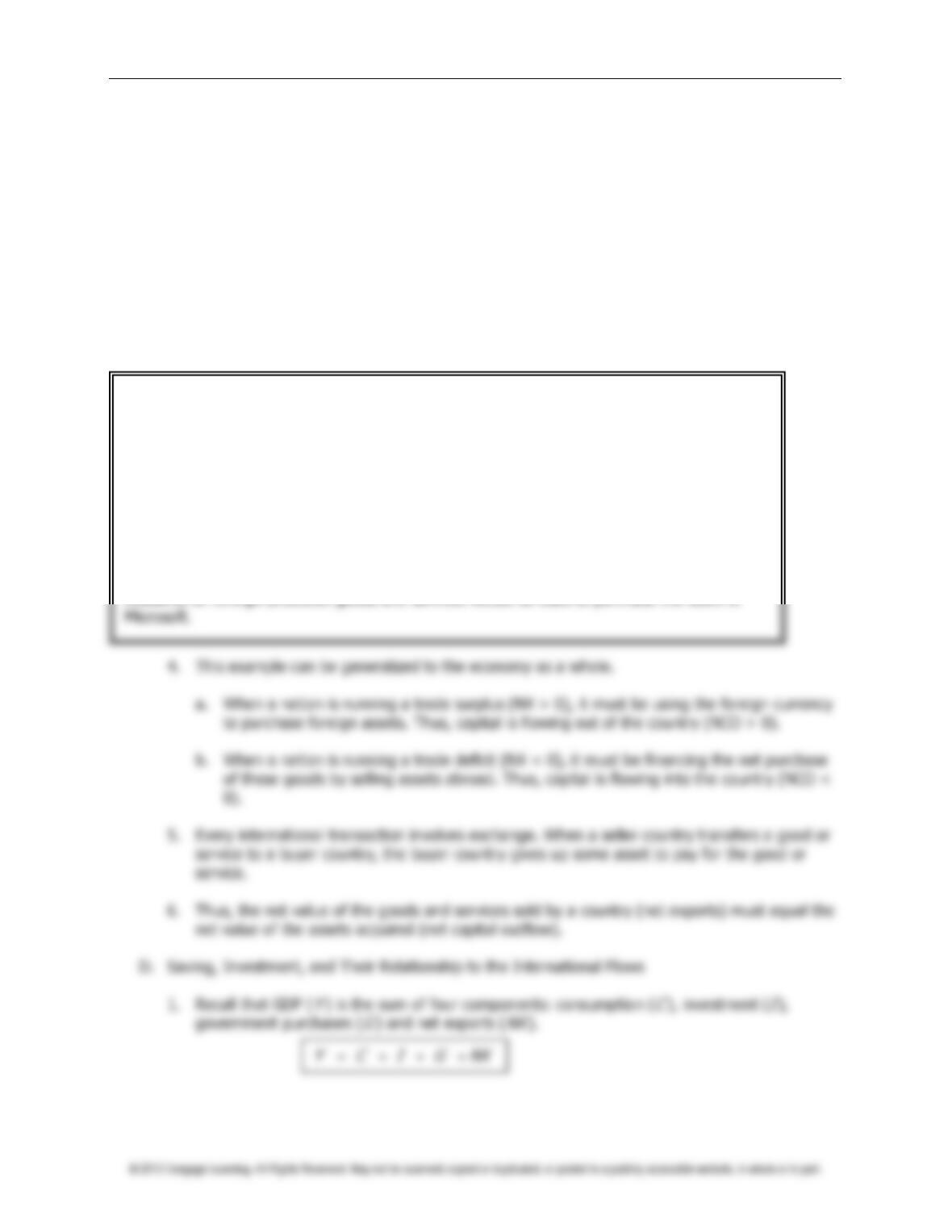
ALTERNATIVE CLASSROOM EXAMPLE:
Assume that U.S. residents do not want to buy any foreign assets, but foreign residents want
to purchase some stock in a U.S. firm (such as Microsoft).
How are the foreigners going to get the dollars to purchase the stock?
They would do it the same way U.S. residents would purchase the stock—they would have to
earn more than they spend. In other words, foreigners must sell the United States more
goods and services than they purchase from the United States.
This leads to negative net exports for the United States. The extra dollars spent by U.S.