Fall 2019 – Copyright © Janet Huston, Ph.D., Texas Tech University
ACCT 2300 Chapter 3 – Page 1
Chapter 3 Notes
Accrual Accounting and Income
Learning Objectives:
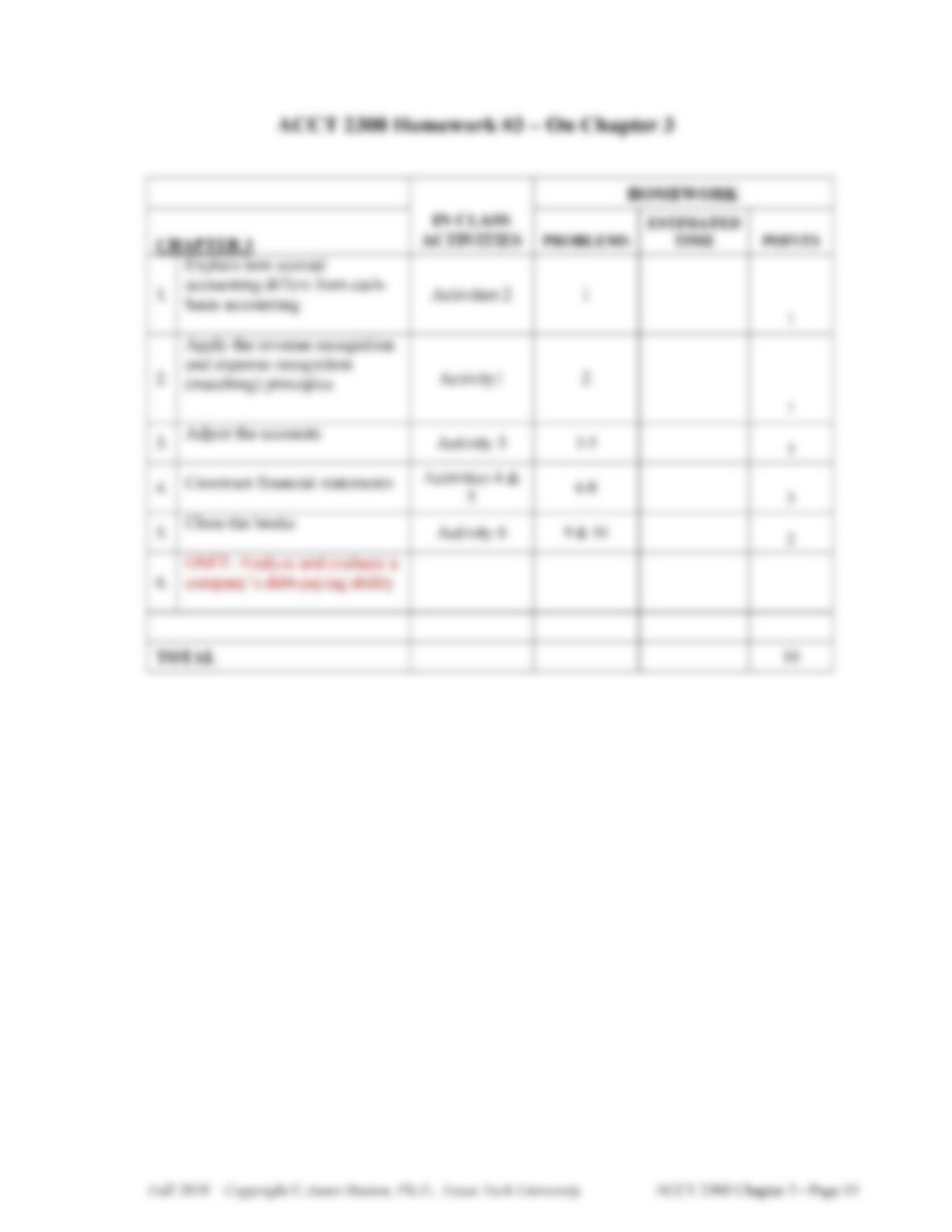
1. Explain how accrual accounting differs from cash-basis accounting
2. Apply the revenue recognition and expense recognition (matching) principles
3. Adjust the accounts
4. Construct financial statements
5. Close the books
6. OMIT: Analyze and evaluate a company’s debt–paying ability
Revenue Recognition Principle
• Revenue: increase in net assets from day to day operations
• Gain: increase in net assets from peripheral or incidental transactions
• Net Assets = Assets – Liabilities
o Increase in Net Assets: either Assets increase or Liabilities decrease
For Revenues and Gains an Increase in Net Assets is either
• Cash ↑ or AR ↑ or NR ↑ or Unearned Revenue ↓
Revenues / Gains
Dr
Cr
↑ Revenue → NI → RE
• Revenue Recognition Principle: explains the timing and measurement of
revenues/gains for firms.
o Timing: when to recognize the revenue.
Recognize revenue when EARNED.
Earned: when a good is transferred or a service is performed
o Measurement: What amount of revenue to recognize.
Cash realized today or the today’s realizable cash equivalent of
future payments.
Realized: cash has been received
Realizable: cash is expected to be received and can be measured.
Revenue
Recognized?
Before Cash Received
(Accrual)
Same Time as Cash
Received
After Cash Received
(Deferral)
Journal Entries
Required:
2 Journal Entries:
1. ↑ Receivable;
↑ Revenue
2. ↑ Cash;
↓ Receivable
1 Journal Entries:
1. ↑ Cash;
↑ Revenue
2 Journal Entries:
1. ↑ Cash;
↑ Liability
2. ↓ Liability;
↑ Revenue

Fall 2019 – Copyright © Janet Huston, Ph.D., Texas Tech University
ACCT 2300 Chapter 3 – Page 2
Matching Principle (Expense Recognition Principle)
• Expense: decrease in net assets from day to day operations
• Loss: decrease in net assets from peripheral or incidental transactions
• Net Assets = Assets – Liabilities
o Decrease in Net Assets: either Assets decrease or Liabilities increase
Expenses / Losses
Dr
Cr
Expense → NI → RE
• Matching Principle: explains the timing and measurement of expenses/losses for
firms.
o Timing: when to incur the expense.
Direct Matching: match expenses with revenues recognized in the
same accounting period
• Expense follows the revenue; the revenue must be
recognized before the expense can be matched.
Example: Our firm sells cars. Before we sell the car, the cost of the
car is considered to be an asset called inventory. When we sell a
car, we recognize Sales Revenue. Then we must incur the expense
of the cost of the car by remove the cost of the car from Inventory
and increasing Cost of Goods Sold. The COGS only increased
because we increased our Sales Revenue.
Indirect Matching: match expenses with a particular period
instead of a revenue.
• Examples: Depreciation on a building, CEO salary, Utility
expense, Rent expense, Insurance expense.
o Measurement: What amount of expense to incur.
Cash paid today or today’s cash equivalent of future payments.
Activity #1
Expense
Incurred?
Before Cash Paid
(Accrual)
Same Time as
Cash paid
After Cash Paid
(Deferral)
Journal Entries
Required:
2 Journal Entries:
1. ↑ Expense;
↑ Liability
2. ↓ Liability;
↓ Cash
1 Journal Entries:
2. ↑ Expense;
↓ Cash
2 Journal Entries:
1. ↑ Prepaid Asset;
↓ Cash
2. ↑ Expense;
↓ Prepaid Asset
Fall 2019 – Copyright © Janet Huston, Ph.D., Texas Tech University
ACCT 2300 Chapter 3 – Page 3
Accrual Basis Accounting versus Cash Basis Accounting
• Accrual basis accounting
o Revenues are recognized when they meet revenue recognition principle
o Expenses are incurred when they meet matching principle.
o Accounting Ph.D. research shows:
Accrual Basis Accounting results in “smooth” earnings.
Accrual Basis Accounting Net Income which is a better indicator of
future cash flows.
• Cash Basis accounting
o Revenues are recognized when cash is
o Expenses are incurred when cash is
Real accounts: Cash and Equity
Nominal Accounts: Revenue, Expense, Withdrawal by owners (all close
to equity)
o Accounting Ph.D. research shows:
Cash Basis Accounting results in “lumpy” earnings.
Cash Basis Accounting is not indicative of what resources were
given up or revenues earned during a period of time.
Which Basis of Accounting is Best?
• Cash basis financial statements are easier to prepare; however, accrual basis
financial statements are required under Generally Accepted Accounting Principles
(GAAP).
• Accounting researchers have generally determined that accrual–based income
statements and balance sheets are more informative of current operations AND
more predictive of future profitability (and even more predictive of future cash
flows).
• Note that public companies MUST use accrual basis accounting.
• Private companies (such as sole proprietorships, partnerships and private
corporations) can use EITHER Cash OR Accrual Basis. However, if a private
company has a lot of bank financing, the bank may require annual financial
statements that are prepared in accordance with GAAP (which means the
financial statements would need to be accrual basis financial statements).
In this class, we will ALWAYS USE ACCRUAL BASIS ACCOUNTING (which is
in accordance with GAAP).
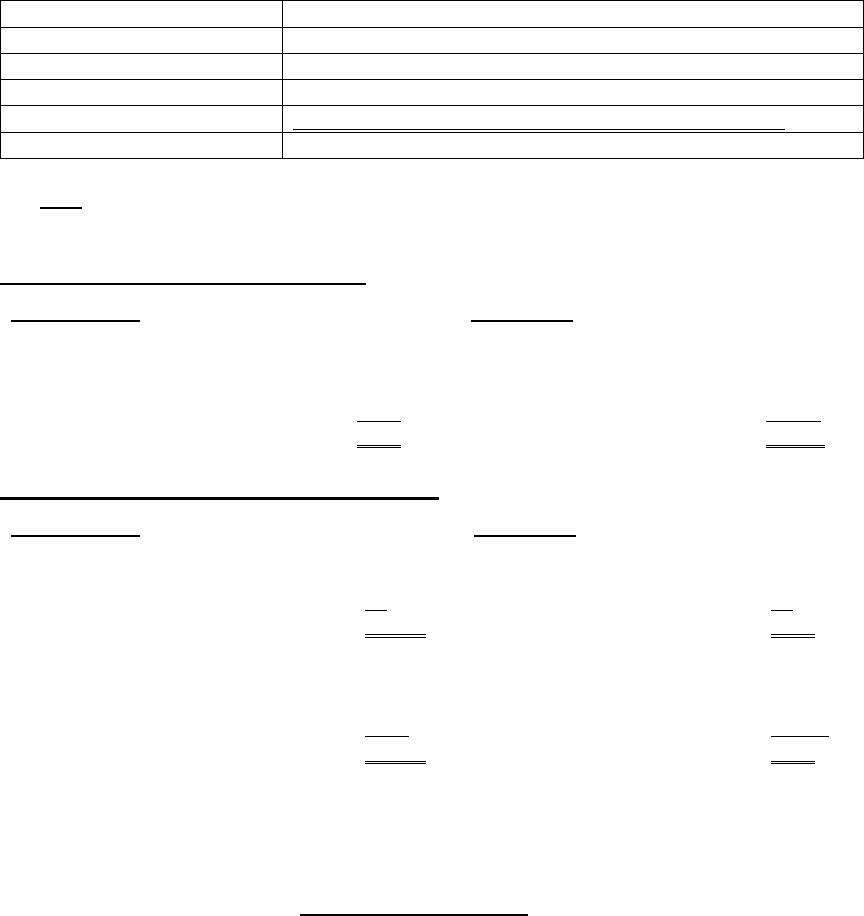
Fall 2019 – Copyright © Janet Huston, Ph.D., Texas Tech University
ACCT 2300 Chapter 3 – Page 4
Example of Accrual versus Cash Basis Accounting
Assume that Cortana has invested $1,500 in her business. She will buy and sell radar jammers to
Elites. Cortana can purchase radar jammers for $12 and sell them for $20. She starts out on her
first day. She leases a booth for $300 a day from the Arbiter (the Arbiter extends credit and lets
Cortana pay for the booth at the end of the week). Cortana purchases 100 radar jammers for $12
each ($1,200). Cortana is able to sell all 100 of the radar jammers for $20 each (total of $20 *
100 radar jammers or $2,000). However, only 25 jammers are sold for cash and the remaining 75
jammers are sold on credit and Cortana will get the money at the end of the week.
First, let’s consider how much cash Cortana has at the end of day 1.
Starts with
$1,500
Rents booth
no effect on cash (Cortana doesn’t have to pay until later)
Purchases radar jammers
minus $1,200
Sells 25 jammers for cash
add $500 (25 jammers for $20 each)
Sells 75 jammers on credit
no effect on cash (Cortana won’t collect cash until later)
Ending Cash Balance
$800
The cash that Cortana has is the same regardless of whether she is using accrual or cash basis
accounting. However, the Income Statement and Balance Sheet will look very different:
INCOME STATEMENT FOR DAY 1:
Accrual Basis
Cash Basis
Revenue (100 jammers X $25)
$2,000
Revenue (25 jammers X $25)
$500
Less expenses:
Cost of jammers ($12 x 100)
$1,200
Cost of jammers ($12 x 100)
$1,200
Booth fee
$300
Booth fee (didn’t pay yet)
$ 0 .
Net Income
$500
Net Loss
($700)
BALANCE SHEET AT THE END OF DAY 1:
Accrual Basis
Cash Basis
Cash
$800
Cash
$800
A/R ($20 X 75 jammers)
$1,500
A/R
$0
Inventory
$0
Inventory
$0
Total Assets
$2,300
Total Assets
$800
Accounts Payable (booth fee)
$300
Accounts Payable
$0
Owner’s Equity (original investment)
$1,500
Owner’s Equity
$1,500
Retained Earnings (the net income)
$500
R/E (the net loss)
($700)
Total Liabilities & Equity
$2,300
Total Liabilities & Equity
$800
Note that net income is drastically different depending on whether the accrual basis or the cash
basis of accounting is used. Cash basis Net Income is simply the cash received for revenues less
the cash paid out for expenses. Accrual basis Net Income recognizes revenue EARNED and
expenses INCURRED regardless of when the cash is exchanged. Also, note that the balance
sheet is very different. While the cash account is the same regardless of the method used, Cash
Basis Balance Sheets do NOT recognize accounts receivable or accounts payable.
Activity #2

Fall 2019 – Copyright © Janet Huston, Ph.D., Texas Tech University
ACCT 2300 Chapter 3 – Page 5
12 Steps of Accounting Cycle (continued from Chapter 2)
1.
2.
3.
4.
5. End of Period
6. Adj. Journal Entries (AJE)
7. Post to Ledger
8. Adjusted TB
9. Prepare FS
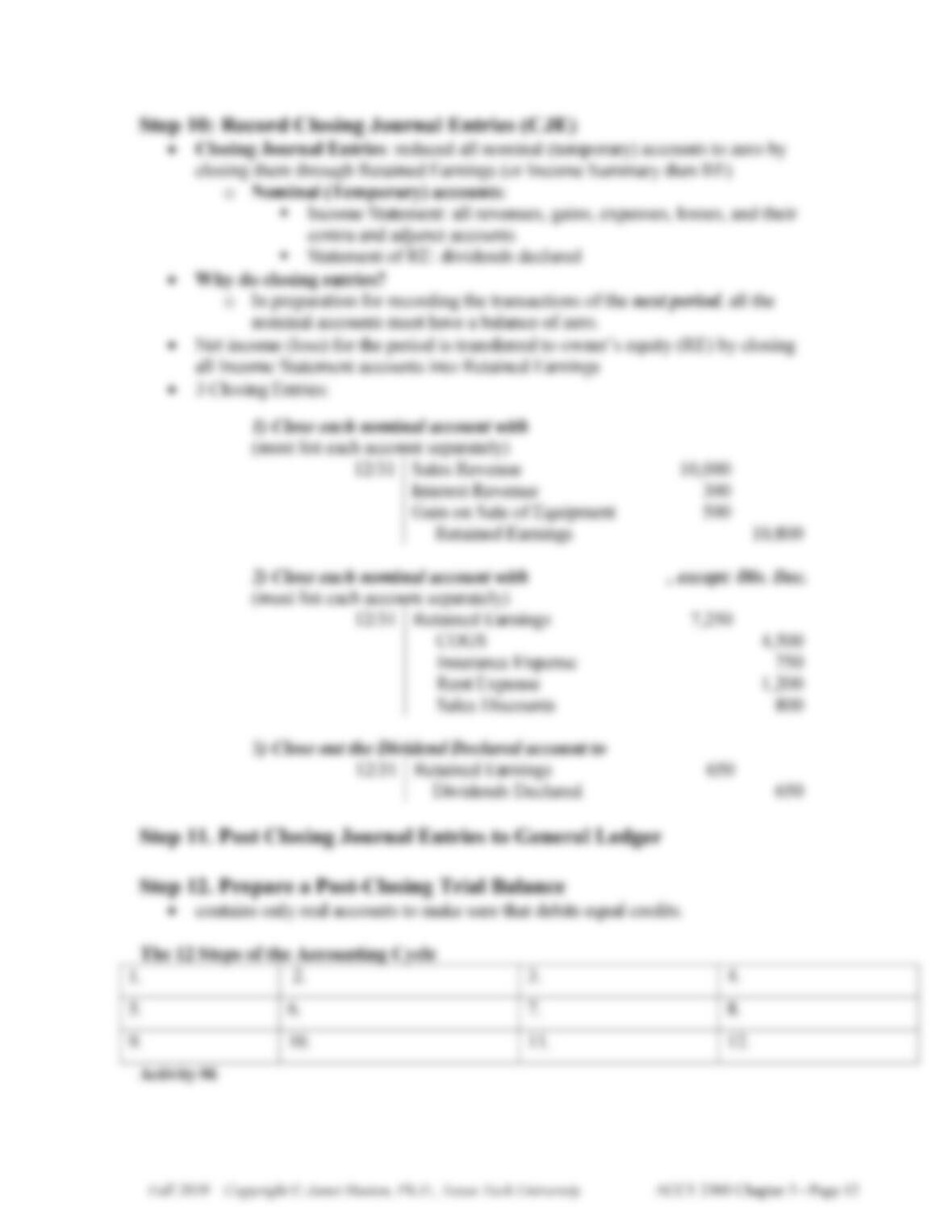
10. Closing Entries (CJE)
11. Post to Ledger
12. Post Closing TB
Step 5. End of Period
• End of Period: artificial time period like end of quarter or fiscal year.
• Going Concern Assumption: assumes firm will have infinite life
o To know how well the business did, we would have to shut down the
business, selling all assets, paying all liabilities, and returning remainder to
owners.
o But we don’t want our firm to go out of business so we assume….
• Periodicity Assumption: breaks life of firm into artificial time periods for the
purpose of creating financial statements.
o Ensures accounting information is reported in regular intervals
Step 6. Record Adjusting Entries (AJE)
• Adjusting Journal Entries: journal entries made at the end of the accounting
period to bring all accounts up to date so that financial statements can be prepared
on an accrual basis.
o Update all unrecorded Revenues and Expenses due to the passage of
o Ensure that Revenue Recognition & Expense Recognition (Matching)
Principles are being followed. These two principles make up the accrual
basis of accounting.
o Required by Periodicity and Going Concern Assumptions.
• Rules of Adjusting Entries:
1. Do not include cash in adjusting entry
2. Every adjusting entry always affects:
at least one account (asset, liability, or equity account)
and at least one account (revenue or expense account)
• Adjusting entries are either Accruals or Deferrals
ABCD:

Fall 2019 – Copyright © Janet Huston, Ph.D., Texas Tech University
ACCT 2300 Chapter 3 – Page 6
• Accruals: when revenue recognized or expense incurred before cash changes
hands Cash comes after (A before C)
o Accrued revenues (assets): revenue is recognized before cash is received
Example 1: On Oct 1, 2018, Sparky invests $20,000 in a CD earning 8% interest
annually. The CD matures on Sept 30, 2019. Principal and interest to be received
at maturity. Sparky’s year-end is Dec 31. Provide the required AJE, use GJEF.
Suppose the company didn’t recognize the revenue until it received the cash. How
would the assets, liabilities, equity and net income be affected in 2018 and 2019?
Assets
12/31/2018
Liabilities
12/31/2018
Equity
12/31/2018
NI
2018
Assets
12/31/201
9
Liabilities
12/31/2019
Equity
12/31/2019
NI
2019
↓ 400
OK
↓ 400
↓ 400
OK
OK
OK
↑ 400
Rev ↓ Rev ↑
o Accrued expenses (liabilities): expenses incurred before cash is paid or
liability recorded
Example 2: Sparky pays employees every other Friday. Employees work 5 days
(M-F) and earn $1,000/day. Fiscal year-end and Dec 31, 2018 falls on the second
Wednesday in the pay period. Provide the required AJE and the entry on Jan 2,
2019 (pay day), use GJEF.
Suppose the company didn’t incur the expense until it paid the cash on Jan 2,
2019. How would the assets, liabilities, equity and net income be affected in
2018 and 2019?
Assets
12/31/2018
Liabilities
12/31/2018
Equity
12/31/2018
NI
2018
Assets
12/31/2019
Liabilities
12/31/2019
Equity
12/31/2019
NI
2019
OK
↓ 8k
↑ 8k
↑ 8k
OK
OK
OK
↓ 8k
↓ Exp ↑ Exp
• Deferrals (commonly referred to as Prepayments): Cash changes hands before the
revenue is recognized or the expense is incurred. Cash comes first (C before D)
o Deferred revenues: cash is received before revenue is recognized
Happens when firm is prepaid for service or goods.
At end of period, firm must recognize the correct amount of revenue
earned and obligation to provide goods/services in the future.
Example 3: College Rentals, Inc. realizes $1,800 for 6 months rent revenue on
November 1, 2018, with the original journal entry included a credit to a real