Chapter 2 Properties of Fluids
Chapter 2
PROPERTIES OF FLUIDS
Density and Specific Gravity
2-1C Intensive properties do not depend on the size (extent) of the system but extensive properties do.
2-2C The specific gravity, or relative density, and is defined as the ratio of the density of a substance to
the density of some standard substance at a specified temperature (usually water at 4°C, for which ρH2O =
1000 kg/m3). That is, H2O
/
ρ
ρ
=SG . When specific gravity is known, density is determined from
H2O
ρ
ρ
×= SG .
2-3C A gas can be treated as an ideal gas when it is at a high temperature or low pressure relative to its
critical temperature and pressure.
2-4C Ru is the universal gas constant that is the same for all gases whereas R is the specific gas constant
that is different for different gases. These two are related to each other by R = Ru /M, where M is the molar
mass of the gas.
2-5 A balloon is filled with helium gas. The mole number and the mass of helium in the balloon are to be
determined.
Assumptions At specified conditions, helium behaves as an ideal gas.
Properties The universal gas constant is Ru = 8.314 kPa.m3/kmol.K. The molar mass of helium is 4.0
kg/kmol.
Analysis The volume of the sphere is
333 m 113.1m) (3
3
4
3
4===
ππ
r
V
He
D = 6 m
20°C
200 kPa
Assuming ideal gas behavior, the mole numbers of He is determined from
kmol 9.286=
⋅⋅
==
K) K)(293/kmolmkPa (8.314
)m kPa)(113.1 (200
3
3
TR
P
N
u
V
Then the mass of He can be determined from
kg 37.1
=
== kg/kmol) kmol)(4.0 (9.286NMm
Chapter 2 Properties of Fluids
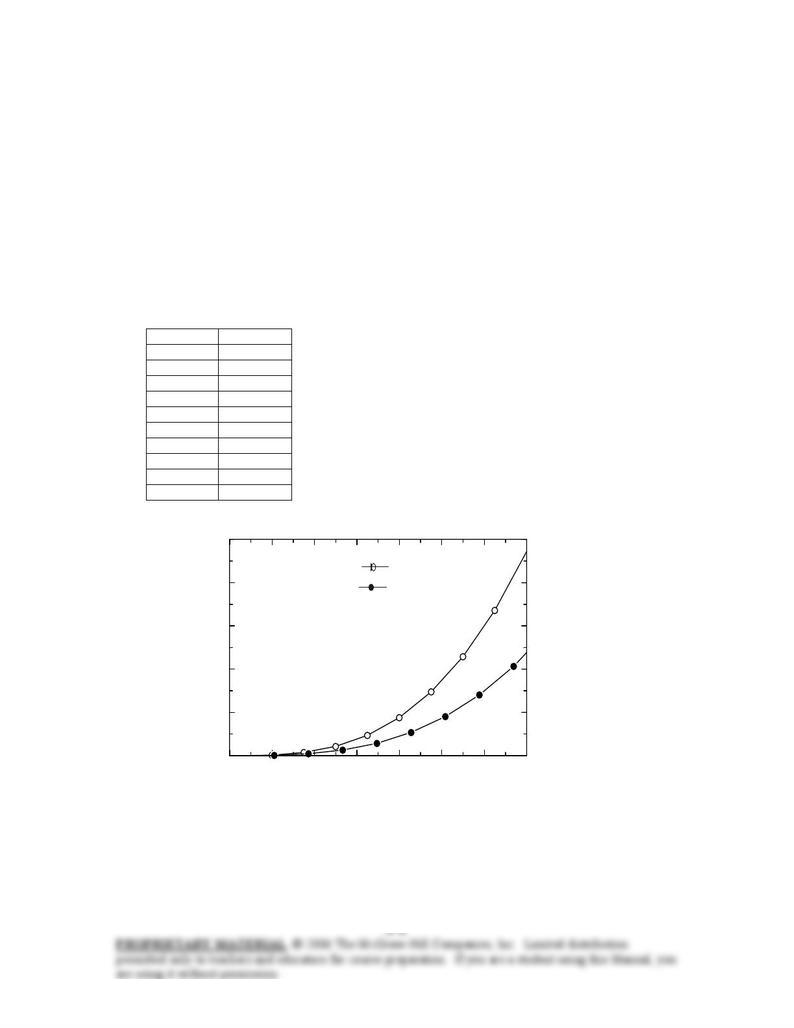
2-6 A balloon is filled with helium gas. The mole number and the mass of helium in the balloon are to
be determined. The effect of the balloon diameter on the mass of helium is to be investigated, and the
results are to be tabulated and plotted.
“Given Data”
{D=6″[m]”}
{P=200″[kPa]”}
T=20“[C]”
P=100“[kPa]”
R_u=8.314“[kJ/kmol*K]”
“Solution”
P*V=N*R_u*(T+273)
V=4*pi*(D/2)^3/3“[m^3]”
m=N*MOLARMASS(Helium)“[kg]”
D [m] m [kg]
0.5 0.01075
2.111 0.8095
3.722 4.437
5.333 13.05
6.944 28.81
8.556 53.88
10.17 90.41
11.78 140.6
13.39 206.5
15 290.4
0246810 12 14
0
100
200
300
400
500
D [m]
m [kg]
Mass of Helium in Balloon as function of Diameter
P = 200 kPa
m [kg]
P = 100 kPa

Chapter 2 Properties of Fluids
2-7 An automobile tire is inflated with air. The pressure rise of air in the tire when the tire is heated and the
amount of air that must be bled off to reduce the temperature to the original value are to be determined.
Assumptions 1 At specified conditions, air behaves as an ideal gas. 2 The volume of the tire remains
constant.
Properties The gas constant of air is R = 0.287 kPa⋅m3/kg⋅K.
Analysis Initially, the absolute pressure in the tire is
PPP
gatm1=+ = + =210 100 310 kPa
Treating air as an ideal gas and assuming the volume of the tire to
remain constant, the final pressure in the tire can be determined from
kPa336kPa)(310
K298
K323
1
1
2
2
2
22
1
11 ===→= P
T
T
P
T
P
T
P
VV
Tire
25°C
210 kPa
Thus the pressure rise is
kPa 26=−=−=∆ 310336
12 PPP
The amount of air that needs to be bled off to restore pressure to its original value is
kg 0.0070=−=−=∆
=
⋅⋅
==
=
⋅⋅
==
0.08360.0906
kg0.0836
K)K)(323/kgmkPa(0.287
)mkPa)(0.025(310
kg0.0906
K)K)(298/kgmkPa(0.287
)mkPa)(0.025(310
21
3
3
2
2
2
3
3
1
1
1
mmm
RT
P
m
RT
P
m
V
V
2-8E An automobile tire is under inflated with air. The amount of air that needs to be added to the tire to
raise its pressure to the recommended value is to be determined.
Assumptions 1 At specified conditions, air behaves as an ideal gas. 2 The volume of the tire remains
constant.
Properties The gas constant of air is R = 0.3704 psia⋅ft3/lbm⋅R.
Tire
0.53 ft3
90°F
20
p
sia
Analysis The initial and final absolute pressures in the tire are
P1 = Pg1 + Patm = 20 + 14.6 = 34.6 psia
P2 = Pg2 + Patm = 30 + 14.6 = 44.6 psia
Treating air as an ideal gas, the initial mass in the tire is
lbm 0.0900
R) R)(550/lbmftpsia (0.3704
)ft psia)(0.53 (34.6
3
3
1
1
1=
⋅⋅
== RT
P
m
V
Noting that the temperature and the volume of the tire remain constant, the final mass in the tire becomes
lbm 0.1160
R) R)(550/lbmftpsia (0.3704
)ft psia)(0.53 (44.6
3
3
2
2
2=
⋅⋅
== RT
P
m
V
Thus the amount of air that needs to be added is
lbm 0.0260
=
−=−=∆ 0.09000.1160
12 mmm

Chapter 2 Properties of Fluids
2-9E A rigid tank contains slightly pressurized air. The amount of air that needs to be added to the tank to
raise its pressure and temperature to the recommended values is to be determined. √
Assumptions 1 At specified conditions, air behaves as an ideal gas. 2 The volume of the tank remains
constant.
Properties The gas constant of air is R = 0.3704 psia⋅ft3/lbm⋅R.
Analysis Treating air as an ideal gas, the initial volume and the final mass in the tank are determined to be
lbm 33.73
R) R)(550/lbmftpsia (0.3704
)ft 3psia)(196. (35
ft 196.3
psia20
R) R)(530/lbmftpsia 4lbm)(0.370 (20
3
3
2
2
2
3
3
1
11
=
⋅⋅
==
=
⋅⋅
==
RT
P
m
P
RTm
V
V
Air, 20 lbm
20 psia
70°F
Thus the amount of air added is
lbm 13.7
=
−=−=∆ 20.033.73
12 mmm
Chapter 2 Properties of Fluids
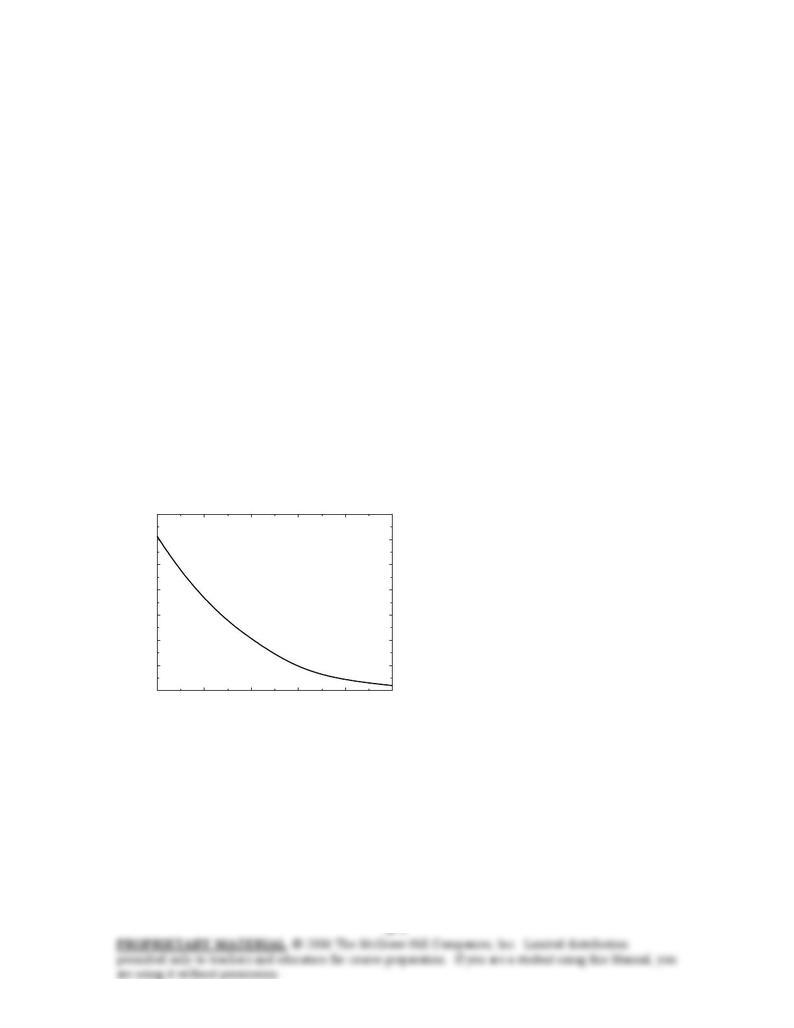
2-10 The variation of density of atmospheric air with elevation is given in tabular form. A relation for the
variation of density with elevation is to be obtained, the density at 7 km elevation is to be calculated, and
the mass of the atmosphere using the correlation is to be estimated. √
Assumptions 1 Atmospheric air behaves as an ideal gas. 2 The earth is perfectly sphere with a radius of
6377 km, and the thickness of the atmosphere is 25 km.
Properties The density data are given in tabular form as
r, km z, km
ρ
, kg/m3
6377 0 1.225
6378 1 1.112
6379 2 1.007
6380 3 0.9093
6381 4 0.8194
6382 5 0.7364
6383 6 0.6601
6385 8 0.5258
6387 10 0.4135
6392 15 0.1948
6397 20 0.08891
6402 25 0.04008
Analysis Using EES, (1) Define a trivial function rho= a+z in equation window, (2) select new parametric
table from Tables, and type the data in a two-column table, (3) select Plot and plot the data, and (4) select
plot and click on “curve fit” to get curve fit window. Then specify 2nd order polynomial and enter/edit
equation. The results are:
0 5 10 15 20 25
0
0.2
0.4
0.6
0.8
1
1.2
1.4
z, km
ρ, kg/m3
ρ(z) = a + bz + cz2 = 1.20252 – 0.101674z + 0.0022375z2 for the unit of kg/m3,
(or, ρ(z) = (1.20252 – 0.101674z + 0.0022375z2)×109 for the unit of kg/km3)
where z is the vertical distance from the earth surface at sea level. At z = 7 km, the equation would give ρ =
0.60 kg/m3.