Chapter 23
1.
a. Uncle Henry’s purchasing of the new, domestically-manufactured refrigerator will
influence the consumption component of GDP.
b. Aunt Jane contributes to GDP when buying a new house. In particular, it is a
contribution to the investment component.
c. The old Victorian house that the Jacksons buy from the Walkers cannot affect the
GDP, because of two reasons. Firstly, since the house was not newly built, it was
already counted in the GDP of the year when it was constructed. Additionally, this
purchasing only involves two families and they do not produce anything new, so this is
not related to GDP.
d. My paying to have my haircut is counted in the consumption component of the GDP,
because I make payment to receive a service.
e. That Ford selling an inventory car does not increase or decrease GDP in total. As the
car was counted as Ford’s investment spending when it was put in the inventory,
investment decreases now that it is sold. Meanwhile, consumption also increases by
exactly that amount. Therefore, GDP does not change.
f. As the car Ford manufactured is sold as a capital good (Avis will use this car as a
means to make more money, then to buy more goods and services), we will see an
increase in investment, so GDP also witnesses a rise.
g. Using money to repave the highway is how the government spends on goods and
services for its citizens, so the government purchases component increases in this
case.
h. When my grandmother is sent a Social Security check, this is a transfer payment –
the government pays but in no exchange for any goods or services. Hence, no changes
happen to GDP.
i. My parents’ purchasing increases consumption, but that decreases net exports as
well, since the wine bottle was not made inside the USA. In conclusion, we see no
change in GDP.
j. Expanding a factory implies purchasing new equipment and spending on new
infrastructure. So investment escalates, so does GDP.
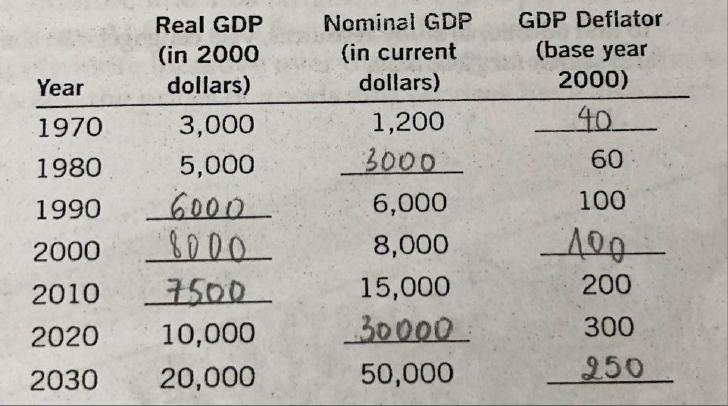
2. Table:
3. Transfer payments cannot be counted in GDP, as when the government makes
these, there is nothing being produced. Also, no goods or services currently produced
are exchanged.
4. Resold products’ value being included in GDP will result in a repeated double–
counting process, as this value will be counted in any year the used goods are on sale.
Money is only transferred from one person to another, which causes total expenditure to