Chapter 1 Introduction and Basic Concepts
Chapter 1
INTRODUCTION AND BASIC CONCEPTS
Fluid Mechanics and Classification of Fluid Flow
1-1C The flow of an unbounded fluid over a surface such as a plate, a wire, or a pipe is external flow. The
flow in a pipe or duct is internal flow if the fluid is completely bounded by solid surfaces. The flow of
liquids in a pipe is called open-channel flow if the pipe is partially filled with the liquid and there is a free
surface, such as the flow of water in rivers and irrigation ditches.
1-2C A fluid flow during which the density of the fluid remains nearly constant is called incompressible
flow. A fluid whose density is practically independent of pressure (such as a liquid) is called an
incompressible fluid. The flow of compressible fluid (such as air) is not necessarily compressible since the
density of a compressible fluid may still remain constant during flow.
1-3C A fluid in direct contact with a solid surface sticks to the surface and there is no slip. This is known
as the no-slip condition, and it is due to the viscosity of the fluid.
1-4C In forced flow, the fluid is forced to flow over a surface or in a tube by external means such as a
pump or a fan. In natural flow, any fluid motion is caused by natural means such as the buoyancy effect
that manifests itself as the rise of the warmer fluid and the fall of the cooler fluid. The flow caused by
winds is natural flow for the earth, but it is forced flow for bodies subjected to the winds since for the body
it makes no difference whether the air motion is caused by a fan or by the winds.
1-5C When a fluid stream encounters a solid surface, the fluid velocity assumes a value of zero at the
surface. The velocity then varies from zero at the surface to the freestream value sufficiently far from the
surface. The region of flow in which the velocity gradients are significant is called the boundary layer. The
development of a boundary layer is caused by the no-slip condition.
1-6C Classical approach is based on experimental observations whereas statistical approacg is based on the
average behavior of large groups of particles.
1-7C A process is said to be steady-flow if it involves no changes with time anywhere within the system
or at the system boundaries.
1-8C Stress is defined as force per unit area, and is determined by dividing the force by the area upon
which it acts. The normal component of a force acting on a surface per unit area is called the normal
stress, and the tangential component of a force acting on a surface per unit area is called shear stress. In a
fluid, the normal stress is called pressure.
1-9C A system is defined as a quantity of matter or a region in space chosen for study. The mass or region
outside the system is called the surroundings. The real or imaginary surface that separates the system from
its surroundings is called the boundary.
1-10C Systems may be considered to be closed or open, depending on whether a fixed mass or a volume in
space is chosen for study. A closed system (also known as a control mass) consists of a fixed amount of
mass, and no mass can cross its boundary. An open system, or a control volume, is a properly selected
region in space.
Chapter 1 Introduction and Basic Concepts
Mass, Force, and Units
1-11C Pound-mass lbm is the mass unit in English system whereas pound-force lbf is the force unit. One
pound-force is the force required to accelerate a mass of 32.174 lbm by 1 ft/s2. In other words, the weight
of a 1-lbm mass at sea level is 1 lbf.
1-12C Kg is the mass unit in the SI system whereas kg-force is a force unit. 1-kg-force is the force required
to accelerate a 1-kg mass by 9.807 m/s2. In other words, the weight of 1-kg mass at sea level is 1 kg-force.
1-13C There is no acceleration, thus the net force is zero in both cases.
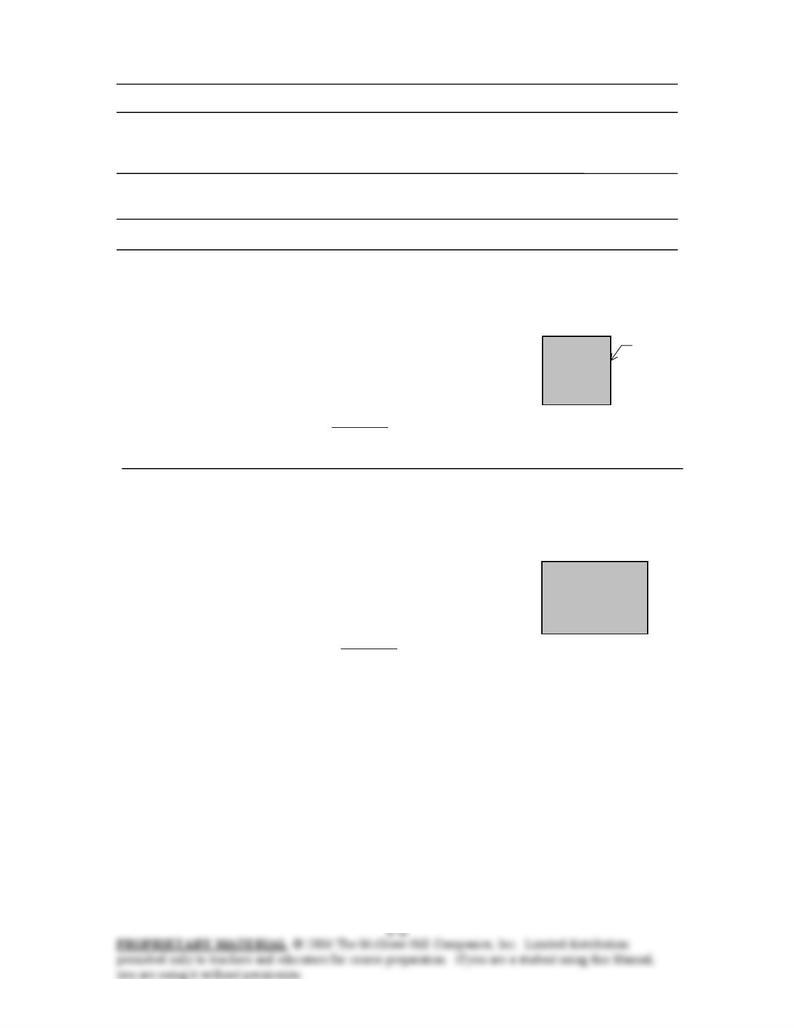
1-14 A plastic tank is filled with water. The weight of the combined system is to be determined.
Assumptions The density of water is constant throughout.
Properties The density of water is given to be ρ = 1000 kg/m3.
Analysis The mass of the water in the tank and the total mass are
mw =
ρV
=(1000 kg/m3)(0.2 m3) = 200 kg
mtotal = mw + mtank = 200 + 3 = 203 kg
Thus,
N 1991=
⋅
== 2
2
m/skg 1
N 1
)m/s kg)(9.81 (203mgW
mtank=3 kg
V
= 0.2
m3
1-15 The interior dimensions of a room are given. The mass and weight of the air in the room are to be
determined.
Assumptions The density of air is constant throughout the room.
Properties The density of air is given to be ρ = 1.16 kg/m3.
ROOM
AIR
6X6X8 m3
Analysis The mass of the air in the room is
kg 334.1=××= = )m 86)(6kg/m (1.16 33
Vρ
m
Thus,
N 3277=
⋅
== 2
2
m/skg 1
N 1
)m/s kg)(9.81 (334.1mgW
Chapter 1 Introduction and Basic Concepts
1-16 The variation of gravitational acceleration above the sea level is given as a function of altitude. The
height at which the weight of a body will decrease by 1% is to be determined.
Analysis The weight of a body at the elevation z can be expressed as
0
z
Wmgm z== − ×
−
(. . )9 807 3 32 10 6
In our case,
WW mg m
ss
== =0 99 0 99 0 99 9 807.. .()(.)
Substituting,
m 29,540=→×−= −zz)1032.3807.9()807.9(99.0 6
Sea level
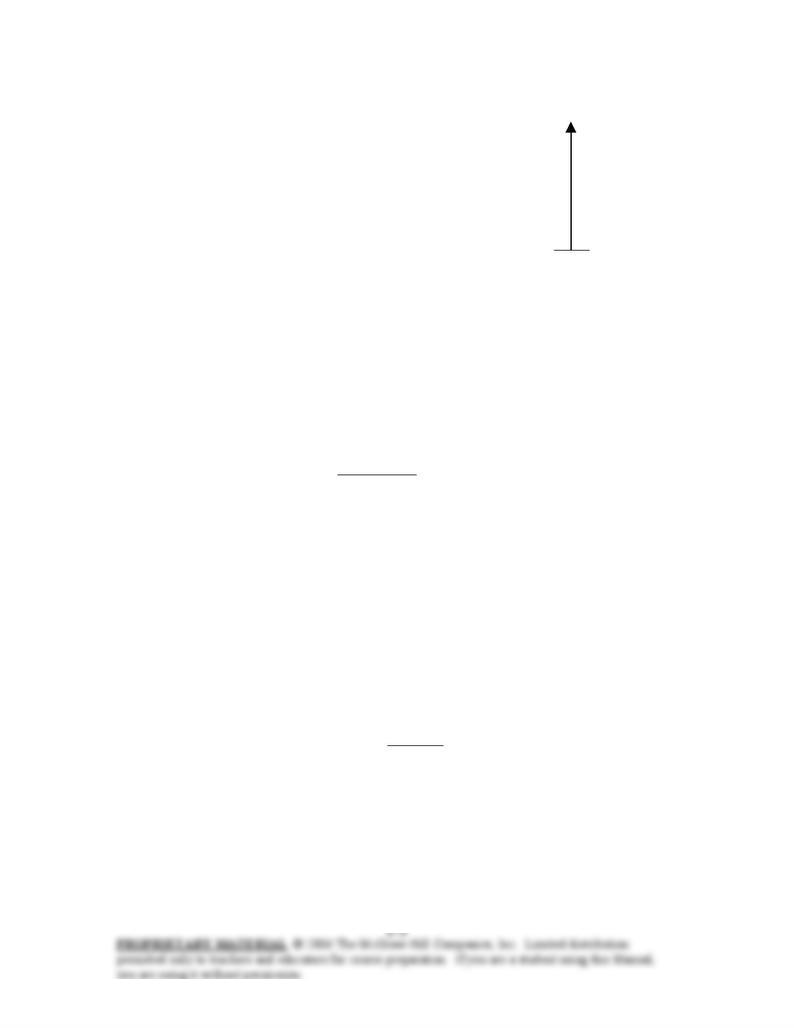
1-17E An astronaut took his scales with him to space. It is to be determined how much he will weigh on
the spring and beam scales in space.
Analysis (a) A spring scale measures weight, which is the local gravitational force applied on a body:
lbf 25.5=
⋅
== 2
2
ft/slbm 32.2
lbf 1
)ft/s lbm)(5.48 (150mgW
(b) A beam scale compares masses and thus is not affected by the variations in gravitational acceleration.
The beam scale will read what it reads on earth,
lbf 150=W
1-18 The acceleration of an aircraft is given in g’s. The net upward force acting on a man in the aircraft is
to be determined.
Analysis From the Newton’s second law, the force applied is
N 5297=
⋅
×=== 2
2
m/skg 1
N 1
)m/s 9.81kg)(6 (90)g 6(mmaF