Chapter 13 Open-Channel Flow
Chapter 13
OPEN-CHANNEL FLOW
Classification, Froude Number, and Wave Speed
13-1C Open-channel flow is the flow of liquids in channels open to the atmosphere or in partially filled
conduits, and is characterized by the presence of a liquid-gas interface called the free surface, whereas
internal flow is the flow of liquids or gases that completely fill a conduit.
13-2C Flow in a channel is driven naturally by gravity. Water flow in a river, for example, is driven by the
elevation difference between the source and the sink. The flow rate in an open channel is established by the
dynamic balance between gravity and friction. Inertia of the flowing fluid also becomes important in
unsteady flow.
13-3C The free surface coincides with the hydraulic grade line (HGL), and the pressure is constant along
the free surface.
13-4C No, the slope of the free surface is not necessarily equal to the slope of the bottom surface even
during steady fully developed flow.
13-5C The flow in a channel is said to be uniform if the flow depth (and thus the average velocity) remains
constant. Otherwise, the flow is said to be nonuniform or varied, indicating that the flow depth varies with
distance in the flow direction. Uniform flow conditions are commonly encountered in practice in long
straight sections of channels with constant slope and constant cross-section.
13-6C In open channels of constant slope and constant cross-section, the fluid accelerates until the head
loss due to frictional effects equals the elevation drop. The fluid at this point reaches its terminal velocity,
and uniform flow is established. The flow remains uniform as long as the slope, cross-section, and the
surface roughness of the channel remain unchanged. The flow depth in uniform flow is called the normal
depth yn, which is an important characteristic parameter for open-channel flows.
13-7C The presence of an obstruction in a channel such as a gate or a change in slope or cross-section
causes the flow depth to vary, and thus the flow to become varied or nonuniform. The varied flow is called
rapidly varied flow (RVF) if the flow depth changes markedly over a relatively short distance in the flow
direction (such as the flow of water past a partially open gate or shortly before a falls), and gradually
varied flow (GVF) if the flow depth changes gradually over a long distance along the channel.
13-8C The hydraulic radius Rh is defined as the ratio of the cross-sectional flow area Ac and the wetted
perimeter p. That is, Rh = Ac/p. Knowing the hydraulic radius, the hydraulic diameter is determined from Dh
= 4Rh.
Chapter 13 Open-Channel Flow
13-9C Knowing the average flow velocity and flow depth, the Froude number is determined from
gyV /Fr =. Then the flow is classified as
Fr < 1 Subcritical or tranquil flow
Fr = 1 Critical flow
Fr > 1 Supercritical or rapid flow
.
13-10C Froude number is a dimensionless number that governs the character of flow in open channels. It is
defined as gyV /Fr = where g is the gravitational acceleration, V is the mean fluid velocity at a cross-
section, and Lc is the characteristic length which is taken to be the flow depth y for wide rectangular
channels. It represents the ratio of inertia forces to viscous forces in channel flow. The Froude number is
also the ratio of the flow speed to wave speed, Fr = V /co.
13-11C The flow depth corresponding to a Froude number of Fr = 1 is the critical depth, and it is
determined from c
gy=V or . gVyc/
2
=
13-12C Yes to both questions.
13-13 The flow of water in a wide channel is considered. The speed of a small disturbance in flow for two
different flow depths is to be determined for both water and oil.
Assumptions The distance across the wave is short and thus friction at the bottom surface and air drag at
the top are negligible,
Analysis Surface wave speed can be determined directly from the relation gh=
0
c.
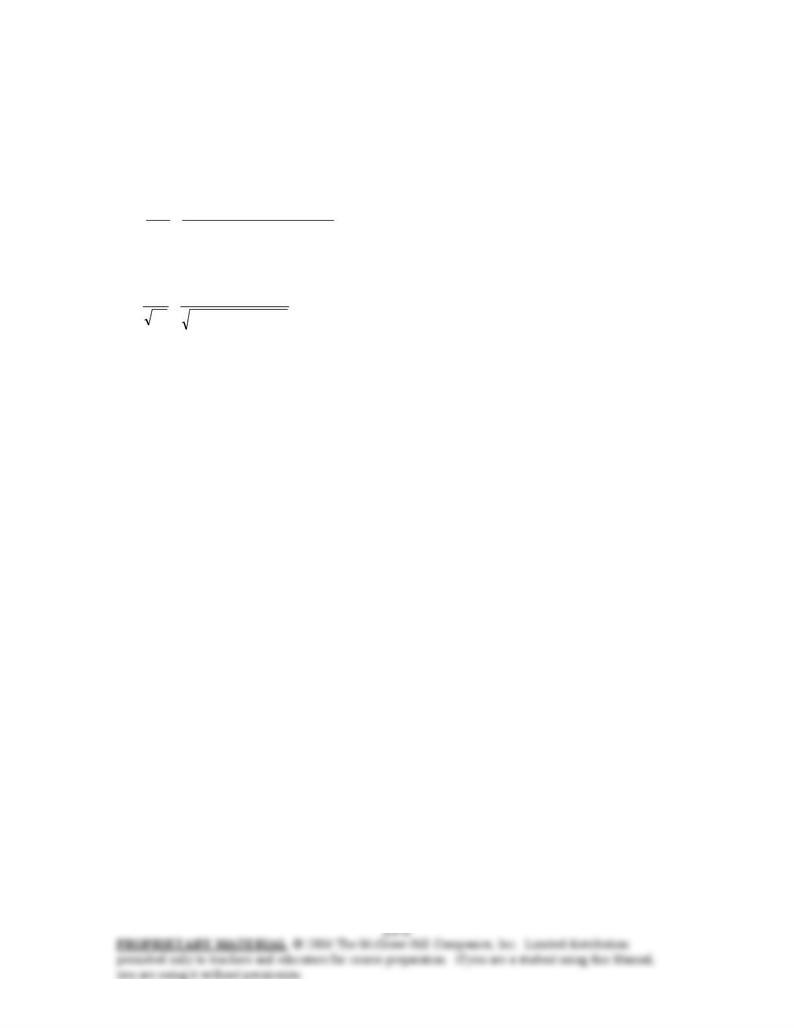
(a) m/s 0.990=== )m1.0()m/s81.9( 2
0ghc
(b) m/s2.80=== m)(0.8)m/s(9.81 2
0ghc
Therefore, a disturbance in the flow will travel at a speed of 0.990 m/s in the first case, and 2.80 m/s in the
second case.
Discussion. Note that wave speed depends on the water depth, and the wave speed increases as the water
depth increases as long as the water remains shallow. Results would not change if the fluid were oil,
because the wave speed depends only on the fluid depth.
Chapter 13 Open-Channel Flow
13-14 Water flows uniformly in a wide rectangular channel. For given flow depth and velocity, it is to be
determined whether the flow is laminar or turbulent, and whether it is subcritical or supercritical.
Assumptions The flow is uniform.
Properties The density and dynamic viscosity of water at 20ºC are
ρ
= 998.0 kg/m3 and
µ
= 1.002×10⁻³
kg/m⋅s.
Analysis (a) The Reynolds number of the flow is
5
3
3
10984.3
s kg/m10002.1
)m2.0)(m/s2)( kg/m0.998(
Re ×=
⋅×
== −
µ
ρ
Vy
which is greater than the critical value of 500. Therefore, the flow is turbulent.
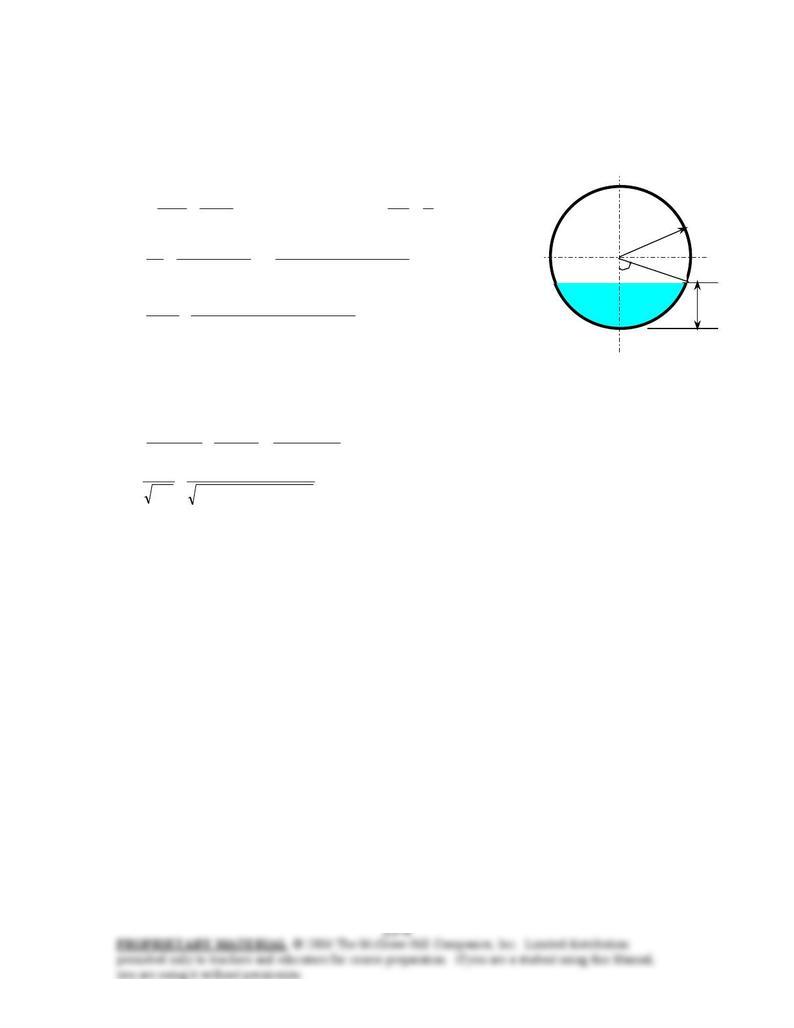
(b) The Froude number is
1.43
m))(0.2m/s(9.81
m/s2
Fr 2=== gy
V
which is greater than 1. Therefore, the flow is supercritical.
Discussion. The result in (a) is expected since almost all open channel flows are turbulent. Also, hydraulic
radius for a wide rectangular channel approaches the water depth y as the ratio y/b approaches zero.
Chapter 13 Open-Channel Flow
13-15 Water flow in a partially full circular channel is considered. For given water depth and average
velocity, the hydraulic radius, Reynolds number, and the flow regime are to be determined.
Assumptions Flow is uniform.
Properties The density and dynamic viscosity of water at 20ºC are
ρ
= 998.0 kg/m3 and
µ
= 1.002×10⁻³
kg/m⋅s.
Analysis From geometric considerations,
3360
2
6060 5.0
1
5.01
cos
π
π
θθ
==°=→=
−
=
−
=R
aR
Then the hydraulic radius becomes
m0.293=
−
=
−
== m) 1(
3/2
)3/cos()3/sin(3/
2
cossin
π
π
π
π
θ
θ
θ
θ
R
p
A
Rc
h
The Reynolds number of the flow is
5
105.84 ×=
⋅×
== −s kg/m10002.1
)m293.0)(m/s2)( kg/m0.998(
Re 3
3
µ
ρ
h
VR
which is greater than the critical value of 500. Therefore, the flow is turbulent.
When calculating the Froude number, the hydraulic depth should be used rather than the
maximum depth or the hydraulic radius. For a non-rectangular channel, hydraulic depth is defined as the
ratio of the flow area to top width,
θ
R = 1 m
a=0.5 m
222 m 6142.0)]3/cos()3/sin(3/[m) 1()cossin( =−=−=
πππθθθ
RAc
m3546.0
m)sin601(2
m6142.0
sin2 widthTop
2
=
°
===
θ
R
AA
ycc
h
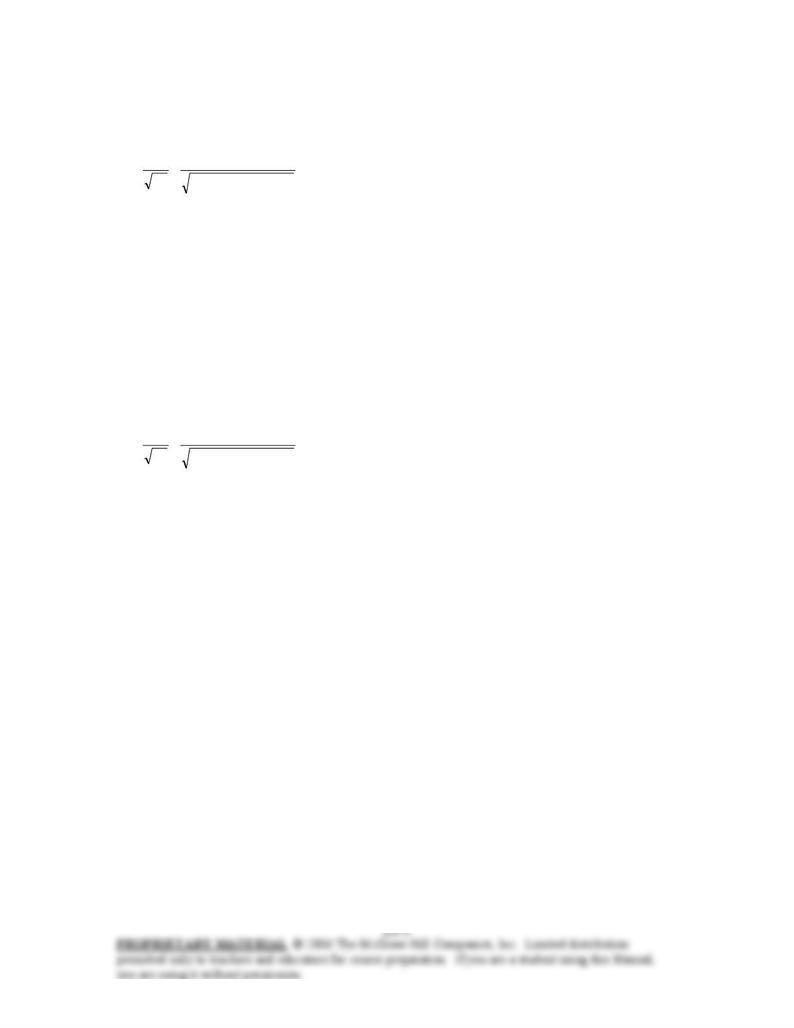
1.07
m))(0.3546m/s(9.81
m/s2
Fr 2=== gy
V
which is greater than 1. Therefore, the flow is supercritical (although, very close to critical).
Discussion Note that if the maximum flow depth were used instead of the hydraulic depth, the result would
be subcritical flow, which is not true.
Chapter 13 Open-Channel Flow
13-16 Water flows uniformly in a wide rectangular channel. For given values of flow depth and velocity, it
is to be determined whether the flow is subcritical or supercritical.
Assumptions 1 The flow is uniform. 2 The channel is wide and thus the side wall effects are negligible.
Analysis The Froude number is
51.4
m))(0.08m/s(9.81
m/s4
Fr 2=== gy
V
which is greater than 1. Therefore, the flow is supercritical.
Discussion Note that the Froude Number is not function of any temperature-dependent properties, and thus
temperature.
13-17 Rain water flows on a concrete surface. For given values of flow depth and velocity, it is to be
determined whether the flow is subcritical or supercritical.
Assumptions 1 The flow is uniform. 2 The thickness of water layer is constant.
Analysis The Froude number is
93.2
m))(0.02m/s(9.81
m/s1.3
Fr 2=== gy
V
which is greater than 1. Therefore, the flow is supercritical.
Discussion Note that this water layer will undergo a hydraulic jump when the ground slope decreases or
becomes adverse.