CHAPTER 13
INVESTMENTS
Debt Investments
Why Companies Invest
Companies purchase investments in debt or share securities generally
for one of three reasons. First, a company may have excess cash that it
does not need for the immediate purchase of operating assets. For
example, many companies experience seasonal fl uctuations in sales. A
marina has more sales in the spring and summer than in the fall and
winter. (The reverse is true for many ski shops.) At the end of an
operating cycle, the marina may have cash on hand that is temporarily
idle until the start of another operating cycle. It may invest the excess
funds to earn a greater return—interest and dividends—than it would
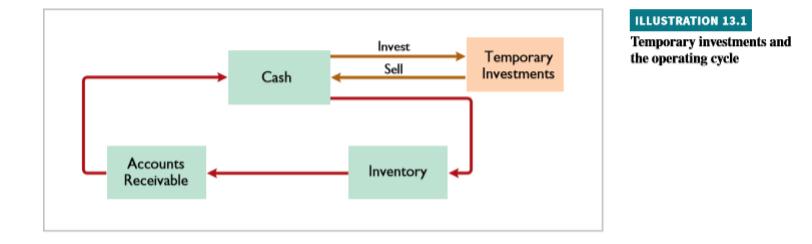
get by just holding the funds in the bank. Illustration 13.1 depicts the role
that such temporary investments play in the o perating cycle.
Excess cash may also result from economic cycles. For example, when
the economy is booming, Siemens (DEU) generates considerable excess
cash. It uses some of this cash to purchase new plant and equipment,
and pays out some of the cash in dividends. But, it may also invest excess
cash in liquid assets in anticipation of a future downturn in the economy.
It can then liquidate these investments during a recession, when sales
slow and cash is scarce.
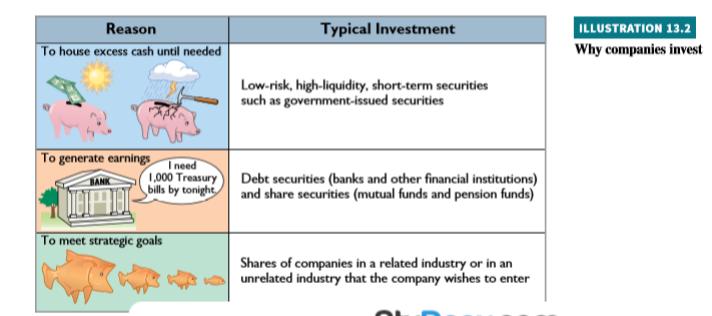
When investing excess cash for short periods of time, companies invest
in low-risk, highly liquid securities—most often short-term government
securities. It is generally not wise to invest short–term excess cash in
ordinary shares because share investments can experience rapid price
changes. If you did invest your short–term excess cash in shares and the
price of the shares declined signifi cantly just before you needed cash
again, you would be forced to sell your investment at a loss.
A second reason some companies purchase investments is to generate
earnings from investment income. For example, banks make most of
their earnings by lending money, but they also generate earnings by
investing primarily in debt securities. Conversely, mutual share funds
invest primarily in share securities in order to benefi t from share-price
appreciation and dividend revenue.
Third, companies also invest for strategic reasons. A company can
exercise some infl uence over a customer or supplier by purchasing a
signifi cant, but not controlling, interest in that company. Or, a company
may purchase a non-c ontrolling interest in another company in a related
industry in which it wishes to establish a presence. A company may also
choose to purchase a controlling interest in another company. For
example, Kraft (USA) purchased Cadbury (GBR) to expand its presence in
the food industry. In summary,
Accounting for Debt Investments
Debt investments are investments in government and company bonds.
In accounting for debt investments, companies make entries to record
(1) the acquisition, (2) the interest revenue, and (3) the sale.
Recording Acquisition of Bonds
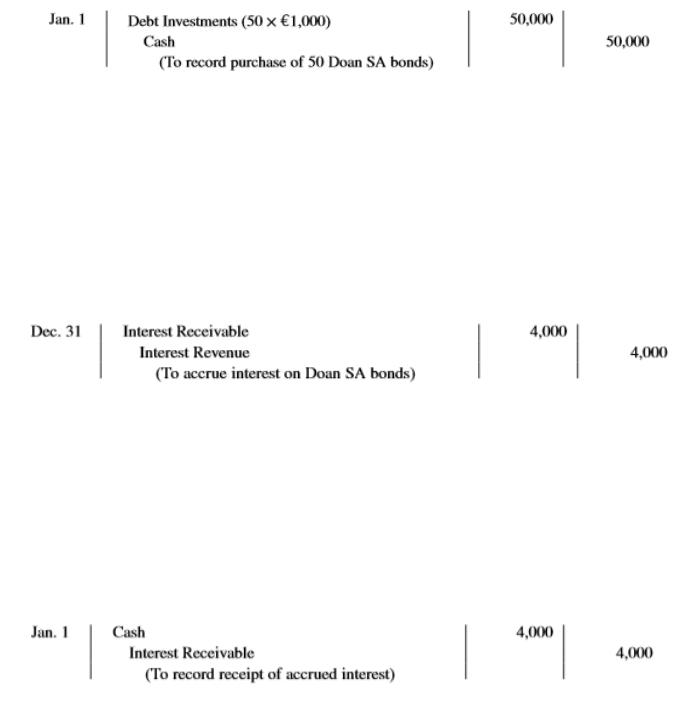
At acquisition, investments are recorded at cost. Assume, for example,
that Kuhl NV acquires 50 Doan SA 8%, 10-year, €1,000 bonds on January
1, 2020, at a cost of €50,000. The entry to record the investment is:
Recording Bond Interest
The Doan SA bonds pay interest of €4,000 annually on January 1 (€50,000
× 8%). If Kuhl NV’s fi scal year ends on December 31, it accrues the
interest of €4,000 earned since J anuary 1. The adjusting entry is:
Kuhl reports Interest Receivable as a current asset in the statement of fi
nancial position. It reports Interest Revenue under “Other income and
expense” in the income statement. Kuhl reports receipt of the interest
on January 1 as follows.
A credit to Interest Revenue at this time is incorrect because the
company earned and accrued interest revenue in the preceding
accounting period.

Recording Sale of Bonds
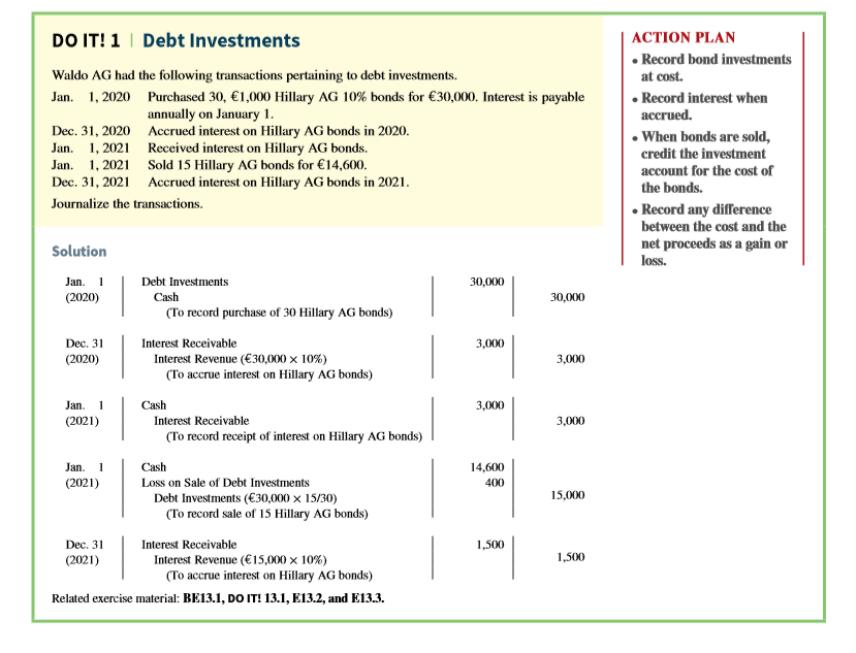
When Kuhl NV sells the bonds, it credits the investment account for the
cost of the bonds. Kuhl records as a gain or loss any diff erence between
the net proceeds from the sale (sales price less brokerage fees) and the
cost of the bonds.
Assume, for example, that Kuhl receives net proceeds of €54,000 on the
sale of the Doan SA bonds on January 1, 2021, after receiving the interest
due. Since the securities cost €50,000, the company realizes a gain of
€4,000. It records the sale as:
Kuhl reports any gains or losses on the sale of debt investments under
“Other income and expense” in the income statement.
Share Investments
Share investments are investments in the shares of other companies.
When a company holds shares (and/or debt) of several diff erent
companies, the group of securities is identifi ed as an investment
portfolio.
The accounting for investments in shares depends on the extent of the
investor’s infl uence over the operating and financial affairs of the issuing
company (the investee). Illustration 13.3 shows the general guidelines.
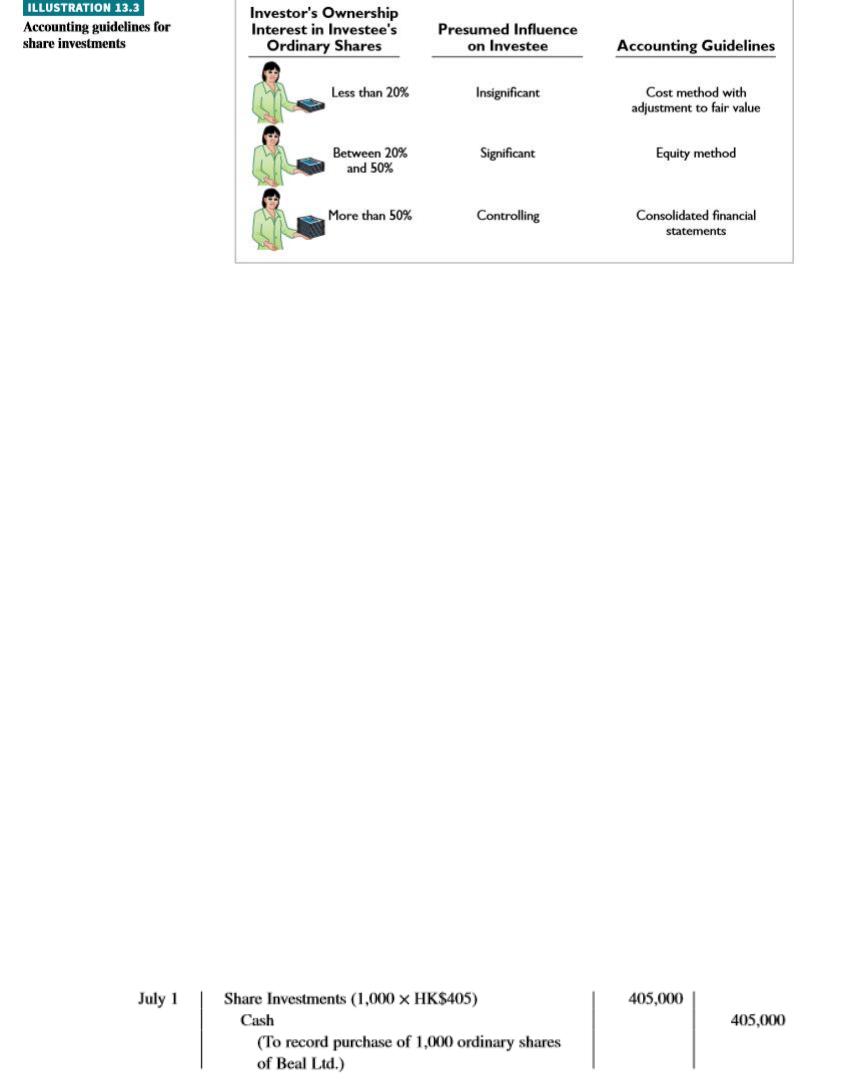
Companies are required to use judgment instead of blindly following the
guidelines.1 However, for homework purposes use the percentage
guidelines in Illustration 13.3 to account for share investments. We
explain the application of each guideline next.
Holdings of Less than 20%
In accounting for share investments of less than 20%, companies use the
cost method. Under the cost method, companies record the investment
at cost, and recognize revenue only when cash dividends are received
(see Helpful Hint).
Recording Acquisition of Shares
At acquisition, share investments are recorded at cost. For example,
assume that on July 1, 2020, Lee Ltd. acquires 1,000 shares (10%
ownership) of Beal Ltd. Lee pays HK$405 per share. The entry for the
purchase is:
Recording Dividends
During the time Lee owns the shares, it makes entries for any cash
dividends received. If Lee receives a HK$20 per share dividend on
December 31, the entry is:
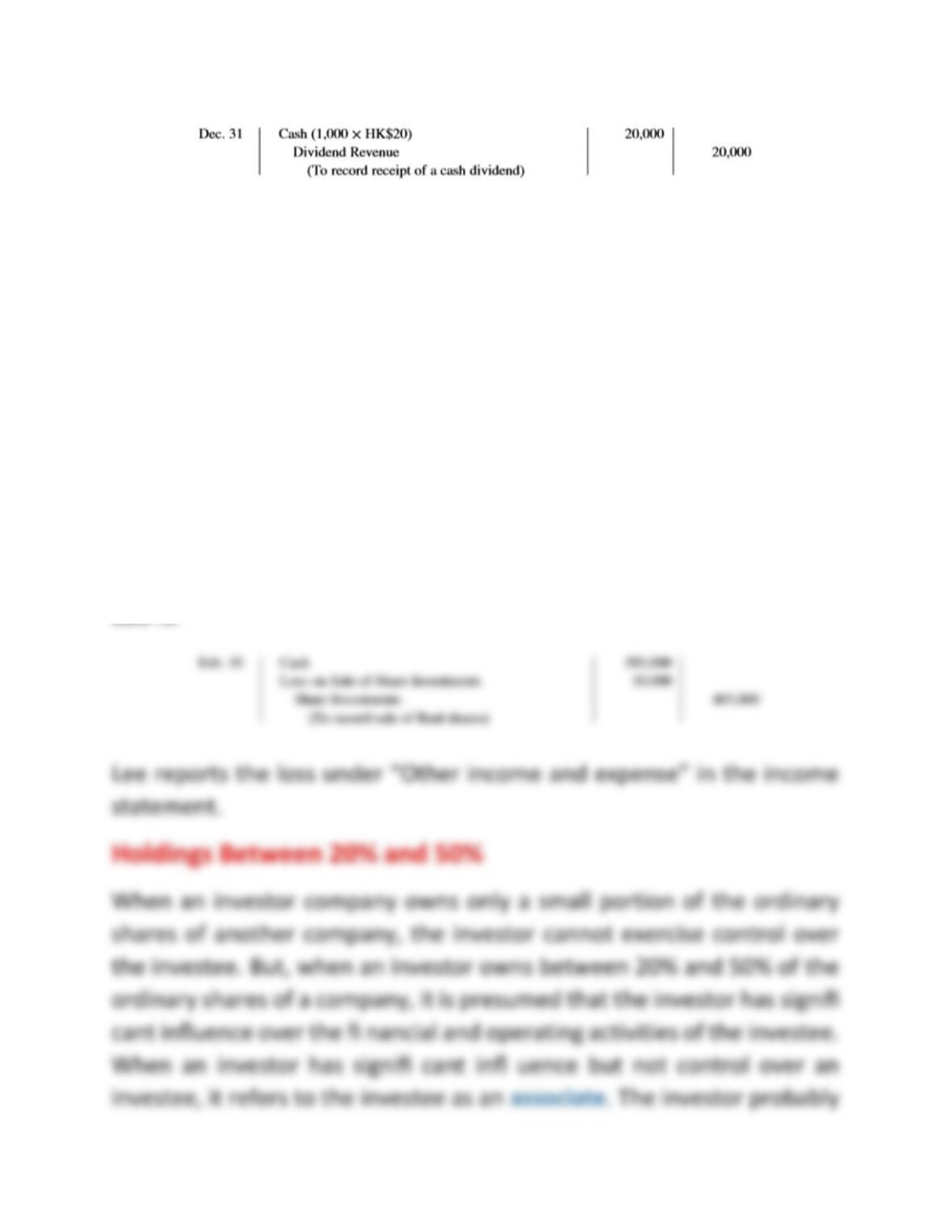
Lee reports Dividend Revenue under “Other income and expense” in the
income statement. Unlike interest on notes and bonds, dividends do not
accrue. Therefore, companies do not make adjusting entries to accrue
dividends.
Recording Sale of Shares
When a company sells a share investment, it recognizes as a gain or a
loss the diff erence b etween the net proceeds from the sale (sales price
less brokerage fees) and the cost of the shares.
Assume that Lee Ltd. receives net proceeds of HK$395,000 on the sale of
its Beal shares on February 10, 2021. Because the shares cost
HK$405,000, Lee incurred a loss of HK$10,000. The entry to record the