Chapter 12 Compressible Flow
Normal Shocks in Nozzle Flow
12-68C No, because the flow must be supersonic before a shock wave can occur. The flow in the
converging section of a nozzle is always subsonic.
12-69C The Fanno line represents the states which satisfy the conservation of mass and energy equations.
The Rayleigh line represents the states which satisfy the conservation of mass and momentum equations.
The intersections points of these lines represents the states which satisfy the conservation of mass, energy,
and momentum equations.
12-70C No, the second law of thermodynamics requires the flow after the shock to be subsonic..
12-71C (a) decreases, (b) increases, (c) remains the same, (d) increases, and (e) decreases.
12-72C Oblique shocks occur when a gas flowing at supersonic speeds strikes a flat or inclined surface.
Normal shock waves are perpendicular to flow whereas inclined shock waves, as the name implies, are
typically inclined relative to the flow direction. Also, normal shocks form a straight line whereas oblique
shocks can be straight or curved, depending on the surface geometry.
12-73C Yes, the upstream flow have to be supersonic for an oblique shock to occur. No, the flow
downstream of an oblique shock can be subsonic, sonic, and even supersonic.
12-74C Yes. Conversely, normal shocks can be thought of as special oblique shocks in which the shock
angle is
β
=
π
/2, or 90o.
12-75C When the wedge half-angle δ is greater than the maximum deflection angle
θ
max, the shock
becomes curved and detaches from the nose of the wedge, forming what is called a detached oblique shock
or a bow wave. The numerical value of the shock angle at the nose is be
β
= 90o.
12-76C When supersonic flow impinges on a blunt body like the rounded nose of an aircraft, the wedge
half-angle
δ
at the nose is 90o, and an attached oblique shock cannot exist, regardless of Mach number.
Therefore, a detached oblique shock must occur in front of all such blunt-nosed bodies, whether two-
dimensional, axisymmetric, or fully three-dimensional.
12-77C Isentropic relations of ideal gases are not applicable for flows across (a) normal shock waves and
(b) oblique shock waves, but they are applicable for flows across (c) Prandtl-Meyer expansion waves.
Chapter 12 Compressible Flow
12-78 For an ideal gas flowing through a normal shock, a relation for V2/V1 in terms of k, Ma1, and Ma2 is
to be developed.
Analysis The conservation of mass relation across the shock is 2211 VV
ρ
ρ
=
and it can be expressed as
===
1
2
2
1
22
11
2
1
1
2
/
/
T
T
P
P
RTP
RTP
V
V
ρ
ρ
From Eqs. 12-35 and 12-38,
−+
−+
+
+
=2/)1(Ma1
2/)1(Ma1
Ma1
Ma1
2
2
2
1
2
1
2
2
1
2
k
k
k
k
V
V
Discussion This is an important relation as it enables us to determine the velocity ratio across a normal
shock when the Mach numbers before and after the shock are known.
Chapter 12 Compressible Flow
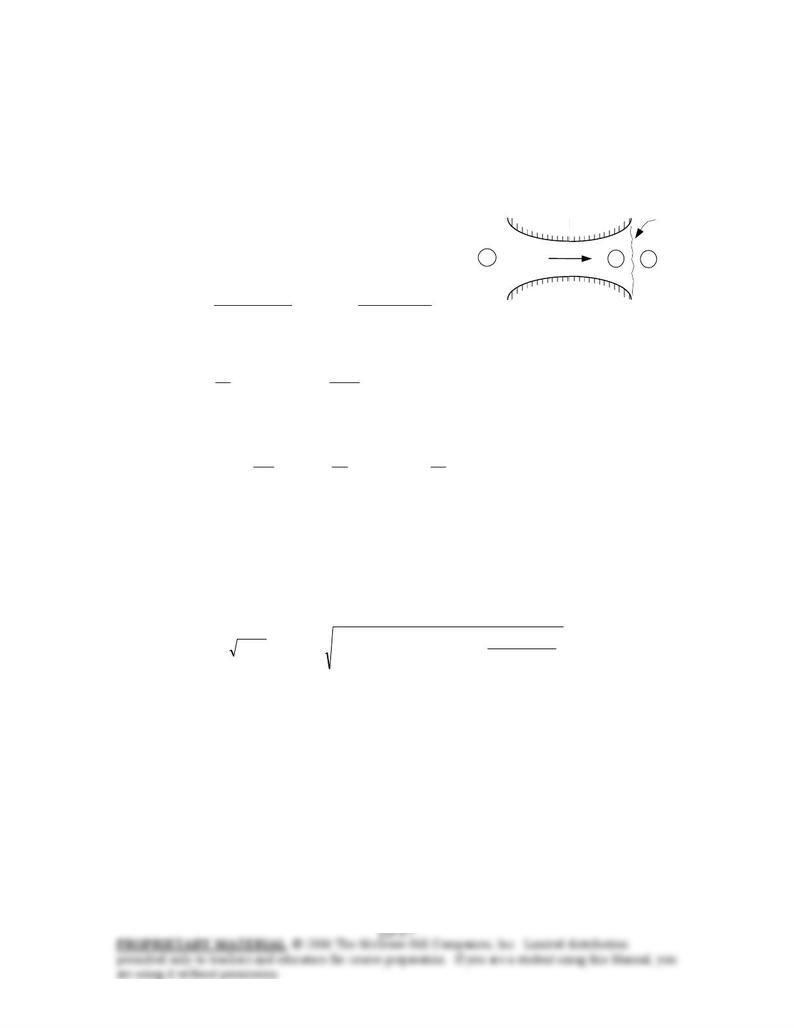
12-79 Air flowing through a converging-diverging nozzle experiences a normal shock at the exit. The
effect of the shock wave on various properties is to be determined.
Assumptions 1 Air is an ideal gas with constant specific heats. 2 Flow through the nozzle is steady, one-
dimensional, and isentropic before the shock occurs. 3 The shock wave occurs at the exit plane.
Properties The properties of air are k = 1.4 and R = 0.287 kJ/kg·K.
Analysis The inlet stagnation properties in this case are identical to the inlet properties since the inlet
velocity is negligible. Then,
P01 = Pi = 1 MPa
T01 = Ti = 300 K
Then,
K7.166
1)2–(1.4+2
2
K) 300(
Ma)1(2
2
22
1
011 =
=
−+
=k
TT
2
i 1
AIR
Shock
wave
Vi
≈
0
and
MPa 1278.0
300
166.7
MPa) 1(
4.0/4.1
)1/(
0
1
011 =
=
=
−kk
T
T
PP
The fluid properties after the shock (denoted by subscript 2) are related to those before the shock through
the functions listed in Table A-14. For Ma1 = 2.0 we read
6875.1and ,5000.4 ,7209.0 ,Ma
1
2
1
2
02
02
2==== T
T
P
P
P
P
0.5774
Then the stagnation pressure P02, static pressure P2, and static temperature T2, are determined to be
P02 = 0.7209P01 = (0.7209)(1.0 MPa) = 0.721 MPa
P2 = 4.5000P1 = (4.5000)(0.1278 MPa) = 0.575 MPa
T2 = 1.6875T1 = (1.6875)(166.7 K) = 281 K
The air velocity after the shock can be determined from V2 = Ma2c2, where c2 is the speed of sound at the
exit conditions after the shock,
V2 = Ma2c2 = m/s 194=
⋅= kJ/kg 1
s/m 1000
K) K)(281kJ/kg 287.0)(4.1()5774.0(Ma
22
22 kRT
Discussion We can also solve this problem using the relations for normal shock functions. The results
would be identical.
Chapter 12 Compressible Flow
Vi
≈
0
shock
wave
AIR 1
i 2
Pb
i 2
Pb
ressible flow and normal shock
shock
wave
Vi
≈
0
AIR 1
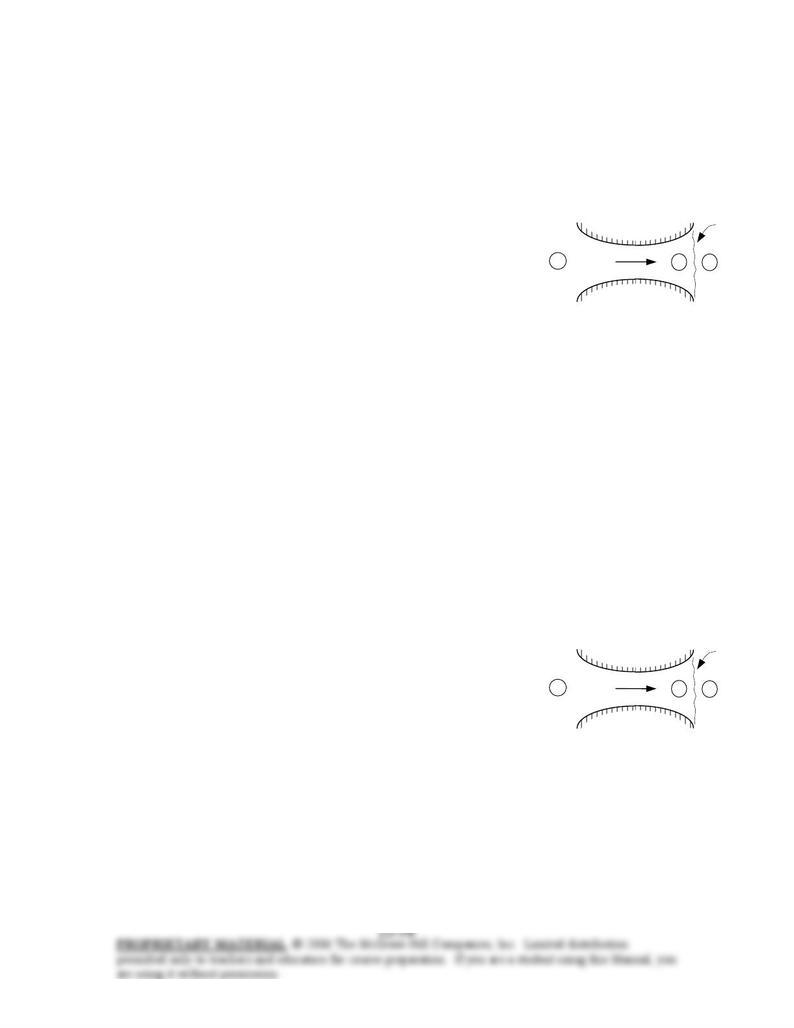
12-80 Air enters a converging-diverging nozzle at a specified state. The required back pressure that
produces a normal shock at the exit plane is to be determined for the specified nozzle geometry.
Assumptions 1 Air is an ideal gas. 2 Flow through the nozzle is steady, one-dimensional, and isentropic
before the shock occurs. 3 The shock wave occurs at the exit plane.
Analysis The inlet stagnation pressure in this case is identical to the inlet pressure since the inlet velocity is
negligible. Since the flow before the shock to be isentropic,
P01 = Pi = 2 MPa
It is specified that A/A* =3.5. From Table A-13, Mach number and the
pressure ratio which corresponds to this area ratio are the Ma1 =2.80
and P1/P01 = 0.0368. The pressure ratio across the shock for this Ma1
value is, from Table A-14, P2/P1 = 8.98. Thus the back pressure, which
is equal to the static pressure at the nozzle exit, must be
P2 =8.98P1 = 8.98×0.0368P01 = 8.98×0.0368×(2 MPa) = 0.661 MPa
Discussion We can also solve this problem using the relations for compressible flow and normal shock
functions. The results would be identical.
12-81 Air enters a converging-diverging nozzle at a specified state. The required back pressure that
produces a normal shock at the exit plane is to be determined for the specified nozzle geometry.
Assumptions 1 Air is an ideal gas. 2 Flow through the nozzle is steady, one-dimensional, and isentropic
before the shock occurs.
Analysis The inlet stagnation pressure in this case is identical to the inlet pressure since the inlet velocity is
negligible. Since the flow before the shock to be isentropic,
P0x= Pi = 2 MPa
It is specified that A/A* = 2. From Table A-13, the Mach number and the
pressure ratio which corresponds to this area ratio are the Ma1 =2.20 and P1/P01
= 0.0935. The pressure ratio across the shock for this M1 value is, from Table
A-14, P2/P1 = 5.48. Thus the back pressure, which is equal to the static
pressure at the nozzle exit, must be
P2 =5.48P1 = 5.48×0.0935P01 = 5.48×0.0935×(2 MPa) = 1.02 MPa
Discussion We can also solve this problem using the relations for comp
functions. The results would be identical.

Chapter 12 Compressible Flow
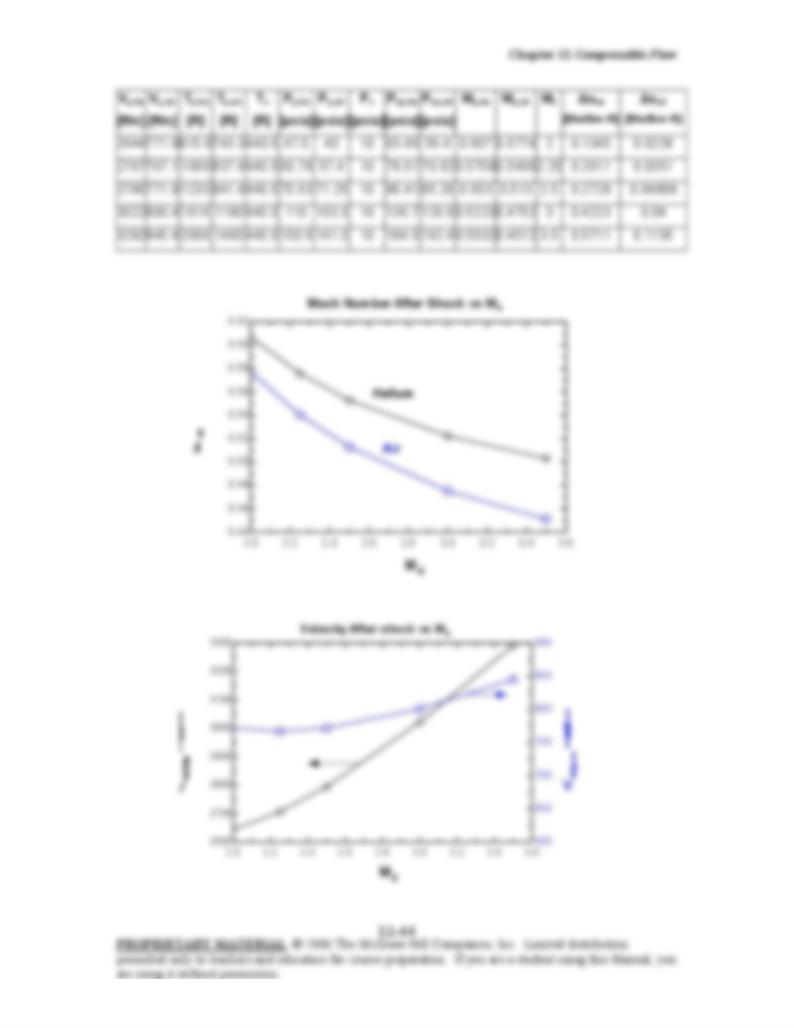
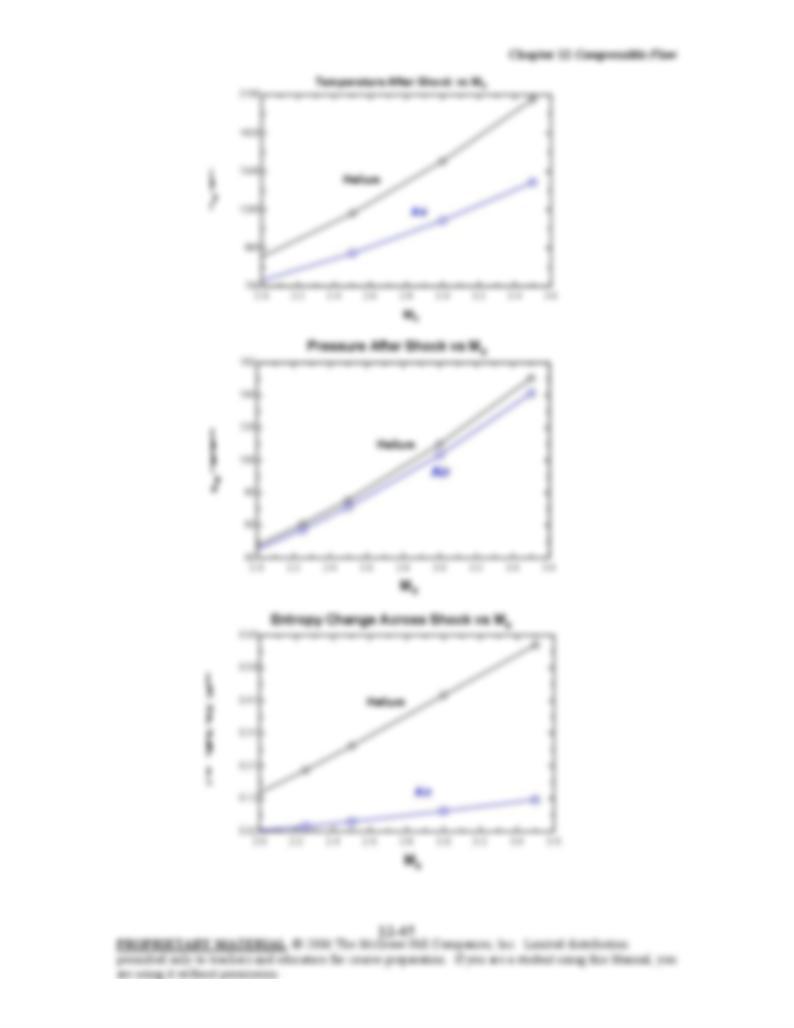
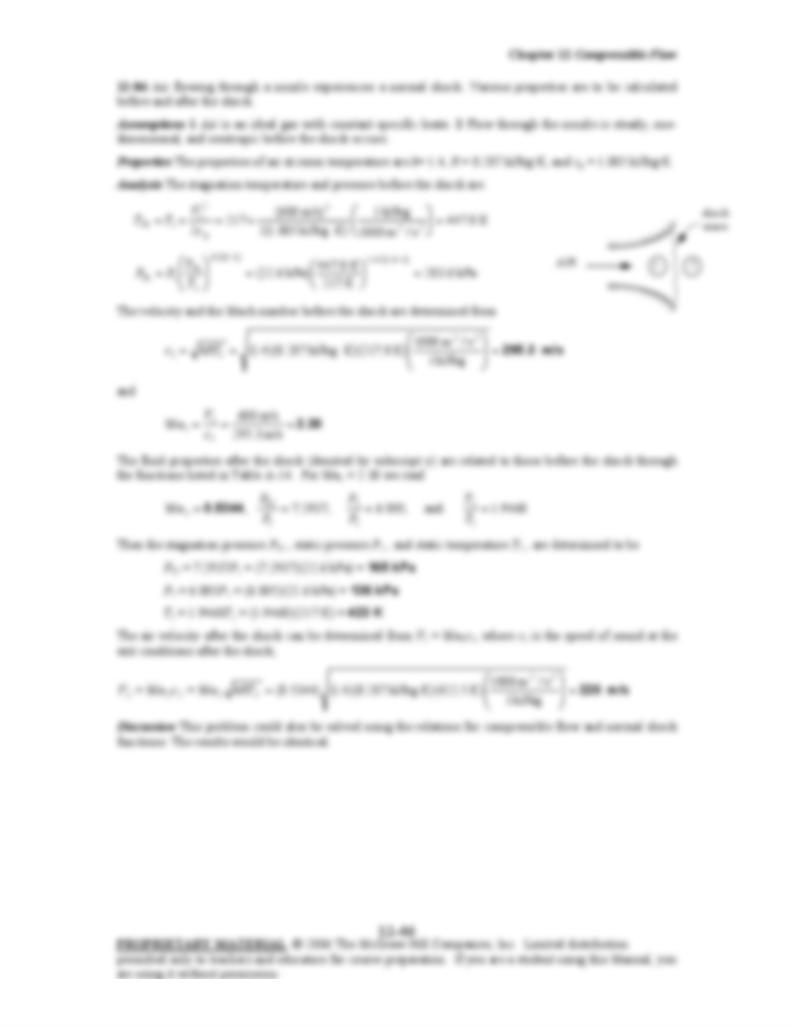
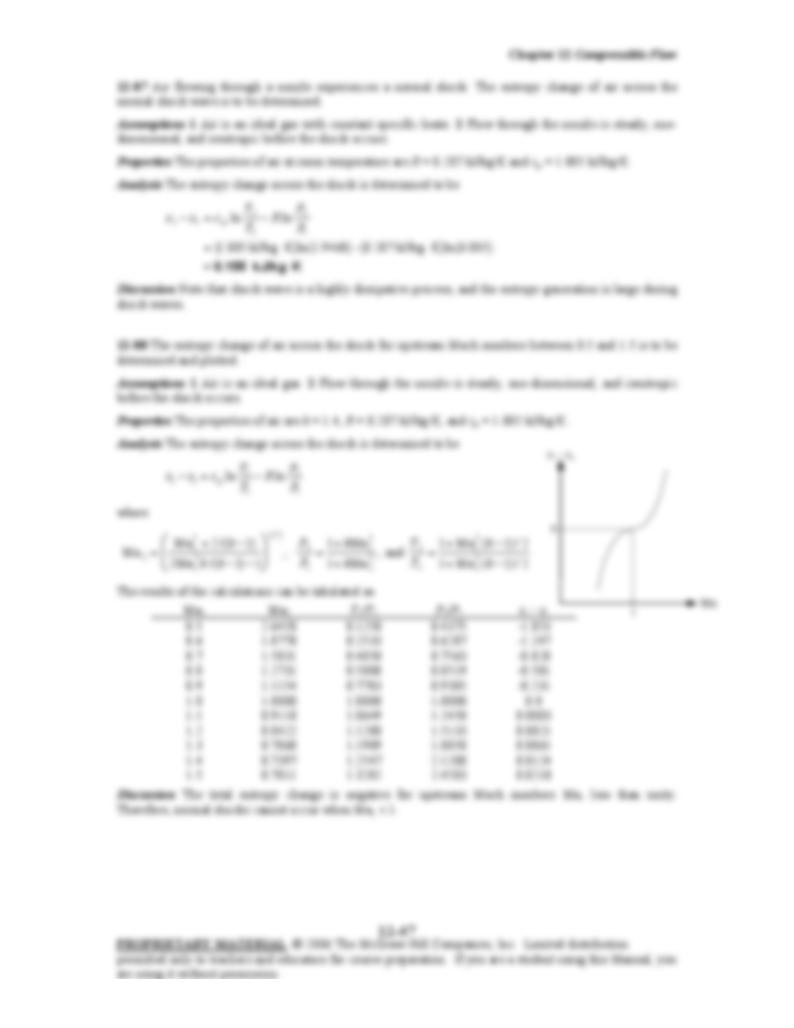
12-82 Air flowing through a nozzle experiences a normal shock. The effect of the shock wave on various
properties is to be determined. Analysis is to be repeated for helium under the same conditions.
Assumptions 1 Air and helium are ideal gases with constant specific heats. 2 Flow through the nozzle is
steady, one-dimensional, and isentropic before the shock occurs.
Properties The properties of air are k = 1.4 and R = 0.287 kJ/kg·K, and the properties of helium are k =
1.667 and R = 2.0769 kJ/kg·K.
Analysis The air properties upstream the shock are shock
wave
Ma1 = 2.5, P1 = 61.64 kPa, and T1 = 262.15 K
Fluid properties after the shock (denoted by subscript 2) are related to those
before the shock through the functions in Table A-14. For Ma1 = 2.5, AIR
i2
1
1375.2and,125.7,5262.8,Ma
1
2
1
2
1
02
2==== T
T
P
P
P
P
0.513 Ma1 = 2.5
Then the stagnation pressure P02, static pressure P2, and static temperature T2, are determined to be
P02 = 8.5261P1 = (8.5261)(61.64 kPa) = 526 kPa
P2 = 7.125P1 = (7.125)(61.64 kPa) = 439 kPa
T2 = 2.1375T1 = (2.1375)(262.15 K) = 560 K
The air velocity after the shock can be determined from V2 = Ma2c2, where c2 is the speed of sound at the
exit conditions after the shock,
m/s 243=
⋅= kJ/kg 1
s/m 1000
K) K)(560.3kJ/kg 287.0)(4.1()513.0(Ma=Ma=
22
22222 kRTcV
We now repeat the analysis for helium. This time we cannot use the tabulated values in Table A-14 since k
is not 1.4. Therefore, we have to calculate the desired quantities using the analytical relations,
0.553=
−−××
−+
=
−−
−+
=
2/1
2
2
2/1
2
1
2
1
21)1667.1/(667.15.22
)1667.1/(25.2
1)1/(Ma2
)1/(2Ma
Ma
kk
k
5632.7
553.0667.11
5.2667.11
Ma1
Ma1
2
2
2
2
2
1
1
2=
×+
×+
=
+
+
=k
k
P
P
7989.2
2/)1667.1(553.01
2/)1667.1(5.21
2/)1(Ma1
2/)1(Ma1
2
2
2
2
2
1
1
2=
−+
−+
=
−+
−+
=k
k
T
T
()
)1/(
2
2
2
2
2
1
1
02 2/Ma)1(1
Ma1
Ma1 −
−+
+
+
=kk
k
k
k
P
P
()
641.92/553.0)1667.1(1
553.0667.11
5.2667.11 667.0/667.1
2
2
2
=×−+
×+
×+
=
Thus, P02 = 11.546P1 = (11.546)(61.64 kPa) = 712 kPa
P2 = 7.5632P1 = (7.5632)(61.64 kPa) = 466 kPa
T2 = 2.7989T1 = (2.7989)(262.15 K) = 734 K
m/s 881=
⋅=== kJ/kg 1
s/m 1000
K) K)(733.7kJ/kg 0769.2)(667.1()553.0(MaMa
22
2222 y
kRTcV