Chapter 12 Compressible Flow
Chapter 12
COMPRESSIBLE FLOW
Stagnation Properties
12-1C The temperature of the air will rise as it approaches the nozzle because of the stagnation process.
12-2C Stagnation enthalpy combines the ordinary enthalpy and the kinetic energy of a fluid, and offers
convenience when analyzing high-speed flows. It differs from the ordinary enthalpy by the kinetic energy
term.
12-3C Dynamic temperature is the temperature rise of a fluid during a stagnation process.
12-4C No. Because the velocities encountered in air-conditioning applications are very low, and thus the
static and the stagnation temperatures are practically identical.
12-5 The state of air and its velocity are specified. The stagnation temperature and stagnation pressure of
air are to be determined.
Assumptions 1 The stagnation process is isentropic. 2 Air is an ideal gas.
Properties The properties of air at room temperature are cp = 1.005 kJ/kg⋅K and k = 1.4.
Analysis The stagnation temperature of air is determined from
K 355.8=
⎟
⎠
⎞
⎜
⎝
⎛
⋅×
+=+= 22
2
2
0/sm 1000
kJ/kg 1
KkJ/kg 005.12
m/s) 470(
K 9.245
2p
c
V
TT
Other stagnation properties at the specified state are determined by considering an isentropic process
between the specified state and the stagnation state,
kPa 160.3=
⎟
⎠
⎞
⎜
⎝
⎛
=
⎟
⎟
⎠
⎞
⎜
⎜
⎝
⎛
=
−
−)14.1/(4.1
)1/(
0
0K 245.9
K 355.8
kPa) 44(
kk
T
T
PP
Discussion Note that the stagnation properties can be significantly different than thermodynamic
properties.

Chapter 12 Compressible Flow
12-6 Air at 300 K is flowing in a duct. The temperature that a stationary probe inserted into the duct will
read is to be determined for different air velocities.
Assumptions The stagnation process is isentropic.
Properties The specific heat of air at room temperature is cp = 1.005 kJ/kg⋅K.
Analysis The air which strikes the probe will be brought to a complete stop, and thus it will undergo a
stagnation process. The thermometer will sense the temperature of this stagnated air, which is the
stagnation temperature, T0. It is determined from
p
c
V
TT 2
2
0+=
AIR
300 K
V
(a) K 300.0=
⎟
⎟
⎠
⎞
⎜
⎜
⎝
⎛
⋅×
=2
s/
2
m 1000
kJ/kg 1
KkJ/kg 005.12
2
m/s) (1
+K 300
0
T
(b) K 300.1=
⎟
⎠
⎞
⎜
⎝
⎛
⋅×
=22
2
0s/m 1000
kJ/kg 1
KkJ/kg 005.12
m/s) (10
+K 300T
(c) K 305.0=
⎟
⎠
⎞
⎜
⎝
⎛
⋅×
=22
2
0s/m 1000
kJ/kg 1
KkJ/kg 005.12
m/s) (100
+K 300T
(d) K 797.5=
⎟
⎠
⎞
⎜
⎝
⎛
⋅×
=22
2
0s/m 1000
kJ/kg 1
KkJ/kg 005.12
m/s) (1000
+K 300T
Discussion Note that the stagnation temperature is nearly identical to the thermodynamic temp erature at
low velocities, but the difference between the two is very significant at high velocities,
Chapter 12 Compressible Flow
12-7 The states of different substances and their velocities are specified. The stagnation temperature and
stagnation pressures are to be determined.
Assumptions 1 The stagnation process is isentropic. 2 Helium and nitrogen are ideal gases.
Analysis (a) Helium can be treated as an ideal gas with cp = 5.1926 kJ/kg·K and k = 1.667. Then the
stagnation temperature and pressure of helium are determined from
C55.5°=
⎟
⎠
⎞
⎜
⎝
⎛
°⋅×
+°=+= 22
2
2
0s/m 1000
kJ/kg 1
CkJ/kg 1926.52
m/s) (240
C50
2p
c
V
TT
MPa 0.261=
⎟
⎠
⎞
⎜
⎝
⎛
=
⎟
⎟
⎠
⎞
⎜
⎜
⎝
⎛
=
−
−)1667.1(/667.1
)1(/
0
0K 323.2
K 328.7
MPa) 25.0(
kk
T
T
PP
(b) Nitrogen can be treated as an ideal gas with cp = 1.039 kJ/kg·K and k =1.400. Then the stagnation
temperature and pressure of nitrogen are determine d fr om
C93.3°=
⎟
⎠
⎞
⎜
⎝
⎛
°⋅×
+°=+= 22
2
2
0s/m 1000
kJ/kg 1
CkJ/kg 039.12
m/s) (300
C50
2p
c
V
TT
MPa 0.233=
⎟
⎠
⎞
⎜
⎝
⎛
=
⎟
⎟
⎠
⎞
⎜
⎜
⎝
⎛
=
−
−)14.1/(4.1
)1/(
0
0K 323.2
K 366.5
MPa) 15.0(
kk
T
T
PP
(c) Steam can be treated as an ideal gas with cp = 1.865 kJ/kg·K and k =1.329. Then the stagnation
temperature and pressure of steam are determined from
K 685C411.8 =°=
⎟
⎠
⎞
⎜
⎝
⎛
°⋅×
+°=+= 22
2
2
0s/m 1000
kJ/kg 1
CkJ/kg 865.12
m/s) (480
C350
2p
c
V
TT
MPa 0.147=
⎟
⎠
⎞
⎜
⎝
⎛
=
⎟
⎟
⎠
⎞
⎜
⎜
⎝
⎛
=
−
−)1329.1/(329.1
)1/(
0
0K 623.2
K 685
MPa) 1.0(
kk
T
T
PP
Discussion Note that the stagnation properties can be significantly different than thermodynamic
properties.
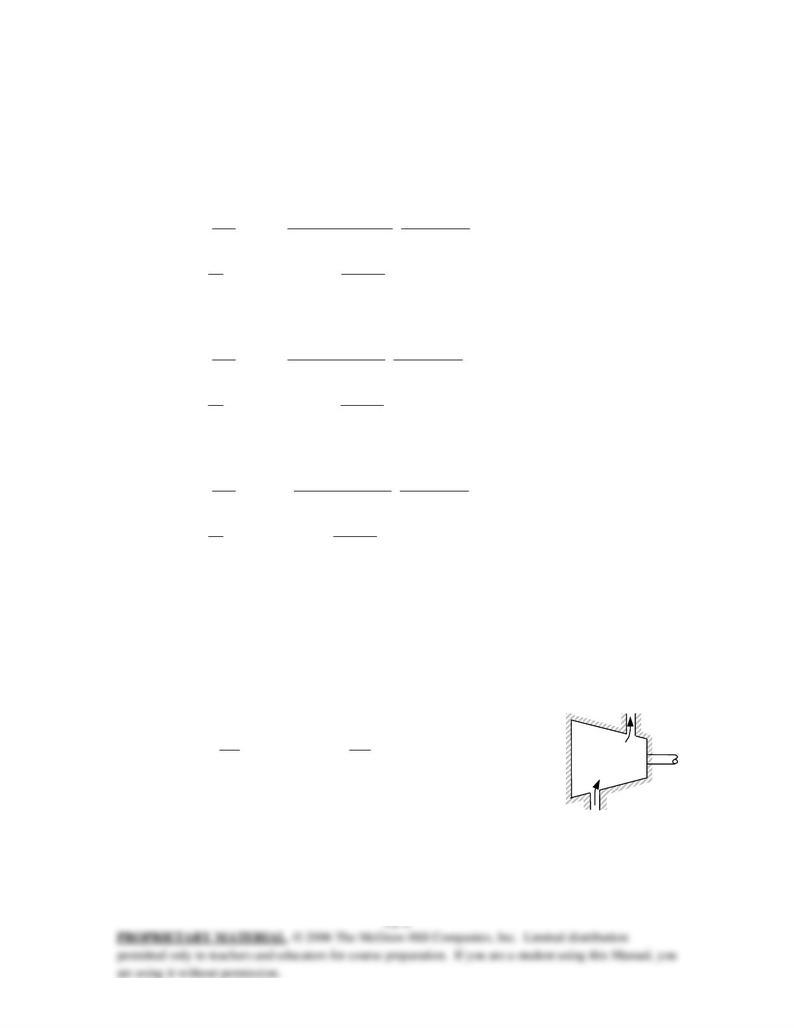
12-8 The inlet stagnation temperature and pressure and the exit stagnation pressure of air flowing through a
compressor are specified. The power input to the compressor is to be determined.
Assumptions 1 The compressor is isentropic. 2 Air is an ideal gas.
Properties The properties of air at room temperature are cp = 1.005 kJ/kg⋅K and k = 1.4.
100 kPa
27°C
AIR
0.02 kg/s
900 kPa
&
W
Analysis The exit stagnation temperature of air T02 is determined from
K 562.4
100
900
K) 2.300( 4.1/)14.1(
/)1(
01
02
0102 =
⎟
⎠
⎞
⎜
⎝
⎛
=
⎟
⎟
⎠
⎞
⎜
⎜
⎝
⎛
=
−
−kk
P
P
TT
From the energy balance on the compressor,
)( 0120in hhmW −= &
&
or,
kW 5.27=300.2)KK)(562.4kJ/kg 5kg/s)(1.00 02.0()( 0102in −⋅=−= TTcmW p
&
&
Discussion Note that the stagnation properties can be used conveniently in the energy equation.
Chapter 12 Compressible Flow
12-9E Steam flows through a device. The stagnation temperature and pressure of steam and its velocity are
specified. The static pressure and temperature of the steam are to be determined.
Assumptions 1 The stagnation process is isentropic. 2 Steam is an ideal gas.
Properties Steam can be treated as an ideal gas with cp = 0.4455 Btu/lbm·R and k =1.329.
Analysis The static temperature and pressure of steam are determined from
F663.7°=
⎟
⎟
⎠
⎞
⎜
⎜
⎝
⎛
°⋅×
−°=−= 22
2
2
0s/ft 25,037
Btu/lbm 1
FBtu/lbm 4455.02
ft/s) (900
F700
2p
c
V
TT
psia 105.5=
⎟
⎠
⎞
⎜
⎝
⎛
=
⎟
⎟
⎠
⎞
⎜
⎜
⎝
⎛
=
−
−)1329.1/(329.1
)1/(
0
0R 1160
R 1123.7
psia) 120(
kk
T
T
PP
Discussion Note that the stagnation properties can be significantly different than thermodynamic
properties.
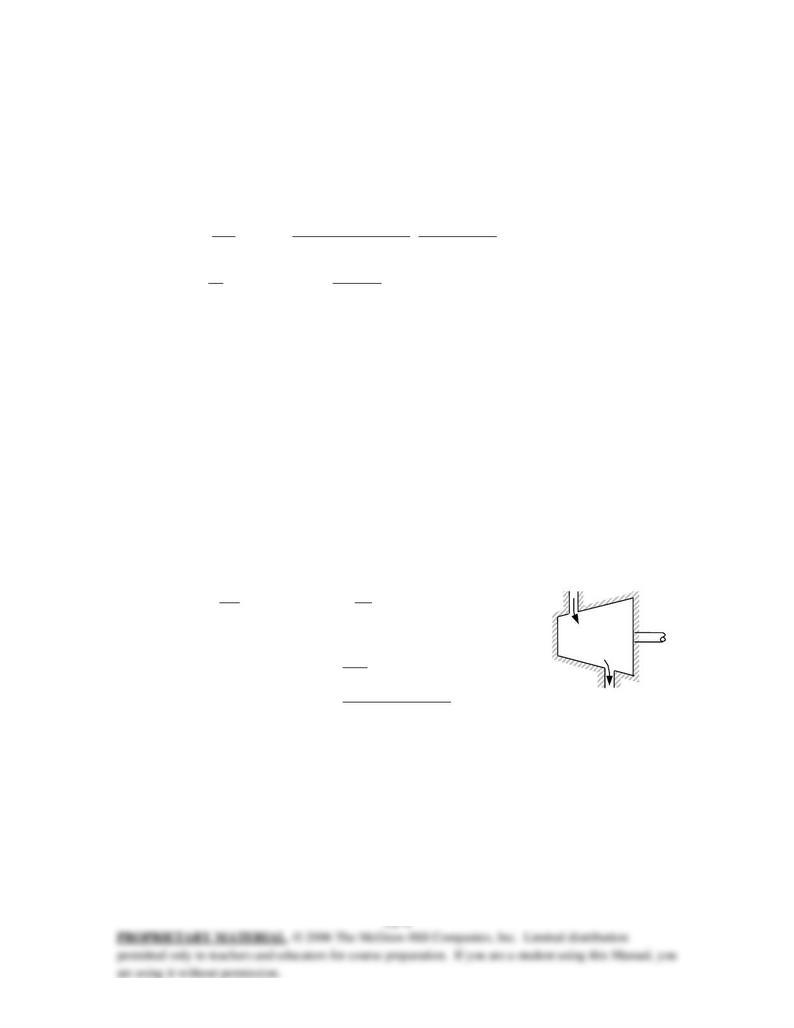
12-10 The inlet stagnation temperature and pressure and the exit stagnation pressure of products of
combustion flowing through a gas turbine are specified. The power output of the turbine is to be
determined.
Assumptions 1 The expansion process is isentropic. 2 Products of combustion are ideal gases.
Properties The properties of products of combustion are cp = 1.157 kJ/kg⋅K, R = 0.287 kJ/kg⋅K, and k =
1.33.
Analysis The exit stagnation temperature T02 is determined to be
100 kPa
1 MPa
750
°
C
K 9.577
1
0.1
K) 2.1023( 33.1/)133.1(
/)1(
01
02
0102 =
⎟
⎠
⎞
⎜
⎝
⎛
=
⎟
⎟
⎠
⎞
⎜
⎜
⎝
⎛
=
−
−kk
P
P
TT
STEAM W
Also,
K kJ/kg157.1 133.1
K) kJ/kg287.0(33.1 1
)(
⋅=
−
⋅
=
−
=⎯→⎯−== k
kR
cRckkcc ppvp
From the energy balance on the turbine,
)( 0120out hhw −=−
or,
kJ/kg 515.2=K.9)5772K)(1023.kJ/kg 157.1()( 0201out −⋅=−= TTcw p
Discussion Note that the stagnation properties can be used conveniently in the energy equation.

Chapter 12 Compressible Flow
2-11 Air flows through a device. The stagnation temperature and pressure of air and its velocity are
specified. The static pressure and temperature of air are to be determined.
Assumptions 1 The stagnation process is isentropic. 2 Air is an ideal gas.
Properties The properties of air at an anticipated average temperatu re of 600 K are cp = 1.051 kJ/kg⋅K and
k = 1.376.
Analysis The static temperature and pressure of air are determined from
K 518.6=
⎟
⎠
⎞
⎜
⎝
⎛
⋅×
−=−= 22
2
2
0s/m 1000
kJ/kg 1
KkJ/kg 051.12
m/s) (570
2.673
2p
c
V
TT
and
MPa 0.23=
⎟
⎠
⎞
⎜
⎝
⎛
=
⎟
⎟
⎠
⎞
⎜
⎜
⎝
⎛
=
−
−)1376.1/(376.1
)1/(
02
2
022 K 673.2
K 518.6
MPa) 6.0(
kk
T
T
PP
Discussion Note that the stagnation properties can be significantly different than thermodynamic
properties.