Chapter 12 Compressible Flow
Review Problems
12-131 A leak develops in an automobile tire as a result of an accident. The initial mass flow rate of air
through the leak is to be determined.
Assumptions 1 Air is an ideal gas with constant specific heats. 2 Flow of air through the hole is isentropic.
Properties The gas constant of air is R = 0.287 kPa⋅m3/kg⋅K. The specific heat ratio of air at room
temperature is k = 1.4.
Analysis The absolute pressure in the tire is
kPa31494220
atmgage =+=+= PPP
The critical pressure is, from Table 12-2,
kPa 94 > kPa 166=kPa) 314)(5283.0(5283.0* 0== PP
Therefore, the flow is choked, and the velocity at the exit of the hole is the sonic speed. Then the flow
properties at the exit becomes
3
)14.1/(1
3
)1/(1
0
*
3
3
0
0
0
kg/m327.2
14.1
2
) kg/m671.3(
1
2
kg/m671.3
K) 298)(Kkg/m kPa287.0(
kPa314
=
+
=
+
=
=
⋅⋅
==
−−k
k
RT
P
ρρ
ρ
K 3.248K) (298
14.1
2
1
2
0
*=
+
=
+
=T
k
T
m/s 9.315K) 3.248(
kJ/kg1
s/m 1000
K) kJ/kg287.0)(4.1(
22
*=
⋅=== kRTcV
Then the initial mass flow rate through the hole becomes
kg/min 0.554=kg/s 0.00924=m/s) /4](315.9m) (0.004)[kg/m 327.2( 23
πρ
== AVm
&
Discussion The mass flow rate will decrease with time as the pressure inside the tire drops.
Chapter 12 Compressible Flow
12-132 The thrust developed by the engine of a Boeing 777 is about 380 kN. The mass flow rate of gases
through the nozzle is to be determined.
Assumptions 1 Air is an ideal gas with constant specific heats. 2 Flow of combustion gases through the
nozzle is isentropic. 3 Choked flow conditions exist at the nozzle exit. 4 The velocity of gases at the nozzle
inlet is negligible.
Properties The gas constant of air is R = 0.287 kPa⋅m3/kg⋅K, and it can also be used for combustion gases.
The specific heat ratio of combustion gases is k = 1.33.
Analysis The velocity at the nozzle exit is the sonic speed, which is determined to be
m/s 6.335K) 295(
kJ/kg1
s/m 1000
K) kJ/kg287.0)(33.1(
22
=
⋅=== kRTcV
Noting that thrust F is related to velocity by VmF &
=
, the mass flow rate of combustion gases is determined
to be
kg/s 1132=
N 1
kg.m/s 1
m/s 335.6
N 000,380 2
== V
F
m
&
Discussion The combustion gases are mostly nitrogen (due to the 78% of N2 in air), and thus they can be
treated as air with a good degree of approximation.
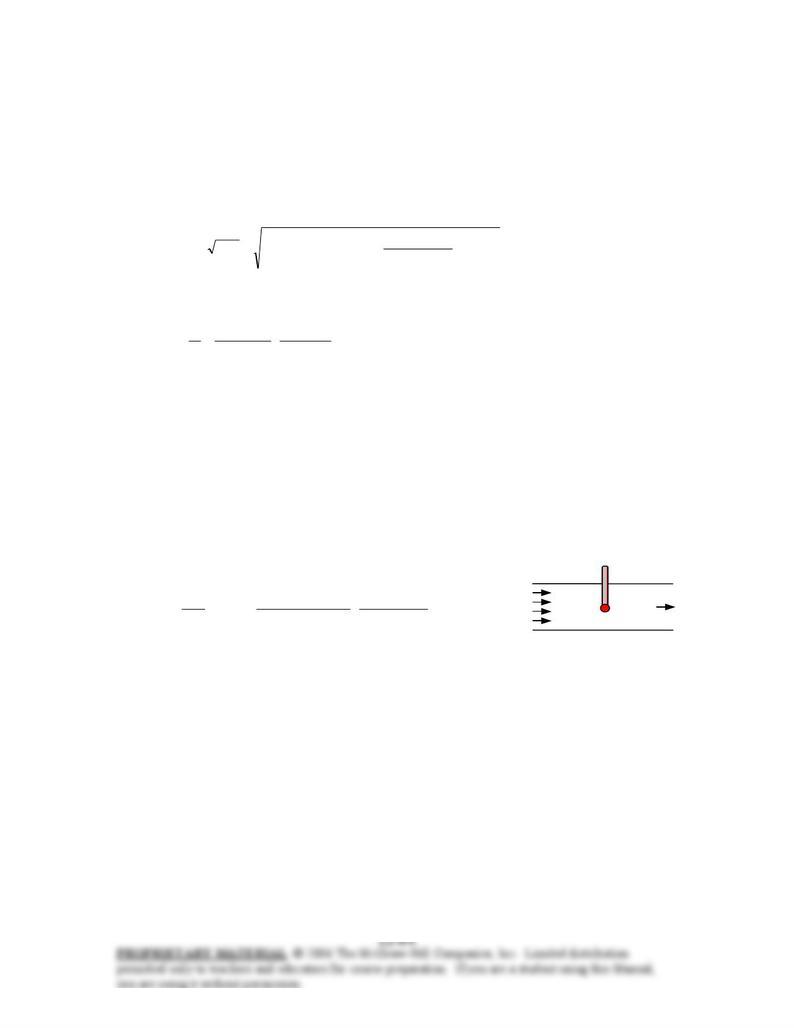
12-133 A stationary temperature probe is inserted into an air duct reads 85°C. The actual temperature of air
is to be determined.
Assumptions 1 Air is an ideal gas with constant specific heats at room temperature. 2 The stagnation
process is isentropic.
Properties The specific heat of air at room temperature is cp = 1.005 kJ/kg⋅K.
Analysis The air that strikes the probe will be brought to a complete stop, and thus it will undergo a
stagnation process. The thermometer will sense the temperature of this stagnated air, which is the
stagnation temperature. The actual air temperature is determined from
T
250 m/s
C53.9°=
⋅×
−°=−= 22
2
2
0s/m 1000
kJ/kg 1
KkJ/kg 005.12
m/s) (250
C85
2p
c
V
TT
Discussion Temperature rise due to stagnation is very significant in high-speed flows, and should always
be considered when compressibility effects are not negligible.

Chapter 12 Compressible Flow
12-134 Nitrogen flows through a heat exchanger. The stagnation pressure and temperature of the nitrogen
at the inlet and the exit states are to be determined.
Assumptions 1 Nitrogen is an ideal gas with constant specific heats. 2 Flow of nitrogen through the heat
exchanger is isentropic.
Properties The properties of nitrogen are cp = 1.039 kJ/kg⋅K and k = 1.4.
Analysis The stagnation temperature and pressure of nitrogen at the inlet and the exit states are determined
from
C14.8°=
°⋅×
°=+= 22
2
2
1
101 s/m 1000
kJ/kg 1
CkJ/kg 039.12
m/s) (100
+C10
2p
c
V
TT Qin
150 kPa
10°C
100 m/s Nitrogen
kPa 159=
=
=
−
−)14.1/(4.1
)1/(
1
01
101 K 283.2
K 288.0
kPa) 150(
kk
T
T
PP 100 kPa
200 m/s
From the energy balance relation systemoutin EEE
∆
=
− with w = 0
C139.9
s/m 1000
kJ/kg 1
2
m/s) 100(m/s) (200
+C)10C)(kJ/kg (1.039=kJ/kg 150
2
)(
2
22
22
2
0
2
1
2
2
12in
°=
−
°−°⋅
∆+
−
+−=
T
T
pe
VV
TTcq p
and
C159°=
°⋅×
+°=+= 22
2
2
2
202 s/m 1000
kJ/kg 1
CkJ/kg 039.12
m/s) (200
C9.139
2p
c
V
TT
kPa 117=
=
=
−
−)14.1/(4.1
)1/(
2
02
202 K 413.1
K 432.3
kPa) 100(
kk
T
T
PP
Discussion Note that the stagnation temperature and pressure can be very different than their
thermodynamic counterparts when dealing with compressible flow.

Chapter 12 Compressible Flow
12-135 An expression for the speed of sound based on van der Waals equation of state is to be derived.
Using this relation, the speed of sound in carbon dioxide is to be determined and compared to that obtained
by ideal gas behavior.
Properties The properties of CO2 are R = 0.1889 kJ/kg·K and k = 1.279 at T = 50°C = 323.2 K.
Analysis Van der Waals equation of state can be expressed as 2
v
a
bv
RT
P−
−
=.
Differentiating, 32
2
)( v
a
bv
RT
v
P
T
+
−
=
∂
∂
Noting that , the speed of sound relation becomes
2
//1 vdvdv −=→=
ρρ
Substituting,
v
ak
bv
kRTv
c
v
P
kv
r
P
kc
TT
2
)( 2
2
2
22
−
−
=
=
=
∂
∂
∂
∂
Using the molar mass of CO2 (M = 44 kg/kmol), the constant a and b can be expressed per unit mass as
0=a and
26 /kgm kPa1882. ⋅kg/m1070.9 3 4−
×=b
The specific volume of CO2 is determined to be
kg/m 300.0
kg/m kPa1882.02
/kgm 000970.0v
K) K)(323.2kg/m kPa(0.1889
= kPa200 3
2
26
3
3
=→
⋅×
−
−
⋅⋅ v
v
Substituting,
m/s 271=
⋅
⋅
−
−
⋅2/1
3
22
23
36
23
23
/kgmkPa 1
s/m 1000
kg)/m 300.0(
)279.1)(kg/mkPa 1882.0(2
)kg/m 009700.0(0.300
K) K)(323.2kJ/kg 1889(1.279)(0.kg)/m (0.300
=c
If we treat CO2 as an ideal gas, the speed of sound becomes
m/s 279=
⋅== kJ/kg 1
s/m 1000
K) K)(323.2kJ/kg 1889.0)(279.1(
22
kRTc
Discussion Note that the ideal gas relation is the simplest equation of state, and it is very accurate for most
gases encountered in practice. At high pressures and/or low temperatures, however, the gases deviate from
ideal gas behavior, and it becomes necessary to use more complicated equations of state.

Chapter 12 Compressible Flow
12-136 The equivalent relation for the speed of sound is to be verified using thermodynamic relations.
Analysis The two relations are
s
P
c
=
∂ρ
∂
2 and
T
P
k
=
∂ρ
∂
2
c
From . Thus, rv drdv=→=−12
//v
sssss v
T
T
P
v
v
T
T
P
v
v
P
v
r
P
c
−=
−=
−=
=
∂
∂
∂
∂
∂
∂
∂
∂
∂
∂
∂
∂
2222
From the cyclic rule,
TPsTPs s
P
T
s
T
P
P
s
s
T
T
P
sTP
−=
→−=
∂
∂
∂
∂
∂
∂
∂
∂
∂
∂
∂
∂
1:),,(
vTsvTs s
T
v
s
v
T
T
s
s
v
v
T
svT
−=
→−=
∂
∂
∂
∂
∂
∂
∂
∂
∂
∂
∂
∂
1:),,(
Substituting,
TvPvTTP v
P
s
T
T
s
v
s
T
v
s
s
P
T
s
vc
−=
∂
−=
∂
∂
∂
∂
∂
∂
∂
∂
∂
∂∂
∂
∂
222
Recall that
P
p
T
s
T
c
=
∂
∂
and
v
v
T
s
T
c
=
∂
∂
Substituting,
TT
v
p
v
P
kv
v
P
c
T
T
c
vc
∂
−=
∂
−=
∂∂
222
Replacing by d
ρ
,
2
/vdv−
T
P
kc
=
∂ρ
∂
2
Discussion Note that the differential thermodynamic property relations are very useful in the derivation of
other property relations in differential form.