Chapter 12 Compressible Flow
Duct Flow with Heat Transfer and Negligible Friction (Rayleigh Flow)
12-96C The characteristic aspect of Rayleigh flow is its involvement of heat transfer. The main
assumptions associated with Rayleigh flow are: the flow is steady, one-dimensional, and frictionless
through a constant-area duct, and the fluid is an ideal gas with constant specific heats.
112-97C The points on the Rayleigh line represent the states that satisfy the conservation of mass,
momentum, and energy equations as well as the property relations for a given state. Therefore, for a given
inlet state, the fluid cannot exist at any downstream state outside the Rayleigh line on a T-s diagram.
12-98C In Rayleigh flow, the effect of heat gain is to increase the entropy of the fluid, and the effect of
heat loss is to decrease it.
12-99C In Rayleigh flow, the stagnation temperature T0 always increases with heat transfer to the fluid, but
the temperature T decreases with heat transfer in the Mach number range of 0.845 < Ma < 1 for air.
Therefore, the temperature in this case will decrease.
12-100C Heating the fluid increases the flow velocity in subsonic flow, but decreases the flow velocity in
supersonic flow.
12-101C The flow is choked, and thus the flow at the duct exit will remain sonic.
Chapter 12 Compressible Flow
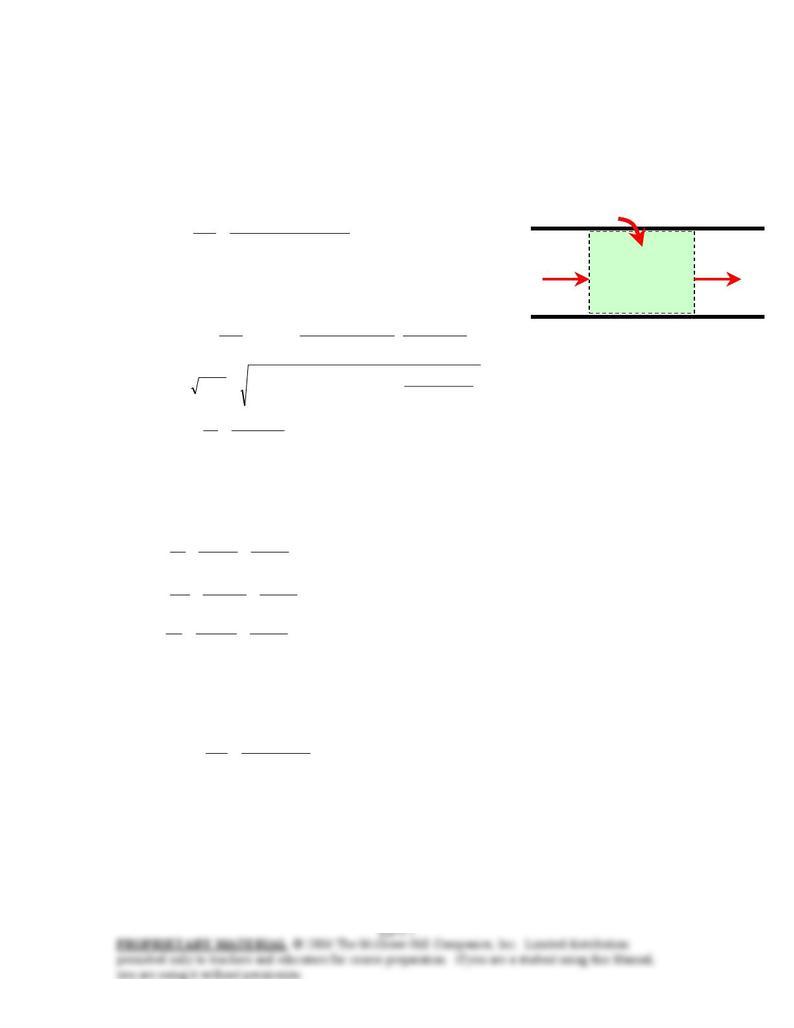
12-102 Fuel is burned in a tubular combustion chamber with compressed air. For a specified exit Mach
number, the exit temperature and the rate of fuel consumption are to be determined.
Assumptions 1 The assumptions associated with Rayleigh flow (i.e., steady one-dimensional flow of an
ideal gas with constant properties through a constant cross-sectional area duct with negligible frictional
effects) are valid. 2 Combustion is complete, and it is treated as a heat addition process, with no change in
the chemical composition of flow. 3 The increase in mass flow rate due to fuel injection is disregarded.
Properties We take the properties of air to be k = 1.4, cp = 1.005 kJ/kg⋅K, and R = 0.287 kJ/kg⋅K.
Analysis The inlet density and mass flow rate of air are
3
1
1
1 kg/m787.2
K) 00 kJ/kgK)(5(0.287
kPa400 === RT
P
ρ
kg/s207.2m/s) 70](4/m) (0.12)[ kg/m787.2( 23
111 ===
πρ
VAm cair
&
The stagnation temperature and Mach number at the inlet are
K 4.502
/sm 1000
kJ/kg1
K kJ/kg005.12
m/s) 70(
K 500
222
2
2
1
101 =
⋅×
+=+=
p
c
V
TT
Q
&
COMBUSTOR
TUBE
P
1 = 400 kPa
T1 = 500 K
V1 = 70 m/s
T2, V2
m/s 2.448
kJ/kg1
s/m 1000
K) K)(500 kJ/kg287.0)(4.1(
22
11 =
⋅== kRTc
1562.0
m/s 2.448
m/s 70
Ma
1
1
1=== c
V
The Rayleigh flow functions corresponding to the inlet and exit Mach numbers are (Table A-15):
Ma1 = 0.1562: T1/T* = 0.1314, T01/T* = 0.1100, V1/V* = 0.0566
Ma2 = 0.8: T2/T* = 1.0255, T02/T* = 0.9639, V2/V* = 0.8101
The exit temperature, stagnation temperature, and velocity are determined to be
804.7
1314.0
0255.1
/
/
*
1
*
2
1
2=== TT
TT
T
T → K 3903
=
=
=
)K 500(804.7804.7 12 TT
763.8
1100.0
9639.0
/
/
*
01
*
02
10
20 === TT
TT
T
T → K 4403)K 4.502(763.8763.8 0120
=
=
=
TT
31.14
0566.0
8101.0
*/
*/
1
2
1
2=== VV
VV
V
V → m/s 1002)m/s 70(31.1431.14 12
=
=
=
VV
Then the mass flow rate of the fuel is determined to be
kJ/kg3920K )4.5024403)(K kJ/kg1.005()( 01
02 =−⋅=−= TTcq p
kW8650) kJ/kg3920)( kg/s2.207(
air === qmQ &
&
kg/s 0.222=== kJ/kg39,000
kJ/s8650
fuel HV
Q
m
&
&
Discussion Note that both the temperature and velocity increase during this subsonic Rayleigh flow with
heating, as expected. This problem can also be solved using appropriate relations instead of tabulated
values, which can likewise be coded for convenient computer solutions.
Chapter 12 Compressible Flow
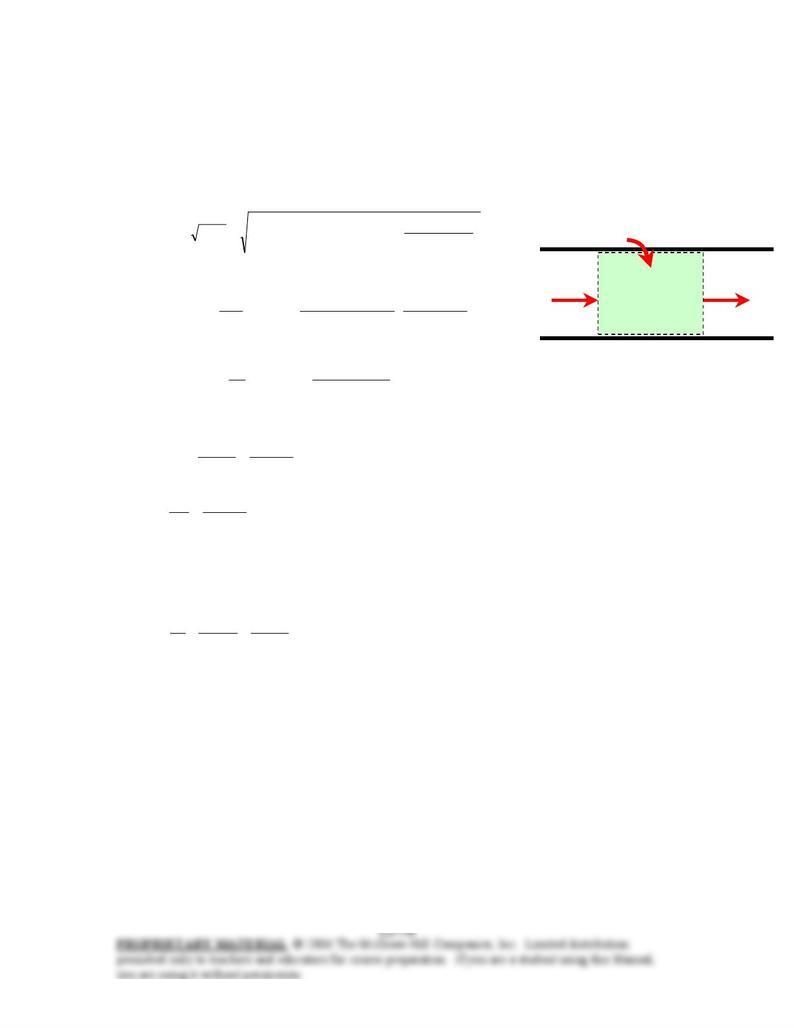
12-103 Fuel is burned in a rectangular duct with compressed air. For specified heat transfer, the exit
temperature and Mach number are to be determined.
Assumptions The assumptions associated with Rayleigh flow (i.e., steady one-dimensional flow of an ideal
gas with constant properties through a constant cross-sectional area duct with negligible frictional effects)
are valid.
Properties We take the properties of air to be k = 1.4, cp = 1.005 kJ/kg⋅K, and R = 0.287 kJ/kg⋅K.
Analysis The stagnation temperature and Mach number at the inlet are
m/s 2.347
kJ/kg1
s/m 1000
K) K)(300 kJ/kg287.0)(4.1(
22
11 =
⋅== kRTc
m/s 4.694m/s) 2.347(2Ma 111 === cV
K 9.539
/sm 1000
kJ/kg1
K kJ/kg005.12
m/s) 4.694(
K 300
222
2
2
1
101 =
⋅×
+=+=
p
c
V
TT
The exit stagnation temperature is, from the energy equation , )( 01
02 TTcq p−=
T2, Ma2
P
1 = 420 kPa
T1 = 300 K
Ma1 = 2
q = 55 kJ/kg
K 6.594
K kJ/kg1.005
kJ/kg55
K 539.9 01
02 =
⋅
+=+=
p
c
q
TT
The maximum value of stagnation temperature T0
* occurs at Ma = 1, and its value can be determined from
Table A-15 or from the appropriate relation. At Ma1 = 2 we read T01/T0
* = 0.7934. Therefore,
K 5.680
7934.0
K 9.539
7934.0
01*
0=== T
T
The stagnation temperature ratio at the exit and the Mach number corresponding to it are, from Table A-15,
8738.0
K 5.680
K 6.594
*
0
02 ==
T
T → Ma2 = 1.642
Also,
Ma1 = 2 → T1/T* = 0.5289
Ma2 = 1.642 → T2/T* = 0.6812
Then the exit temperature becomes
288.1
5289.0
6812.0
/
/
*
1
*
2
1
2=== TT
TT
T
T → K 386
=
=
=
)K 300(288.1288.1 12 TT
Discussion Note that the temperature increases during this supersonic Rayleigh flow with heating. This
problem can also be solved using appropriate relations instead of tabulated values, which can likewise be
coded for convenient computer solutions.
Chapter 12 Compressible Flow
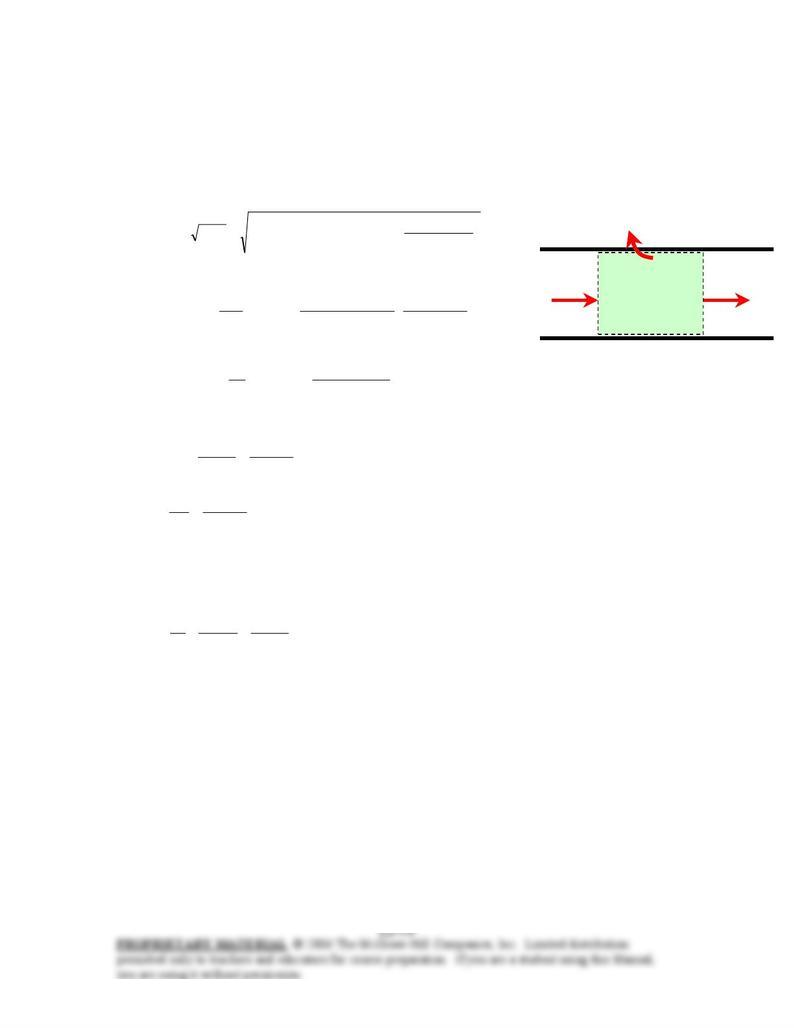
12-104 Compressed air is cooled as it flows in a rectangular duct. For specified heat rejection, the exit
temperature and Mach number are to be determined.
Assumptions The assumptions associated with Rayleigh flow (i.e., steady one-dimensional flow of an ideal
gas with constant properties through a constant cross-sectional area duct with negligible frictional effects)
are valid.
Properties We take the properties of air to be k = 1.4, Cp = 1.005 kJ/kg⋅K, and R = 0.287 kJ/kg⋅K.
Analysis The stagnation temperature and Mach number at the inlet are
m/s 2.347
kJ/kg1
s/m 1000
K) K)(300 kJ/kg287.0)(4.1(
22
11 =
⋅== kRTc
m/s 4.694m/s) 2.347(2Ma 111 === cV
K 9.539
/sm 1000
kJ/kg1
K kJ/kg005.12
m/s) 4.694(
K 300
222
2
2
1
101 =
⋅×
+=+=
p
c
V
TT
The exit stagnation temperature is, from the energy equation , )( 01
02 TTcq p−=
P
1 = 420 kPa
T1 = 300 K
Ma1 = 2
q = -55 kJ/kg
T2, Ma2
K 2.485
K kJ/kg1.005
kJ/kg-55
K 539.9 01
02 =
⋅
+=+=
p
c
q
TT
The maximum value of stagnation temperature T0
* occurs at Ma = 1, and its value can be determined from
Table A-15 or from the appropriate relation. At Ma1 = 2 we read T01/T0
* = 0.7934. Therefore,
K 5.680
7934.0
K 9.539
7934.0
01*
0=== T
T
The stagnation temperature ratio at the exit and the Mach number corresponding to it are, from Table A-15,
7130.0
K 5.680
K 2.485
*
0
02 ==
T
T → Ma2 = 2.479
Also,
Ma1 = 2 → T1/T* = 0.5289
Ma2 = 2.479 → T2/T* = 0.3838
Then the exit temperature becomes
7257.0
5289.0
3838.0
/
/
*
1
*
2
1
2=== TT
TT
T
T → K 218
=
=
=
)K 300(7257.07257.0 12 TT
Discussion Note that the temperature decreases and Mach number increases during this supersonic
Rayleigh flow with cooling. This problem can also be solved using appropriate relations instead of
tabulated values, which can likewise be coded for convenient computer solutions.
Chapter 12 Compressible Flow
12-105 Air is heated in a duct during subsonic flow until it is choked. For specified pressure and velocity
at the exit, the temperature, pressure, and velocity at the inlet are to be determined.
Assumptions The assumptions associated with Rayleigh flow (i.e., steady one-dimensional flow of an ideal
gas with constant properties through a constant cross-sectional area duct with negligible frictional effects)
are valid.
Properties We take the properties of air to be k = 1.4, cp = 1.005 kJ/kg⋅K, and R = 0.287 kJ/kg⋅K.
Analysis Noting that sonic conditions exist at the exit, the exit temperature is
m/s 620m/s)/1 620(/Ma 222 =
=
=Vc
22 kRTc = → m/s 620
kJ/kg1
s/m 1000
K) kJ/kg287.0)(4.1(
22
2=
⋅T
It gives T2 = 956.7 K. Then the exit stagnation temperature becomes
K 1148
/sm 1000
kJ/kg1
K kJ/kg005.12
m/s) 620(
K 7.956
222
2
2
2
202 =
⋅×
+=+=
p
c
V
TT
P
2= 270 kPa
V2= 620 m/s
Ma2= 1
q = 60 kJ/kg
P
1
T1
Ma1
The inlet stagnation temperature is, from the energy equation , )( 01
02 TTcq p−=
K 1088
K kJ/kg1.005
kJ/kg60
–K 1148 02
01 =
⋅
=−=
p
c
q
TT
The maximum value of stagnation temperature T0
* occurs at Ma = 1, and its value in this case is
T02 since the flow is choked. Therefore, T0
* = T02 = 1148 K. Then the stagnation temperature ratio at the
inlet, and the Mach number corresponding to it are, from Table A-15,
9478.0
K 1148
K 1088
*
0
01 ==
T
T → Ma1 = 0.7649
The Rayleigh flow functions corresponding to the inlet and exit Mach numbers are (Table A-15):
Ma1 = 0.7649: T1/T* = 1.017, P1/P* = 1.319, V1/V* = 0.7719
Ma2 = 1: T2/T* = 1, P2/P* = 1, V2/V* = 1
Then the inlet temperature, pressure, and velocity are determined to be
017.1
1
/
/
*
1
*
2
1
2== TT
TT
T
T → K 974
=
=
=
)K 7.956(017.1017.1 21 TT
319.1
1
/
/
*
1
*
2
1
2== PP
PP
P
P → kPa 356
=
=
=
) kPa270(319.1319.1 21 PP
7719.0
1
*/
*/
1
2
1
2== VV
VV
V
V → m/s 479
=
=
=
)m/s 620(7719.07719.0 21 VV
Discussion Note that the temperature and pressure decreases with heating during this subsonic Rayleigh
flow while velocity increases. This problem can also be solved using appropriate relations instead of
tabulated values, which can likewise be coded for convenient computer solutions.