CHAPTER 12
CORPORATION
The Corporate Form of Organization
Many years ago, a noted scholar defi ned a corporation as “an artifi cial being,
invisible, intangible, and existing only in contemplation of law.” This defi nition is
the foundation for the prevailing legal interpretation in many countries that a
corporation is an entity separate and distinct from its owners.
A corporation is created by law, and its continued existence depends upon the
statutes of the jurisdiction in which it is incorporated. As a legal entity, a
corporation has most of the rights and privileges of a person. The major exceptions
relate to privileges that only a living person can exercise, such as the right to vote
or to hold public offi ce. A corporation is subject to the same duties and
responsibilities as a person. For example, it must abide by the laws, and it must pay
taxes.
Two common ways to classify corporations are by purpose and by ownership. A
corporation may be organized for the purpose of making a profi t, or it may be not–
for–profi t. For–profi t corporations include such well-known companies as BHP
Billiton (AUS), Hyundai Motors (KOR), LUKOIL (RUS), and Microsoft (USA). Not-for-
profi t corporations are organized for charitable, medical, or educational purposes.
Examples are the I nternational Committee of the Red Cross (CHE) and the Bill &
Melinda Gates Foundation (USA).
Classification by ownership diff erentiates publicly held and privately held
corporations. A publicly held corporation may have thousands of shareholders. Its
shares are regularly traded on a national securities exchange such as the São Paùlo
Stock Exchange (BRA). Examples are Toyota (JPN), Siemens (DEU), Sinopec (CHN),
and General Electric (USA).
In contrast, a privately held corporation usually has only a few shareholders, and
does not off er its shares for sale to the general public (see Alternative
Terminology). Privately held companies are generally much smaller than publicly
held companies, although some notable exceptions exist. Cargill Inc. (USA), a
private corporation that trades in grain and other commodities, is one of the largest
companies in the world.
Characteristics of a Corporation
A number of characteristics distinguish corporations from proprietorships and
partnerships. We explain the most important of these characteristics below.
Separate Legal Existence
In most countries, an entity is separate and distinct from its owners. The
corporation acts under its own name rather than in the name of its shareholders.
Volvo (SWE) may buy, own, and sell property. It may borrow money, and it may
enter into legally binding contracts in its own name. It may also sue or be sued, and
it pays its own taxes.
In a partnership, the acts of the owners (partners) bind the partnership. In contrast,
the acts of its owners (shareholders) do not bind the corporation unless such
owners are agents of the corporation. For example, if you owned shares of Volvo,
you would not have the right to purchase inventory for the company unless you
were designated as an agent of the corporation.
Limited Liability of Shareholders
Since a corporation is a separate legal entity, in most countries creditors have
recourse only to corporate assets to satisfy their claims. The liability of
shareholders is normally limited to their investment in the corporation. Creditors
have no legal claim on the personal assets of the owners unless fraud has occurred.
Even in the event of bankruptcy, shareholders’ losses are generally limited to their
capital investment in the corporation.
Transferable Ownership Rights
Ordinary shares give ownership in a corporation. These shares are transferable
units. Shareholders may dispose of part or all of their interest in a corporation
simply by selling their shares. The transfer of an ownership interest in a partnership
requires the consent of each owner. In contrast, the transfer of shares is entirely at
the discretion of the shareholder. It does not require the approval of either the
corporation or other shareholders.
The transfer of ownership rights between shareholders normally has no eff ect on
the daily operating activities of the corporation. Nor does it aff ect the corporation’s
assets, liabilities, and total equity. The transfer of these ownership rights is a
transaction between individual owners. The company does not participate in the
transfer of these ownership rights after the original sale of the ordinary shares.
Ability to Acquire Capital
It is relatively easy for a corporation to obtain capital through the issuance of
shares. Investors buy shares in a corporation to earn money over time as the share
price grows. Investors also like to invest in shares because they have limited liability
and shares are readily transferable. Also, individuals can become shareholders by
investing relatively small amounts of money. In sum, the ability of a successful
corporation to obtain capital is virtually unlimited.
Continuous Life
The life of a corporation is stated in its charter. The life may be perpetual, or it may
be limited to a specifi c number of years. If it is limited, the company can extend
the life through renewal of the charter. Since a corporation is a separate legal
entity, its continuance as a going concern is not aff ected by the withdrawal, death,
or incapacity of a shareholder, employee, or offi cer. As a result, a successful
company can have a continuous and perpetual life.
Corporation Management
Shareholders legally own the corporation. However, they manage the corporation
indirectly through a board of directors they elect. The board, in turn, formulates
the operating policies for the company. The board also selects offi cers, such as a
president and one or more vice presidents, to execute policy and to perform daily
management functions.
Illustration 12.1 presents a typical organization chart showing the delegation of
responsibility. The chief executive offi cer (CEO) has overall responsibility for
managing the business. As the organization chart shows, the CEO delegates
responsibility to other offi cers. The chief accounting offi cer is the controller. The
controller’s responsibilities include (1) maintaining the accounting records, (2)
maintaining an adequate system of internal control, and (3) preparing fi nancial
statements, tax returns, and internal reports. The treasurer has custody of the
corporation’s funds and is responsible for maintaining the company’s cash position.
The organizational structure of a corporation enables a company to hire
professional managers to run the business (see Ethics Note). On the other hand,
the separation of ownership and management often reduces an owner’s ability to
actively manage the company.
Government Regulations
A corporation is subject to governmental regulations. Laws prescribe the
requirements for issuing shares, the distributions of earnings permitted to
shareholders, and the eff ects of retiring shares. Securities laws govern the sale of
shares to the general public. Also, most publicly held corporations are required to
make extensive disclosure of their fi nancial aff airs to securities regulators through
quarterly and annual reports. In addition, when a corporation lists its shares on
organized securities exchanges, it must comply with the reporting requirements of
these exchanges. Government regulations are designed to protect the owners of
the corporation.
Additional Taxes
In most countries, owners of proprietorships and partnerships report their share of
earnings on their personal income tax returns. The individual owner then pays
taxes on this amount. Corporations, on the other hand, must pay government taxes
as a separate legal entity. These taxes can be substantial.
In addition, shareholders must pay taxes on cash dividends (pro rata distributions
of net income). Thus, many argue that the government taxes corporate income
twice (double taxation)—once at the corporate level, and again at the individual
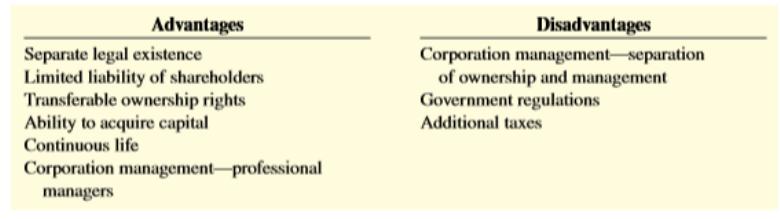
level. In summary, Illustration 12.2 shows the advantages and disadvantages of a
corporation compared to a proprietorship and a partnership.
Advantages
1. Separate legal existence
2. Limited liability of shareholders
3. Transferable ownership rights
4. Ability to acquire capital
5. Continuous life
6. Corporation management—professional managers
Disadvantages
1. Corporation management—separation of ownership and management
2. Transferable ownership rights
3. Additional taxes
Forming a Corporation
The steps for forming a corporation vary somewhat across countries. The i nitial
step in forming a corporation is to fi le an application with the appropriate g
overnmental agency in the jurisdiction in which incorporation is desired. The
application describes the name and purpose of the corporation, the types and
number of shares that are authorized to be issued, the names of the i ndividuals
that formed the company, and the number of shares that these individuals agreed
to purchase. Regardless of the number of jurisdictions in which a corporation has
operating divisions, it is typically incorporated in only one state or country.
It is to the company’s advantage to incorporate in a state or country whose laws
are favorable to the corporate form of business organization. For e xample, Gulf Oil
(USA) changed its state of incorporation to Delaware to thwart possible unfriendly
takeovers. There, certain defensive tactics against t akeovers can be approved by
the board of directors alone, without a vote by shareholders.
After the government approves the application, it grants a charter (see Alternative
Terminology). The charter may be an approved copy of the application form, or it
may be a s eparate document containing the same basic data. Upon receipt of its
charter, the c orporation estab lishes by-laws. The by-laws establish the internal
rules and procedures for conducting the aff airs of the corporation. Corporations
engaged in commerce outside their state or country must also obtain a license from
each of those governments in which they do business. The license subjects the
corporation’s operating activities to the general corporation laws of that state or
country. Costs incurred in the formation of a corporation are called organization
costs. These costs include legal and government fees, and promotional
expenditures involved in the organization of the business. Corporations expense
organization costs as incurred. Determining the amount and timing of future
benefi ts is so diffi cult that it is standard procedure to take a conservative approach
of expensing these costs immediately.
Shareholder Rights
When chartered, the corporation may begin selling ownership rights in the form of
shares. When a corporation has only one class of shares, it is ordinary shares. Each
ordinary share gives the shareholder the ownership rights pictured in Illustration
12.3. The articles of incorporation or the by-laws state the ownership rights of a
share.
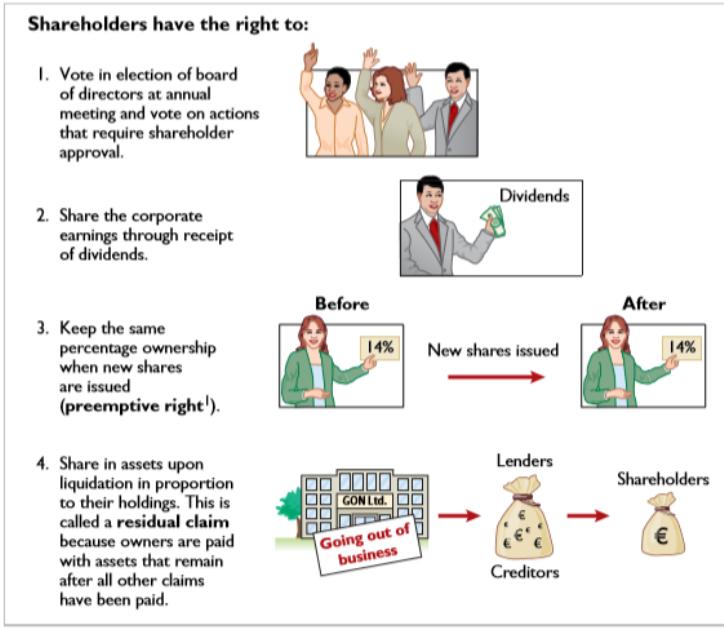
Shareholders have the right to:
1. Vote in election of board of directors at annual meeting and vote on
actions that require shareholder approval.
2. Share the corporate earnings through receipt of dividends.
3. Keep the same percentage ownership when new shares are issued
(preemptive right1).
4. Share in assets upon liquidation in proportion to their holdings. This is
called a residual claim because owners are paid with assets that remain
after all other claims have been paid
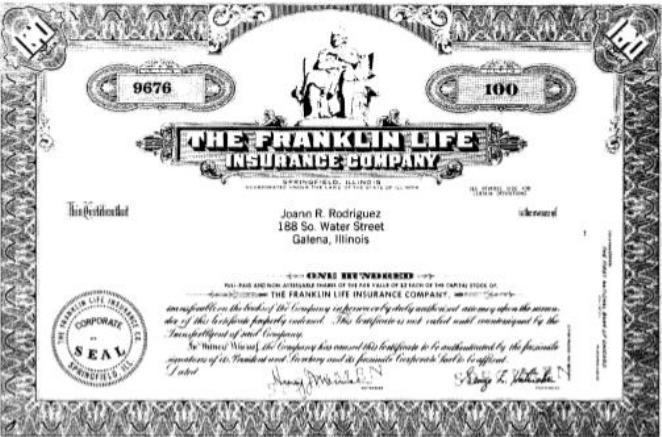
Proof of share ownership is evidenced by a form known as a share certificate. As
Illustration 12.4 shows, the face of the certifi cate shows the name of the co
rporation, the shareholder’s name, the class and special features of the share, the
number of shares owned, and the signatures of authorized corporate offi cials.
Prenumbered certifi cates facilitate accountability. They may be issued for any
quantity of shares.
Share Issue Considerations
In considering the issuance of shares, a corporation must resolve a number of basic
questions: How many shares should it authorize for sale? How should it issue the
shares? At what price should it issue the shares? What value should the corporation
assign to the shares? These questions are addressed in the following sections.
Authorized Shares
The charter indicates the amount of shares that a corporation is authorized to sell.
The total amount of authorized shares at the time of incorporation normally
anticipates both initial and subsequent capital needs. As a result, the number of
shares authorized generally exceeds the number initially sold. If it sells all
authorized shares, a corporation must obtain consent of the jurisdiction to amend
its charter before it can issue additional shares.
The authorization of ordinary shares does not result in a formal accounting entry.
The reason is that the event has no immediate eff ect on either corporate assets
or equity. However, the number of authorized shares is often reported in the
equity section. It is then simple to determine the number of u nissued shares that
the corporation can issue without amending the charter: subtract the total shares
issued from the total authorized. For example, if Quanta Computer (TWN) was
authorized to sell 100,000 ordinary shares and issued 80,000 shares, 20,000 shares
would remain unissued.
Issuance of Shares
A corporation can issue ordinary shares directly to investors. Alternatively, it can
issue the shares indirectly through an investment banking fi rm that specializes in
bringing securities to the attention of prospective investors. Direct issue is typical
in closely held companies. Indirect issue is customary for a publicly held
corporation.
In an indirect issue, the investment banking fi rm may agree to underwrite the
entire share issue. In this arrangement, the investment banker buys the shares
from the corporation at a stipulated price and resells them to investors. The
corporation thus avoids any risk of being unable to sell the shares. Also, it obtains
immediate use of the cash received from the underwriter. The investment b anking
fi rm, in turn, assumes the risk of reselling the shares, in return for an underwriting
fee.2 For example, Google (USA) (the world’s number-one Internet search engine)
used underwriters when it issued a highly successful initial public off ering, raising
$1.67 billion. The underwriters charged a 3% underwriting fee (approximately $50
million) on Google’s share off ering.
How does a corporation set the price for a new issue of shares? Among the factors
to be considered are (1) the company’s anticipated future earnings, (2) its expected
dividend rate per share, (3) its current fi nancial position, (4) the current state of
the economy, and (5) the current state of the securities market. The calculation can
be complex and is properly the subject of a fi nance course.
Market Price of Shares
The shares of publicly held companies are traded on organized exchanges. The
interaction between buyers and sellers determines the prices per share. In general,
the prices set by the marketplace tend to follow the trend of a company’s earnings
and dividends. But, factors beyond a company’s control, such as an oil embargo,
changes in interest rates, or the outcome of a presidential election, may cause day-
to–day fl uctuations in market prices.
The trading of ordinary shares on securities exchanges involves the transfer of
already issued shares from an existing shareholder to another investor. These
transactions have no impact on a corporation’s equity.

How to Read Share Quotes
Organized exchanges trade the shares of publicly held companies at prices per
share established by the interaction between buyers and sellers. For each listed
security, the fi nancial press reports the high and low prices of the shares during
the year, the total volume of shares traded on a given day, the high and low prices
for the day, and the closing market price, with the net change for the day. adidas
(DEU) is listed on a number of exchanges. Here is a listing for adidas (prices are in
euros).
These numbers indicate the following. The high and low market prices for the
previous 52 weeks were €113.38 and €70.61. The trading volume for the day was
61,753 shares. The high, low, and closing prices for that date were €113.38,
€111.18, and €113.07, respectively. The net change for the day was an increase of
€1.20 per share.
For shares traded on organized exchanges, how are the prices per share
established? What factors might infl uence the price of shares in the
marketplace? (Go to the book’s companion website for this answer and
additional questions.)
Par and No-Par Value Shares
Par value shares (sometimes nominal) are ordinary shares to which the charter has
assigned a value per share. Years ago, par value determined the legal capital per
share that a company must retain in the business for the protection of corporate
creditors; that amount was not available for withdrawal by shareholders. Thus, in
the past, most governments required the corporation to sell its shares at par or
above.
However, par value was often immaterial relative to the value of the company’s
shares—even at the time of issue. Thus, its usefulness as a protective device to c
reditors was questionable. For example, one U.S. company’s par value is $1 per
share, yet a new issue in 2017 would have sold at a market price in the $27 per
share range. Thus, par has no relationship with market price. In the vast majority
of cases, it is an immaterial amount. As a consequence, today many governments
do not require a par value. Instead, they use other means to protect creditors.
No-par value shares are ordinary shares to which the charter has not assigned a
value. No-par value shares are fairly common today. For example, Nike (USA) and
AnheuserBusch InBev (BEL) both have no-par shares. In many countries, the board
of directors assigns a stated value to no-par shares.
DO IT! 1a Corporate Organization
Indicate whether each of the following statements is true or false. If false, indicate
how to correct the statement.
____ 1. Similar to partners in a partnership, shareholders of a corporation have
unlimited liability.
____ 2. It is relatively easy for a corporation to obtain capital through the issuance
of shares.
____ 3. The separation of ownership and management is an advantage of the
corporate form of business.
____ 4. T he journal entry to record the authorization of or dinary shares includes
a credit to the appropriate share capital account.
Solution
1. False. The liability of shareholders is normally limited to their investment in
the corporation. 2. True. 3. False. The separation of ownership and
management is a disadvantage of the corporate form of business. 4. False.
The authorization of ordinary shares does not result in a formal accounting
entry.
Corporate Capital
Equity is identifi ed by various names: stockholders’ equity, shareholders’ equity,
or corporate capital. The equity section of a corporation’s statement of fi nancial
position consists of two parts: (1) share capital and (2) retained earnings (earned
capital).
The distinction between share capital and retained earnings is important from
both a legal and a fi nancial point of view. Legally, corporations can make
distributions of earnings (declare dividends) out of retained earnings in most
countries. However, they often cannot declare dividends out of share capital.
Management, shareholders, and others often look to retained earnings for the