Chapter 11 Flow Over Bodies: Drag and Lift
Flow over Flat Plates
11-43C The fluid viscosity is responsible for the development of the velocity boundary layer. Velocity
forces the boundary layer closer to the wall. Therefore, the higher the velocity (and thus Reynolds number),
the lower the thickness of the boundary layer.
11-44C The friction coefficient represents the resistance to fluid flow over a flat plate. It is proportional to
the drag force acting on the plate. The drag coefficient for a flat surface is equivalent to the mean friction
coefficient.
11-45C The local friction coefficient decreases with downstream distance in laminar flow over a flat plate.
11-46C The average friction coefficient in flow over a flat plate is determined by integrating the local
friction coefficient over the entire plate, and then dividing it by the length of the plate. Or, it can be
determined experimentally by measuring the drag force, and dividing it by the dynamic pressure.
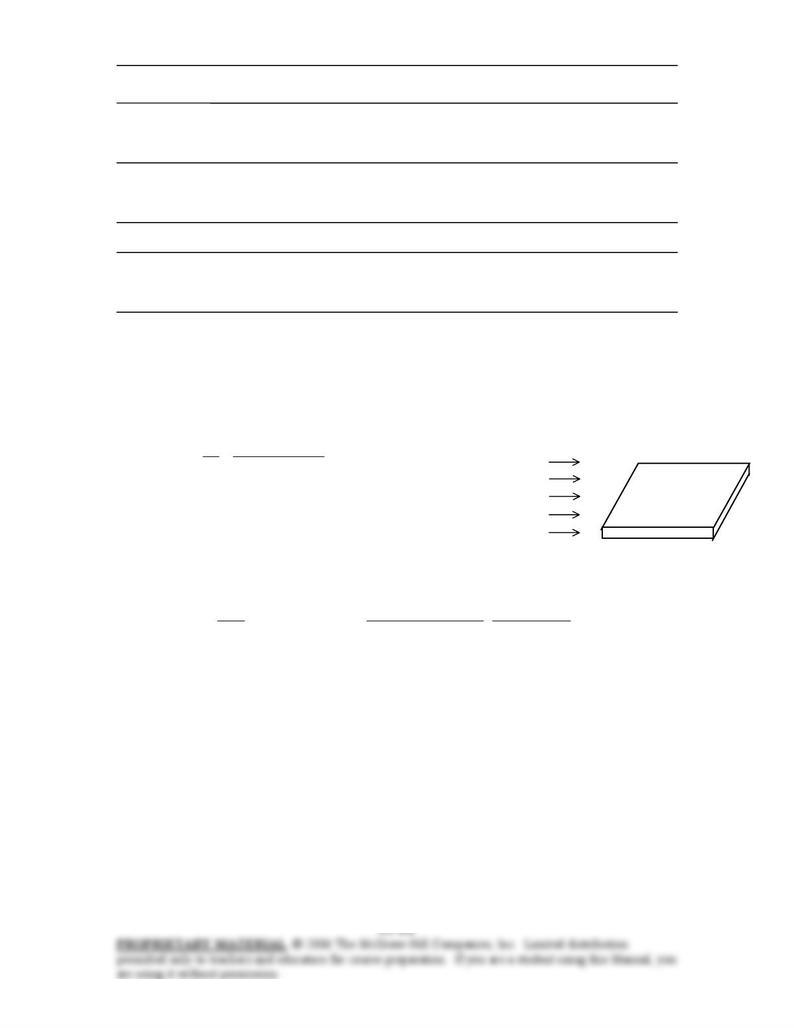
11-47E Light oil flows over a flat plate. The total drag force per unit width of the plate is to be determined.
Assumptions 1 The flow is steady and incompressible. 2 The critical Reynolds number is Recr = 5 × 10⁵. 3
The surface of the plate is smooth.
Properties The density and kinematic viscosity of light oil at 75°F are ρ = 55.3 lbm/ft3 and ν = 7.751×10⁻³
ft2/s.
Analysis Noting that L = 15 ft, the Reynolds number at the end of the plate is
4
23 10161.1
/sft 10751.7
ft) ft/s)(15 6(
Re ×=
×
== −
ν
VL
L
Oil
6 ft/s
which is less than the critical Reynolds number. Thus we have laminar flow
over the entire plate, and the average friction coefficient is determined from
01232.0)10161.1(328.1Re328.1 5.045.0 =××== −−
L
f
C
L
= 15 ft
Noting that the pressure drag is zero and thus C for a flat plate, the
drag force acting on the top surface of the plate per unit width becomes
fD C=
lbf 5.87=
⋅
××== 2
23
2
2
ft/slbm 32.2
lbf 1
2
ft/s) 6)(lbm/ft 8.56(
)ft 115(01232.0
2
V
ACF f
D
ρ
The total drag force acting on the entire plate can be determined by multiplying the value obtained above
by the width of the plate.
Discussion The force per unit width corresponds to the weight of a mass of 5.87 lbm. Therefore, a person
who applies an equal and opposite force to the plate to keep it from moving will feel like he or she is using
as much force as is necessary to hold a 5.87 lbm mass from dropping.
Chapter 11 Flow Over Bodies: Drag and Lift
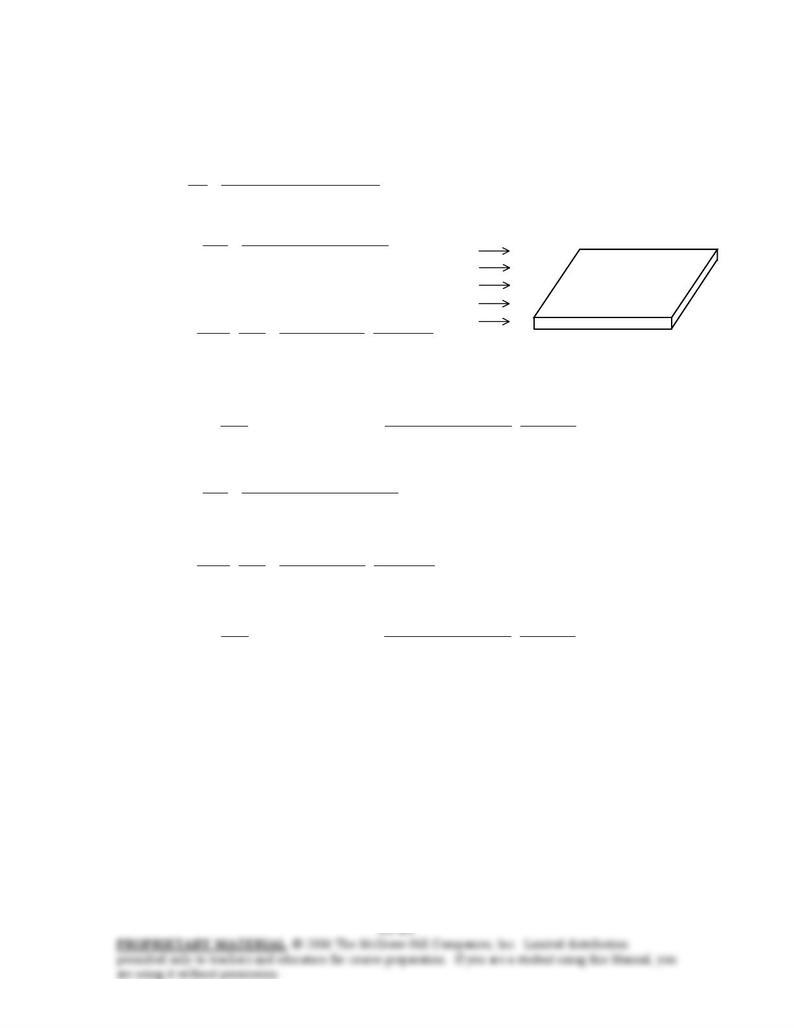
11-48 Air flows over a plane surface at high elevation. The drag force acting on the top surface of the plate
is to be determined for flow along the two sides of the plate. √
Assumptions 1 The flow is steady and incompressible. 2 The critical Reynolds number is Recr = 5×10⁵. 3
Air is an ideal gas. 4 The surface of the plate is smooth.
Properties The dynamic viscosity is independent of pressure, and for air at 25°C it is µ = 1.849×10⁻⁵
kg/m⋅s. The air density at 25°C = 298 K and 83.4 kPa is
3
3 kg/m9751.0
K) K)(298/kgm kPa(0.287
kPa83.4 =
⋅⋅
== RT
P
ρ
Analysis (a) If the air flows parallel to the 8 m side, the Reynolds number becomes
6
5
3
10531.2
s kg/m10849.1
m) m/s)(8 6() kg/m9751.0(
Re ×=
⋅×
== −
µ
ρ
VL
L
which is greater than the critical Reynolds number. Thus we
have combined laminar and turbulent flow, and the friction
coefficient is determined to be
003189.0
10531.2
1742
–
)10531.2(
074.0
Re
1742
–
Re
074.0
65/165/1 =
××
==
L
L
f
C
2.5 m
8 m
6 m/s
Air
Noting that the pressure drag is zero and thus for a flat plate, the
drag force acting on the top surface of the plate becomes
fD CC =
N 1.12=
⋅
××== 2
23
2
2
m/s kg1
N 1
2
m/s) 6)( kg/m9751.0(
)m 5.28(003189.0
2
V
ACF f
D
ρ
(b) If the air flows parallel to the 2.5 m side, the Reynolds number is
5
5
3
10910.7
s kg/m10849.1
m) m/s)(2.5 6() kg/m9751.0(
Re ×=
⋅×
== −
µ
ρ
VL
L
which is greater than the critical Reynolds number. Thus we have combined laminar and turbulent flow,
and the friction coefficient is determined to be
002691.0
10910.7
1742
–
)10910.7(
074.0
Re
1742
–
Re
074.0
55/155/1 =
××
==
L
L
f
C
Then the drag force acting on the top surface of the plate becomes
N 0.94=
⋅
××== 2
23
2
2
m/s kg1
N 1
2
m/s) 6)( kg/m9751.0(
)m 5.28(002691.0
2
V
ACF f
D
ρ
Discussion Note that the drag force is proportional to density, which is proportional to the pressure.
Therefore, the altitude has a major influence on the drag force acting on a surface. Commercial airplanes
take advantage of this phenomenon and cruise at high altitudes where the air density is much lower to save
fuel.
Chapter 11 Flow Over Bodies: Drag and Lift
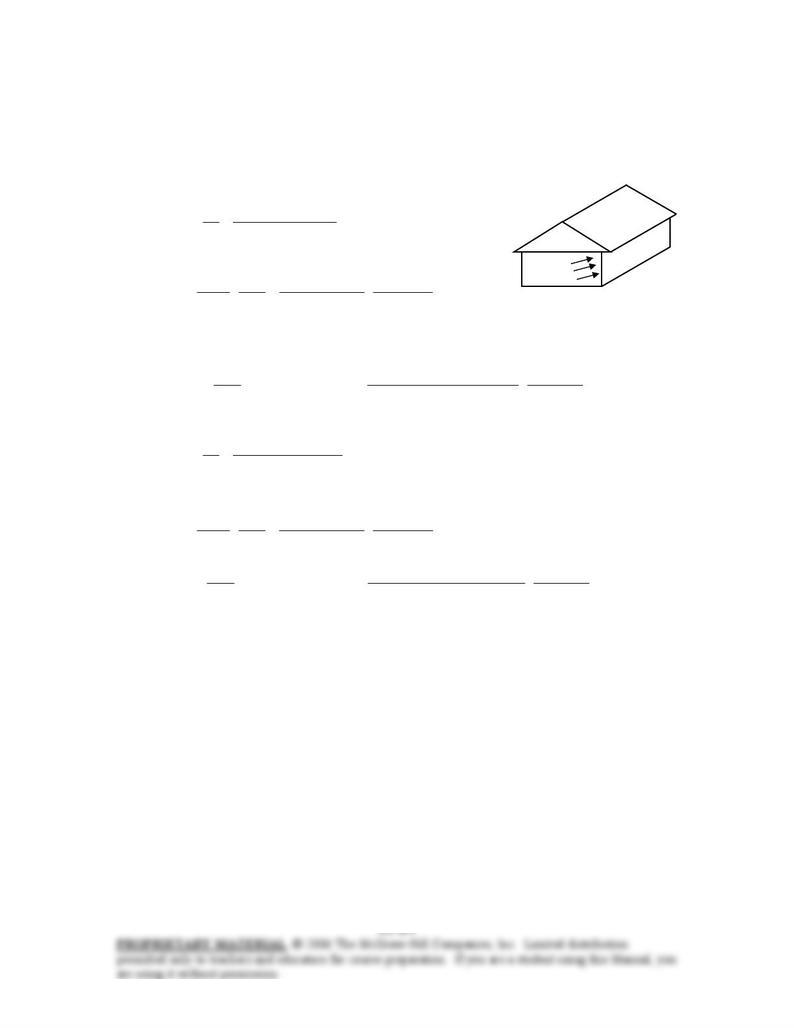
11-49 Wind is blowing parallel to the side wall of a house. The drag force acting on the wall is to be
determined for two different wind velocities. √EES
Assumptions 1 The flow is steady and incompressible. 2 The critical Reynolds number is Recr = 5×10⁵. 3
Air is an ideal gas. 4 The wall surface is smooth (the actual wall surface is usually very rough). 5 The wind
blows parallel to the wall.
Properties The density and kinematic viscosity of air at 1 atm and 5°C are ρ = 1.269 kg/m3 and ν =
1.382×10⁻⁵ m2/s .
Air
55 km/h
4 m
10 m
Analysis The Reynolds number is
7
25 10105.1
/sm 10382.1
m) m/s)(10 6.3/55(
Re ×=
×
== −
υ
VL
L
which is greater than the critical Reynolds number. Thus we have
combined laminar and turbulent flow, and the friction coefficient is
002730.0
10105.1
1742
–
)10105.1(
074.0
Re
1742
–
Re
074.0
75/175/1 =
××
==
L
L
f
C
Noting that the pressure drag is zero and thus CfD C
=
for a flat plate, the drag force acting on the wall
surface is
N 16.2=
⋅
××== 2
23
2
2
m/s kg1
N 1
2
m/s) 6.3/55)( kg/m269.1(
)m 410(00273.0
2
V
ACF f
D
ρ
(b) When the wind velocity is doubled to 110 km/h, the Reynolds number becomes
7
25 10211.2
/sm 10382.1
m) m/s)(10 6.3/110(
Re ×=
×
== −
υ
VL
L
which is greater than the critical Reynolds number. Thus we have combined laminar and turbulent flow,
and the friction coefficient and the drag force become
002435.0
10211.2
1742
–
)10211.2(
074.0
Re
1742
–
Re
074.0
75/175/1 =
××
==
L
L
f
C
N 57.7=
⋅
××== 2
23
2
2
m/s kg1
N 1
2
m/s) 6.3/110)( kg/m269.1(
)m 410(002435.0
2
V
ACF f
D
ρ
Treating flow over the side wall of a house as flow over a flat plate is not quite realistic. When flow hits a
bluff body like a house, it separates at the sharp corner and a separation bubble exists over most of the side
panels of the house. Therefore, flat plat boundary layer equations are not appropriate for this problem, and
the entire house should considered in the solution instead.
Discussion Note that the actual drag will probably be much higher since the wall surfaces are typically very
rough. Also, we can solve this problem using the turbulent flow relation (instead of the combined laminar-
turbulent flow relation) without much loss in accuracy. Finally, the drag force nearly quadruples when the
velocity is doubled. This is expected since the drag force is proportional to the square of the velocity, and
the effect of velocity on the friction coefficient is small.
Chapter 11 Flow Over Bodies: Drag and Lift
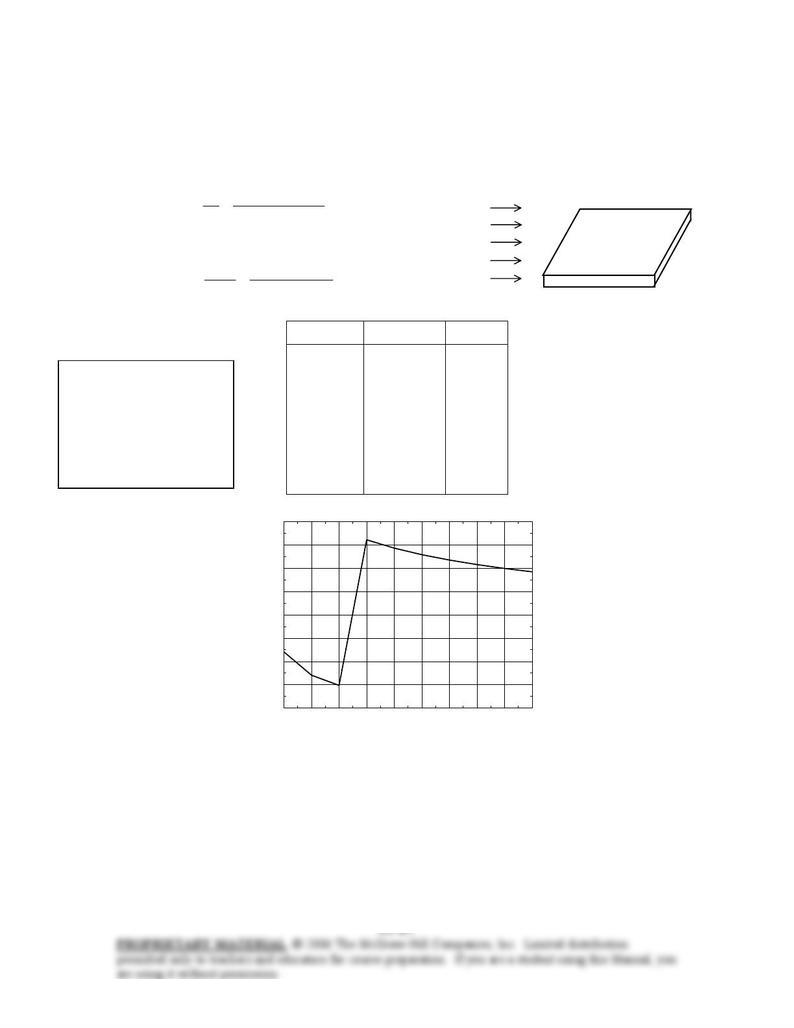
11-50E Air flows over a flat plate. The local friction coefficients at intervals of 1 ft is to be determined and
plotted against the distance from the leading edge.
Assumptions 1 The flow is steady and incompressible. 2 The critical Reynolds number is Recr = 5×10⁵. 3
Air is an ideal gas. 4 The surface of the plate is smooth.
Properties The density and kinematic viscosity of air at 1 atm and 70°F are ρ = 0.07489 lbm/ft3 and ν =
0.5913 ft2/h = 1.643×10⁻⁴ ft2/s .
Analysis For the first 1 ft interval, the Reynolds number is
5
24 10522.1
/sft 10643.1
ft) ft/s)(1 25(
Re ×=
×
== −
υ
VL
L
10 ft
Air
25 ft/s
which is less than the critical value of 510
5
×
. Therefore, the flow
is laminar. The local friction coefficient is
001702.0
)10522.1(
664.0
Re
664.0
5.055.0
,=
×
==
xf
C
We repeat calculations for all 1-ft intervals. The results are
x, ft Re Cf
1
2
3
4
5
6
7
8
9
10
1.522E+05
3.044E+05
4.566E+05
6.088E+05
7.610E+05
9.132E+05
1.065E+06
1.218E+06
1.370E+06
1.522E+06
0.001702
0.001203
0.000983
0.004111
0.003932
0.003791
0.003676
0.003579
0.003496
0.003423
rho=0.07489 “lbm/ft3”
nu=0.5913/3600 “ft2/s”
V=25
“Local Re and C_f”
Re=x*V/nu
“f=0.664/Re^0.5”
f=0.059/Re^0.2
123 4 5 6 7 8 9 10
0.0005
0.001
0.0015
0.002
0.0025
0.003
0.0035
0.004
0.0045
x, ft
f
Discussion Note that the Reynolds number exceeds the critical value for x > 3 ft, and thus the flow is
turbulent over most of the plate. For x > 3 ft, we used for friction
coefficient. Note that C
LL
f
C1742/Re–Re/074.0 5/1
=
f decreases with Re in both laminar and turbulent flows.