Copyright 2021 © McGraw-Hill Education. All rights reserved. No reproduction or distribution without the prior
written consent of McGraw-Hill Education.
Solutions Manual, Chapter 11 1
Chapter 11
Performance Measurement in Decentralized
Organizations
Solutions to Questions
11-1 In a decentralized organization,
decision-making authority isn’t confined to a few
top executives; instead, decision-making
authority is spread throughout the organization.
11-2 The benefits of decentralization include:
(1) by delegating day-to–day problem solving to
lower-level managers, top management can
concentrate on bigger issues such as overall
strategy; (2) empowering lower-level managers
to make decisions puts decision-making
authority in the hands of those who have the
most up-to-date information about day-to–day
operations; (3) by eliminating layers of decision-
making and approvals, organizations can
respond more quickly to customers and to
changes in the operating environment; (4)
granting decision-making authority helps train
lower-level managers for higher-level positions;
and (5) empowering lower-level managers to
make decisions can increase their motivation
and job satisfaction.
11-3 The manager of a cost center has
control over cost, but not revenue or the use of
investment funds. A profit center manager has
control over both cost and revenue. An
investment center manager has control over
cost and revenue and the use of investment
funds.
11-4 Margin is the ratio of net operating
income to total sales. Turnover is the ratio of
total sales to average operating assets. The
product of the two numbers is the ROI.
11-5 Residual income is the net operating
income an investment center earns above the
company’s minimum required rate of return on
operating assets.
11-6 If ROI is used to evaluate performance,
investment center managers may reject
profitable investment opportunities whose rate
of return exceeds the company’s required rate of
return but whose rate of return is less than the
investment center’s current ROI. The residual
income approach avoids this problem because
any project whose rate of return exceeds the
company’s minimum required rate of return will
result in an increase in residual income.
11-7 A transfer price is the price charged
when one responsibility center within a company
provides goods or services to another
responsibility center in the same company.
11-8 Suboptimization occurs when
responsibility center managers forego additional
companywide profits by making decisions that
are not in the best interests of the overall
company or even in the best interests of their
own responsibility center.
11-9 A service department’s budgeted costs
,
rather than its actual costs, should be charged
to operating departments. This prohibits a
service department from passing on cost
overruns to operating departments.
11–10 Sales dollars are often a very poor base
for allocating costs because sales dollars vary
from period to period, whereas the costs are
often largely fixed
.
Therefore, a letup in sales
effort in one department will shift allocated costs
from that department to other, more successful
departments. In effect, the departments putting
forth the best sales efforts are penalized in the
form of higher cost allocations.
Copyright 2021 © McGraw-Hill Education. All rights reserved. No reproduction or distribution without the prior
written consent of McGraw-Hill Education.
2 Managerial Accounting, 17th Edition
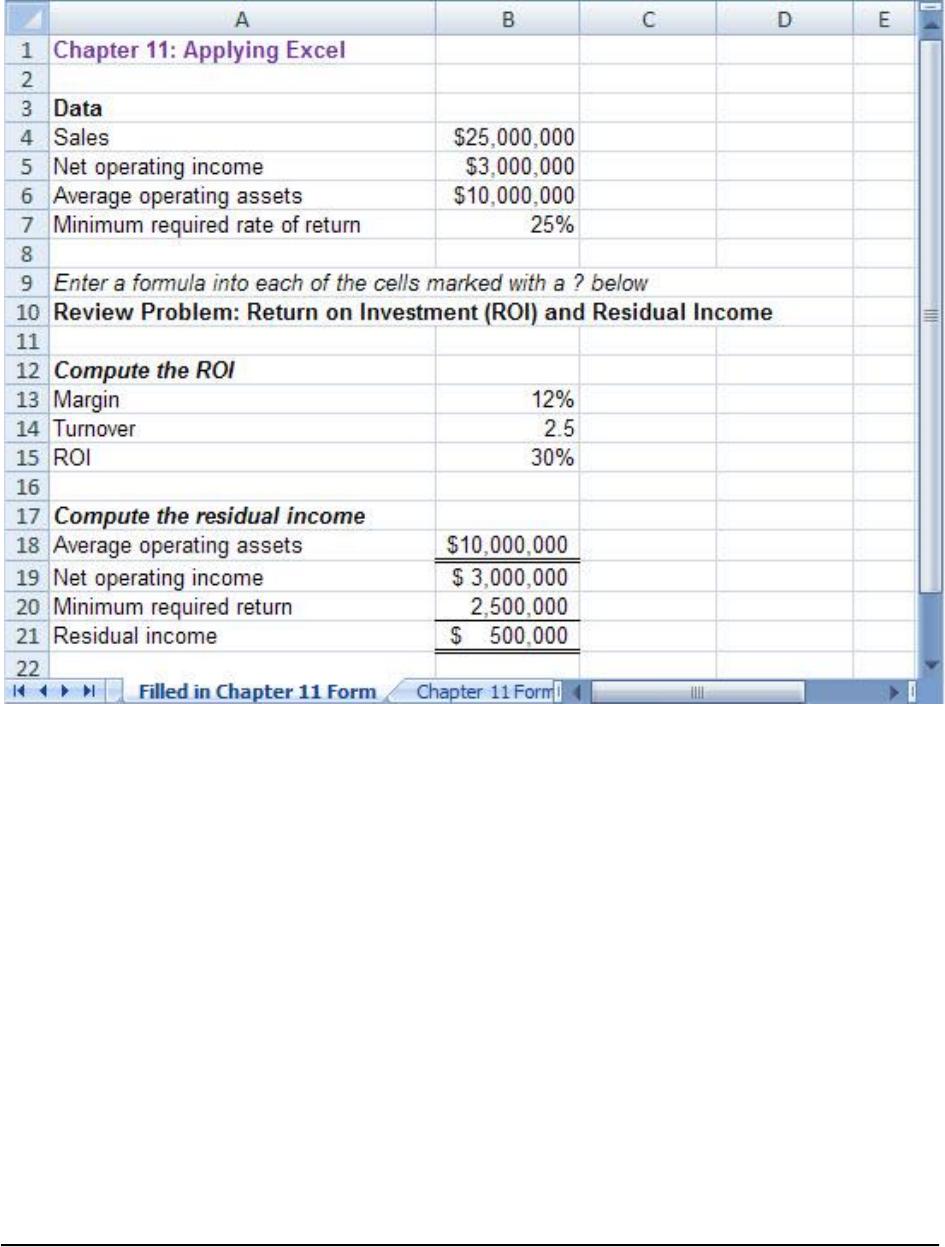
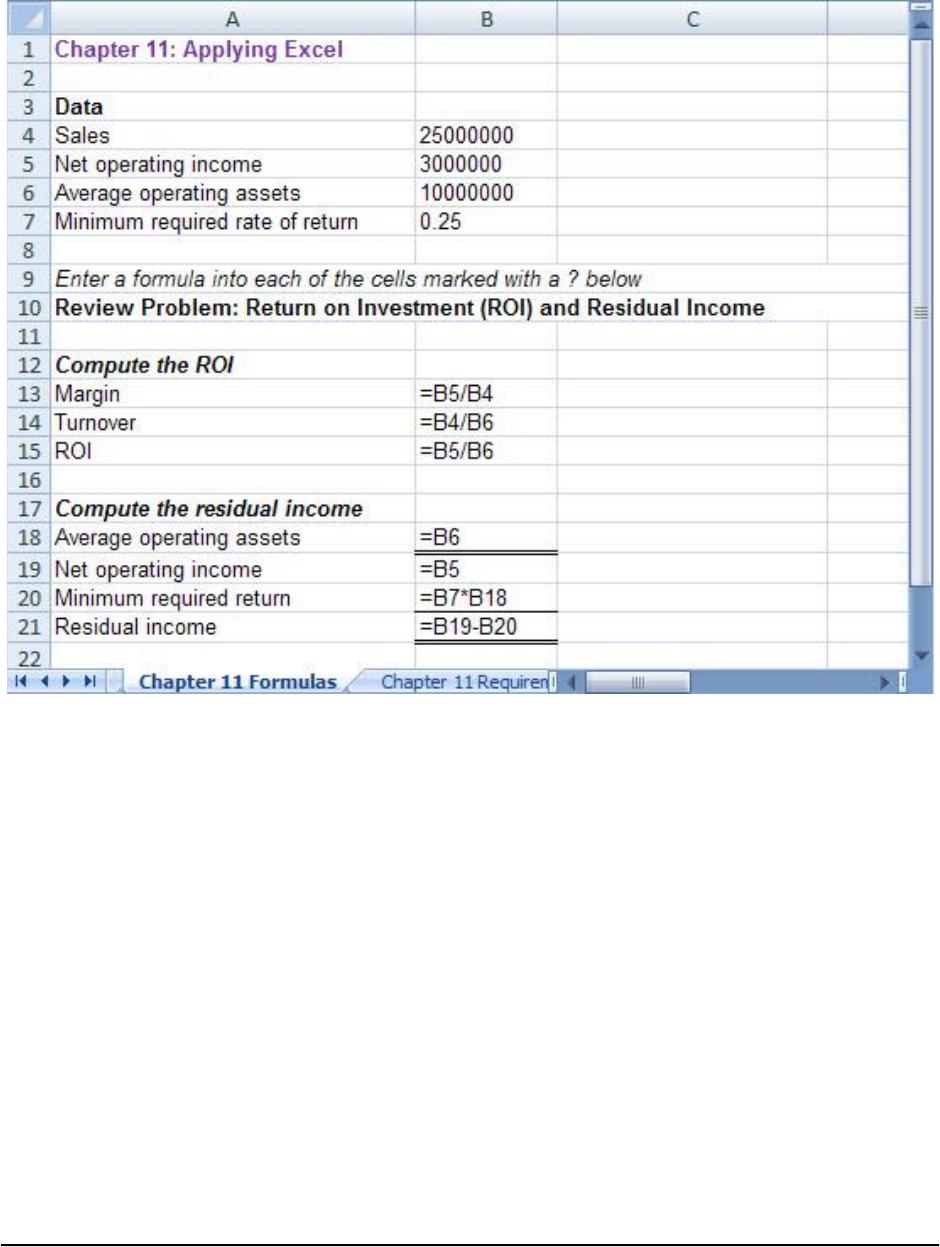
Chapter 11: Applying Excel
The completed worksheet is shown below.
Copyright 2021 © McGraw-Hill Education. All rights reserved. No reproduction or distribution without the prior
written consent of McGraw-Hill Education.
Solutions Manual, Chapter 11 3
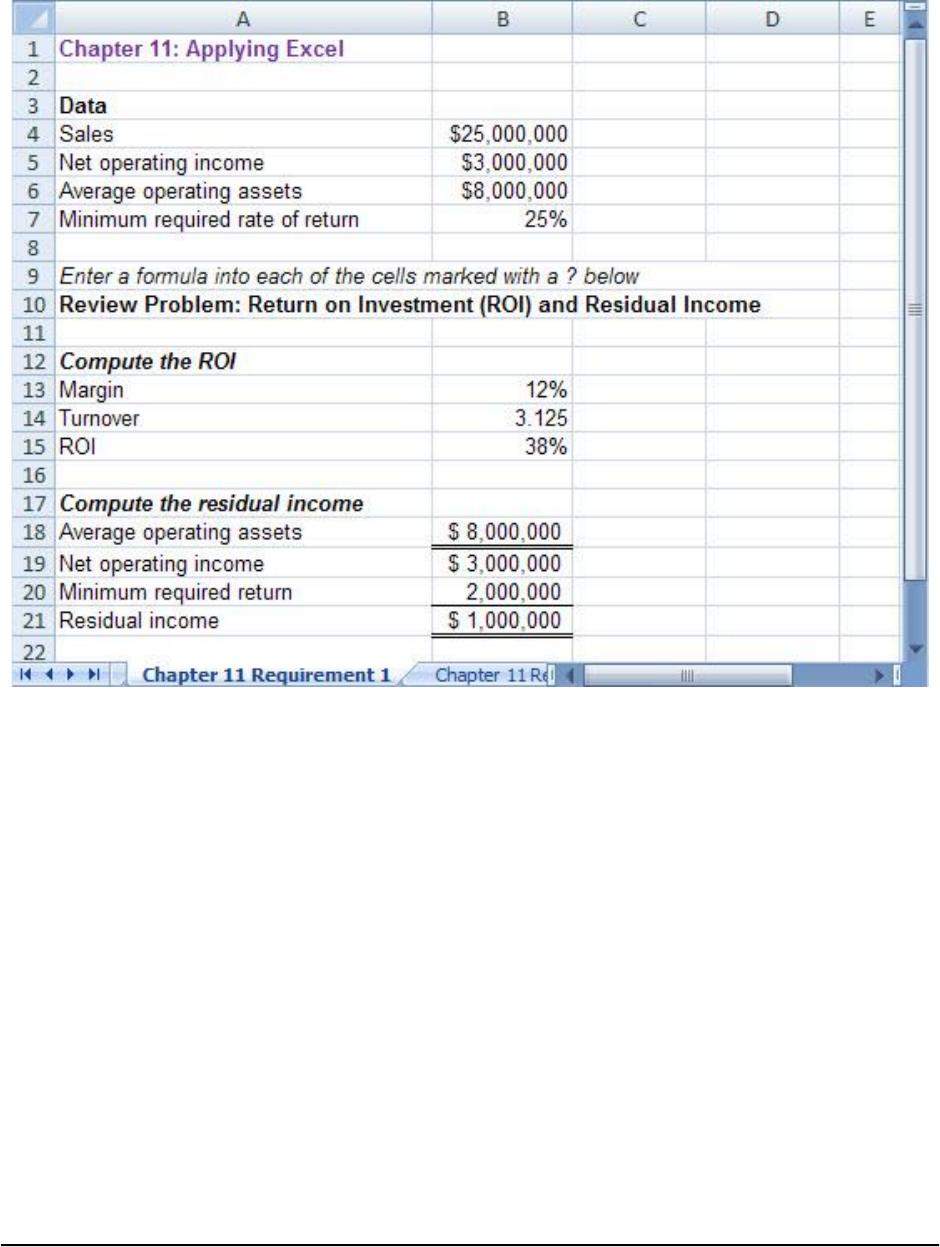
Chapter 11: Applying Excel (continued)
The completed worksheet, with formulas displayed, is shown below.
Copyright 2021 © McGraw-Hill Education. All rights reserved. No reproduction or distribution without the prior
written consent of McGraw-Hill Education.
4 Managerial Accounting, 17th Edition
Chapter 11: Applying Excel (continued)
1. With the changes in average operating assets, the result is:
An increase in average operating assets will increase both the ROI and
residual income.
ROI = Net operating income/Average operating assets
Residual income = Net operating income – Required return
Required return = Minimum required rate of return × Average
operating assets
ROI increases because average operating assets is in the denominator
of ROI. Residual income increases when average operating assets
decreases because a reduction in the average operating assets results in
a reduction of the required return.
Copyright 2021 © McGraw-Hill Education. All rights reserved. No reproduction or distribution without the prior
written consent of McGraw-Hill Education.
Solutions Manual, Chapter 11 5
Chapter 11: Applying Excel (continued)
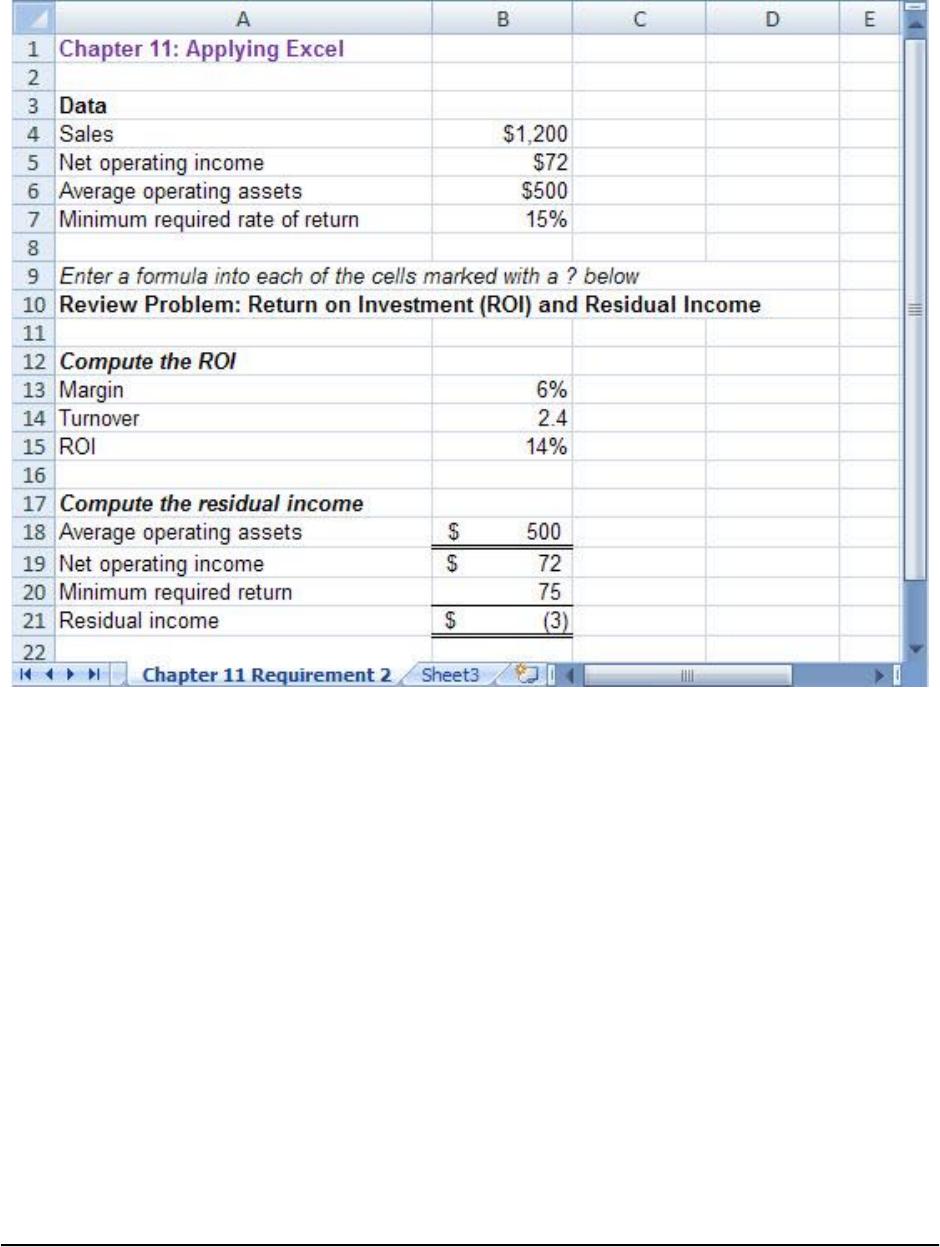
2. With the revised data, the worksheet should look like this:
a. As shown above, the ROI is 14%.
b. As shown above, the residual income is $(3).
c. Because the ROI of 14% is less than minimum required return of
15%, the residual income is negative.

Copyright 2021 © McGraw-Hill Education. All rights reserved. No reproduction or distribution without the prior
written consent of McGraw-Hill Education.
6 Managerial Accounting, 17th Edition
The Foundational 15
1. Last year’s margin is:
Net operating income
Margin = Sales
$200,000
= = 20%
$1,000,000
2. Last year’s turnover is:
Sales
Turnover = Average operating assets
$1,000,000
= = 1.6
$625,000
3. Last year’s return on investment (ROI) is:
ROI = Margin × Turnover
= 20% × 1.6 = 32%
4. The margin for this year’s investment opportunity is:
Net operating income
Margin = Sales
$30,000*
= = 15%
$200,000
* $200,000 – [$200,000 × (1 – 60%)] – $90,000 = $30,000
5. The turnover for this year’s investment opportunity is:
Sales
Turnover = Average operating assets
$200,000
= = 1.67 (rounded)
$120,000

The Foundational 15 (continued)
6. The ROI for this year’s investment opportunity is:
ROI = Margin × Turnover
= 15% × 1.67 = 25% (rounded)
7., 8., and 9.
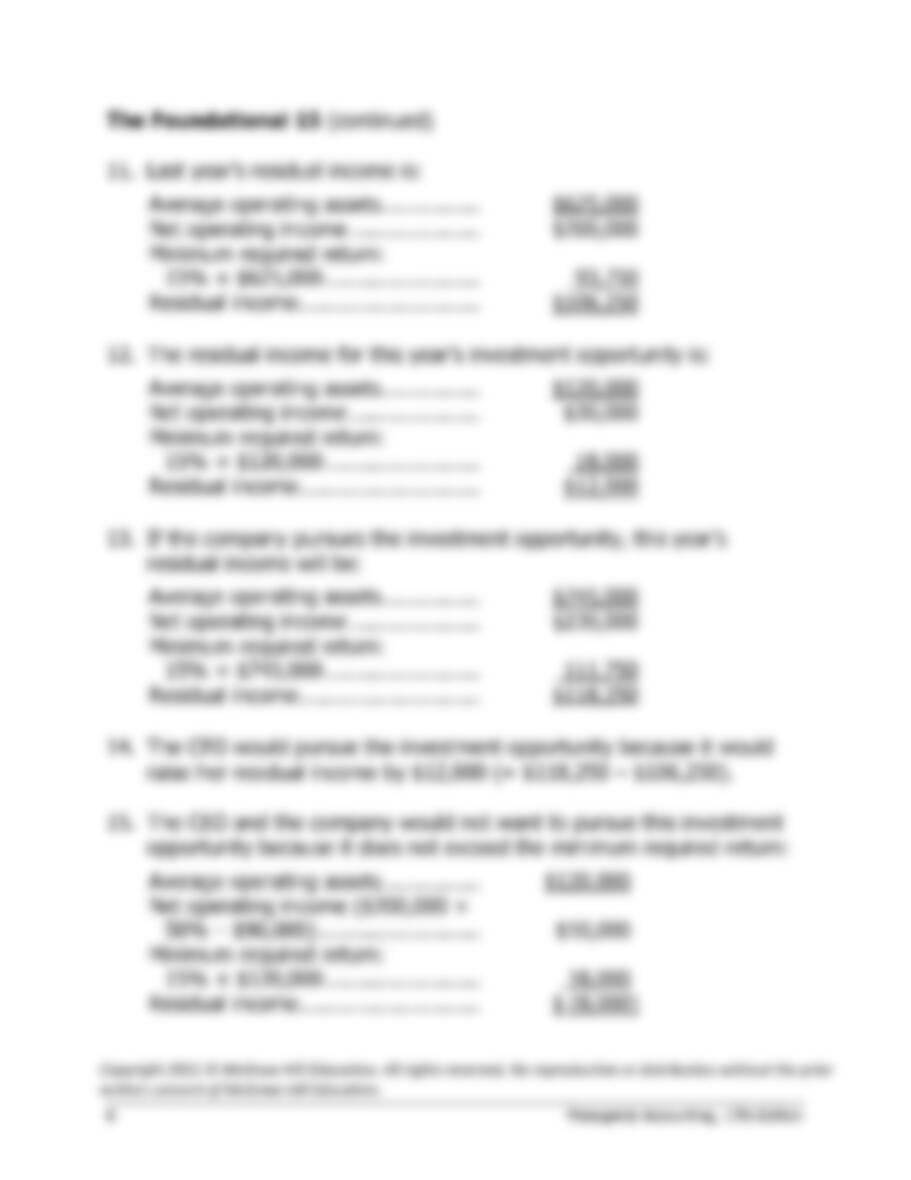
If the company pursues the investment opportunity, this year’s margin,
turnover, and ROI would be:
Net operating income
Margin = Sales
$200,000 + $30,000
=
$1,000,000 + $200,000
$230,000
= = 19.2% (rounded)
$1,200,000
Sales