Chapter 1 Accounting Information Systems: An Overview
Data vs. information
• Data are facts stored in the system
o A fact could be a number, date, name…
o 例如:2/22/14; ABC company; 123; 99; 3; 20; 60
• The previous slide just showed facts, if we put those facts within a context of a sales
invoice, for example, it is meaningful and considered information.
o Invoice Date: 2/22/14 Invoice #: 123 Customer: ABC company
o Item # 99 Qty 3 Price $20
o Total Invoice Amount $60
Value of Information
• Information is valuable when the benefits exceed the costs of gathering, maintaining,
and storing the data
• Benefit (i.e. improved decision making) > Cost (i.e. time and resources used to get the
information)
What makes information useful?
7 general characteristics that make information useful:
1. Relevant: information needed to make a decision (e.g. the decision to extend customer
credit would need relevant information on customer balance from an A/R aging report)
2. Reliable: information free from bias
3. Complete: does not omit important aspects of events or activities
4. Timely: information needs to be provided in time to make the decision
5. Understandable: information must be presented in a meaningful manner
6. Verifiable: two independent people can produce the same conclusion
7. Accessible: available when needed
Organizational decisions and information needed
• Business organizations use business processes to get things done. These processes
are a set of structured activities that are performed by people, machines, or both to
achieve a specific goal.
• Key decisions and information needed often come from these business processes.
Relevant
Reduces uncertainty, improves decision making, or confirms or corrects
prior expectations.
Reliable
Free from error or bias; accurately represents organization events or
activities.
Complete
Does not omit important aspects of the events or activities it measures.
Timely
Provided in time for decision makers to make decisions.
Understandable
Presented in a useful and intelligible format.
Verifiable
Two independent, knowledgeable people produce the same information.
Accessible
Available to users when they need it and in a format they can use.
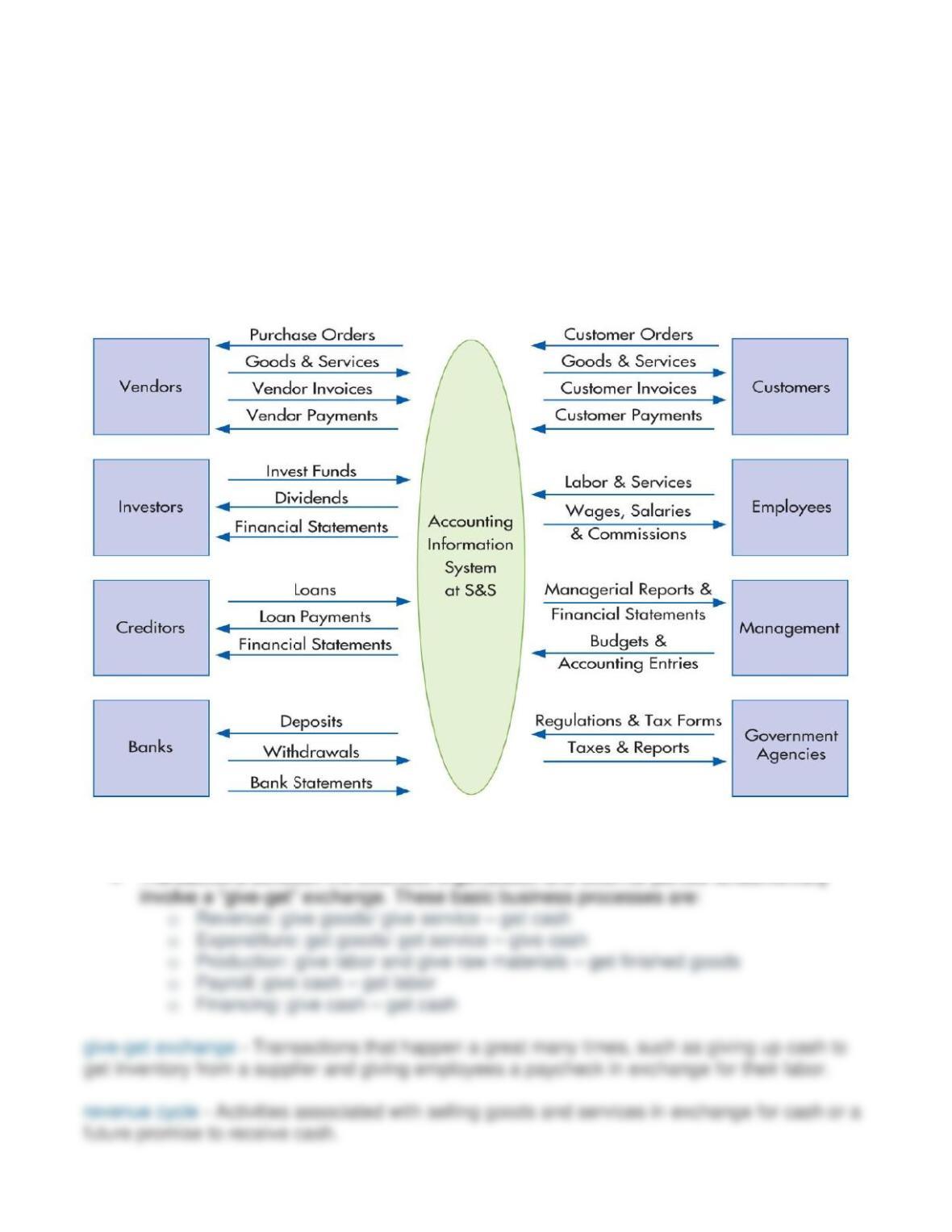
Transactional information between internal and external parties in an AIS
• Business organizations conduct business transactions between internal and external
stakeholders
• Internal stakeholders are employees in the organization (e.g. employees and managers)
• External stakeholders are trading partners such as customers and vendors as well as
other external organizations such as Banks and Government
• The AIS captures the flow of information between these users for the various business
transactions
Interactions Between AIS and Internal and External Parties
Basic Business Processes