Chapter 1
➢ Business Combination
➢ Motivation for Business Combination
o Increase Revenue
o Decrease cost
o Access to Know how
o Access to product
o More market share
o Access to Liquidity
o Benefit from tax
o Diversification
o Risk reduction
o Etc.
➢ Goodwill
A-Corporation acquired B-Corporation (all assets and liability of B) and B-Corporation dissolved.
Example:
On January 2, of 2015, A-Corporation entered into a business combination with B-Corporation in which
B is dissolved. A-Corporation pays $1,650,000 for B, the consideration consisting of 66,000 shares of A-
Corporation of $10 par common stock with a market value of $25 per share. In addition, A pays the
following expenditures in cash at the time of the merger.
Finder’s Fee $ 70,000
Accounting and Legal fees $130,000
Registration and Issuance cost of securities $ 80,000
Total $280,000
Balance sheet and fair value information for the two companies on December 3
1, 2014, immediately before the merger, is as follows (in thousands):
A Book Value B Book Value B Fair Value
Cash $ 300 $ 60 $ 60
Accounts Receivable 460 100 80
Inventories 1,040 160 240
Land 800 200 300
Building-net 2,000 400 650
Equipment-net 1,000 600 450
Patent —— —– 100
Total Assets $5,600 $1,520 $1,880
Accounts Payable $ 600 $ 80 $ 80
Note Payable 1,200 400 320
Common Stock, $10 par 1,600 600
Additional Paid-in-Capital 1,200 100
Retained Earnings 1,000 340
Total Liabilities and Owners’ Equity $5,600 $1,520
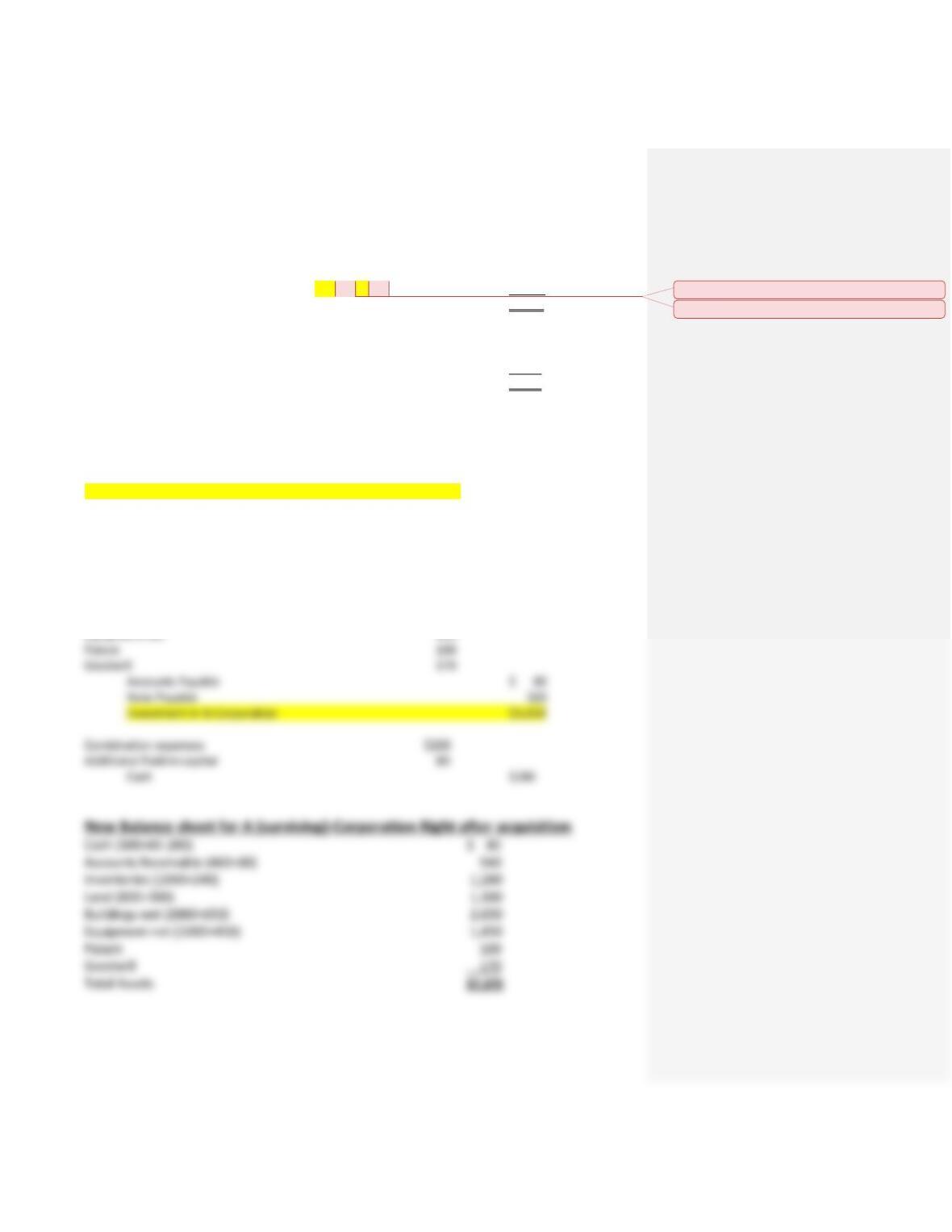
Commented [Office1]: Book Value is irrelevant
Commented [Office2]: To get the 1650 is subtract the
patent and the liabilities
Calculations:
Cost of Acquisition (66,000 shares @ $25) in thousand $1,650
Fair Value of net identifiable assets ($1,780– $400)= $1,380 $1,380
Excess payment $ 270
Allocation of excess payment:
Patent $ 100
Goodwill $ 170
Total $ 270
Journal Entries:
Investment in B-Corporation $1,650
Common Stock $ 660
Other Paid-in-capital $ 990
Cash $ 60
Accounts Receivable-net 80
Inventories 240
Land 300
Buildings-net 650
Commented [Office3]: The total asset minues the patent
Commented [Office4]: Liabilities (80+320)