Business Idea
Generation and
Initial Evaluation
Part One: Laying the Groundwork for Small
Business
Chapter 3
© McGraw-Hill Education. All rights reserved. Authorized only for instructor use in the classroom. No reproduction or further distribution permitted without the prior written consent of McGraw-Hill Education.

© McGraw-Hill Education
Learning Objectives
•Describe a systematic means for examining skills in order to
generate new business ideas
•Discuss the elements of opportunity analysis
•Analyze how to choose a business

© McGraw-Hill Education
Chapter Overview
Chapter begins by identifying a systematic way to generate a list
of potential businesses
Next, it examines the marketplace for opportunities
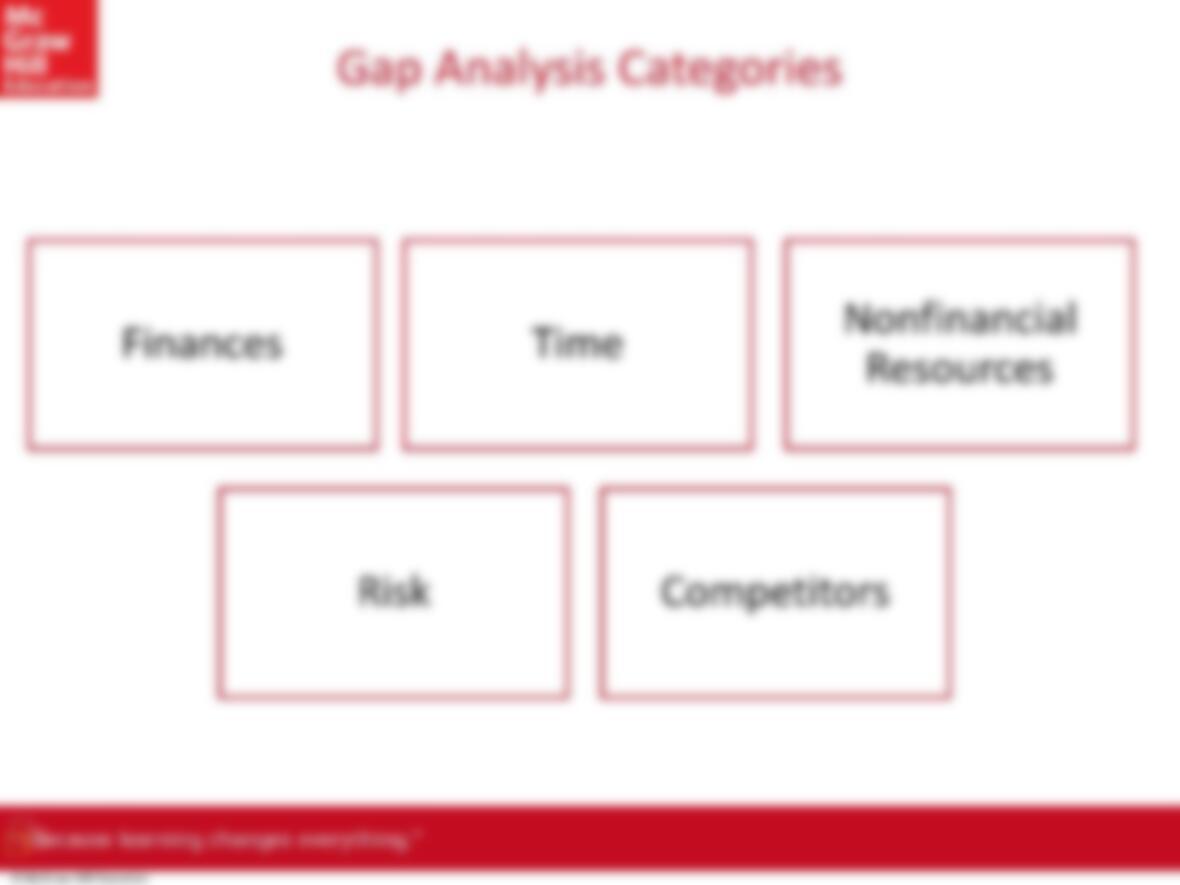
•Gap analysis is looked at specifically
Final part of the chapter is devoted to choosing a business,
including analyzing potential risks and threats

© McGraw-Hill Education
Suggested Approach to Developing a Quality
Business Idea
•List and evaluate your own personal skill sets
•Carefully analyze the market and look for gaps or some unmet
need
•Compare the ability to fill those gaps with the opportunities
available

© McGraw-Hill Education
Skills Analysis, 1
Founders must have the necessary skills and a depth of
understanding to build a long-term advantage in the market
Synergy is essential
•Synergy: Connection between the entrepreneur’s skills,
understanding of an industry, and the ability to create a competitive
advantage such that the sum of the parts of the new business is
greater than the individual parts alone

© McGraw-Hill Education
Skills Analysis, 2
Skills are idiosyncratic to the individual
Specific areas for skill identification include:
•Hobbies
•Education
•Work experience
•Family history

Hobbies and Activities
Each hobby develops a specific skill
Questions the potential business owner should ask include:
•What hobbies or activities do you pursue on an active, perhaps
daily basis and over your lifetime?