Chapter # 5
1. In most markets scarce goods or services are rationed among competing users, and ______ perform that task.
A. non-monetary prices
B. monetary prices
C. government organizations
D. private organizations
2. Home football games at your college are free for students and most of the students like to go to the game. What
is the non-monetary cost for you to go to the game?
A. Gas that you will need for your car.
B. Money you paid for body painting and artificial hair.
C. The outrageous price you had to pay for hot dog and soda.
D. The 5 hours you waited in the line to get ticket.
3. The time one spends researching the performance and fuel economy of new cars on the Internet is an example
of a(n)
A. monetary cost.
B. non-monetary cost.
C. information cost.
D. implied cost.
4. In some countries, medical care is provided free to citizens and paid for by the government. In those countries,
medical care is
A. not a scarce resource.
B. available at zero opportunity cost.
C. rationed by non-monetary costs.
D. available at no cost to everyone who wants it.
5. JoJo is shopping for a new computer. A mail-order computer can be delivered to JoJo’s home for $1,200. JoJo
could pick up the same computer at the warehouse for $1,000.How should JoJo decide.
A. JoJo should definitely drive to the warehouse because the monetary cost is $200 lower.
B. JoJo should drive to the warehouse if the value of his travel time plus wear and tear on his car is less than $200.
C. JoJo should definitely have the computer delivered, because the $200 saving is less than 20% of the purchase
price.
D. JoJo should definitely drive to the warehouse because the $200 saving is more than 10% of the purchase price.

6. The tendency for consumers to purchase more of a good or service as its price falls is called
A. the law of supply.
B. the law of increasing cost.
C. the Low-Hanging Fruit principle.
D. the law of demand.
7. The law of demand indicates that as the cost of an activity
A. falls, less of the activity will occur.
B. rises, more of the activity will occur.
C. rises, the level of the activity may or may not increase depending on the individual.
D. falls, more of the activity will occur.
8. According to the law of demand, when the price of shoes ______ you will consume ________ shoes.
A. rises, more
B. falls, more
C. rises, the same amount
D. falls, the same amount
9. As the price of computers falls, the quantity demanded of computers increases. This is an application of
A. the law of supply
B. production possibility expansion
C. the law of demand
D. needs versus wants
10. After subsistence levels of food, shelter, and clothing are provided,
A. all other goods and services are “needs.”
B. many goods and services are “needs.”
C. all other goods and services are “wants.”
D. all other goods and services are “luxuries.”
11. Taking a limousine to a five star restaurant in New York is a
A. necessity to Donald Trump but a luxury to Joe Average.
B. necessity to both Joe Average and Donald Trump
C. want to both Joe Average and Donald Trump.
D. want to Donald Trump and a luxury to Joe Average.
12. As living standards improve,
A. things that were once luxuries become needs.
B. things that were once wants become needs.
C. needs are eliminated, leaving only wants.
D. needs remain the same, but wants increase.

13. Shelter for homeless people is an example of
A. a want
B. a need
C. something they can live without
D. something hard to find
14. Higher education is a ________ and assigned textbooks are ________.
A. need; needs
B. want; wants
C. need; wants
D. want; needs
15. Rice requires extensive irrigation, therefore water for rice farmers in California is
A. not as important as for farmers in Pennsylvania, where they grow little rice
B. a necessity
C. a need
D. a want
16. Ten years ago you had never even heard of wireless internet. Now you complete assignments for class on a
laptop that accesses the Internet using wireless technology. This is evidence that
A. things that were once wants can become needs.
B. needs remain the same, but wants change.
C. needs and wants both increase with increases in technology.
D. needs decrease with technology, but wants increase.
17. According to economists, the satisfaction people get from their consumption activities is called
A. demand
B. utility
C. needs
D. wants
18. Utility maximization means that people try to allocate their ______ to maximize their ___________.
A. utility, spending
B. resources, satisfaction
C. time, work
D. limited resource, desires
19. Pat just spent a thousand dollars on a painful dental procedure. In this case
A. Pat’s resources yielded negative utility
B. demand for dental procedures is upward sloping.
C. we can assume that having the dental services performed increased Pat’s utility.
D. utility is irrelevant to this decision to spend money.

During Thanksgiving you participated in a pumpkin-pie eating contest since you love pumpkin pie. You really
enjoyed the first two pies, the third one was OK, but as soon as you ate the 4th one you became ill and lost the
contest.
20. Your total utility _______with each pie you ate up to the 3rd pie.
A. increased
B. decreased
C. stayed the same
D. first increased than decreased
21. Beyond the 3rd pie your total utility
A. increases, but by less than for the first three pies
B. decreases
C. stays the same
D. is zero
22. You got ______ utility from eating the 1st pie than eating the 3rd pie.
A. less
B. more
C. the same amount of
D. marginal
23. You got ______ utility from eating the 4th pie than eating the 2nd pie.
A. less
B. more
C. the same amount of
D. marginal
Sven likes to water ski, but can only water ski during the one week that he is on vacation. Therefore, he plans to
ski every day, for eight hours a day. The first day, Sven skied for eight hours and enjoyed every hour. The second
day, Sven slept in and then skied for seven hours, which was fun but not as much fun as the first day. The third
day, Sven skied for six hours, but was starting to get a bit bored by the end. The fourth day, Sven skied for four
hours and then took a nap. On the fifth day of Sven’s vacation, Sven went blueberry picking all day.
24. Sven’s total utility _______with each hour that he skied.
A. increased
B. decreased
C. remained constant
D. first increased than decreased
25. On the fifth day of Sven’s vacation, he had decided that another hour of skiing would yield
A. more utility than the day before
B. the same level of utility as the day before
C. less utility than blueberry picking
D. no utility at all

26. Sven gets ______ utility from his first hour of skiing than from his tenth hour of skiing.
A. less
B. more
C. the same
D. the same amount, but better quality
27. Sven’s vacation convinced him that
A. even for activities he really enjoys, diminishing marginal utility eventually sets in.
B. blueberry picking yields higher total utility than does water skiing.
C. even for activities he really enjoys, total utility declines each time he engages in it.
D. economic theory applies only to things you buy, not recreation
28. ______ is the additional utility gained from consuming an additional unit of a good.
A. Total utility
B. Marginal Utility
C. Utility
D. Utils
29. Pat’s total utility after eating 99 Reese’s Peanut Butter Cups was less than his total utility after eating his
hundredth. Therefore, Pat’s marginal utility for the 100th peanut butter cup was
A. positive, but less than one.
B. positive, but less than Pat’s marginal utility for the 99th peanut butter cup
C. zero,
D. negative
30. The term marginal utility denotes the amount by which ______ changes when consumption changes by_____
unit(s).
A. total utility, 1
B. demand, 5
C. demand, 1
D. total utility, 5
31. Laura’s total utility from consuming 8, 9, and 10 bonbons is 35, 42, and 45, respectively. Her marginal utility
from the 9th bonbon is
A. 42
B. 77
C. 7
D. 4.67
32. Suppose Chris’ marginal utility from the first taco Chris eats is 15 and Chris’ marginal utility from the second
taco is 12. One can infer that Chris
A. has total utility of 2 tacos equal to 27.
B. should eat only one taco.
C. has average utility for 2 tacos of 27.
D. should eat 2 tacos.
33. If marginal utility is positive as consumption increases,
A. the consumer will not experience diminishing marginal utility.
B. total utility will remain high and constant as consumption increases.
C. total utility will increase as consumption increases.
D. the demand curve will have a positive slope.
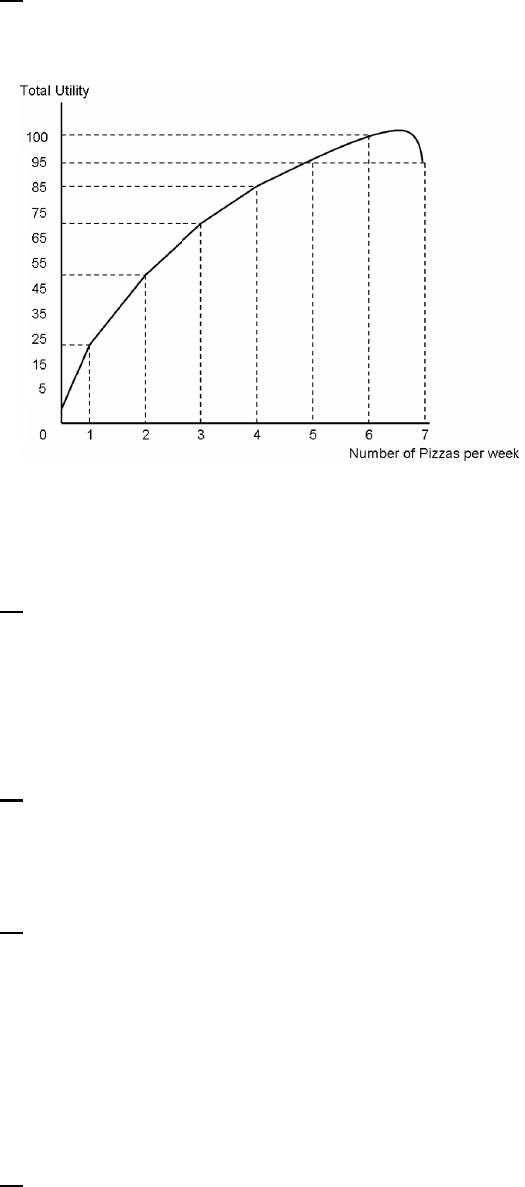
34. Refer to the figure above. The total utility of consuming 4 pizzas each week is
A. 50
B. 70
C. 85
D. 95
35. Refer to the figure above. The marginal utility of the sixth pizza is
A. 95
B. 100
C. 5
D. 15
36. Refer to the figure above. The total utility of consuming two pizzas in a single week is
A. 45
B. 60
C. 30
D. 15
37. Refer to the figure above. The marginal utility of the 7th pizza is
A. 10
B. 5
C. -10
D. -5
38. Refer to the figure above. Total utility increases with each additional pizza consumed up to the _____ and than
declines, but marginal utility _______ with each additional pizza consumed each week.
A. 7th pizza, increases
B. 6th pizza, increases
C. 5th pizza, stays the same
D. 6th pizza, decreases
39. Moe’s parents frequently tell him how it was back in their childhoods. They had a smaller house, fewer toys,
only one car and one black-and-white TV, but they were happy. In fact, Moe’s parents claim that they were
happier than Moe and his friends are today even though Moe and his friends all have much more stuff. Moe
concludes that
A. his parents are irrational, because for rational people total utility increases with consumption.
B. Moe’s parents are subject to diminishing marginal utility, but Moe and his friends are not.
C. economic models cannot be applied to two different generations.
D. the social forces that influence demand have changed since Moe’s parents were young.
40. Donald has vast riches and consumes thousands of dollars worth of consumer goods each week, yet he is
never satisfied. Why not?
A. Wants are unlimited, but resources are finite.