Financial Accounting
Eleventh Edition
Global Edition
Chapter 3
Accrual
Accounting
Copyright © 2018 Pearson Education, Inc. All Rights Reserved.

Copyright © 2018 Pearson Education, Inc. All Rights Reserved.
Learning Objectives
3.1 Explain how accrual accounting differs from cash-basis
accounting
3.2 Apply the revenue and expense recognition principles
3.3 Adjust the accounts
3.4 Prepare updated financial statements
3.5 Close the books

Copyright © 2018 Pearson Education, Inc. All Rights Reserved.
Learning Objective 3.1
Explain how accrual accounting differs from cash-basis
accounting

Copyright © 2018 Pearson Education, Inc. All Rights Reserved.
Explain How Accrual Accounting Differs
From Cash-Basis Accounting (1 of 4)
Accrual Accounting
•Records impact of transactions when they occur
•Records:
–Income when earned
–Expenses when incurred

Copyright © 2018 Pearson Education, Inc. All Rights Reserved.
Explain How Accrual Accounting Differs
From Cash-Basis Accounting (2 of 4)
Cash-Basis Accounting
•Records only cash transactions
–Cash receipts
–Cash payments
•Fails to capture the underlying economic phenomenon
•Results in incomplete financial statements
•Only used by businesses that do not follow accounting
standards

Copyright © 2018 Pearson Education, Inc. All Rights Reserved.
Explain How Accrual Accounting Differs
From Cash-Basis Accounting (3 of 4)
•Accrual accounting records cash transactions, such as:
–Collecting cash from customers
–Receiving cash from interest earned
–Paying salaries, rent, and other expenses
–Borrowing money
–Paying off loans
–Issuing shares

Copyright © 2018 Pearson Education, Inc. All Rights Reserved.
Explain How Accrual Accounting Differs
From Cash-Basis Accounting (4 of 4)
•The Time-Period Concept
–Accounting information is reported at regular intervals
–Basic accounting period is one year
–Companies also prepare financial statements for interim
periods

Copyright © 2018 Pearson Education, Inc. All Rights Reserved.
Learning Objective 3.2
Apply the revenue and expense recognition principles

Copyright © 2018 Pearson Education, Inc. All Rights Reserved.
Apply the Revenue and Expense
Recognition Principles (1 of 4)
The Revenue Principle
•Deals with two issues:
–When to record (recognize) revenue
–What amount of revenue to record
Revenue is recognized when:
–risks and rewards of ownership of the goods has transferred to
the buyer
–the entity retains neither continuing managerial involvement
usually associated with ownership nor effective control over
goods sold

Copyright © 2018 Pearson Education, Inc. All Rights Reserved.
Apply the Revenue and Expense
Recognition Principles (2 of 4)
The Revenue Principle
Revenue is recognized when:
–the amount of revenue can be measured reliably
–it is probable that the economic benefits associated with the
transaction will flow to the entity
–the costs incurred or to be incurred in respect of the transaction
can be measured reliably

Copyright © 2018 Pearson Education, Inc. All Rights Reserved.
Apply the Revenue and Expense
Recognition Principles (3 of 4)
The Expense Recognition Principle
•Includes two steps:
–Identify all expenses incurred during the period
–Measure the expenses and recognize them in the
same period in which any related revenues are earned
•To recognize an expense along with related revenues
means to subtract expenses from related revenues to
compute net income or net loss.
Apply the Revenue and Expense
Recognition Principles (4 of 4)
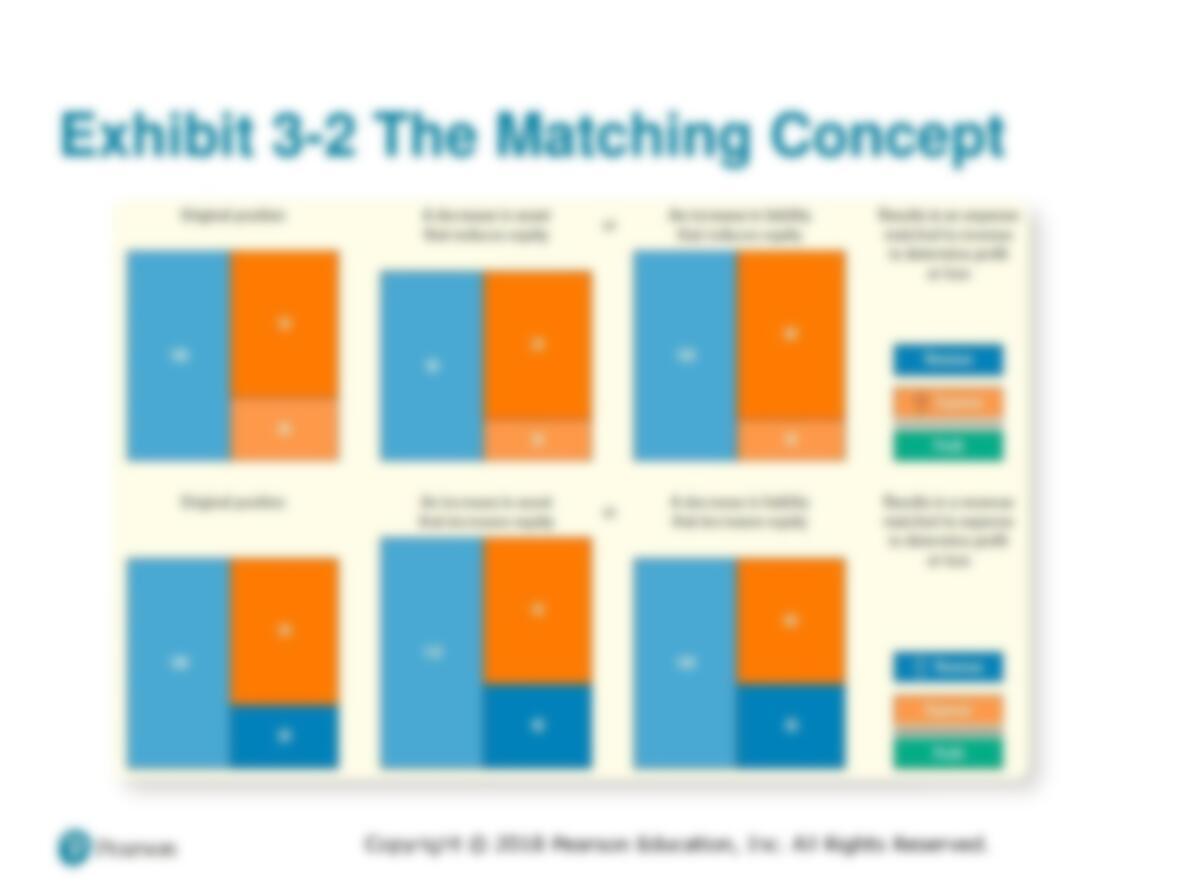
The Matching Concept explains the relationship between
expenses and revenues
Includes two steps: