Chapter 12
12.1 Planes and Surfaces
Given a fixed point P0= (x0, y0, z0) and a non-zero normal vector n=ha, b, ci, the set of all points
Psatisfying
*
P0P·n= 0 (i.e.,
*
P0Pis orthogonal to n) is called a plane. The equation for such a
plane is
a(x−x0) + b(y−y0) + c(z−z0)=0
or, equivalently,
ax +by +cz =ax0+by0+cz0.
The coefficients a, b, and cdetermine the orientation of the plane (they are the components of
the normal vector), while x0+y0+z0determines the location of the plane.
Example: Find an equation of the plane that passes through the (non-collinear) points P=
(2,−1,3), Q = (1,4,0), and R= (0,−1,5).
Solution: We first find the displacement vectors
*
P Q and
*
P R:
*
P Q =h1−2,4−(−1),0−3i=h−1,5,−3i
*
P R =h0−2,−1−(−1),5−3i=h−2,0,2i
We now take the cross product of
*
P Q and
*
P R to find n(because the cross product of two vectors
is orthogonal to both vectors):
n=
*
P Q ×
*
P R =
ˆ
iˆ
jˆ
k
−1 5 −3
−2 0 2
=
5−3
0 2
ˆ
i−
−1−3
−2 2
ˆ
j+
−1 5
−2 0
ˆ
k
= [5(2) −0(−3)]ˆ
i−[−1(2) −(−2)(−3)]ˆ
j+ [−1(0) −(−2)(5)]ˆ
k
= 10ˆ
i+ 8ˆ
j+ 10ˆ
k=h10,8,10i
Because nis orthogonal to
*
P Q and
*
P R, and because any scalar multiple of nis parallel to n
and, thus, also orthogonal to
*
P Q and
*
P R, we can choose n=h5,4,5iin order to simplify our
calculations. This step is optional – any scalar multiple of the cross product will result in an
orthogonal vector and will lead to a mathematically equivalent equation for the plane.
We can choose any of the given points for the plane equation and obtain a mathematically
equivalent result. For this problem, we will use the point Pto write the equation:
5(x−2) + 4(y+ 1) + 5(z−3) = 0 OR 5x+ 4y+ 5z= 21.
Two distinct planes are said to be parallel if their normal vectors are parallel (i.e., the normal
vectors are scalar multiples of one another). Two distinct planes are said to be orthogonal if their
normal vectors are orthogonal (i.e., the dot product of the normal vectors is 0).
Example: Find an equation of the plane that passes through (−2,4,1) and is parallel to the plane
described by the equation 3x−2y+z= 4.
1
Solution: We first find the normal vector
*
nto the given plane: h3,−2,1i. Note that
*
nwill also be
normal to any plane parallel to the given plane. Now, we use the formula for a point and normal
vector to write an equation of the plane:
3(x+ 2) −2(y−4) + 1(z−1) = 0 OR 3x−2y+z=−13
Let Cbe a curve located in a plane P, and let lbe a line that does not lie in P. The surface
consisting of all of the lines parallel to lthat pass through Cis called a cylinder. The set of points
at which a surface intersects a plane that is parallel to one of the coordinate planes is called the
trace of the surface. Each surface as an xy-trace, a yz-trace, and an xz-trace. Traces are often
used to identify types of surfaces.
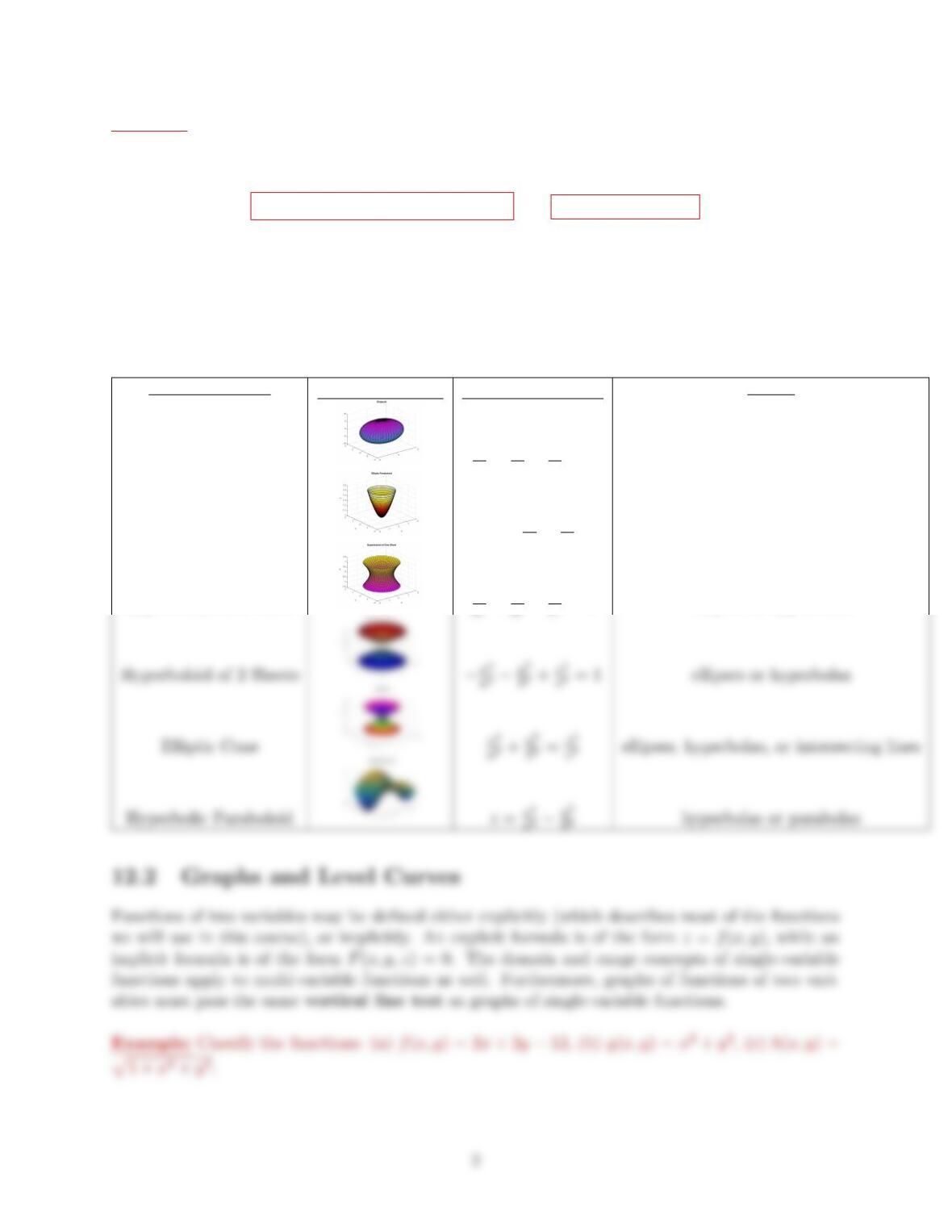
Name of Surface Graph of Surface Standard Equation Traces
Ellipsoid x2
a2+y2
b2+z2
c2= 1 ellipses
Elliptic Paraboloid z=x2
a2+y2
b2ellipses or parabolas
Hyperboloid of 1 Sheet x2