Ch 5- Social Media: Living in the Connected World
• Social media is defined collectively as the different forms of online communication
through which users can create communities to exchange information, ideas, messages,
and other content.
• Social media platforms act as a home base for an online community. To access the
conversations held there, users must become members.
• There are three basic types of social media platforms; however, many social media sites
demonstrate characteristics of two and sometimes all three of these types.
o Social Networking Sites–
▪ are websites or apps (such as Facebook, Pinterest, Snapchat, and LinkedIn)
that provide virtual communities for people to share daily activities, send
messages, post opinions, increase their circle of online friends, and more.
o Social Bookmarking Sites-
▪ give you a place to save, organize, and manage links to websites and other
resources on the Internet. Usually these lists are then shared with other
users.
o Blogging Sites & Forums–
▪ Blogging sites and forums enable members to hold conversations by
posting articles, making comments, or facilitating interactions on
dedicated discussion boards.
▪ Blogs are sites that regularly post articles and other content for readers,
who can then comment on those articles and share them on other social
media sites.
• Consumers rely on the communities created by social media for their buying decisions in
the following ways:
o Discover new goods and services: According to one recent report conducted by
comScore and Group M Search, 28% of respondents said that sites like YouTube,
Facebook, and Twitter helped steer them toward new brands and products.
o To conduct research and share information: Consumers visit blogs and social
networking sites to delve further into a topic—whether it’s an industry, a brand,
or a specific product. Reviews or rankings by fellow consumers, along with other
shared information, can carry a lot of weight in certain purchase decisions.
o To make final purchase decisions: Another study found that 72% of consumers
regard online reviews as a primary driver of their decision to buy.
• Marketers generally view the overall goal of social media marketing (SMM) as developing
a conversation with current and potential customers. However, this doesn’t always mean
that social media posts will be used to promote a product or publicize a sale. Any SMM
plan must be built around specific goals. Marketers should ask themselves: “What do we
want to accomplish through this campaign?”
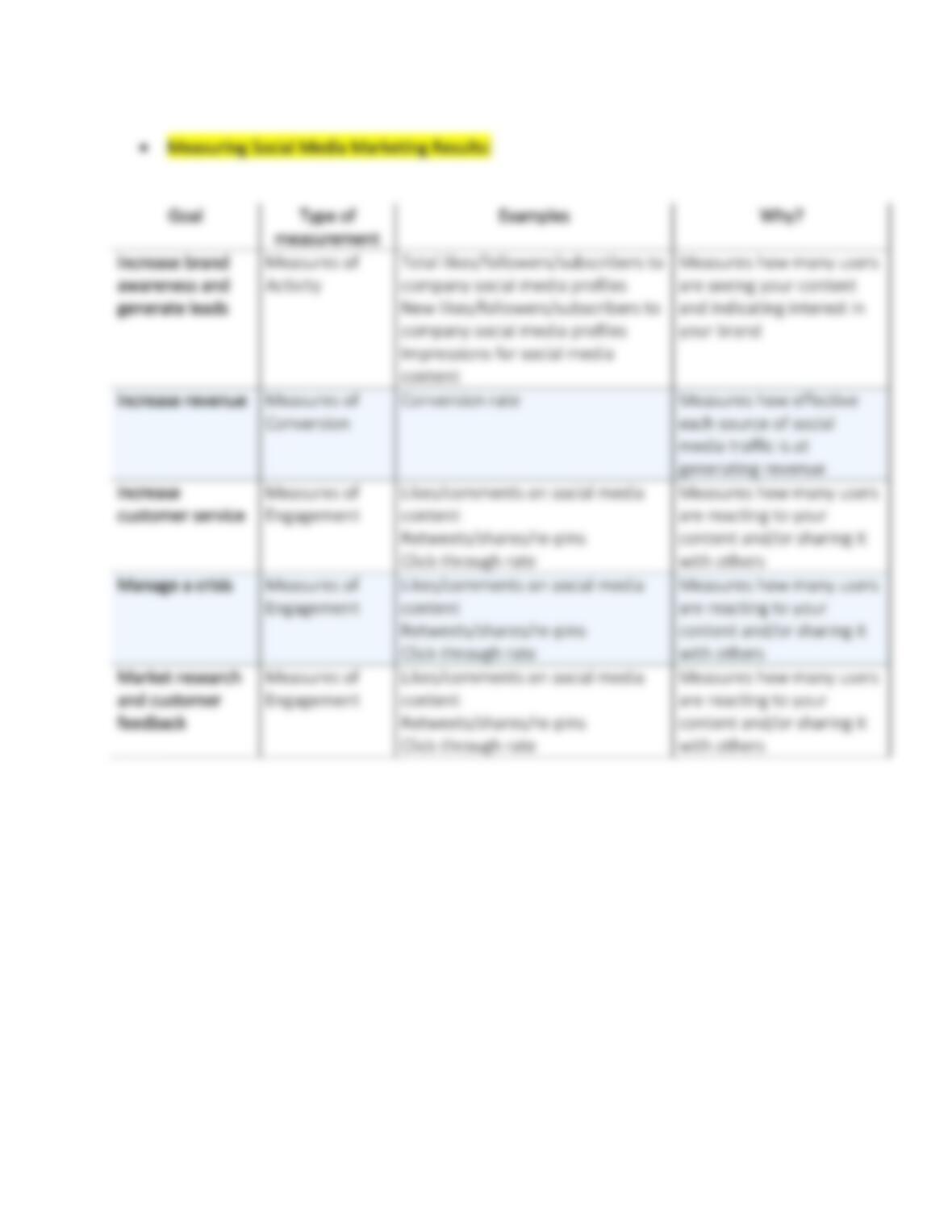
• There are 5 types of goals marketers pursue with SMM:
o Increase Brand Awareness & Generate Leads–
▪ The purpose of this goal is to increase the number of people who are
aware of the company and its products. In addition, brands hope to
increase the positive perception of the brand.
o Increase Revenues–
▪ Typically, the end goal of any promotional campaign is to increase sales.
Social media marketing is no different, which is why you’ll often see
“Sponsored Ads” on Facebook, “Promoted Pins” on Pinterest, and “Snap
Ads” on Snapchat.
o Improve Customer Service–
▪ Social media provides companies the ability not only to communicate
directly and easily with customers, but also to detect and address the
problems customers might be experiencing.
o Manage a Crisis–
▪ The real-time nature of social media also provides companies the ability to
better manage a public relations crisis. With social media, companies can
respond more quickly and distribute their message more directly.
o Market Research & Customer Feedback–
▪ Every strategy in an effective social media marketing campaign traces back