CEO EXECUTIVE
COMPENSATION
Narvaez
1
CEO Executive Compensation
Horacio F. Narvaez
Professor Karen Wisdom, M.A.
Bus 601-30
1 August 2018
Narvaez
2
1.0 Executive Summary
Giant corporations throughout Corporate America offer executives compensation packages
an average working American would only dream of. The CEO of any corporation is the highest
paid induvial. Compensation packages now-a-days include more than just their base salary.
CEOs from any corporation now receive bonuses, stocks, equity gains, perks, new equity, just to
name a few. This report will observe the current trend of executive compensations which is still
on the rise. This report will also observe the gap between CEOs and the average working
American. What ways can we minimize the inequality in compensation between executives and
the average working American? This report should help you understand where we as Americans
stand within the subject of executive compensation.

Narvaez
3
Table of Contents
Title Page …………………………………………………………………………………………………..1
1.0 Executive Summary.…………..………………………………………………………………..…….2
Table of Contents ………………………………………………………………………………………….. 3
2.0 Content
2.1 Introduction……………..…………….……………………………………………..………….4
2.2 Historical Background…..………………………...…………………………………….……4
2.3 Events & Facts …………..…………………….………………………………..……………..5
2.4 Chronology of Key Event…………………….………………………………………..………6
3.0 Description of Stakeholders
3.1 Values …………………………………………………………………………………..…….7
3.2 Assumptions……….……………………………………………………………………..…….7
3.3 Interests ……………………………………………………………………………….………8
3.4 Position ………..……………………………………………………………….………….….8
3.5 Opinion …………..……………………………………………………………………………9
3.6 Claims ……………………………………..………………………………..……………..…….9
4.0 Thesis ……………………………….……………………………………………………...…………10
5.0 Proposed Option/Call to Action ..….………………………………………………..……………….10
6.0 Identify Assumptions ..……………..…………………………………………………………………11
7.0 Identify Biases …………..……….……………………………………………………..……………12
8.0 Strength…………………..…….…………………………………………………………………….13
9.0 Limitations ………………….……………………………………………………………………….14
10.0 Potential Negative Outcomes ….………………………………………………………..………….14
11.0 Rationale for Continuing Support………………………………………………………………..…15
12.0 Overview & Current Context……………………………………………………………………….15
13.0 Identification & Evaluation of Options……………………………………………….………………16
14.0 Thesis & Recommendations……………………………………………………………………….16
15.0 Assumptions & Biases……………………………………………………………………………..17
16.0 Concessions…………………………………………………………………………………………17
17.0 Conclusion………………………………………………………………………………………….18
Reference Page………….……………………………………………………..…………………………19
Appendix A ……………….…………………………….……………………………………………….21
Narvaez
4
2.1 Introduction
In many corporations, especially giant corporations, compensation of high level
executives, such as the Chief Executive Officer (CEOs), Chief Financial Officer (CFOs), and
Chief Operating Officer (COOs), are based on the performance of their corporations,
respectively. In a good based economy, corporations are aggressive for high level performances
from their high executives since corporations pay levels and based performances bonuses are
tremendously astronomical. Lately, there has been plenty of debate over CEO compensation as
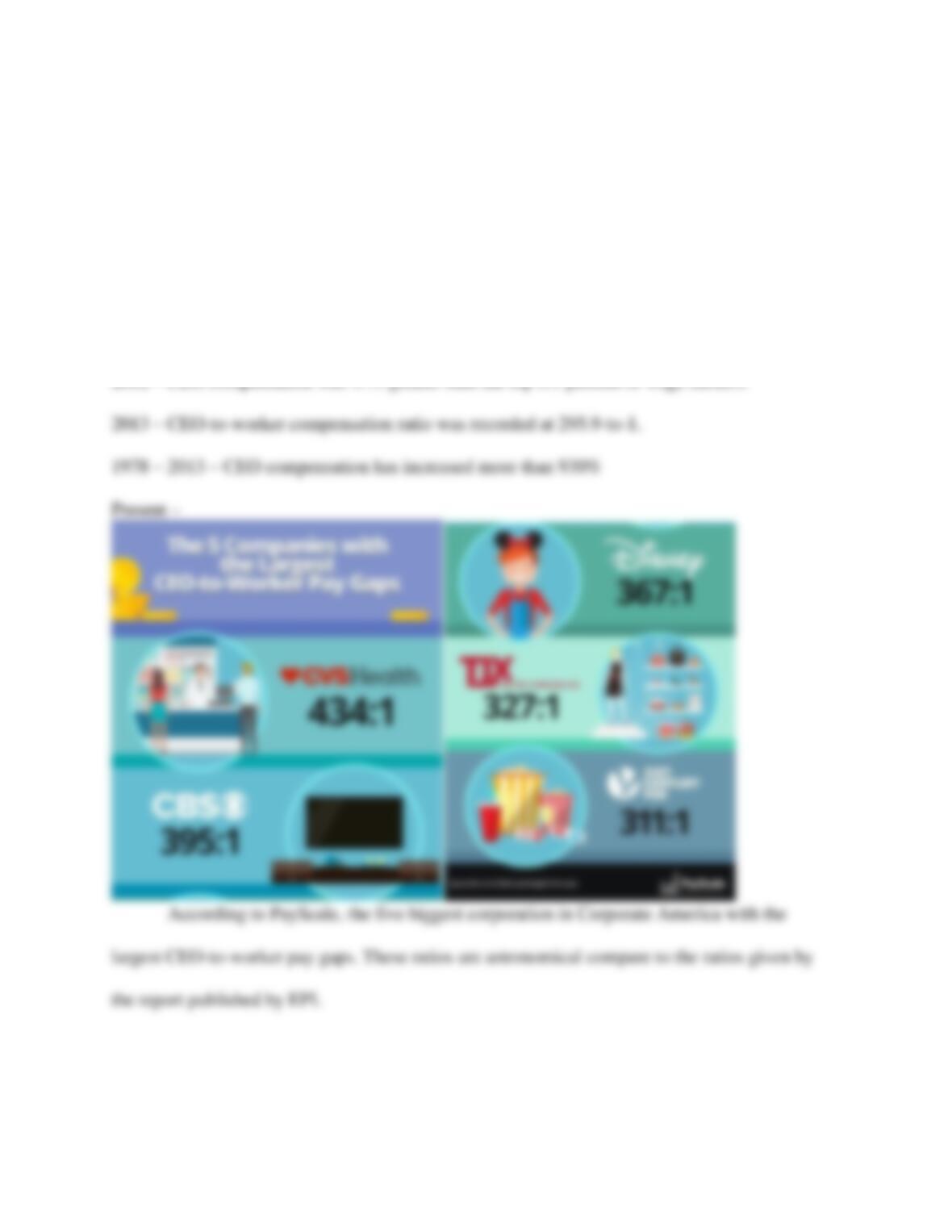
well as their benefit policies. For example, just recently The Walt Disney Company CEO Bob
Iger has been under fire because of his yearly compensation and on top of his compensation not
being enough he asked for another raise. However, what is making Mr. Iger look bad is he is not
willing to approve higher wages for company employees in Southern California. This paper will
examine CEOs compensations and benefits, CEOs and stakeholders of the company, potential
strength and weakness as well as assumption and biases.
2.2 Historical Background
A trend that continues to move in favor of CEOs compensation is compensation
continues to rise throughout the years. A report done by Alyssa Davis and Lawrence Mishel from
the Economic Policy Institute states, “CEO-to-worker compensation ratio was 20-to-1 in 1965
and 29.9-to-1 in 1978, grew to 122.6-to-1 in 1995, peaked at 383.4-to-1 in 2000, and was 295.9-
to-1 in 2013, far higher than it was in the 1960s, 1970s, 1980s, or 1990s” (Davis & Mishel,
2014). The ratio given to us from the first time a CEO-to-worker compensation ratio was
recorded in 1965 was still high for a ratio in the 60s. However, if you see the ratios throughout
the years, the numbers keep rising in favor of CEO compensation and it does not seem it will go
away anytime soon especially if you have the top CEOs of giant corporations having a positive
impact within their corporations.

Narvaez
5
2.3 Events and Facts
A CEO-to-worker 20-to-1 ratio first recorded in 1965 seem high. What is the current
CEO-to-worker compensation ratio fifty-three years later? According to a report by Davis and
Mishel from EPI (Economic Policy Institute) just in 2013 the ratio was at a steady 295.9-to-1.
The ratio went down from 383.4-to-1 when it reached its peaked in 2000 to 295.1–to-1 from
2013. However, an interesting fact from the same EPI report is if Facebook’s CEO average from
2013 was added to the data the CEO-to-worker compensation ratio would rise tremendously. The
average pay of the CEO would have been $24.3 million and the average CEO-to-worker ratio
compensation would have risen to 510.7-to-1.
From 1965 (the first year of the first recorded ratio) to 1978, the CEO-to-worker
compensation increased from 20-to-1 to 29.9-to-1. CEO compensation has been thriving since
1978. Grace Donnelly, a writer for Fortune states in her article, “though CEO compensation
has fallen slightly in the past few years, it has increased by more than 930% since
1978. CEO pay has grown faster than the stock market or the wages of the top 0.1
percent” (Donnelly, 2017). More than 930% seems crazy and questionable, however, that
is reality. Some CEOs in corporate America make more than an average American.
CSX Corporation, a real estate company pays their average salary employee a salary of
about 79K according to PayScale. Before his death, CSX Corporation CEO E. Hunter Harrison
2017 total compensation was $151,147,286 making him the highest paid CEO in S&P 500,
according to AFL-CIO. AFL-CIO is a database that shows top CEOs compensation. His
compensation includes his yearly salary, stock awards, option awards just to name a few. The
average employee for CSX made just a mere 5.19% of their CEO compensation for the year.
Narvaez
6
2.4 Chronology of Key Events
1965 – First CEO-to-worker compensation was recorded. A ratio of 20-to-1.
1978 – CEO-to-worker compensation ratio grew to 29.9-to-1.
1995 – CEO-to-worker compensation ratio grew from 29.9-to-1 to 122.6-to-1 in just 17 years.
2000 – CEO-to-worker compensation ratio in just five years grew from 122.6-to-1 to its peaked:
a compensation ratio of 382.4-to-1 was recorded.