Central limit theorem,
chapter 5, section 5.4, page 223-229

Does sample mean follow any particular
distribution?
•Sample mean has a distribution with the following mean and variance
•mean of sample mean= population mean
•variance of sample mean= population variance/ sample size….. very
important
•If sample size rises, sampling distribution of mean tends to normal
distribution
•For sample size more than 30, distribution of sample mean follows a
normal distribution
•This is central limit theorem

Central limit theorem,
stated formally
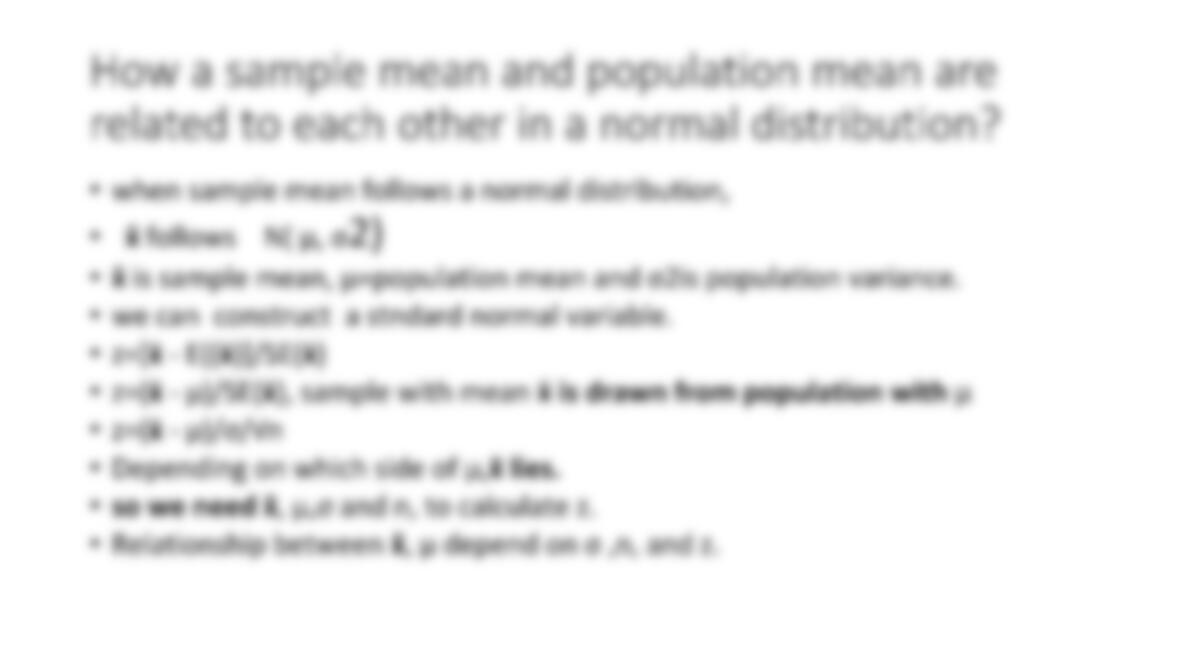
Let X1,x2,x3…xnbe a random sample drawn from a population with mean μ and variance σ2 .
Then if n is sufficiently large,
x̄ has approximately a normal distribution with
mean of x̄=μ and
variance of x̄=σ2/n
sampling distribution of mean
•If population distribution is normal, distribution of sample mean will
also be normal.
•ordinarily, nothing is known about a population distribution!!!!!!
•so any assumption about the population distribution may not be
meaningful.
•What happens when population distribution is not normal?
, distribution of
sample mean will be normal, when sample size is more than 30.
•Are there sny exceptions?
•Must we always need a sample size 30?

Significance of central limit theorem
•The sampling distribution of mean will be a normal distribution if
sample size exceeds 30, even when population distribution is not
normal.
•a very important theorem in Statistics.
•The essence of inferential Statistics is to predict population
parameters by using random sample.
•For this purpose, central limit theorem comes to be a very handy tool.

Two important points
•CLT is applicable when the variable is either discrete or continuous.
•If the population distribution is uniform, one does not need a sample
size equal to 30. For sample size more than equal to 12, CLT provides
a good approximation. the sampling distribution of mean
approximate a normal distribution.

Why we need to know about nature of sampling
distribution
in order to construct confidence interval for provide an estimate of the
population

Estimated values provided by estimator must follow a
distribution, for the purpose of estimation of a
confidence interval.
•Sample mean under certain conditions follow a normal distribution.
•population distribution is normal
•sample size exceeds 30.
•Sample variance follows a chi sq distribution
•sample proportion follows a binomeal distribution.
•It is not possible to link an estimator with the population
paramerter, it is atempting to esimate unless we are aware of the
particular distribution, followed by estimated values produced by the
estimator from random samples of same size.

A basic understanding
•It is not possible to construct confidence interval for population
paramerter,
•unless we are aware of the particular distribution,
•followed by estimated values
•produced by the estimator
•for estimating population parameter
•from random samples of same size.

Point estimator
chapter 6, page 240-246.
Concept
Examples
properties
sampling error
limitations

Examples of point estimator
•Sample mean is a point estimator of population mean because it
provides a single estimate of the population mean, once sample is
drawn.
•Sample variance is a point estimator of population variance because
it provides a single estimate of the population parameter, once
sample is drawn.
•Sample proportion is a point estimator of population proportion
because it provides a single estimate of the population parameter,
once sample is drawn.
sensible estimate : good judgement based on
reason and experience
•When there is no experience, we have to depend on reason.
•If we use an estimator, there has to be a reason behind using it.
•this brings us to methods of deriving estimator.
•Such methods provide a reason to arrive at an estimator.