1
Fundamental Concepts of Health and Nursing (FCHN)
Lecture 3: Philosophy of nursing & caring; Nursing models and theories
Intended Learning Outcomes
On completion of this lecture, students will be able to:
1. Illustrate the concepts of theory
2. Differentiate different types of nursing theories
3. Describe the meaning of caring
4. Identify nursing theories related to caring
Definitions of Nursing
Florence Nightingale, the first nurse theorist defined………
“the act of utilizing the environment of the patient to assist him in his recovery”
Virginia Henderson, one of the first modern nurses defined ………
“the unique function of the nurse is to assist the individual, sick or well, in the
performance of those activities contributing to health or its recovery (or to peaceful
death) that he would perform unaided if he had the necessary strength, will, or
knowledge, and to do this in such a way as to help him gain independence as rapidly as
possible”
Nightingale & Henderson: nursing in relation to the client and the client’s environment
Henderson: nurses concerned with both healthy and ill individuals; interaction with clients
even when recovery may not be feasible; taking up teaching and advocacy roles
Theoretical Definitions
It goes beyond simplistic common definitions
It describes what nursing is and the interrelationship among nurses, nursing, the client, the
environment, and the intended client outcome
Common themes:
➢ Nursing is caring
➢ Nursing is an art
➢ Nursing is a science
➢ Nursing is client centered
➢ Nursing is holistic
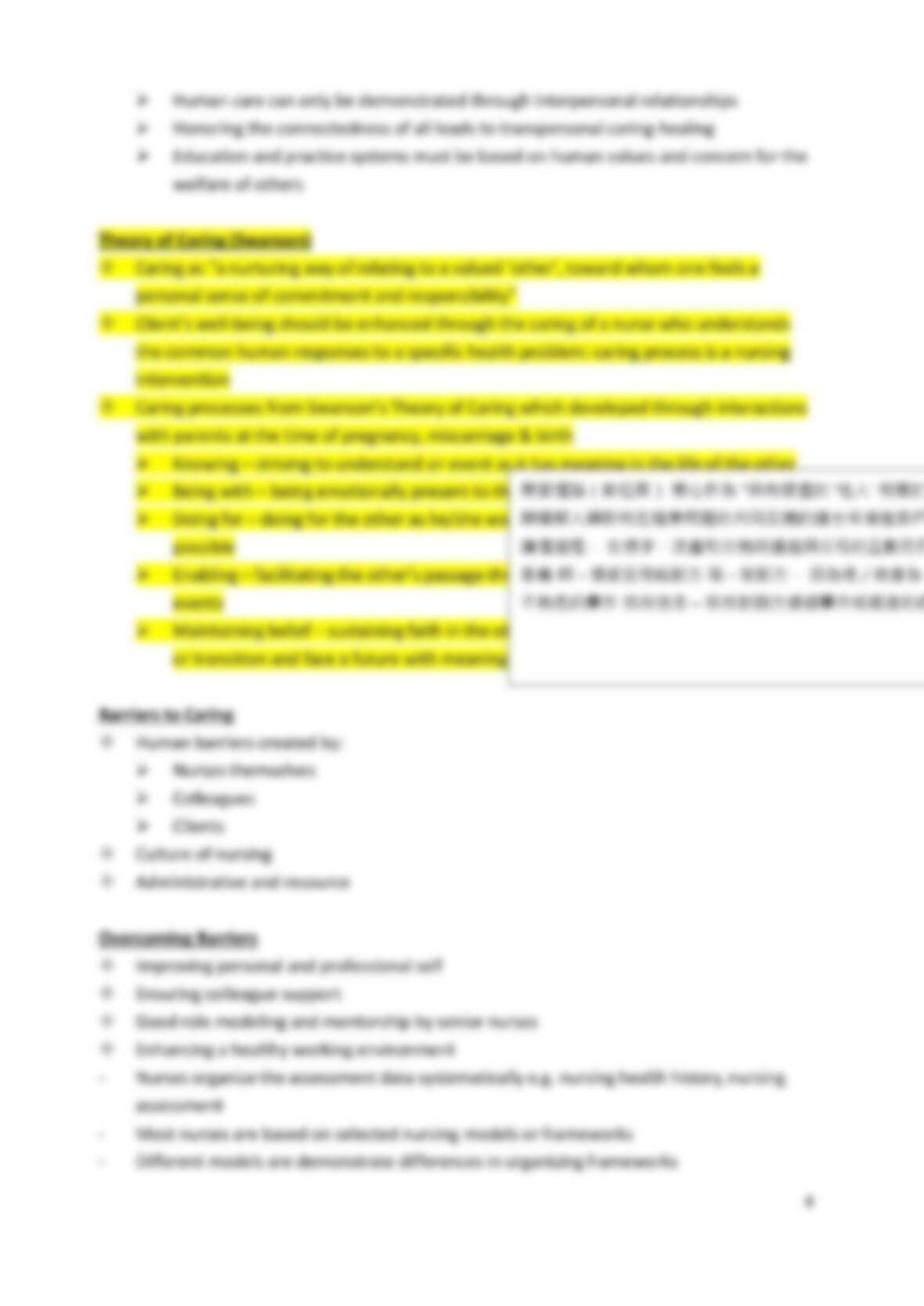
➢ Nursing is adaptive
➢ Nursing is concerned with health promotion, health maintenance, and health
restoration
➢ Nursing is a helping profession

2
Domain of Nursing
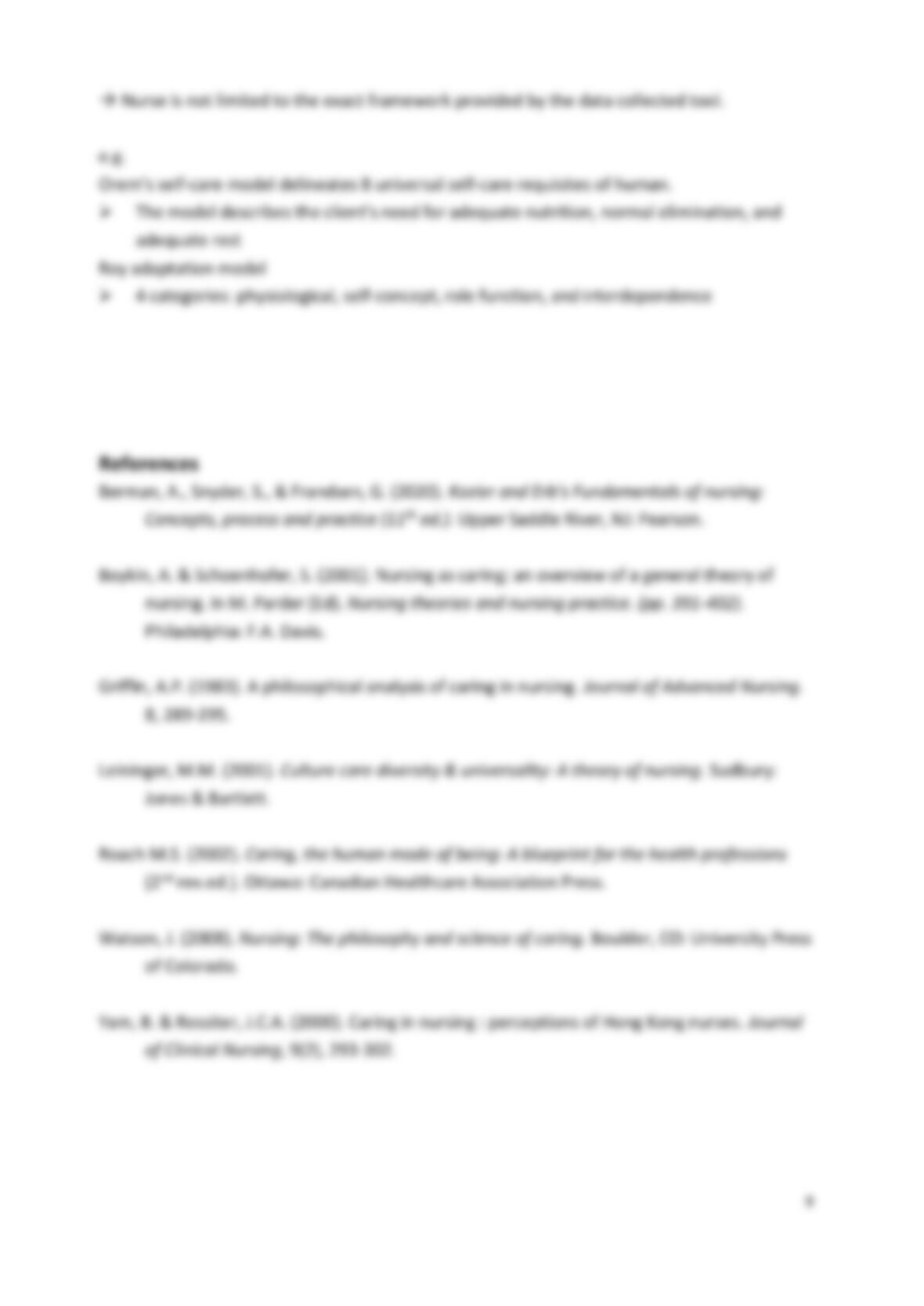
Perspective of a profession
➢ Provide the subject, central concepts, values and beliefs, phenomena of interest and
central problems of a discipline
Domain of nursing
➢ Provide both practical and theoretical aspect of the discipline
Paradigm
➢ A pattern of thought to describe the domain of a discipline
➢ It links the knowledge of science, philosophy, and theories accepted and applied by
the discipline
➢ Paradigm of nursing includes 4 links: person, health, environment/situation, and
nursing
– Person
the recipient of nursing care, including individual clients, groups, families,
and communities
– Health
Degree of wellness or well-being that the client experience
It is dynamic and continuously changing
– Environment / Situation
Includes all possible conditions affecting clients and the settings in which
their health care needs occur
It has positive and negative effects on the person’s level of health and
health care needs
– Nursing
“…diagnosis and treatment of human responses to actual or potential
health problems…” (American Nurses Association, 2010)
Theory
Explain a phenomenon
➢ e.g. self-care or caring
➢ Using Orem’s self-care deficit theory → explain how clients meet their own
therapeutic self-care demands
Nursing theory
➢ Conceptualization of some aspect of nursing that describes, explain, predicts, or
prescribes nursing care

3
Nursing Theories
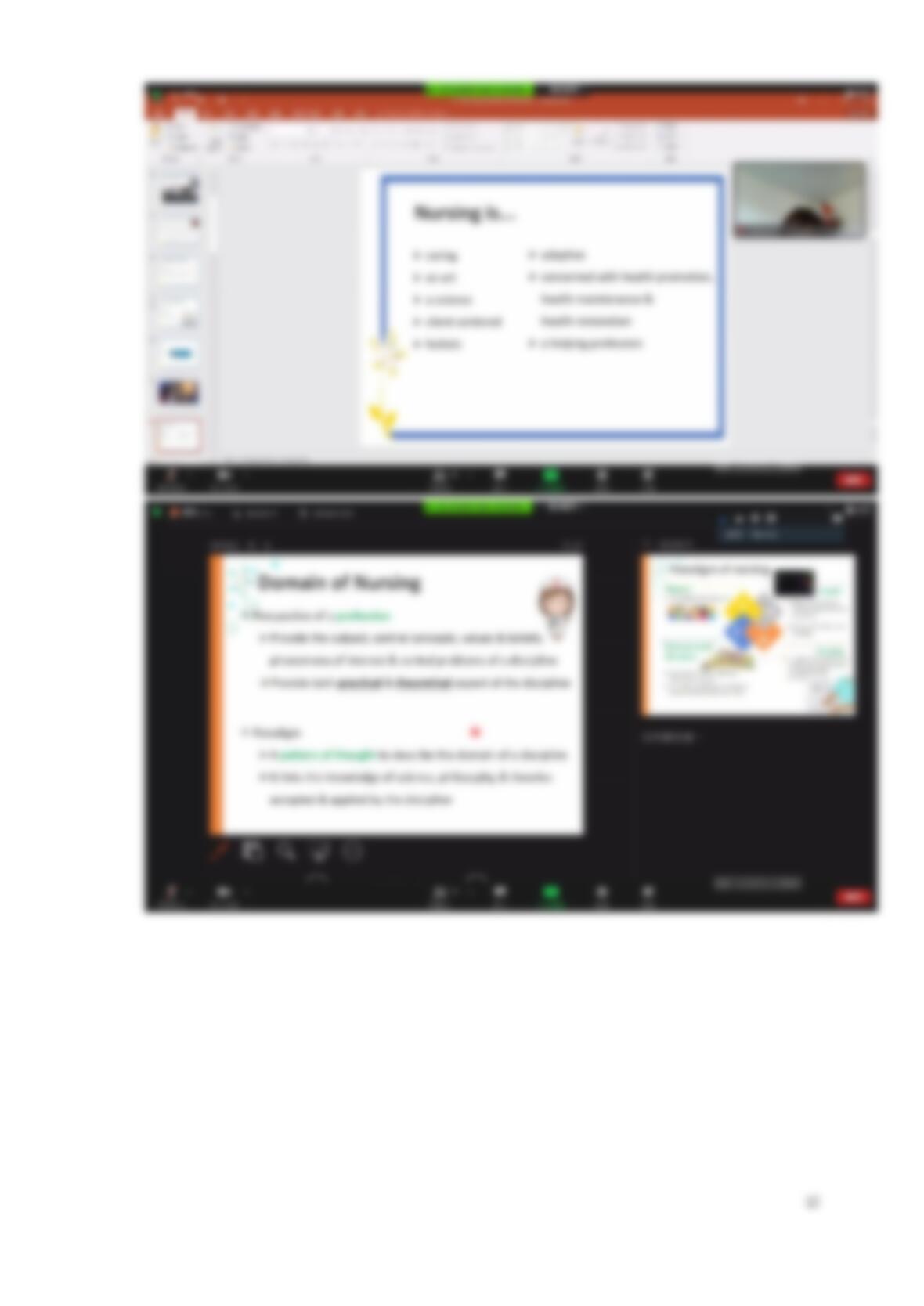
Nightingale’s Environmental Theory
Theorist: Florence Nightingale (1986)
Facilitate the reparative processes of the body by manipulating client’s environment
Nurse manipulates client’s environment to include appropriate noise, nutrition, hygiene,
light, comfort, socialization, and hope
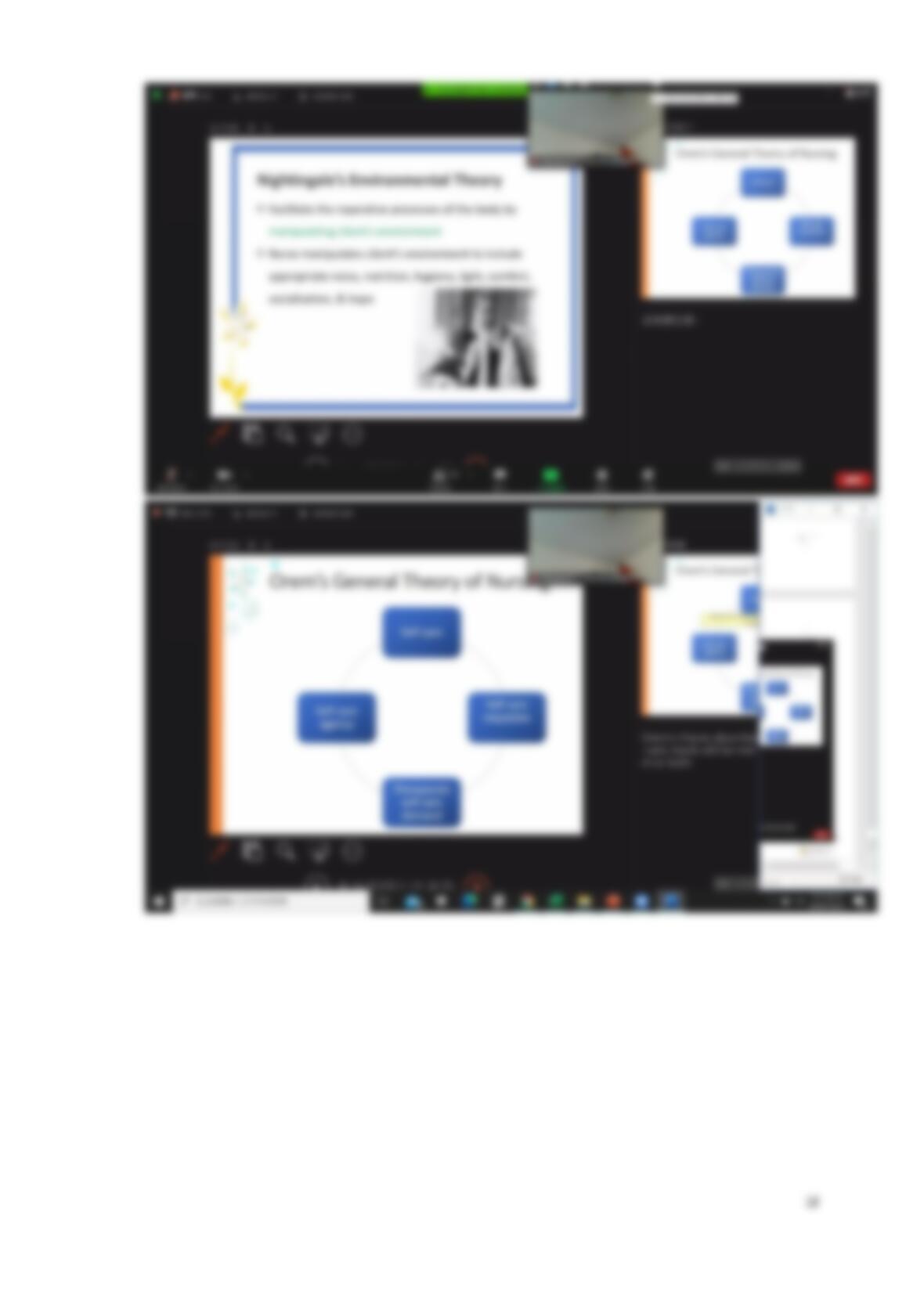
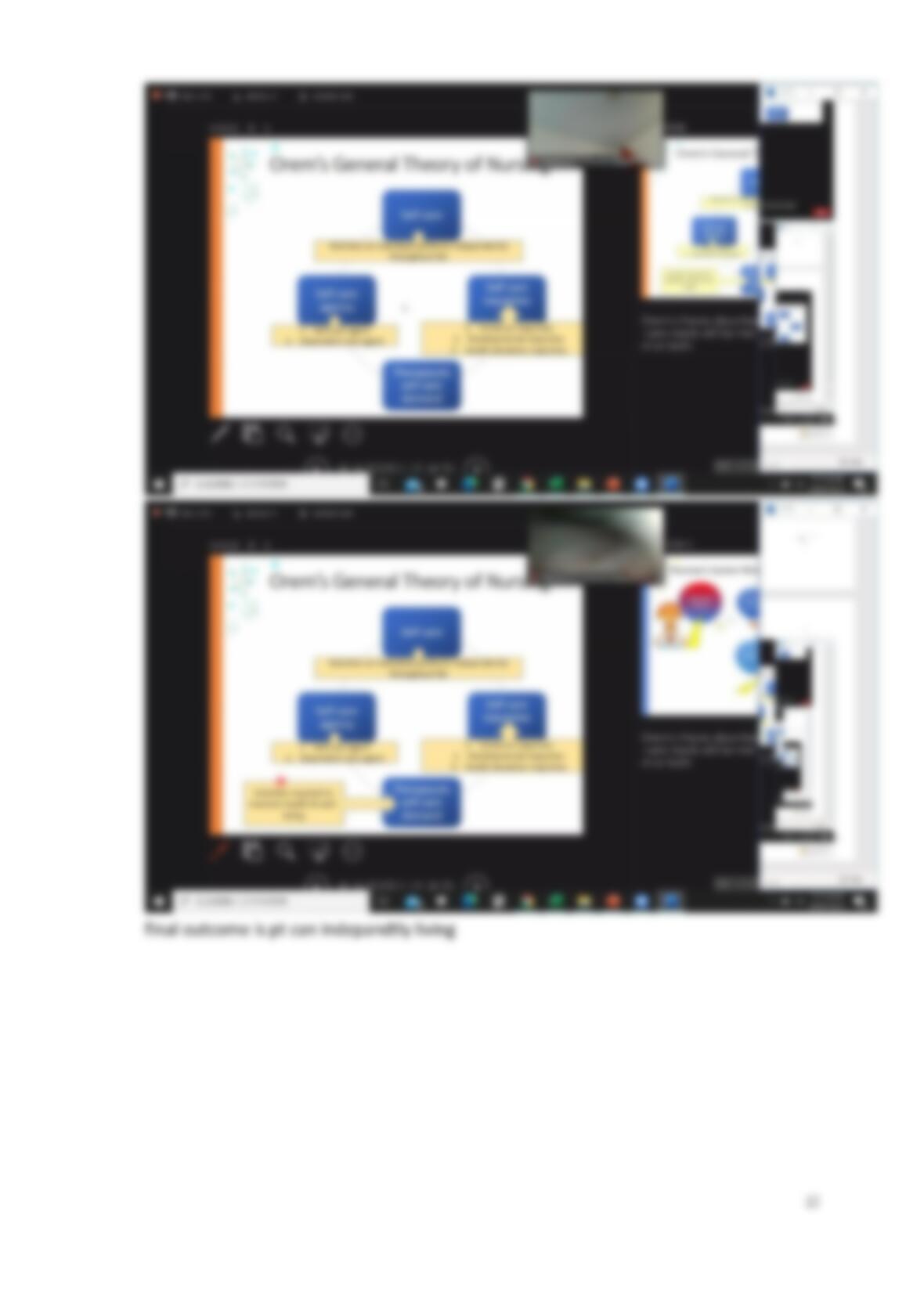
Orem’s General Theory of Nursing
Theorist: Dorothea Orem (1971)
Based on 4 concepts: self-care, self-care agency, self-care requisites, and therapeutic self-
care demand
➢ Self-care
Activities an individual performs independently throughout life to promote and
maintain personal well-being
➢ Self-care agency
The individual’s ability to perform self-care activities
It consists of 2 agents:
– Self-care agent: an individual who performs self-care independently
– Dependent care agent: a person other than the individual who provides
the care
➢ Self-care requisites (also called self-care needs)
Measures or actions taken to provide self-care
3 categories:
– Universal requisites: common to all people e.g. maintaining intake
and elimination of air, water, and food etc.
– Developmental requisites : result from maturation or are associated
with conditions or events, e.g. adjusting to a change in body image or
to the loss of a spouse
– Health deviation requisites: result from illness, injury, or disease or its
treatment
➢ Therapeutic self-care demand
All self-care activities required to maintain health and well-being
Care for and help patient attain total self-care
Nursing care is necessary when the client is unable to fulfill biological, psychological,
developmental, or social needs

4
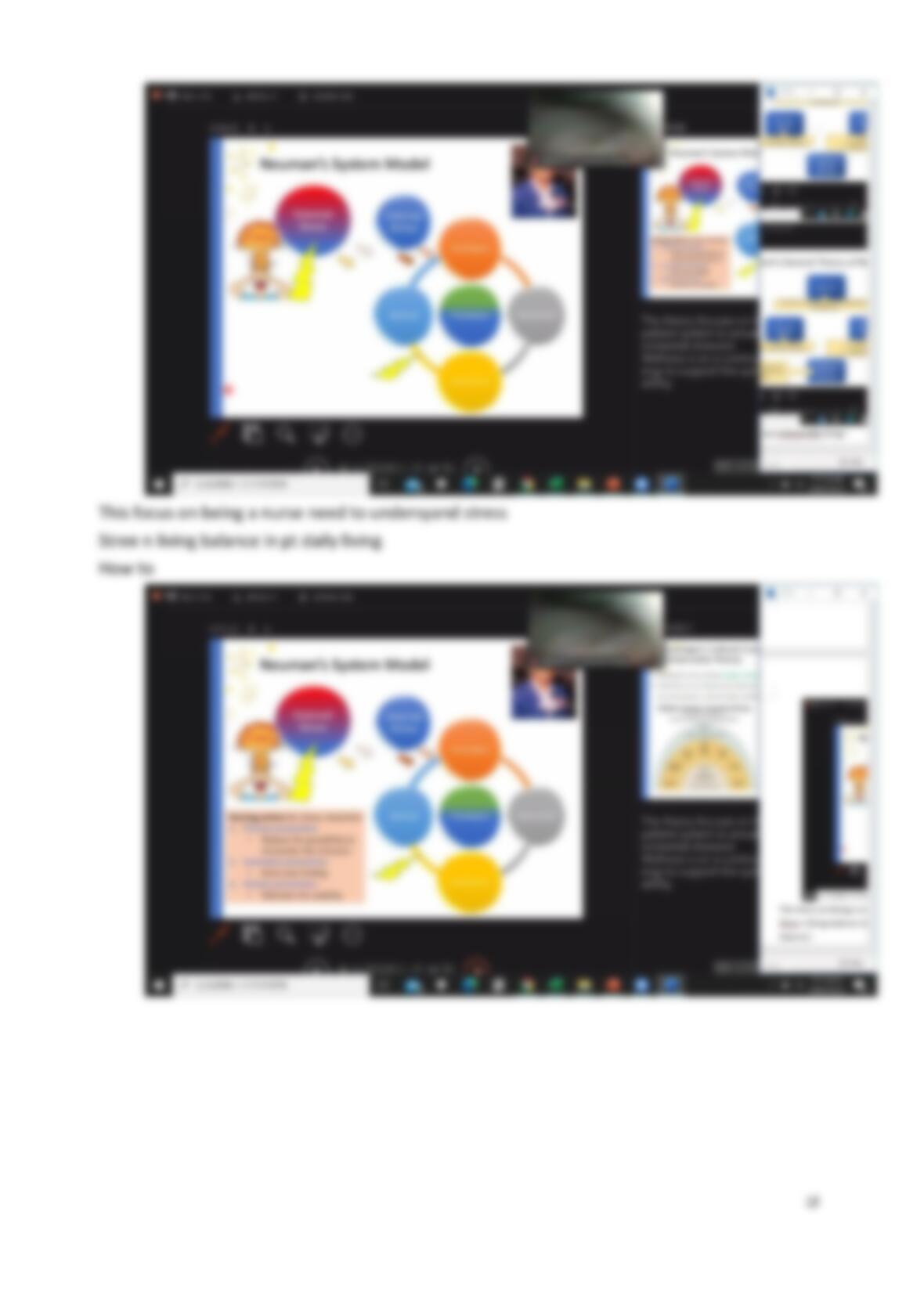
Neuman’s System Model
Theorist: Betty Neuman (1974)
The system is composed of 5 concepts that interact with one another: physiological,
psychological, sociocultural, developmental, and spiritual
Based on stress and the client’s reaction to the stressor
Consider any internal and external factors as stressors that affect the client’s stability and
any or all of the 5 system concepts
Interact with both internal and external environmental factors and all levels of prevention
(primary, secondary, and tertiary) to achieve optimal wellness
Help individual, families, and groups attain and maintain maximal level of total wellness
by purposeful interventions
Stress reduction is goal of systems model of nursing practice
Nursing actions are in primary , secondary, or tertiary level of prevention
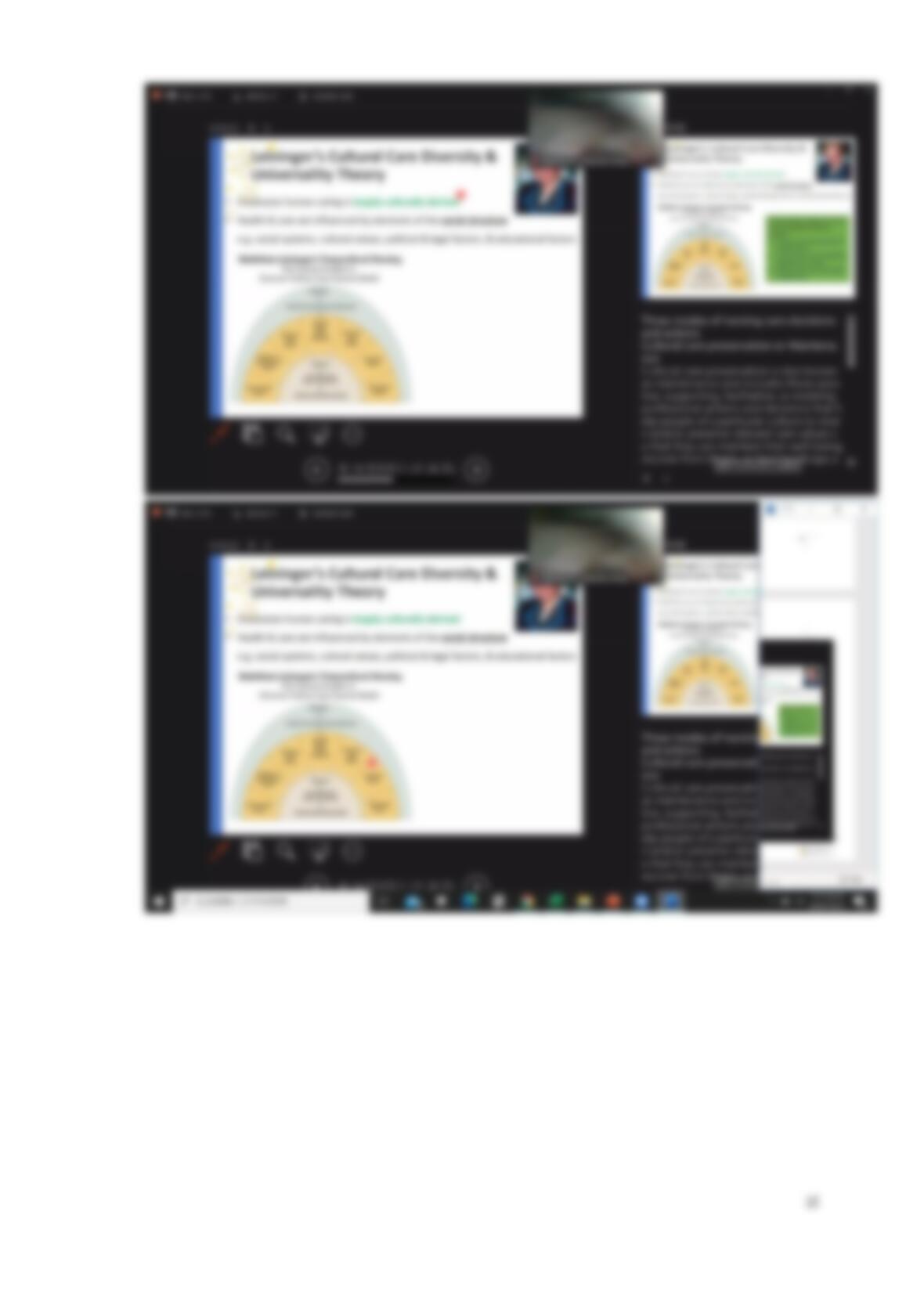
Leininger’s Cultural Care Diversity and Universality Theroy
Theorist: Madeleine Leininger
Emphasize human caring is largely culturally derived
Health and care are influenced by elements of the social structure e.g. social systems,
cultural values, political and legal factors, economic factors, and educational factors
Presents 3 intervention modes for nurses to assist people of diverse cultures:
➢ Culture care preservation and maintenance
➢ Culture care accommodation, negotiation, or both
➢ Culture care restructuring and repatterning
Roy’s Adaptation Model
Theorist: Sister Callista Roy (1970)
View the patient as an adaptive system
The goal of nursing is to help the person adapt to changes in physiological needs, self-
concept, role function, and interdependent relations during health and illness
Need for nursing care occurs when the client cannot adapt to internal and external
environmental demands
All individuals must adapt to the demands:
➢ Meeting basic physiological needs
➢ Developing a positive self-concept
➢ Performing social roles
➢ Achieving a balance between dependence and independence
Nurses determines which demands are causing problems for a patient and assess how
well the client is adapting to them
Nurses provide direct care at helping the client adapt to the changes

5
Watson’s Human Caring Theory
Jean Watson (1979)
The practice of caring is central to nursing
It is the unifying focus for practice
The purpose of nursing action is to understand the interrelationship among health,
illness, and human behavior
Design the mode around the caring process which requires:
➢ the nurse to be knowledgeable about human behaviour and human responses to
actual or potential health problems
➢ the nurse needs to know individual client needs, how to respond to others, and
strengths and limitations of the client and family and those of the nurse
➢ the nurse comforts and offers compassion and empathy to clients and their families
Definition of Caring
Caring is sharing deep and genuine concern about the welfare of another person
Caring is a dimension of human relating, and often referred to as the art of nursing
“Assisting, supporting, or enabling another individual or group with evident or
anticipated needs to ameliorate or improve a human condition or lifeway, or to face
death” (Leininger, 2001)
“An altruistic, active expression of love, & is the intentional & embodied recognition of
value & connected ness” (Boykin & Schoenhofer, 2001)
Caring consists of 2 complementary aspects
➢ Instrumental activities: physical duty
➢ Expressive activities: attitudes & feelings
(Griffin, 1983; Watson, 1979)
Caring Practice
Involve connection, mutual recognition, and involvement between nurse and client
Care for another person → help him grow and actualize himself
關愛的定義 關愛是分享對他人福利的深切和真正關心 護
理是人類相關的一個方面,通常被稱為護理藝術 “協助、
支援或使另一個人或團體具有明顯的或 改善或改善人類
狀況或生命狀況或面臨死亡的預期需求「(萊寧格,
2001 年) “利他主義, 積極表達愛, 是有意的 — — 對
價值的承認 — — 連接” (博伊金和肖恩霍夫, 2001
年) 關愛包括兩個互補方面 儀器活動:體力勞動 表達活
動:態度與感受

6
Nursing Theories on Caring
Culture Care Diversity and Universality (Leininger)
Leininger produced the Sunrise model to depict her theory of cultural care diversity and
universality.
Emphasize care as a “distinct , dominant, unifying, and central focus of nursing”
3 intervention modes:
– Culture care preservation and maintenance
– Culture care accommodation, negotiation, or both
– Culture are restricting and repattering
Assume nurses must understand different cultures in order to function effectively
Theory of Bureaucratic Caring (Ray)
Caring focuses on caring in organizations (e.g. hospitals) as cultures
Caring in nursing is contextual and is influenced by the organizational structure
Ray states that care for a patient may be affected by political, legal, economic,
educational, physiologic, socio-cultural and technological factors.
Caring, the Human Mode of Being (Roach)
Caring as a philosophical concept
Caring is the human mode of being
All individuals are caring, and develop their caring abilities by being true to self, being
real, and being who they truly are
Caring to be unique in nursing because caring is the center of all attributes
Roach defines these attributes as the six C’s of caring:
➢ Compassion – Awareness of one’s relationship to others, sharing their joys, sorrows,
pain, and accomplishments. Participation in the experience of another.
e.g. Attempt to experience what patient is experiencing.
➢ Competence – Having the “knowledge, judgment, skills, energy, experience and
motivation required to respond adequately to the demands of one’s professional
responsibilities”.
e.g. Must know what the condition is about, how treated, what is available to the
patient.
➢ Confidence – Comfort with self, client, and others that allows one to build trusting
relationships.
e.g. I must instill in the patient and family a feeling of confidence.
➢ Conscience – Morals ethics, and an informed sense of right and wrong. Awareness
of personal responsibility.
e.g. Trust self and what I think is right in this situation.
➢ Commitment – The deliberate choice to act in accordance with one’s desires as well
as obligations, resulting in investment of self in a task or cause.
e.g. As a nurses we can help the patient and family come to terms with her illness.
➢ Comportment – Appropriate bearing, demeanor, dress, and language that are in
harmony with a caring presence. Presenting oneself as someone who respects
others and demands respect.
e.g. Show respect for patient first, disease second.
Nursing as caring (Boykin and Schoenhofer)
Know people and nurture them as individuals living and growing in caring
Emphasize the importance of the nurse knowing self as a caring person → nurse can be
authentic to self, freeing oneself to truly be with others
Caring is a lifetime process, lived moment to moment by the nurse and constantly
unfolding
Theory of Human Caring (Watson)
View caring as the essence and the moral ideal of nursing
It is the unifying focus for practice.
Nursing interventions related to human care originally referred to as carative factors how
now been translated into 10 clinical caritas processes:
1. Embrace altruistic values and practice loving kindness with self and others.