2
1. Executive Summary
Fly Ash Brick Project is the idea of Rajiv Sharma (“Sharma”), which involves the
manufacturing and selling of bricks made out of fly ash, a residue obtained from
combustion of coal which is widely available in India due to the high utilisation of
coal in the production of thermal power. Million tons of fly ash are produced in India
every year and this production is increasing as more thermal power plants are built
up to meet the demands in the country. Other than the environmental problem that
caused by a massive production of fly ash, the handling of the waste is another
challenge for the country as the disposal of fly ash waste would need a huge size of
land.
Given that the waste will increase in the future, it is imperative to innovate the
utilization of the fly ash waste. According to a research, fly ash is good to be used in
a building material such as bricks and since there would be an increase in
construction activities, it is anticipated that the demands for bricks would also be
equally increased.
Based on such preliminary analysis, Rajiv Sharma (“Sharma”) has come up with a
plan to build a fly ash brick manufacturing plant. Sharma, who has years of
experience in the construction industry, knew that the expansion of construction
activities will raise the demand for bricks and therefore would increase the potential
of fly ash bricks in the market.
Sharma was of the view that the market has potential to support the ash bricks
demands since India has forecasted a shortage of 20 million to 70 million home units
to accommodate the increasing population. Hence, it will be a great business
opportunity in the construction industry to sell a new product such as fly ash bricks,
that is much more reliable than conventional bricks.
3
2. Abstract
Sharma had approached his friend, Alok Gupta (“Gupta”) and further discussed with
Gupta on the business plan for the proposed fly ash manufacturing. Basically, the
plant had the capacity to produce 4 million bricks per year but nonetheless, the
production would be much depending on the market demand as well as the capability
and productivity of the plant and equipment. After considering those factors, the
partners estimated to sell 2.4 million bricks annually at an average price of Rs7,000
per 1,000 bricks.
They have also agreed for an initial investment of Rs.10 million in which Rs.6
million would be raised from their own resources while the balance is to be obtained
from a loan where they managed to get a loan from a local bank at an interest rate of
12% per annum against the mortgage of the equipment.
In addition to the above, Sharma has also forecasted the investment amount in fixed
assets, working capital, and monthly expenses and other relevant costs.
The idea had gained Gupta’s interest but unlike Sharma who had extensive years of
experience in the construction industry and confident in the idea, Gupta was rather
sceptical on the feasibility of this project and suggested to consult an expert to
ascertain the viability of the project before both of them investing in the business.

4
3. Introduction
In ensuring the feasibility of the investment proposal, it is vital for the partners to
identify how much the company would need to invest in the fixed assets and
working capital and how many units of sale the company needs to achieve in order
to be on break-even point. It is also critical to calculate the return on equity and to
analyse whether the company would be able to meet its debt obligations for
sustainability.
This case study will focus on the Cost Volume Profit (CVP) analysis which is one of
the financial models that shows how changes in sales volume, prices, and costs will
affect profits. The CVP analysis can be utilized for planning, making projections and
for decision-making purposes. This analysis would also determine how changes in
costs and volume affect a company’s operating income and net income.
In performing this CVP analysis, there are several assumptions that could be
considered including high-low method, contribution method, break-even point
analysis and operating leverage.
5
4. Analysis
Fixed Expense
Fixed expense is known as fixed cost means these are expenses that are not
dependent on volume of goods produced by the business.Basically fixed cost
comprises real estate taxes, insurance, supervisory salary, depreciation and
advertisement.
Routine Expenses
Per Month (Rs)
Per Year (Rs)
Total For 5 Years
(Rs)
Building Rent
50,000
600,000
3,000,000
Administrative Cost
10,000
120,000
600,000
Office Supply
5,000
60,000
300,000
Electricity (for lighting)
10,000
120,000
600,000
Miscellaneous
20,000
240,000
1,200,000
Total
95,000
1,140,000
5,700,000
Exhibit 1: Routine Expenses
Exhibit 1 shows fixed cost for this fly ash brick project.
Personal Expenses
Per Month (Rs)
Per Year (Rs)
Total For 5 Years
(Rs)
Workers
100,000
1,200,000
6,000,000
Office Assistant
20,000
240,000
1,200,000
Watchman
15,000
180,000
900,000
Drivers
25,000
300,000
1,500,000
Production Manager
(Sharma)
50,000
600,000
3,000,000
Total
210,000
2,520,000
12,600,000
Exhibit 2: Personal Expenses
From Exhibit 2,we can see that all these people’s salaries are not included in labour
because these employees are not related to the production activities.
Fixed Expenses
Per Month (Rs)
Per Year (Rs)
Total For 5 Years
(Rs)
Routine Expenses
95,000
1,140,000
5,700,000
Personal Expenses
210,000
2,520,000
12,600,000
Total
305,000
3,660,000
18,300,000
Exhibit 3: Fixed Expenses
Exhibit 3 shows the total fixed cost per month,per year and for five years.
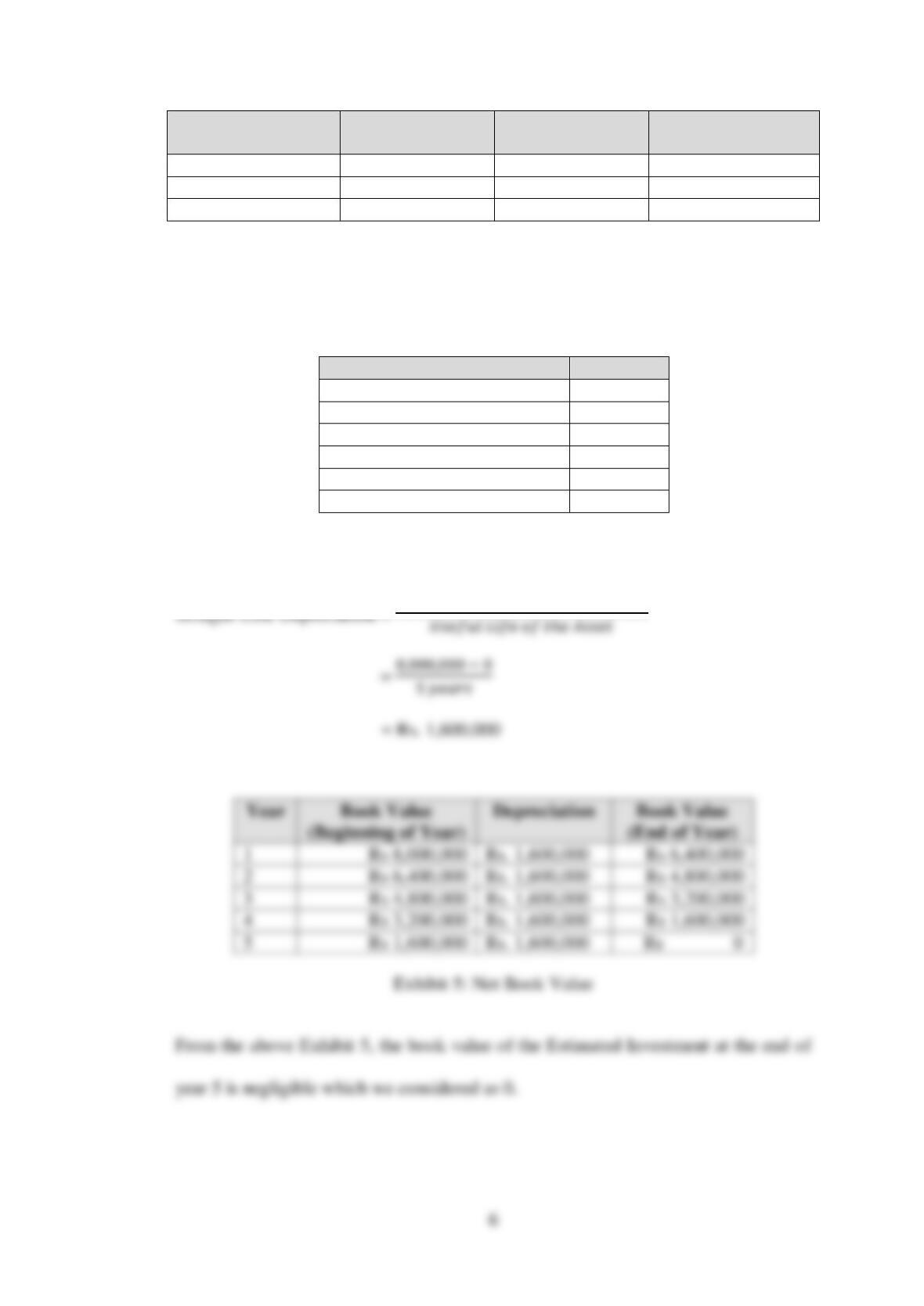
Estimated Investment
Cost (Rs)
Building Modification
1,400,000
Water Supply Arrangements
100,000
Machinery
2,000,000
Trucks
3,000,000
Payload Machine
1,500,000
Total
8,000,000
Exhibit 4: Estimated Investment
Book Value
2
Rs 6,400,000
Rs. 1,600,000
4
Rs 3,200,000
Rs. 1,600,000