One winter evening of January 2013, Mr. Azim Premji* was having tea and reading an
article published in Hindustan Times which said “Wipro joins Infosys, TCS in beating
profit forecasts” #. It was something which pleased Mr Premji. He wished to hear such
good news for a long time and it definitely gave a sense of achievement. At the same time,
he was trying to analyse what is the prime reason for this success from which Wipro was
waded off for a long time. Is it bull market, high profits of Wipro’s long-term customers,
failure of competitors or change in leadership he brought in 2011?
Definitely, the leadership plays an important role in company’s performance. But was the
decision of change in 2011 from dual-CEO to single CEO model correct? Were the
changes in the organization aligned with the leader’s vision? Could the performance have
been better than this? Mr. Premji recalls those gloomy days of 2008-2009 when nothing

was going right for Wipro. At that time he took a decision which wasn’t ever tested or
implemented in Indian IT Industry. He brought in dual CEO model to steer his
organization during the tough time of global recession. Acknowledging his two responsible
CEOs to steady the [1]business and bringing revenue up from $2bn to $5bn he did realize
that the system won’t continue to flourish and excel for long. Post-recession when market
expected growth, Wipro didn’t keep pace and the disappointing results forced Azim to take
a decision and implement a leaner and efficient Leadership structure with single CEO
spearheading the organization. With more than a year gone by, it was time to dissect the
rationale behind changes in Leadership in Wipro and whether it really helped the company
move on the right track at faster pace.
Ever since Wipro was incorporated on 29th December, 1945, it has grown steadily to
become the third largest IT Services Company in India and the 13th largest publicly traded
company in the country. Back in 2005, the then CEO Mr. Vivek Paul decided to leave the
company and join the Texas Pacific group. Azim Premji had to don the role of both a CEO
and a Chairman. Wipro’s organizational structure was complex with the IT business having
two organizations – Wipro Infotech and Wipro Technologies. After Paul left, the
executives who headed these verticals and horizontals were expected to function as the
CEO’s of their respective departments. It was then that Wipro announced the appointment
of not one but two CEO’s – Girish Paranjpe, the president of the BFSI (banking, financial
services and insurance) and Suresh Vaswani, the president of Wipro InfoTech. The
company believed that the two would work very well as a team as they had been with the
company for more than fifteen years.
With the ever changing global market scenario and the steady growth in revenues coming
from global markets, Wipro believed that two leaders at the top were better than one. It
was then that the concept of a joint CEO became a reality with me going back to being the
Chairman of the company. In 2010, started expressing dissatisfaction with the way things
were being handled and told Wipro that the enterprise was losing their confidence.
Technology heads were starting to become reluctant to increase their business with the
company. Several factors were responsible for this change. Firstly, many IT Majors were
aligning their teams by the industries they served; while at Wipro a multiple team structure
was still followed termed as the three-axes structure. Secondly, most of the industry was
moving ahead on strategy while Wipro was not .The Company was concentrating mostly
on the cost side at a time its peers were targeting the revenue side. Thirdly, Wipro was slow
in making decisions under its joint-CEO structure.
In February 2011, the dual CEO role was removed and Mr. T.K.Kurien was inducted as the
new CEO. After this change was brought about, post four quarters of timid growth, Wipro

recorded an increase of six per cent in the September quarter zooming past peers Infosys
and HCL Technologies. The company underwent a sales growth of up to three per cent;
while Infosys had a flat quarter. There was a growth in Wipros share of larger customers
wallets. Contribution of the top five customers to the company has grown a percentage
point to 11.8 per cent with the number of clients contracting work more than $100 million
value or more. Wipro has been growing leaps and bounds. We have learnt that strategy
without execution is hallucination and we aspire to strategize smartly and climb the ladder
in the years to come “
Industry Background
The word software” was coined as a prank as early as 1953, but did not appear in print
until the 1960. Before this time, computers were programmed either by customers, or the
few commercial computer vendors of the time, such as UNIVAC and IBM. The first
company founded to provide software products and services was Computer Usage
Company in 1955.
According to Gartner[2], global IT software spending was estimated at US 267bn in 2011.
This mainly includes sales of software products, support and maintenance. With a size of
US 845bn in 2011, the IT services industry represents a much larger portion in the ICT
market. Together, IT Software and IT services represent approximately 30% of the whole
IT industry, with Computer Hardware (11%) and the Telecom industry (59%).The U.S. is
estimated to control more or less 50% share of the world software market. In India, the
industry has grown more than 30 % annually throughout the last two decades. From about
$50 million in exports in the late 1980’s, the industry grew at around 30% a year to more
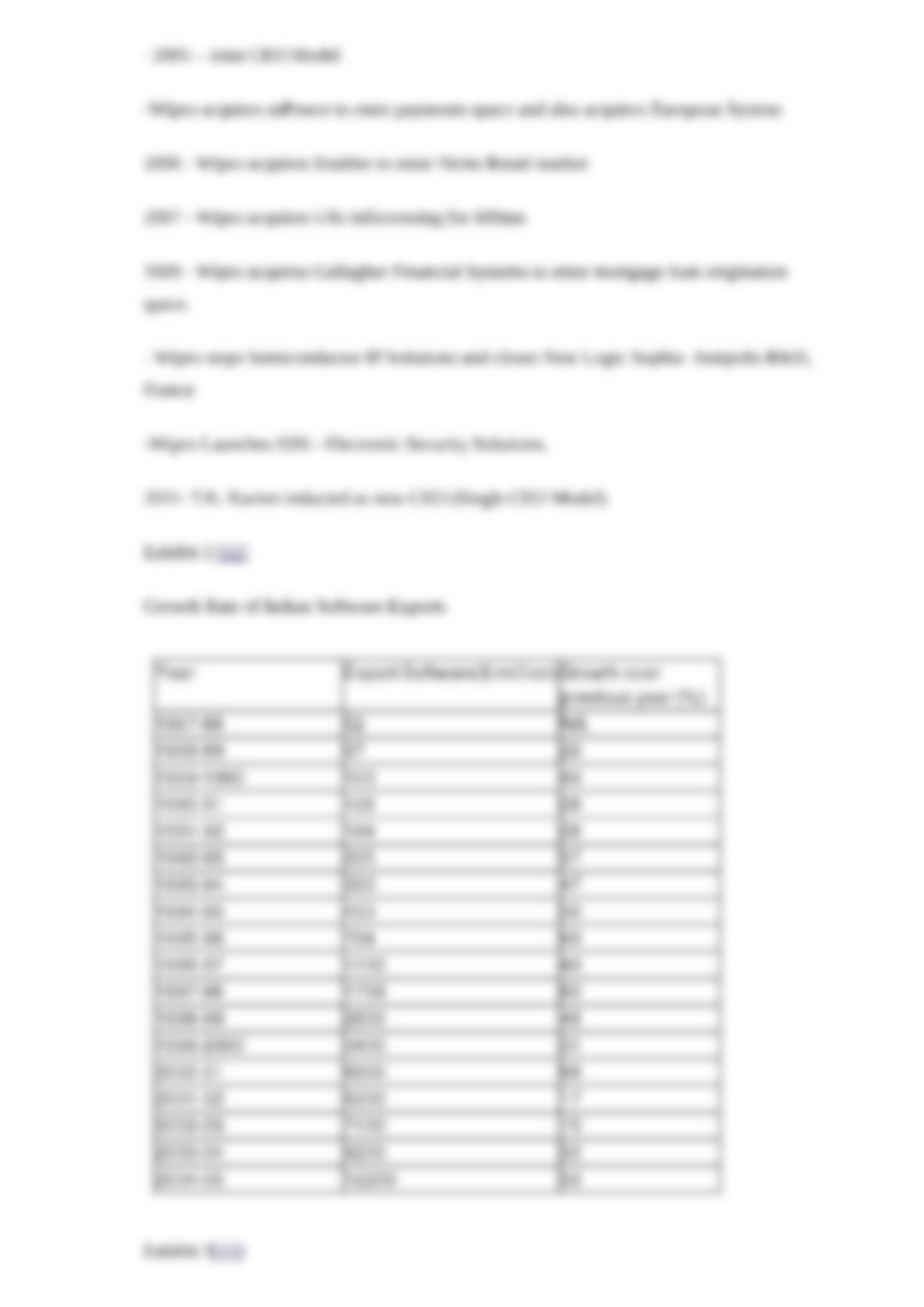
than $200 million exported by 1993 (Exhibit 2). In the boom years of mid and late 1990’s,
software exports grew 50 – 60 percent annually , reaching $6 billion by 2001.Even during
the infamous ‘dot com’ bust, software exports continued to grow by about 25 % annually ,
which significantly outpaced the growth in the software industry anywhere in the world.
Software products within the Global IT industry are mainly categorized into four types:
Application software, whose role is mainly to improve business processes and the level of
automation within the organization, this type of software is used directly by the end-users
and workers.
System software is the infrastructure software foundation which manages and links the
hardware, the network and the software together.
Middleware and tools are intermediary software that stand between the system

infrastructure and application software and allow different software to interact with each
other.
Electronic games that form part and parcel of the software industry as they provide
interactions with a user interface offering visual feedback on a video display. Both paid
and ad-funded games.
Major Players
IT Software is quite a concentrated market, with the top 20 players representing
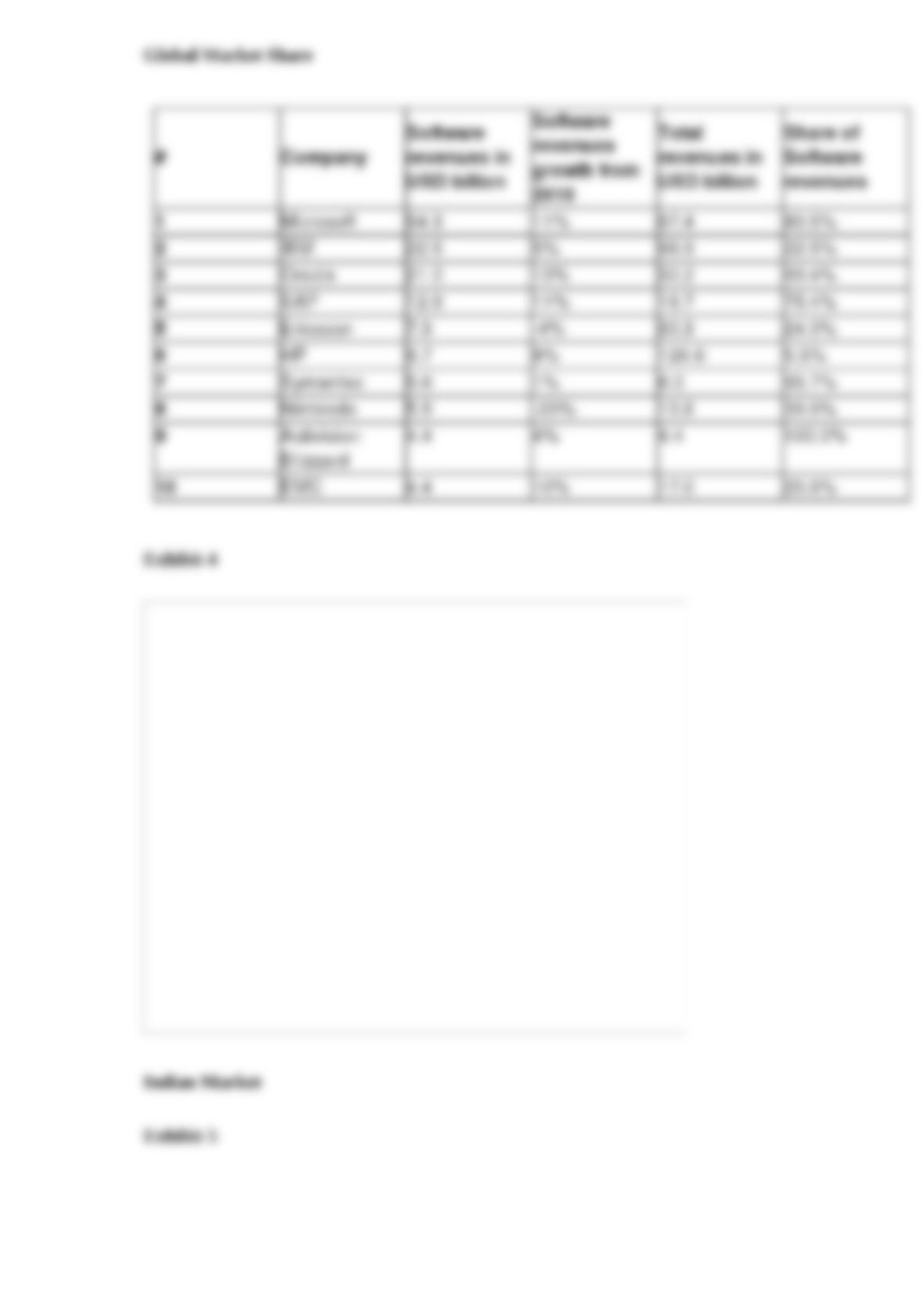
approximately 75% of the market. Combined revenue of the top 3 players, Microsoft, IBM
and Oracle – all US
incorporated companies – is US 97.7 billion, representing more than 40% of the total
market[3]. (Exhibit 3)
As per Nasscom experts3, the top 5 players in both the IT and ITeS sectors are TCS (Tata
Consultancy Services), Infosys Ltd, Wipro, Cognizant and HCL. TCS is the largest
provider of information technology and business process outsourcing services in Asia with
revenue of $6.3 billion. Along India TCS also operates in Africa, Asia, Australia, Europe,
North America, and South America. The market share of TCS is 25% of the total market
(Exhibit 4). Infosys is the second-largest India-based IT services company. Infosys is an
India based multinational company mainly dealing with business consulting, technology,
engineering, and outsourcing services. Their market size is about 18% of the total market
share.
Wipro is the third major India-based IT services company. Wipro is an India based
multinational company dealing with information technology (IT) services, consulting and
outsourcing services. Headquartered in Bangalore, Karnataka, the company operates in 54
countries across the globe. They have a market share of 15%.Cognizant Technology
Solutions Corporation is a provider of information technology, consulting and business
process outsourcing (BPO) services. The company claimed is very much sound financially
with revenues of $2.6 billion in cash and short term investments. They have a market share
of 13%.
HCL Technologies is an India based information technology service provider
headquartered in Noida, UP. The company is the fourth largest IT Company in India and is
ranked 48 in the global list of IT services providers. Along with many big acquisitions
HCL Technologies took over the UK based AXON Group for U.S. $658 million and
renamed as HCL Axon. Their market share will come to around 10 %.
Challenges of Industry
Despite these bright and encouraging facets of the software industry there are certain areas
of concern, which need to be given the desired attention and weightage. Some of these
areas of concern or challenges are:
The most formidable challenge facing Indian software industry is sustainability of high
growth rate of software exports in future. From the 50 % growth in 1990, it has come