Case Study on Optimizing of CNIC processing at NADRA office
Wah Cantt using Arena
Abstract:
Discrete event simulation is the process of designing a representative model of a real system and
conducting experiments with that model. For purpose of either understanding the behavior of the system
or evaluating different proposed strategies for the operation of a system, discrete event simulation is a
tool suitable for the study of systems and improves the overall efficiency. Arena is a discrete event
simulation and automation software developed by Systems Modeling and acquired by Rockwell
Automation. It uses the SIMAN processor and simulation language in this work, the existing production
system of NADRA office is studied and utilization of each resource is analyzed. This survey attempts
to reduce the Queue and improve the performance of NADRA. All necessary data were gathered
through visiting the Office and registering the observations. Simulation model was designed using
Arena software.
Keywords: NADRA; Simulation model; Scheduling; ARENA Simulation
Introduction:
National Database and Registration Authority (NADRA) charged with the establishment of a
new registration system for the entire population of Pakistan. NADRA is one of the leading
System Integrators in the global identification sector and boasts extensive experience in
designing, implementing and operating solutions for corporate and public sector clients.
Basic Explanation:
NADRA is one of the leading System Integrators in the global identification sector and boasts
extensive experience in designing, implementing and operating solutions for corporate and
public sector clients. NADRA offers its clients a portfolio of customizable solutions for
identification, e-governance and secure documents. NADRA has successfully implemented the
Multi-Biometric National Identity Card & Multi-Biometric e-Passport solutions for Pakistan,
Passport Issuing System for Kenya, Bangladesh High Security Driver’s License, and Civil
Registration Management System for Sudan amongst other projects.
Problem Statement:
NADRA office located at Aslam Market, Wah Cantt. The branch manager want to improve the
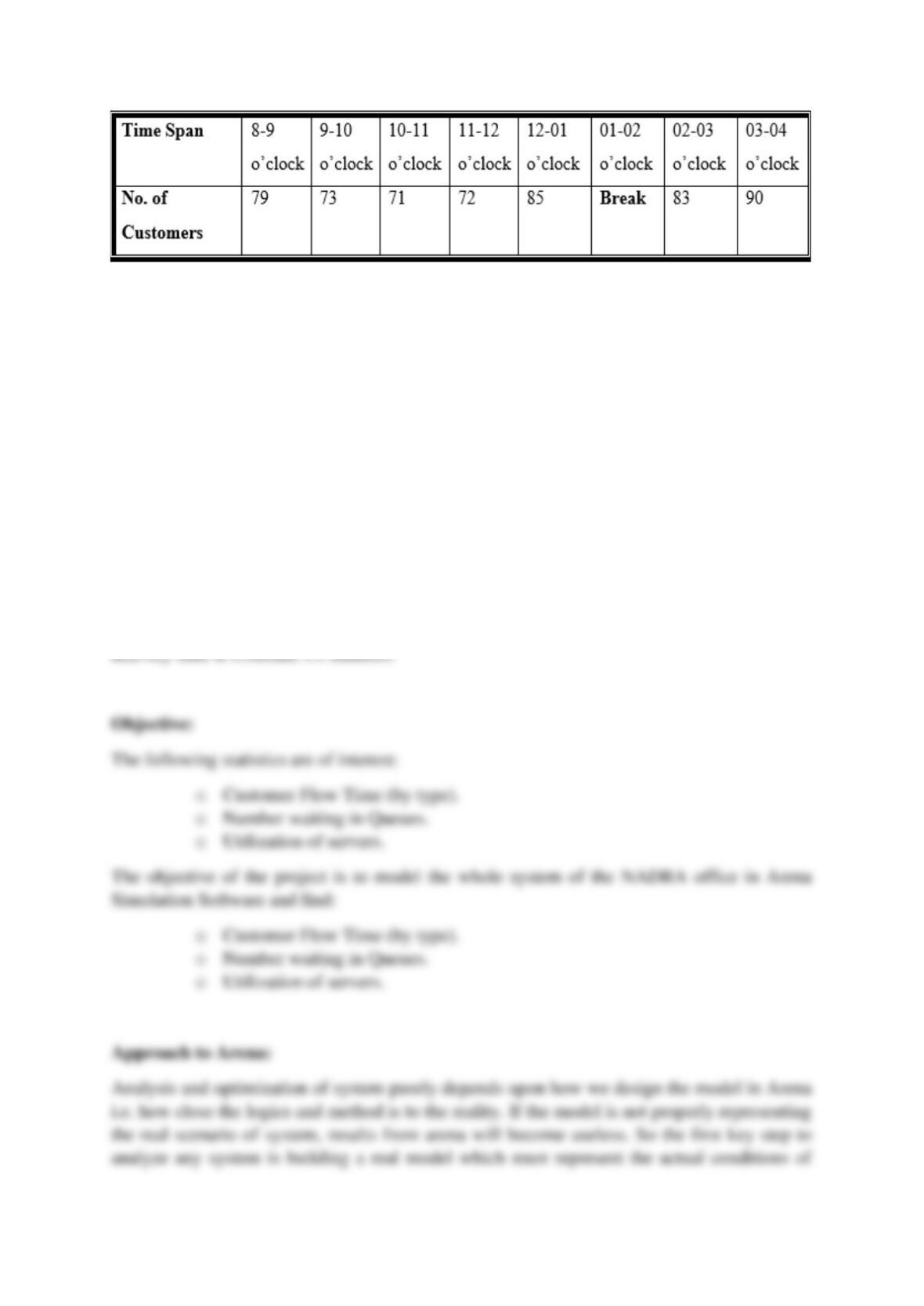
system of the CNIC processing. Customers arrive according to the following schedule:
Incoming customers are distinguished according to their types: i.e. 20% customers are arriving
individually, 70% are arriving in pairs (say couples) and the remaining customers are arriving
in the form groups (mostly of three). Following arrival, each incoming customer type proceeds
as a separate entity. Moving further customers are distinguished according to the service they
want to earn from the respective servers. 70% of the customers are those that want new ID
card, this type of customers are directed to the token counter, 10% of the customers are those
that are coming to get the necessary information for CNIC processing, these customers are
further distinguished among male and female customers. The remaining 20% of the customers
are those that are coming to collect their ID card, these customers are further distinguished
among male and female customers before directed to the card delivery counter. 95% of the
customers moved on to the next servers for further processing and the remaining 5% customers
are rejected due to the unavailability of the necessary documents required for the CNIC
processing. After getting token, customers wait in the waiting area until his/her turn when the
server is free to serve them.
Customers move towards the photographer where photographer clicks a picture of the customer
and sent it to the next server. Picture process time is uniformly distributed as UNIF (6, 6.5)
minutes. Customers move towards the server that enters the bio data of the customer and sent
it to the next server. Data Entry time is a Constant 7 minutes. Customers move towards the
server that takes the signatures and fingers impression for CNIC of the customer and sent it to
the next server. Signatures and fingers impression time is Constant 8 minutes. Customers move
towards the server that deliver the complete printed form to the customer for attestation. Form