CASE STUDY OF NORTHEAST AIRLINES
Alexandra Prilepin
BUS 420
Dr. Rebecca House
December 1, 2018
Table of Contents
1. Problem Statement ………………………………………………………………………………. 3
2. Data Analysis ……………………………………………………………………………………… 4
a. Industry:………………………………………………………………………………………….. 4
b. Competitive Analysis: ………………………………………………………………………. 5
c. SWOT Analysis: ……………………………………………………………………………… 6
d. Economic Product Life Cycle: …………………………………………………………… 8
3. Alternatives ………………………………………………………………………………………… 8
4. Financial Analysis ……………………………………………………………………………..11
5. Conclusion ………………………………………………………………………………………..14
1. Problem Statement
Northeast Airlines, an airline company that was founded in 1967 as an intrastate airline
linking Dallas, Houston and San Antonio, is now the fourth largest domestic carrier in terms of
customers boarded and the most profitable airline company in the United States, providing low-
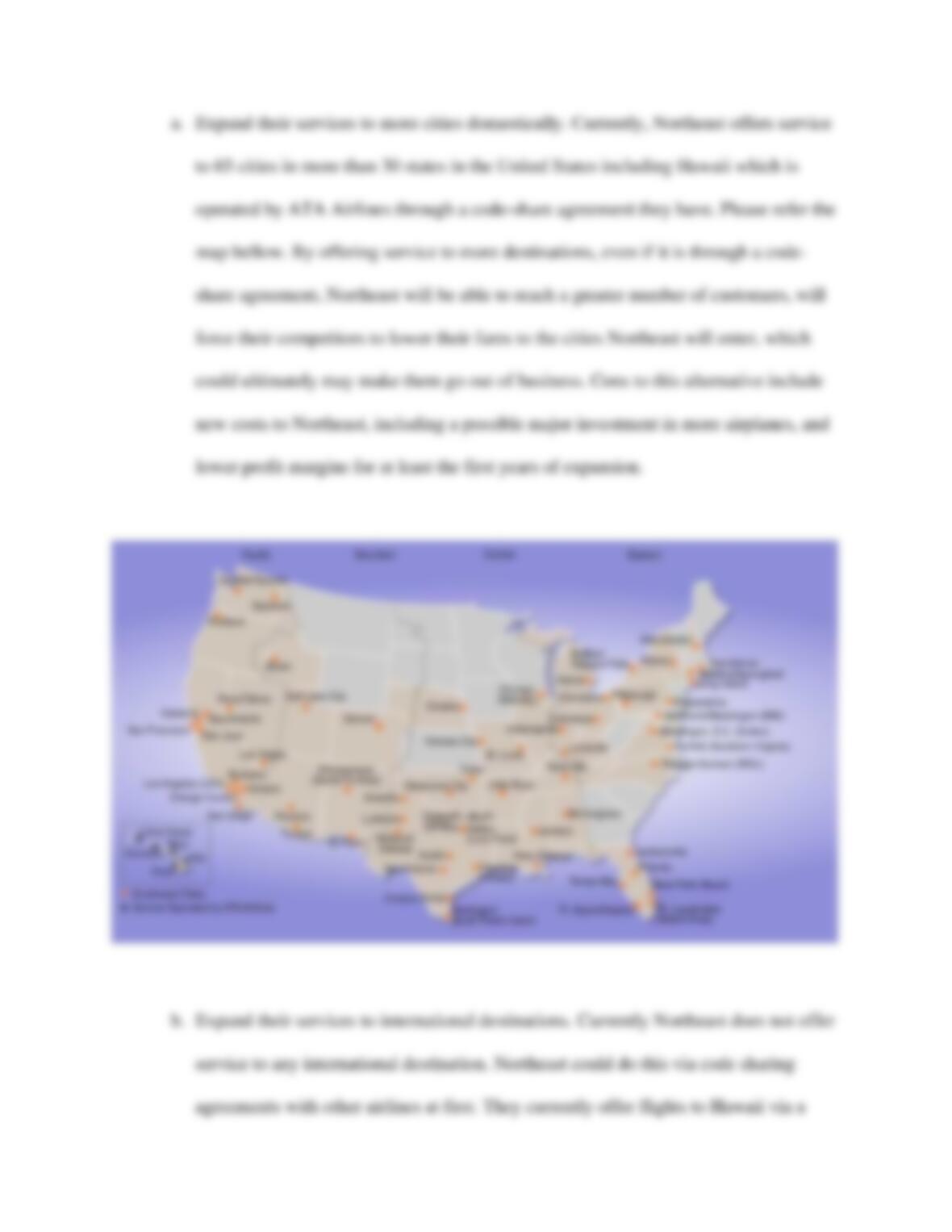
fare air transportation service among 65 cities in more than 30 states. Northeast’s success is due
to its low-cost strategy. Northeast operates solely Boeing 737s and offers only coach seats. The
company primarily provides short haul, high frequency, point-to-point air transportation where
in-flight meals or advanced seating are not offered. Northeast has been able to differentiate itself
from its competitors by offering the lowest prices.
One of the leading reasons for the success of Northeast is its focus on customers. Its
mission statement has not changed since 1988, and is: “The mission of Northeast Airlines is
dedication to the highest quality of Customer Service delivered with a sense of warmth,
friendliness, individual pride, and Company Spirit”
(http://www.northeast.com/about_swa/mission.html).
While Northeast has been able to enjoy both profits and success in the past years,
historical events such as the terrorist attacks of September 11, 2001 and poor economic
conditions have made competition more intense. Bigger companies are trying to emulate
Northeast Airlines’ strategy by lowering their price of tickets while still offering more luxurious
services than Northeast does. This could result in competitors offering low rates to areas not also
covered by Northeast, but to all the other destinations where Northeast doesn’t fly. Could this be
an indication that Northeast needs to make a few changes in its strategy and upgrade the seats
and services it offers to its customers? Should it expand to greater regions domestically and
internationally? If Northeast doesn’t pay attention to the future and its strategy another
competitor could certainly come along and knock the company out of the top spot.
2. Data Analysis
a. Industry:
The US airline industry consists of about 3,000 companies, with combined annual
revenue of $120 billion. The industry is highly concentrated; almost 90 percent of the revenues
come from the top 12 companies.
Airlines depend heavily on the health of the US economy, which affects air travel.
Because many of the airlines’ costs are fixed, the profitability of individual companies depends
on the efficiency of its operations and on favorable fuel and labor costs. In addition, flight
equipment that a company uses is crucial to efficient operations since the cost, capacity, and fuel
efficiency of airplanes vary substantially. For example, a large plane like the Boeing 747