Case Report – Apple Expanding the iPhone into China
A. Executive Summary
Today, Apple is one of the world’s leading manufacturers of personal computers,
smartphones, and tablet computers. In 2013, Apple generated over $171 billion dollars in
revenue, and over $37 billion in profits (Koetsier, 2013). In 2007, Apple introduced the iPhone,
a revolutionary new smartphone that took the market by storm. After the initial release in the
United States, Apple expanded the product line into many foreign markets. Over the next two
years, Apple expanded the iPhone into 86 countries around the world, including almost all of
Europe and the Americas, as well as many other Asia Pacific countries, and many African
regions (World Time – The History of the iPhone, 2014). In late 2009, Apple entered into the
largest mobile smartphone market in the world, the People’s Republic of China (Toto, 2009).
Apple has been selling computers and electronics around the world for decades. Apple
has had an ongoing relationship with China for many years; however that relationship has
generally been from an operations standpoint. Since the Mid-1990s, Apple has outsourced the
majority of their product manufacturing to facilities in China (O’Brian, 2014), and while many
Apple products, such as iMacs, MacBooks, and iPods have been available in China for many
years, none of these products have been very popular with the Chinese market (Newman, 2013).
When Apple was considering the entry of the iPhone into the Chinese market, it was clear
there was a huge potential for profits. The steadily growing economy and booming middle class
presented a growing demand for high-end smartphones, and no one company had truly broken
into the market segment at that time (Crockett, 2008). Apple decided to aggressively pursue the
market unlike some other smartphone manufactures, and eventually came to an agreement with
one of the largest wireless providers in China, China Unicom, to establish a joint venture for
China Unicom to become the exclusive carrier for iPhones in China during launch (Toto, 2009).
The iPhone would be sold in both China Unicom stores throughout the region, as well as direct
to consumers through the Apple website. To accommodate this market, Apple was required to
modify the device to fit China’s wireless technology and regulations, something Apple does not
normally do.
Typically, Apple employs an International Strategy approach to their products when
expanding to new markets, with a “one-size fits all” mentality for all of their products. However,
in this situation, regulations and hardware modifications specific to the region required Apple to
make an exception, and pursue a Localization Strategy within the Chinese market. With the
growth of the middle class and demand for newer mobile technology in China, Apple saw the
huge potential for growth this market and made the exception.
B. Current State of the People’s Republic of China
Economic Environment
Over the past 30 years, the Chinese economy has been on a strong and steady growth
pattern, with an annual average real GDP growth rate of around 10% (Wu, 117). Much of this
growth can be attributed to the reform from a more socialist economy, to an overall market-
oriented economy in the late 1970s and early 1980s. This shift has made inward Foreign Direct
Investment (FDI) much more attractive to many organizations and investors, and gave foreign
investment firms and organizations greater access to the relatively well-educated, low-cost labor
force in China, and in turn this increase in FDI also created many new job opportunities in
China, and increased China’s total contribution to the world market in the form of exports (Wu,
117-119).
To support the transition to a market-based economy in the early 1980s, China achieved
membership in both the International Monetary Fund (IMF), and the World Bank in the spring of
1980 (Lewis, 2009). Later in 2001, China also joined the World Trade Organization (WTO),
which required a number of law reforms including the elimination of some government price
controls, and the elimination of export subsidies on agricultural products (Lewis, 2009). China is
also a founding member of the United Nations (UN News Center, 2014), as well as the G-20
(G20 Members, 2014).
China also has its own trade union, the All-China Federation of Trade Unions (ACFTU),
which is a nationalized worker organization of the PRC which consists of over 193 million
members, and is the only trade union operating within the PRC at this time. The ACFTU has a
long history of rises and falls in conjunction with the many political and governmental changes
that have occurred since the ACFTUs founding in 1925 (The Economist, 2008). The ACFTU
still has deep ties with the Community Party in China, and has been criticized for favoring large
scale economic growth and business expansion, in exchange for the fair treatment of workers,
and worker’s rights. (The Economist, 2008)
The ongoing efforts of the People’s Republic of China to attract new investments and
grow their economy have been very successful. By the end of 2010, China had attracted more
than US$1,020 billion in FDI inflows, making it the largest FDI recipient in the developing
world (Wu, 117). These huge amounts of FDI have greatly contributed to the ongoing economic
growth in China, as well the expansion of exports (Wu, 118).
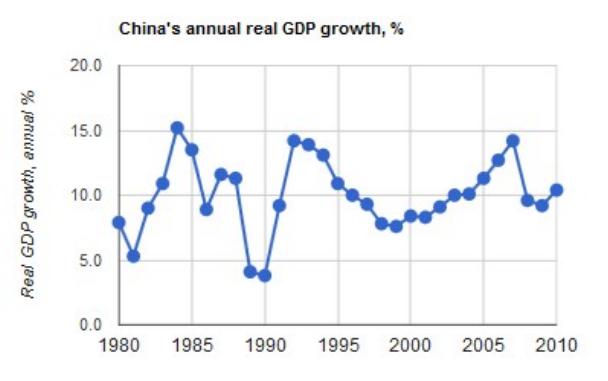
China’s Annual GPD Growth % (Sedghi, 2012).
Despite the ongoing economic growth, there have been many problems surrounding trade
barriers and intellectual property infringement in the PRC in recent years. China has many anti-
competitive policies that include subsidies to many national industries that artificially drive down
prices of many consumer goods in China, making it almost impossible for foreign firms to
compete and sell these goods in China (Scissors, 2012). In addition, there is an ongoing problem
with IP infringement in China, especially within the consumer electronics industry, where
counterfeit goods and imitations are often directly copying and imitating many branded
consumer electronics on the market. This type of IP infringement deters many U.S. firms from
exporting technology to PRC, to then see their products reverse engineered and sold domestically
(Scissors, 2012).
All of these combined factors create an interesting scenario for Apple. As far as
economic factors are concerned, there are many pros for Apple in targeting the Chinese market.
China is clearly working hard to make itself a leading world economy, and has done so
successfully. China has already enticed Apple by engaging the company from an operations
standpoint, with the majority of Apple’s product manufacturing taking place in Chinese facilities
since the mid-1990s (O’Brian, 2014). From an economic standpoint, the biggest potential risk
for Apple is the rampant IP infringement present in China, and the potential for the iPhone to be
copied and sold at lower prices than Apple could offer. This type of activity is already rampant
throughout China, and there is not much that Apple can do to fight it without stronger IP
provisions in the Trans-Pacific Partnership, which seems unlikely in the short term (Scissors,
2012).
Political Environment
The People’s Republic of China has been under Communist Rule since it was founded in
1949, after the Communist Party defeated Kuomintang through Civil War (BBC News Asia,
2014). While the PRC has transitioned away from the Maoist radicalism that led to millions of
deaths in the 1950s and 1960s, the Communist party continued to play a key role in the control