SKS and AP Microfinance Crisis
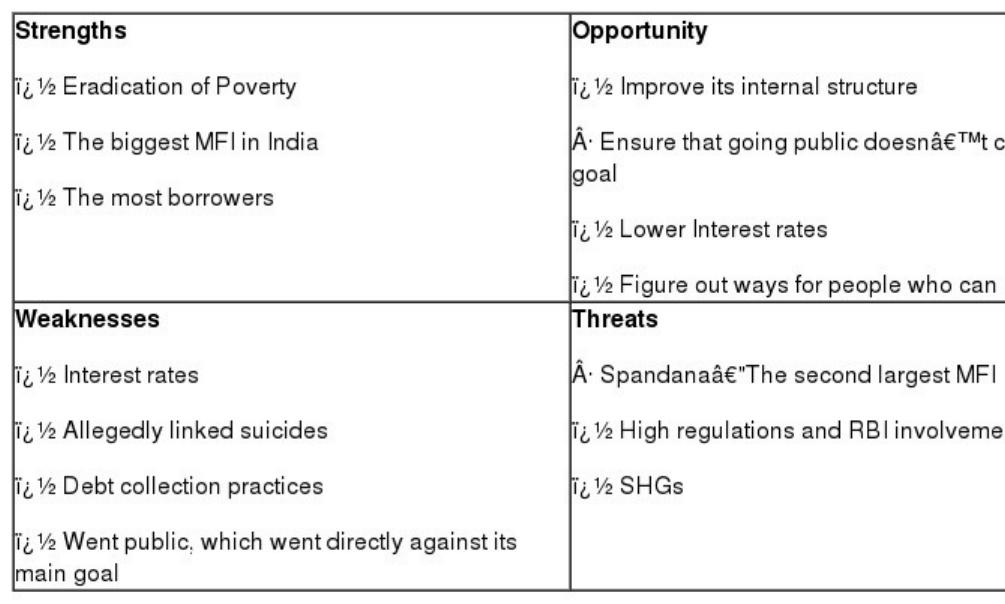
Founded in 1997 as a non-profit organization by Vikram Akula, SKS saw rapid growth,
and it converted into for-profit Non-Banking Financial Company (NBFC) in 2005. Its
borrower base grew in large numbers, from just 25 thousand active members in 2003 to 5.8
million active members in 2010. In this report I will analyze the recent AP ordinance
passed on October 15, 2010 and the ensuing financial crisis in the microfinance sector in
India. I will begin with a brief introduction of both the SKS and the microfinance industry
in India. I will then analyze the rapid growth of microfinance industry in India, the turmoil
that it has went into recently, and the recommendations that I think would help Indian
government in recovering their once flourishing industry.
Introduction (SKS):
SKS is a non-banking financial company. It was founded in 1997 as a not-for profit
organization, but quickly converted into a for-profit Non-Banking financial Company in
order to tap into the capital markets. The company has been flourishing ever since Vikram
Akula laid its foundation. One evidence of it was it’s IPO, which valued SKS at $1.5
billion, well below Mexican MFI Compartamos, but well above the valuation of BRAC in
Bangladesh.
Introduction (Microfinance industry in India):
Microfinance in India began as a government initiated program. It was designed by

National Bank for Agricultural and Rural Development (NABARD) and Self-help Groups
(SHG) as a linkage program. It was a mechanism designed to provide financial services to
those that were at the very low of the pyramid. But, because its operations and costs were
highly reliable on government funding and subsidies, the model was unstable. Though,
recently the Grameen model of joint liability groups (JLG) has been taken as an
alternative. According to the MFI network in India, the total microfinance loans in India
are roughly around $6.5 billion.
Microfinance’s Initial success in India:
Microfinance flourished as an industry in India because of the relationship the Indian
government had with social businesses. The RBI’s “priority sector status” enabled the
microfinance sector to develop at an astonishing speed. Because of the roles that the banks
played, the industry had seen constant success ever since it was started. The “priority
sector” lending requirements state that the public sector banks should channel funding
(About 40%) to underserved sectors of the country such as agriculture, and small
businesses and microfinance. It is important to understand that the private sector banks