King Saud University
College of Administrative Sciences
Strategic Management
597 BUS
Case analysis
Target Corporation
Professor
Dr. Nadia Ayoub
Contents
Introduction
Vision Statement
Mission Statement
Strategy Analysis
State 1: The Input Stage
External Factor Evaluation
•Opportunities
•Threats
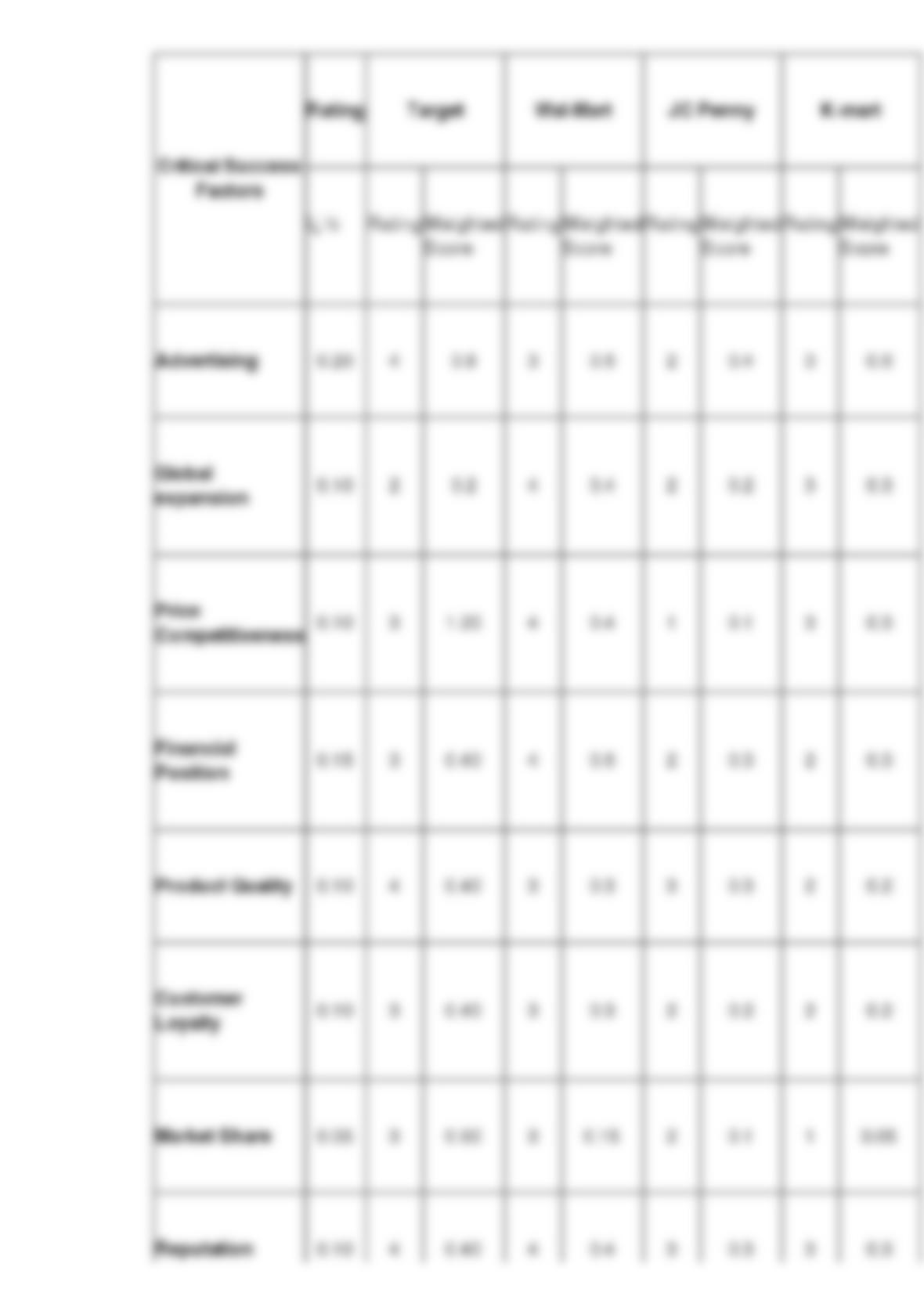
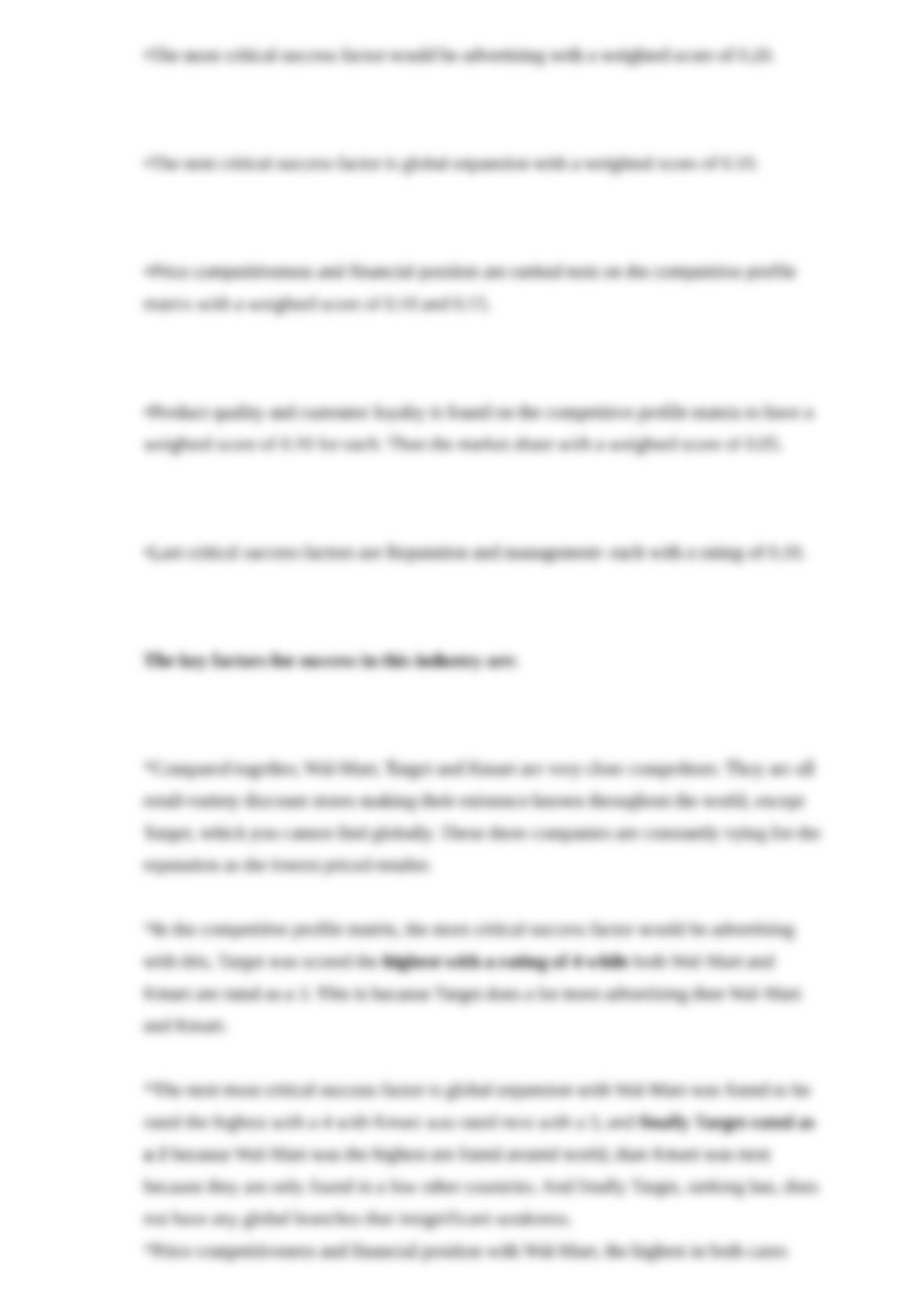
Competitive Profile Matrix
Internal Factor Evaluation
•Strengths
•Weaknesses
Summary of Financial Ratios in Target Corporation
Stage 2: The Matching Stage
1) The Strengths-Weaknesses-Opportunities-Threats (SWOT) Matrix,
2) The Strategic Position and Action Evaluation (SPACE) Matrix,
3) The Grand Strategy Matrix,
4) The Internal-External (IE) Matrix.
Summary of Matrix Analysis
Stage 3: The Decision Stage
Quantitative Strategic Planning Model [QSPM]
Recommendations

Epilogue
Introduction
Target Corporation is a powerful retail brand. It has a reputation for value for money,
convenience and a wide range of products all in one store. Target Corporation is the
third-largest general merchandise retailer in the United States.
It offers an assortment of general merchandise, including consumables and commodities;
electronics, entertainment, sporting goods, and toys; apparel and accessories; and home
furnishings and decor; as well as a line of food items. The company operates its stores
under Target and SuperTarget brands. It also sells its merchandise online, as well as offers
credit cards to its customers. In addition, the company runs Target Clinics in select twin
cities Target stores, which offer various services, including flu shots; and treatment for
common illnesses, such as strep throat, bronchitis, and skin conditions.
Targets first store opened in Roseville, Minnesota, in 1962. Its on-trend merchandise at
affordable prices launched a new era in discount retailing. This “T-1” stores were easy to
shop, attractive and always clean. It served as the prototype for every Target store opened
since then, and it changed how consumers think about discount shopping.
Today, Target operates approximately 1,500 stores in 47 states, including more than 175
Super Target stores that add an upscale grocery shopping experience. In addition to the
photo processing, pharmacy and Food Avenue restaurants found in almost every Target,
Super Target includes an in-store bakery, deli, and meat and produce sections.
The corporation consists of six operating divisions, three of which are the retail stores
Target, Marshall Field’s, and Mervyn’s. In addition, there is target direct (direct marketing
and electronic retailing division), Target Financial Services, and Associated Merchandising
Corp. Robert Ulrich, Chair and CEO, has led these six divisions since 1994. Target
Corporation evolved from two long-standing retail chains, Dayton’s and Hudson’s.
In 1903, George Dayton established Dayton Dry Goods store in Minneapolis, MN that
offered return privileges and liberal credit. His store eventually expanded into a full-line
department store that was twelve stories tall. In 1966, Dayton’s gone public and grew
through acquisitions.
Hudson’s originally began in 1873 when Joseph Hudson opened a men’s clothing store in
Detroit that offered its customers return privileges and price marking instead of bargaining.
Hudson’s became the largest retailer of men’s clothing by 1891.
After World War II, both companies saw the need to expand into the growing suburban
market. It was the largest shopping center of its time in the United States. In 1956,
Dayton’s built the world’s first fully enclosed shopping mall, Southdale. In 1962, Dayton’s
opened the first Target store. The Dayton Hudson Corporation formed in 1969 after the
acquisition of the family-owned Hudson’s. Dayton Hudson bought Mervyn’s retail chain
of forty-seven stores in 1978, and Marshall Field’s department stores in 1990. Because the
Target division was so successful, the company changed its name to Target Corporation in
2000.
Vision Statement
We’re a company living a clear vision: to be the best. In every area of our business. In
everything we do.
Our nationwide channel of retail stores, distribution centers and corporate offices offer you
thousands of opportunities to join our team and bring your best.
Our team members bring more than their great energy to work every day. They bring their
unique perspectives, experiences and differences to work, too. They give us the strength to
dare ourselves to be the best—and the power to achieve it.
Mission Statement
The primary mission is to expand our worldwide leadership position in quality, cost, and
customer satisfaction through the integration of people, technology, and business systems
and to transfer knowledge, technology, and experience throughout Target Corporation.
Mission Statement Components
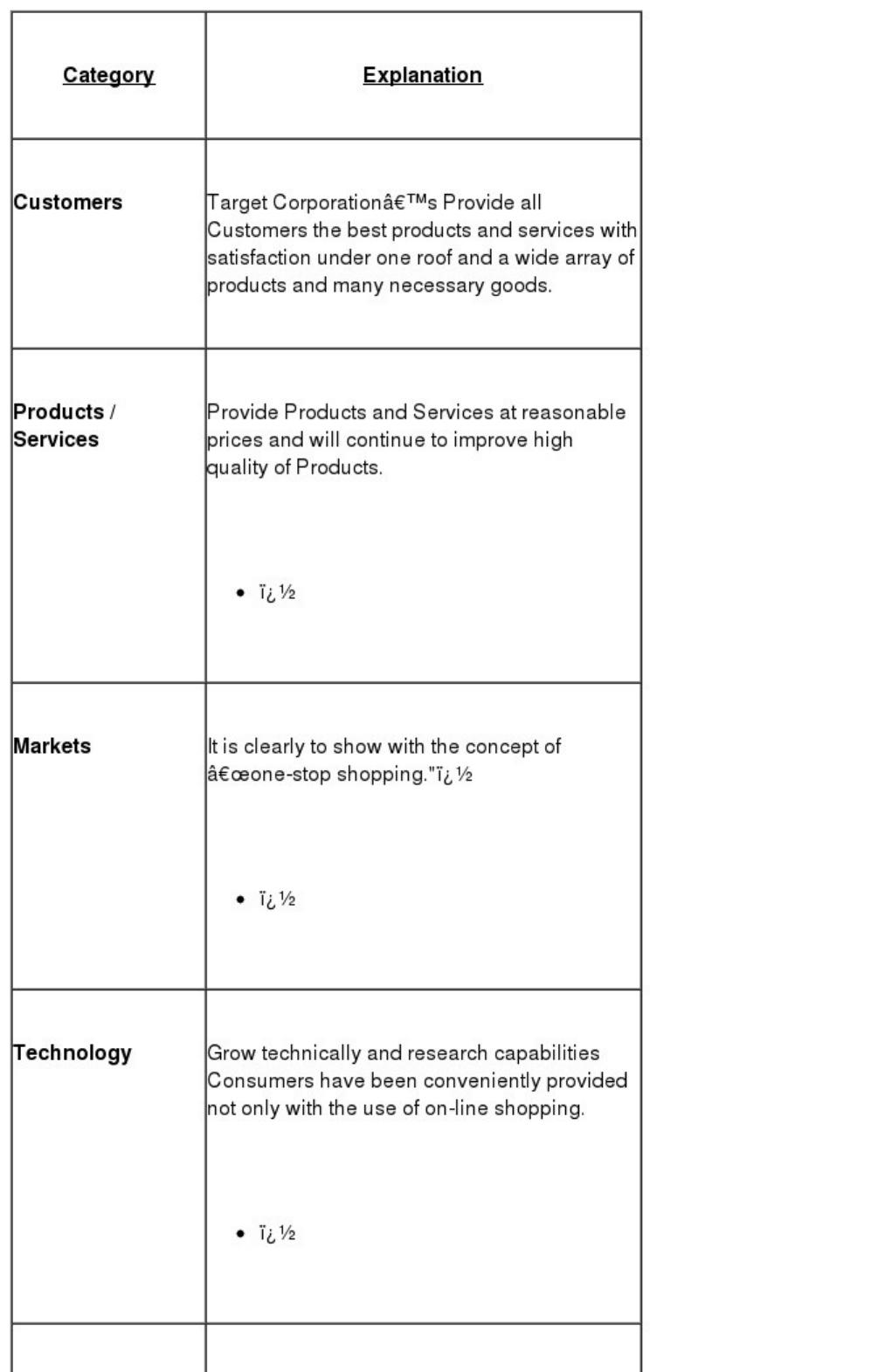
1. Customers
2. Products or services
3. Markets
4. Technology
5. Concern for survival, profitability, growth
6. Philosophy
7. Self-concept
8. Concern for public image
9. Concern for employees

Although Mr. Ulrich’s first letter to shareholders stated, “We are committed to serving our
guests better than the competition with trend-right, high-quality merchandise at very
competitive prices. We are committed to being a low-cost, high-quality distributor of
merchandise through “boundary-less” functioning, -through leverage resources, expertise,
and economies across divisions.”
Strategy Analysis
There are three-stage decision-making frameworks:
State 1: The Input Stage
1). External Factor 2). Competitive Profile 3). Internal Factor
Evaluationatrix (EFE) Matrix (CPM) Evaluation (IFE)
External Factor Evaluation
The External Factor Evaluation includes weighing a list of key factors that are external, or
outside the control of the company.
The most important an external audit focuses that managers can formulate strategies to
take advantage of the opportunities and minimize of threats. There are five categories of
key external forces that could benefit an organization in the future:
1. Economic Forces,
2. Social, Cultural, Demographic, and Environmental Forces,
3. Political, Governmental, and Legal Forces,
4. Technological Forces, and
5. Competitive Forces.
There are sources for information on external factors including the Internet, and
competitor’s financial statements.
1. Opportunities:
The opportunities identified for Target Corporation are as follows:
•Consumers want ease of shopping
An opportunity facing the industry is that customers want ease of shopping. To provide the
ease of shopping the industry is guaranteeing that the customers will find what they want
when they want it. This is supported by convenient presentation and the right level of
service every time the customer shops.
•Technological
An opportunity facing the industry is that Internet shopping is growing. To take advantage
of Internet shopping, the industry is focused around the customer. The customer receives
friendly site designs, efficient order fulfillment, fast delivery and professional customer
response. They process returns, refunds, and rebates quickly.
That mean the internet can be used as a marketing tool, and it can greatly reduce
communication costs. It can also act as a substitute for a newsletter published on paper.
•Better-educated and more affluent society
Government has taken an active role in the education of society.
Increased level of income
More people are getting better paying jobs Because of the increase in the education level
of society and increase the number of two-income households. This is increase of money
available for non-essential purchases, and for the purchase of higher-priced quality goods.
•Expanding economy
The economy in the United States has been growing steadily in recent years and Low
inflation, unemployment, and low interest rates increased spending and growth
opportunities for businesses and individuals.
•Increased social awareness and Environment conscious consumers
Target Corporation’s objectives have always included Corporate Governance and genuine
concern for the communities in which they operate.
•Retail sales expected to increase and similar shopping patterns worldwide
2. Threats:
The threats identified for Target Corporation are as follows:
•Technological
A threat facing the industry is that technological advances may make the products
obsolescent. As technology advances, products being sold today are gone tomorrow; this
provides fewer products for retailers to sell.
•Competition for Market Share
Substitute products more easily because of intense competition, the cost of producing
many consumer products tend to have fallen because of lower manufacturing costs.
Manufacturing cost has fallen due to outsourcing to low-cost regions of the World. This
has lead to price competition, resulting in price deflation in some ranges. Intense price
competition is a threat.
•The population is aging
The population of the United States is rapidly becoming older. The percentage of the
population over age 50 increased by 18.5 percent during the 1990’s while the population
under age 50 grew by only 3.5 percent. Target should address this issue by offering
products and services that are attractive to an aging society in order to remain competitive.
•Interest rates are rising
Rising interest rates are a threat to all organizations due to the increased cost of borrowing
and their inverse relationship to stock prices. This could force an organization to forego
capital expenditures for expansion or implementation of certain strategies.
•Increase in online shopping
Consumers now have access to multitudes of retail outlets online. They can comparison
shop and make purchases without having to leave their home. The E-commerce industry
has grown rapidly and is changing the way people do business.
•Trend is toward super centers
The convenient one-stop shopping center has evolved into the super center. More
consumers are enjoying the convenience of one-stop shopping for all their retail needs.
External Factor Evaluation Matrix for Target Corporation
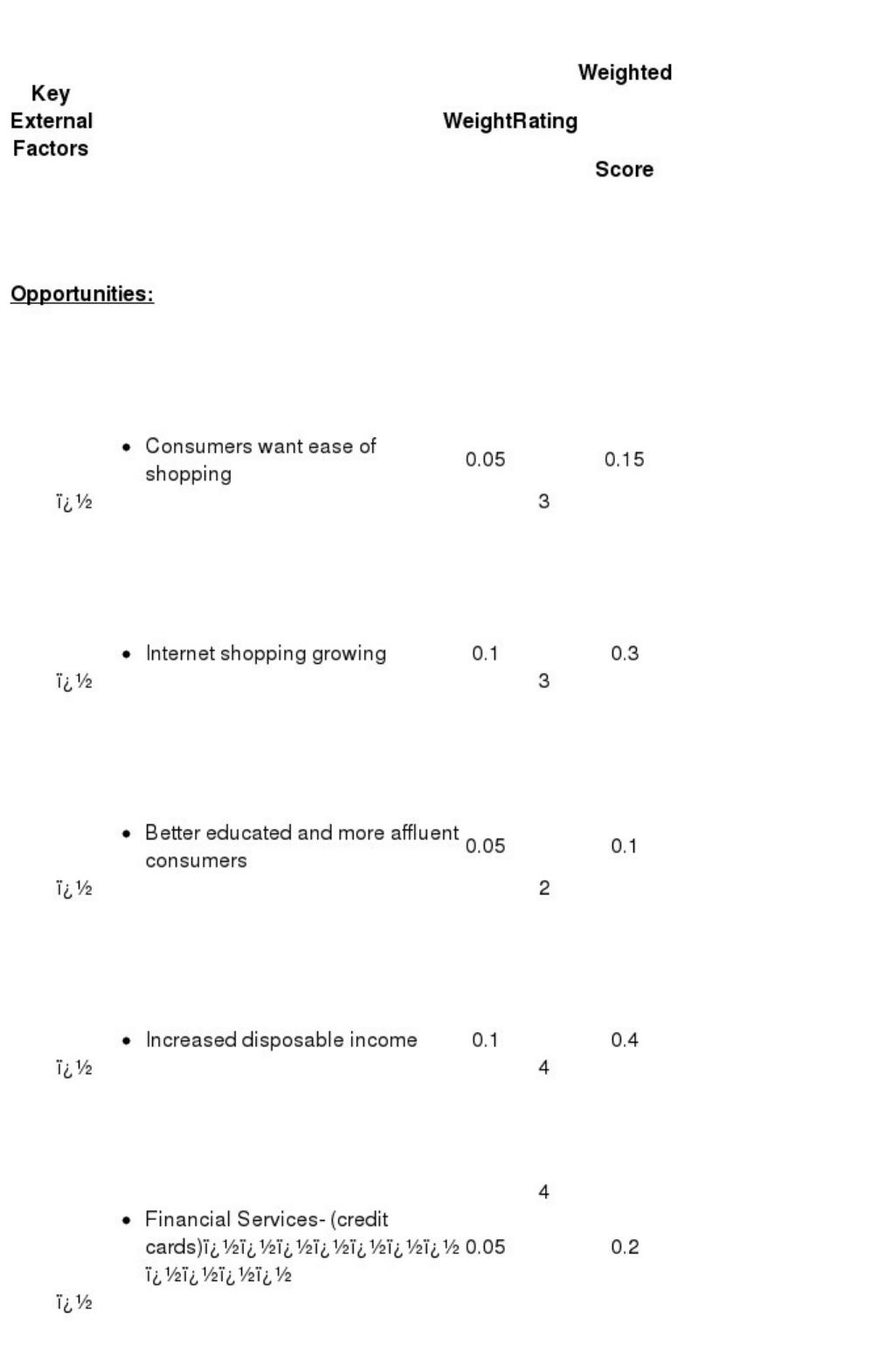
* Target Corporation’s has main opportunities that we identified were increasing Internet
shopping; ease of shopping .The increase in on-line shopping is the most important factor
affecting the industry. Target Corporation has an electronic retailing division called target
direct. Consumers can access online shopping services through Target Corporation’s