Case Analysis:
Colgate-Palmolive
Precision Toothbrush
Monique Priestley Winter 2011: MCDM COM588 Digital Media Marketing & Branding Rick McPherson/Brian Marr

Table of Contents
Analysis & Strategy!1
Executive Summary!1
Situation Analysis!1
Strategic Alternatives !2
Proposed Strategy!3
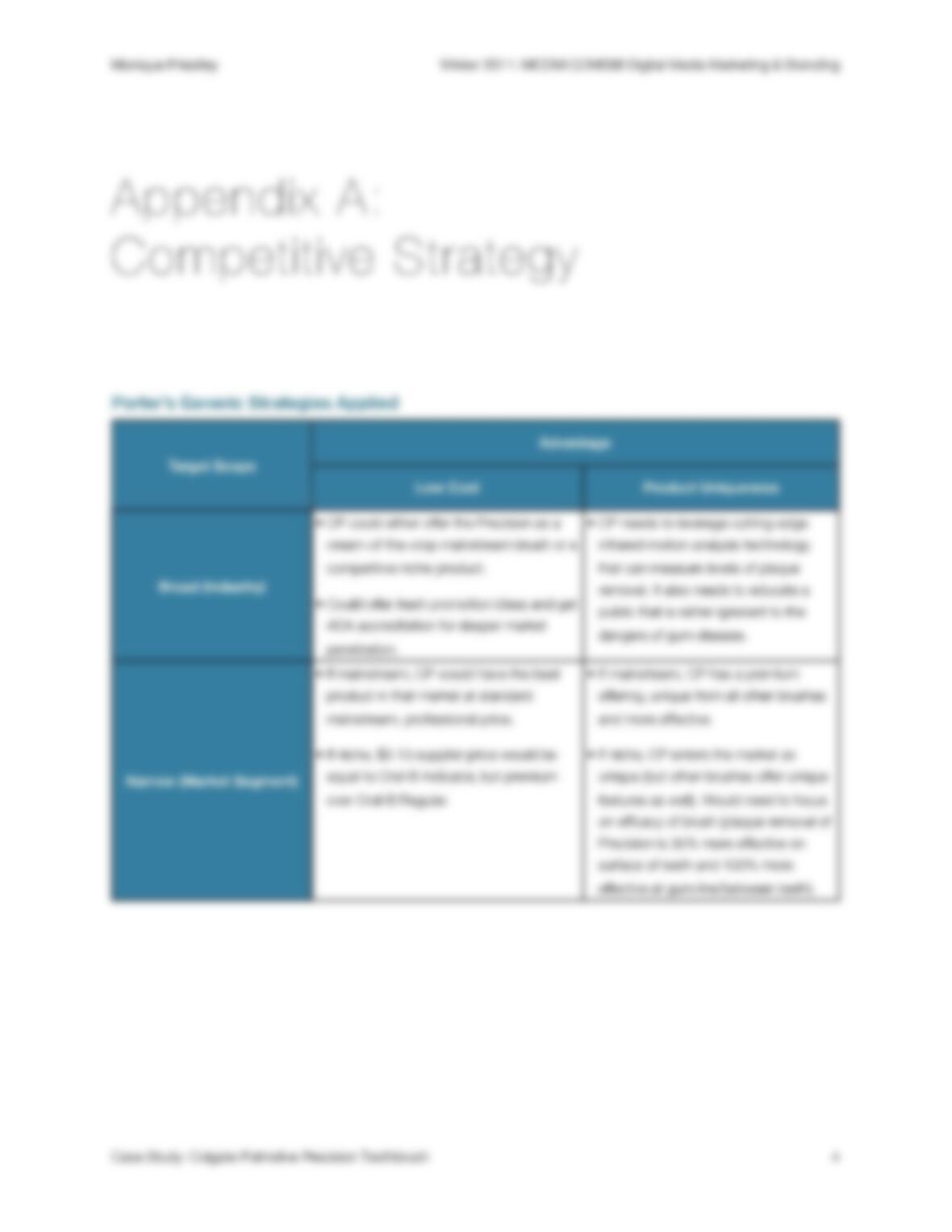
Appendix A: Competitive Strategy!4
Porter’s Generic Strategies Applied!4
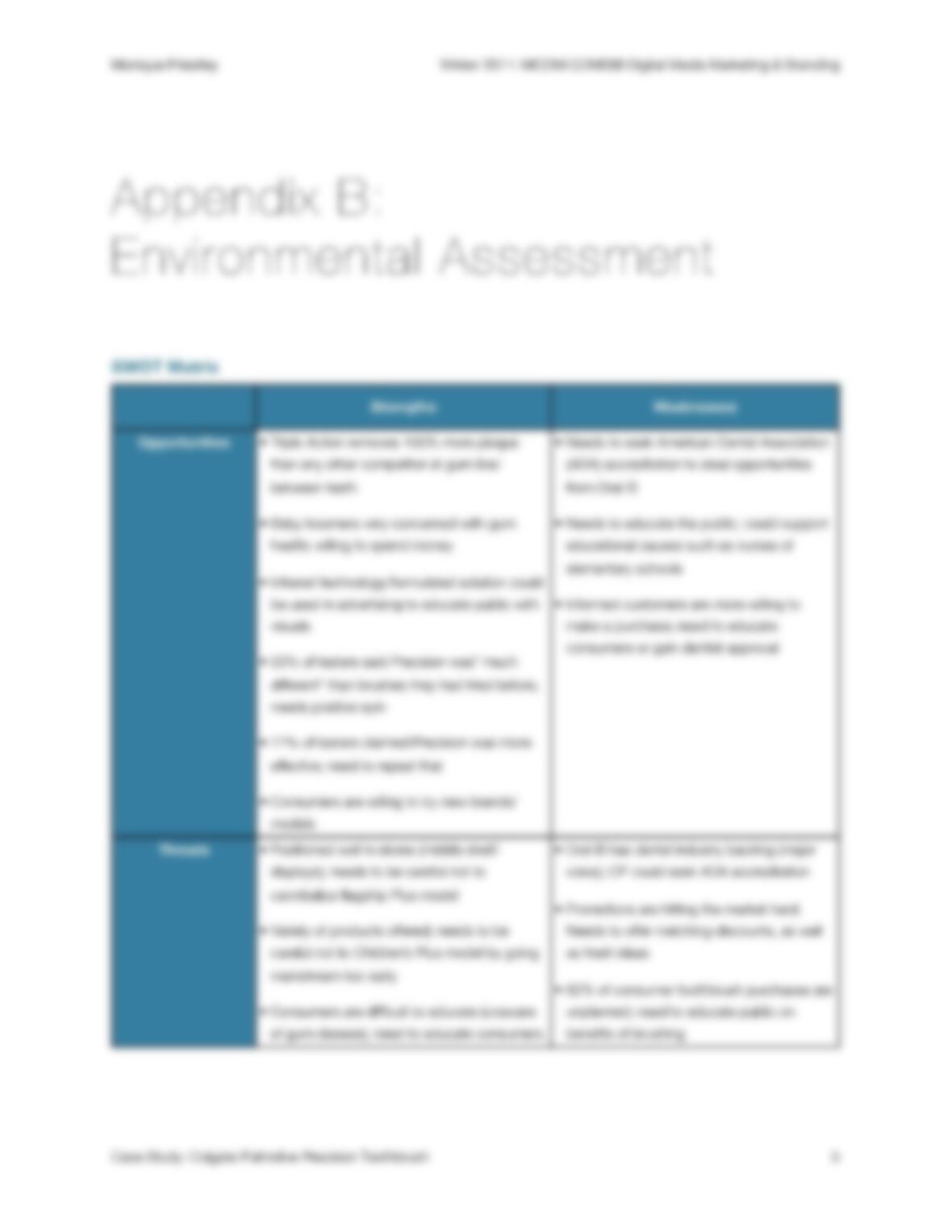
Appendix B: Environmental Assessment!5
SWOT Matrix!5
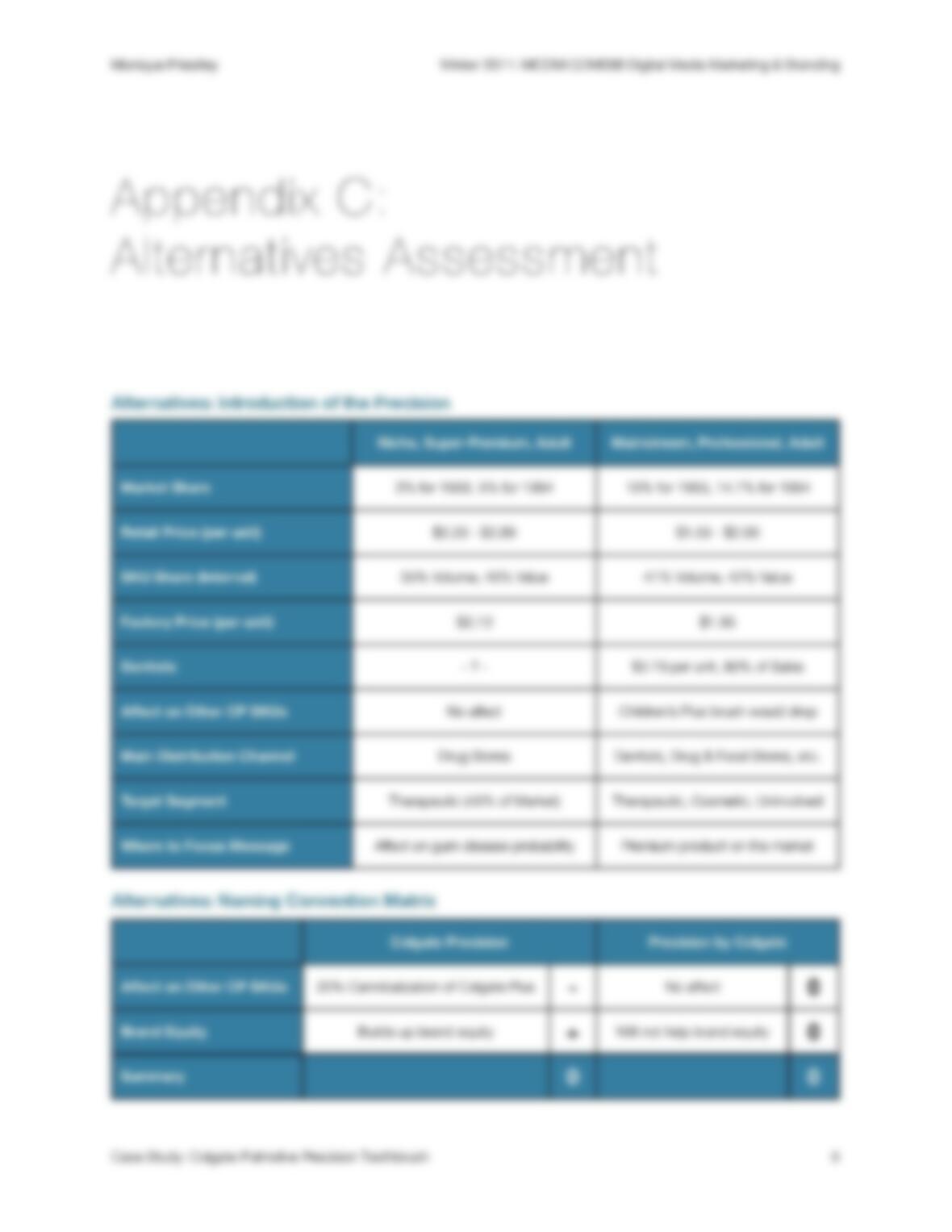
Appendix C: Alternatives Assessment!6
Alternatives: Introduction of the Precision!6
Alternatives: Naming Convention Matrix!6
Appendix D: Segmentation & Targeting!7
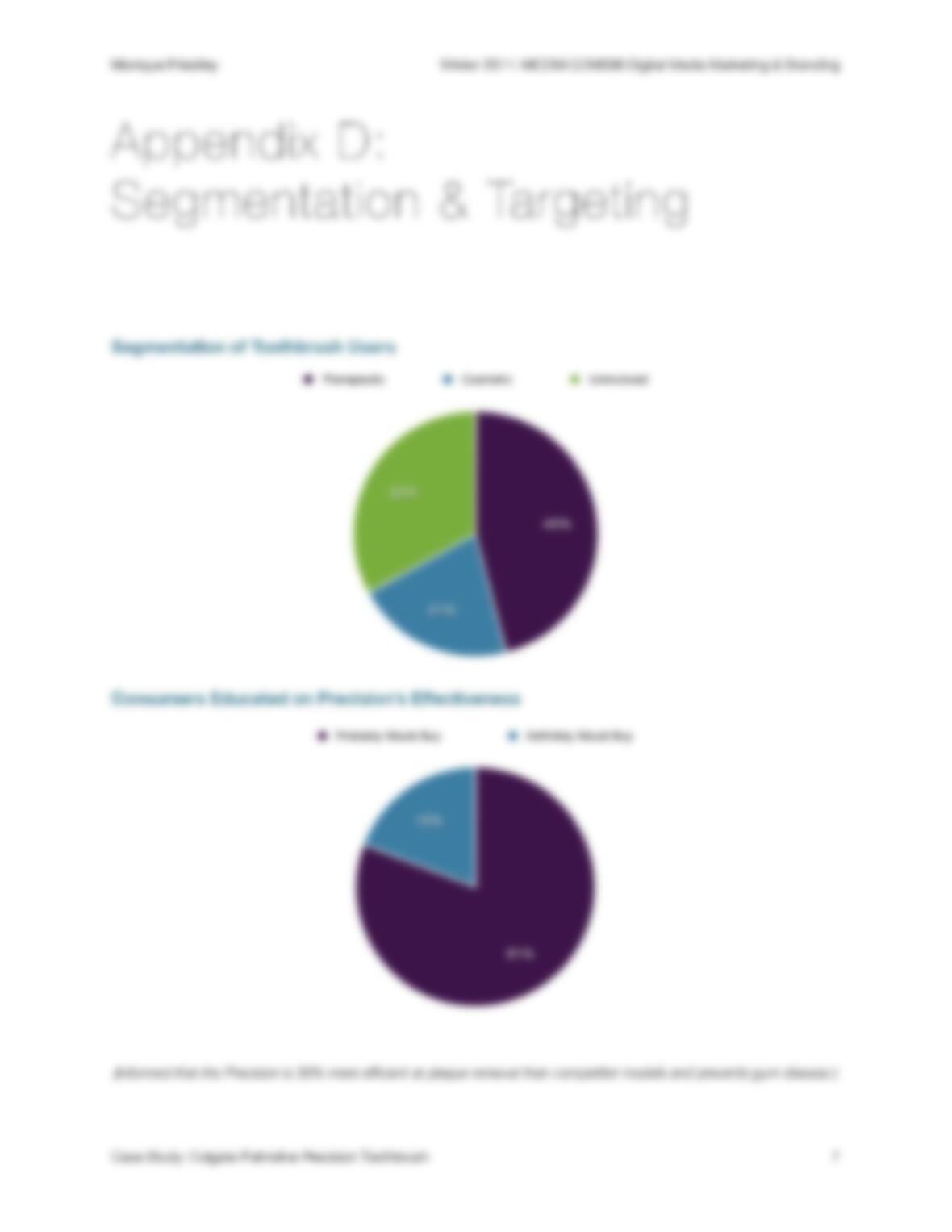
Segmentation of Toothbrush Users!7
Consumers Educated on Precision’s Effectiveness!7
Appendix E: Positioning!8
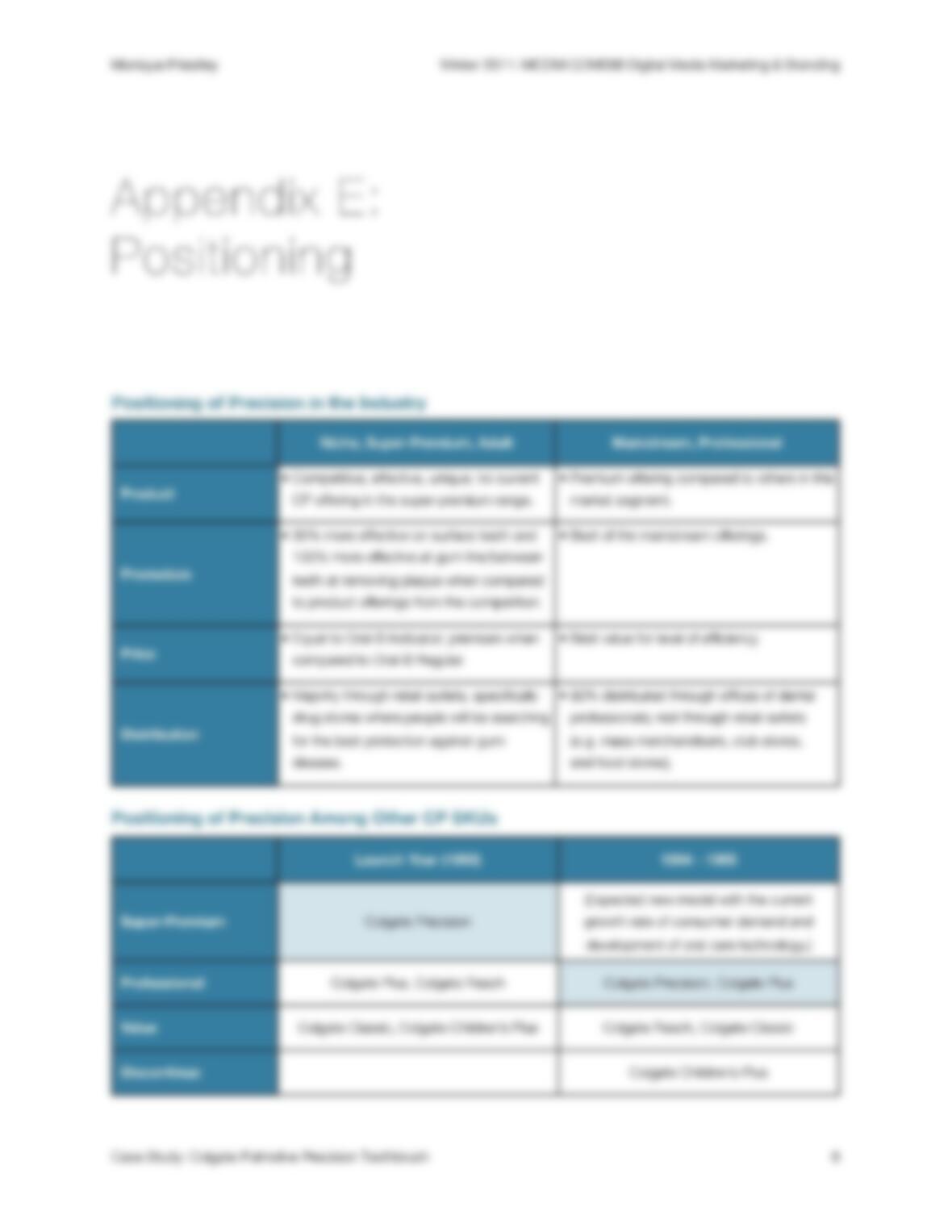
Positioning of Precision in the Industry!8
Appendix F: Positioning Map!9
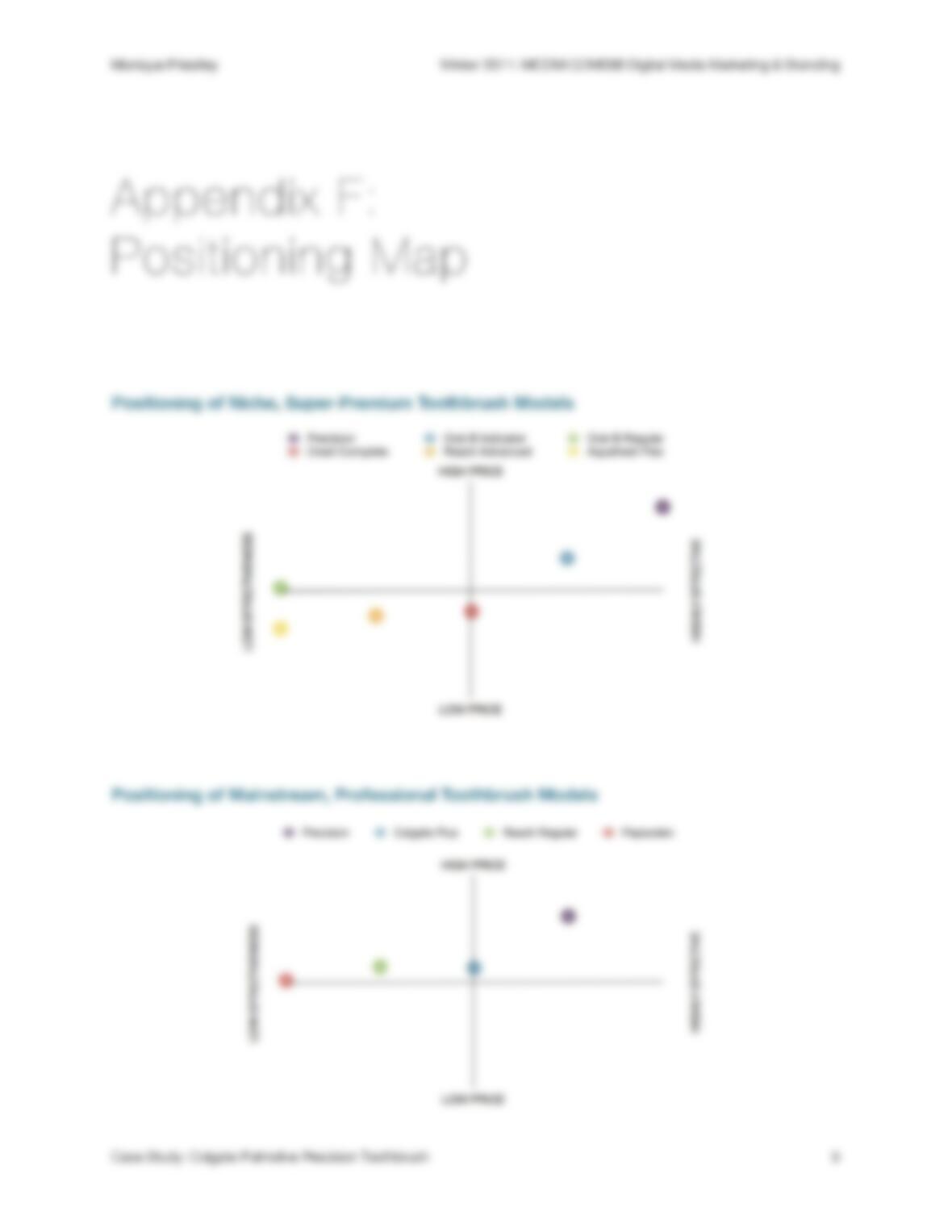
Positioning of Niche, Super-Premium Toothbrush Models !9
Positioning of Mainstream, Professional Toothbrush Models!9
Monique Priestley!Winter 2011: MCDM COM588 Digital Media Marketing & Branding
Case Study: Colgate-Palmolive Precision Toothbrush“i

Analysis & Strategy
Executive Summary
In July 1992, CP senior management announced a new toothbrush model, the Precision, that was set to launch in early
1993. In order to meet consumer demand CP could introduce the toothbrush as a niche, super-premium or a
mainstream, professional product. It could also introduce the product using standard naming conventions or introduce a
new labeling system by calling it the “Precision by Colgate.” CP could leverage existing industry relationships and make
an effort to form new ones in order to gain a competitive edge. At launch, CP could plan to offer competitive promotions,
a popular offering that was slowly becoming standard practice in the oral care industry. The company could also increase
its advertising budget to include educating the public on the dangers of gum disease. Depending on how it chooses to
introduce the Precision toothbrush to the market, 1992 could serve as an important year for CP to establish itself as the
definitive oral health care company.
Situation Analysis
Environmental Analysis
In 1992, Colgate-Palmolive (CP) was the global leader in household and personal care products. It was also the leader in
retail toothbrush sales in the United States. Prior to the 1990s, consumers were satisfied with toothbrushes that were
aesthetically pleasing. As therapeutic toothbrush sales rose it became apparent that baby boomers were becoming
increasingly concerned with their oral health, specifically their gums. As a result, the toothbrush industry experienced a
massive influx of worthy competitors and the formation of a niche, super-premium market. In order to gain an edge each
competitor worked on developing new toothbrush technology, forming alliances with dental professionals, expanding
advertising budgets and offering promotions that would grab consumer attention.
Industry Analysis
Not only can the industry be broken down by price models (super-premium, professional, and value), it can broken down
a second time into niche and mainstream offerings. Consumers of this industry can be sorted into three categories:
therapeutic, cosmetic, and uninvolved.
Competitive Analysis
One promising conclusion that can be drawn from the competitive analysis is that every company has been caught off
guard by the change in consumer behavior, emergence of new technology, and introduction of new players entering the
playing field. For example, in 1988, Johnson & Johnson introduced “new brush technology” only to phase it out by 1992.
In order to get an edge, competitors, Johnson & Johnson, Oral-B, Procter & Gamble, and Smithkline Beecham (latter
two are new competitors), are offering promotions in the form of coupons, mail-in refunds, and bundles.
Environmental Analysis
Strengths
With 43% of the global toothpaste market and 16% of the global toothbrush market, CP has defined itself a leader of
household and personal are products worldwide, and positioned itself as the number one retailer of toothbrush products
in the United States. CP utilizes a cutting-edge infrared motion analysis and technique to measure exact levels of plaque
Monique Priestley!Winter 2011: MCDM COM588 Digital Media Marketing & Branding
Case Study: Colgate-Palmolive Precision Toothbrush“1
removed by its products in consumer tests. CP’s Triple Action head removes 35% more surface plaque and 100% more
gum line and in-between teeth plaque than its competitors’ products. As a company with years of experience, CP has
formed a strong relationship with subcontracting manufacturer, Anchor Brush. It has also put together a task force of
research & development, marketing experts, dental professionals, and outside consultants. Because of its good standing
relationship with retail stores, it is able to position its products on the middle shelf, right between its competitors, Reach
and Oral-B.
Weaknesses
Although industry players are manufacturing products to improve oral health, it has been difficult to educated consumers
of the importance of preventing gum disease (which is a common motivator to improve dental care habits). One major
advantage that the competitor, Oral-B, has over the other companies is the ability to say it is recommended by dental
professionals. By seeking accreditation from the American Dental Association, partnering with dental providers, and
offering support to elementary school dental education programs, CP could not only work on educating the public, it
would also position itself to steal market share away from its main competitor, Oral-B.
Opportunities
In consumer tests, 55% of consumers found the CP Precision model was very different from other brushes and 77%
claimed it was more effective. Seeing as a majority of consumers are willing to experiment with new brands/models, CP
could make being new, different, and effective the major tenants of its marketing messaging; along with including
messaging concerning their incredible ability to fight gum disease, it should have a rock solid campaign.
Threats
Because of the recent market saturation, the various producers of oral health care products have rushed to offer
Monique Priestley!Winter 2011: MCDM COM588 Digital Media Marketing & Branding